
China’s “Great Leap Forward” That Killed Over 30 Million People
The many flaws in Mao Zedong’s campaign for economic growth
In November 1957, a special celebration took place in Moscow. It was the 40th anniversary of the October Revolution, the event that led to the rise of Communism. Leaders of communist countries gathered together for rounds of mutual congratulating and envisaging of a prosperous future. Nikita Khrushchev, head of the Soviet Union, announced his vision of exceeding the industrial output of the United States within the next 15 years.
One man was listening very carefully.
Mao Zedong, leader of the People’s Republic of China, was an ideologist. He believed in the communist doctrine and its superiority with his entire being. And just a few months prior, he had launched and almost immediately terminated the “Hundred Flowers” campaign of soliciting criticism from the public. He had seen a glimpse of the colossal discontent with his regime among Chinese intellectuals, students, and artists, and his response was now going to be what it had always been: to double down.
Mao was inspired by Khrushchev’s vision. So he made his own pledge. Within the next 15 years, China would surpass the industrial output of the United Kingdom.
He went back to China, set the wheels in motion, and in 1958 launched the “Great Leap Forward” program. Only 4 years later it was canceled, after having tanked China’s economy, caused the greatest famine in human history, and killed between 30 and 55 million people.
Flaw #1 | The Communes
In what felt like one swift motion, Mao destroyed the way of life in rural China.
The Land Grab
Chinese peasants could no longer own private land. Instead, all farmlands were collectivized and people worked in exchange for “free food.”
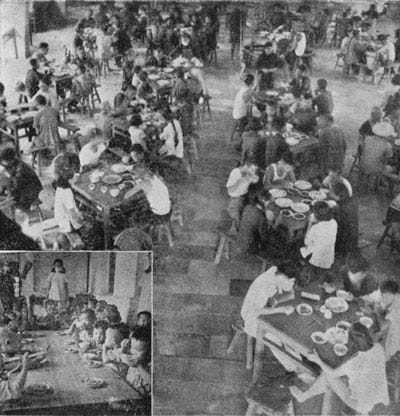
The groundwork for this transition, however, had been laid down by Mao in gradual steps since 1949. His regime encouraged the formation of “agricultural collectives,” wherein groups of families would share tools and farm animals.
These collectives started as small groups of several families and by the time of the Great Leap Forward’s launch they consisted of several hundred members each. Within one year of the launch, each commune averaged 5,000 households.
Now, Chinese peasants found themselves without any land and any right to the output of their work. Everything was owned by the state and then re-distributed back to the people. Or at least, that was the official plan. In reality, everything was taken by the state but less and less reached the Chinese citizens.
The Subjugation
The communes weren’t only about farmland, however. They were about the people. Increasingly, local statesmen would relocate workers, assigning them on various projects depending on the current economic needs. Many peasants would be uprooted and sent off to work in a strange place. Their homes would be taken too, most often to use for materials but sometimes as a punishment.
In what can only be described as enslavement, millions of people were stripped of their lands, homes, and rights and roped into back-breaking forced labor.
All customs and traditions were banished. In true Orwellian fashion, people were only allowed to congregate in political campaigns. Weddings, funerals, and festivals were outlawed. Local markets no longer existed, because the state provided food rations.
Everything that humanized rural life in China was criminalized.
The Punishments
In a system that exploited cheap labor from people who had no rights and no recourse, the only method to motivate workers was that of fear and punishment. People were persecuted, tortured, mutilated, buried alive, thrown into lakes with their hands tied.
It is estimated that 8% of the deaths during the Great Leap Forward were killings by the local government. Taking the lowest estimation of deaths during this period, 30 million people, then at least 2.4 million people were murdered by the party for disobeying orders, stealing food, not working fast enough, voicing criticism or doubt of the regime, or any other misstep seen as a transgression.
The most common form of penalty, however, was not meant to inflict death — even though sometimes it did. Formally called “struggle sessions,” this punishment was a form of public chastisement and humiliation. The transgressor was brought out in his or her workplace, or sometimes in a sports stadium to allow for a bigger “audience,” and verbally and physically abused until he or she confessed.
The very foundation of the Great Leap Forward was the destruction of humanity in rural China. It is no wonder, then, what happened next.
Flaw #2 | The Grain
Mao wanted to dazzle the world. His sole purpose with the Great Leap Forward was to position China as a leading industrial exporter.
So after seizing all farmlands, he wanted to maximize the output.
He attempted to do that in two ways: Agricultural innovation and food rations. Both failed miserably.
Mao was enthralled by the ideas of Soviet agronomist and pseudo-scientist Trofim Lysenko who proposed several methods to increase crop output. One was to plant seeds densely. Where one seed would be planted, now farmers had to plant six. Of course, that only ended up stunting the growth of crops.
Another innovation was “deep plowing” — where farmers would plow at 15–20 centimeters, now they had to do it at 2 meters because the deep soil was considered more fertile and so the plants would develop large root systems. Of course, that failed too. Most of the seedlings remained buried underground.
Moderately fertile land was ignored because Lysenko advocated that only very fertile land is worth the effort. But since his other methods to farm fertile land were downright abusive, Chinese farmers ended up with a huge drop in crops.
What made thinks worse was the Four Pests Campaign that targeted sparrows and other birds who were eating crops. This only resulted in an abnormal spike in insects that devastated a big part of the crop fields.
The grain yield dwindled.
But the majority of it was earmarked for foreign export. So when the high quotas could not be met, the grain came out of people’s food rations.
Flaw #3 | The Steel
Mao envisioned two pillars of his massive industrial reform: grain and steel. He had no understanding of either one.
When it came to grain, he trusted the ideas of a pseudo-scientist from the Soviet Union. And when it came to steel, he trusted a promising but misleading example from the Anhui province. The Anhui leader, Zeng Xisheng, showed Mao a backyard steel furnace and claimed it can manufacture high-quality steel.
This was enough for Mao to fall in love. He ignored warnings from experts telling him that steel can only be produced in big factories using coal as fuel and mandated backyard steel furnaces for every commune.
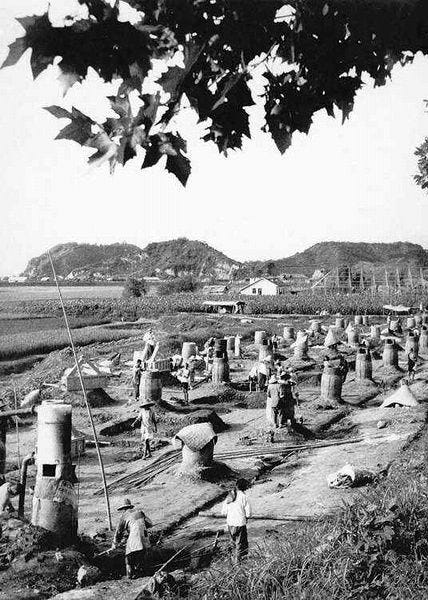
The quotas for steel were as aggressive as the quotas for grain. Local leaders had to divert workers away from the farmlands and focus the labor force on the production of steel.
But the small furnaces were almost working against them. They needed a lot of fuel— so people were literally forced to feed them their own pots and pans — and yet the output was of the lowest possible quality.
Of course, nobody spoke up. They already knew what happened to critics of the regime after the “Hundred Flowers” experiment.
Mao finally saw the truth on a visit to a large-scale factory in Manchuria. But he did not stop his program. He was worried this might “dampen the revolutionary enthusiasm of the masses.” Instead, the end of the backyard furnaces came in a gradual and quiet way several long months later.
Meanwhile, grain fields abandoned by workers who had been sent to manufacture steel were now rotting.
Flaw #4 | The Water
China could only meet its ambitious grain quotas by also seizing control of the water.
This attempt was also catastrophic.
During the Great Leap Forward, multiple irrigation channels were built to supply water to dry lands. This was done in a rushed way, with no input from experts, but at a great human cost.
The irrigation projects were referred to as “killing fields” by the peasant workers and hundreds of thousands of starved and exhausted people gave their lives in China’s irrigation program.
But the irrigation channels themselves were poorly constructed. Similarly to the irrigation project in the Soviet Union that destroyed the Aral Sea while manically growing cotton, China was driven by aggressive quotas and abused the land and the cheap labor it had at its disposal instead of applying educated and strategic planning.
Multiple dams were built during this period on the same principle. Forced labor, rushed projects. As a result, two decades later when Typhoon Nina struck the Henan province, 62 poorly-constructed dams collapsed in one of history’s worst ecological and humanitarian disasters.
Flaw #5 | The Lies
Steel production was of abysmal quality. Abandoned crop fields rotted because of workers’ shortages. Irrigation systems didn’t work well. Soviet agricultural innovations only lowered the production of grain.
The Great Leap Forward was neither great, nor a leap, and nothing seemed to move forward.
And yet China kept exporting.
How?
Local province leaders were in fierce competition with each other. They overpromised and increased quotas several-fold. They were only interested in holding onto power and remaining in Mao’s favor. So when the export quotas could not be met, they took the grain out of the food rations.
Tens of millions of Chinese peasants starved to death, many of them in front of locked warehouses full of grain. People resorted to eating leaves, clay, coal, and in the worst-hit provinces, there were records of cannibalism.
The response of officials was to cover things up and focus on presenting an image of success and abundance. Zeng Xisheng, the Anhui leader who came up with the backyard furnace fiasco, was called out by a fellow party member because of the rising death toll in his province. Xisheng reported him to Mao as an enemy and got him purged from the party. Later, when the famine in Anhui became an emergency, Xisheng could not report it or ask for help because he had already labeled the initial reports as an exaggeration.
Most province leaders followed this mindset. The more their production plunged, the more they overpromised. And the more peasants died.
The streets of many villages were covered in corpses. Only later reports would reference them. At the time, people were afraid to speak up and be labeled an enemy of the party. Doctors were prohibited from listing “starvation” as a cause of death, and nobody was talking about the unfolding of the biggest famine in history.
At the top, Mao was hearing an echo of the suffering. He did get reports about people dying of starvation, but he was convinced the peasants were lying. In fact, he thought they were stealing grain. That, and a few natural “disasters” such as floods and droughts, was the official reason for the increasing struggle of China to meet its own targets. When Mao was challenged by a party member Peng Dehuai in 1959, he stayed true to tradition: he expelled Dehuai from the party and purged his supporters.
The world heard echoes too. Several countries offered aid to China. Japan even suggested a shipment of 100,000 tonnes of wheat completely in secret, outside of the public eye.
China rejected it all. And it kept exporting.
It took 4 years in total for enough political libido to gather within the party and in 1962 Mao was opposed, forced to step down, and the program was officially terminated.
By the end of the Great Leap Forward, China had lost 5 to 10% of its population of 600 million.
