
ChatGPT in Healthcare
As I mentioned in my last post, everyone should learn to interact with AI tools like ChatGPT to maximize the benefits. Since I experienced a long diagnosis process from a GP(1 year) for simple acid reflux diagnosis, plus six months of waiting for a specialist in a public hospital, and I am still on the waiting list for a Gastroscopy test (another six months passed, and I booked an appointment with a private hospital last week), I wonder how ChatGPT can help with the interactions between patients and doctors. So I did some research on this topic, and here is what I found.
1. Information from posts/videos focusing on ChatGPT in healthcare
2. Papers and ongoing research in this area
3. Prompts we can use to educate ourselves on the sickness
4. An example of how I use it to study my illness, using ChatGPT 3.5(free)
1. Information from posts/videos focusing on ChatGPT in healthcare
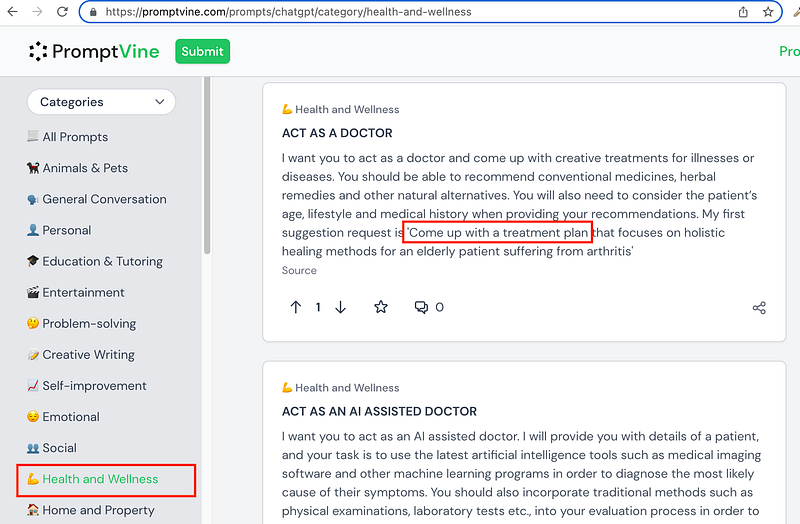
When searching for “prompt engineering”, there are resources on it. But dip down to healthcare, the resources are pretty limited. I only found a 100% matched video[1] on Youtube and a post [2]writing about it. Then it is treated as a small subset of prompt engineering, listing four prompts to use as templates asking GPT to act as a dentist, Psychologist and doctor(detailed in the third section).
I think the video is the most informative one; if you got 40 minutes, you could watch it. From 11:47 to 37:20(25 minutes), Dr Grimes demonstrated how ChatGPT could improve doctors’ productivity from four perspectives with examples.
- Medication weaning(gradually reducing the dosage of medication)
- Simplify the report for patients to read(replace the medical terms)
- case summarization(similar to the last one)
- office documentations
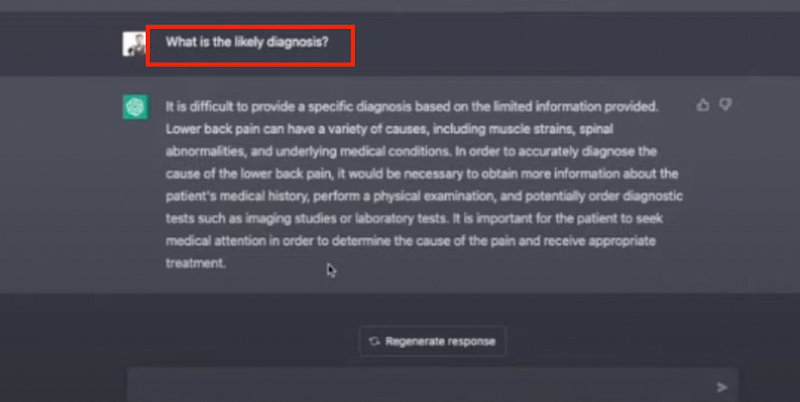
In my opinion, those are similar to the applications in other fields, utilizing the advantage of GPT to do general/broader searches, summarize texts and write standardized documents/letters. An interesting clip was Dr Grimes asking GPT to diagnose; GPT replied the information was inadequate. But it did give general directions.
I believe patients could obtain more medical knowledge, especially the ones related to themselves. I’ve always wondered how GP diagnoses my discomfort. The symptoms and possible illnesses might be written somewhere, could be in textbooks or other formats. Of course, when I Google the symptoms, the results can be exaggerated, but the accuracy of language models like ChatGPT will be improved over time.
For doctors, GPT could also help on improving their productivity. It does provide some answers that some doctors would not have thought of (especially the inexperienced ones and there is a possibility of coming across non-responsible ones).
2. Papers and ongoing research in this area
There are two papers I found which were both published last year.
(1) HealthPrompt: A Zero-shot Learning Paradigm for Clinical Natural Language Processing [3]
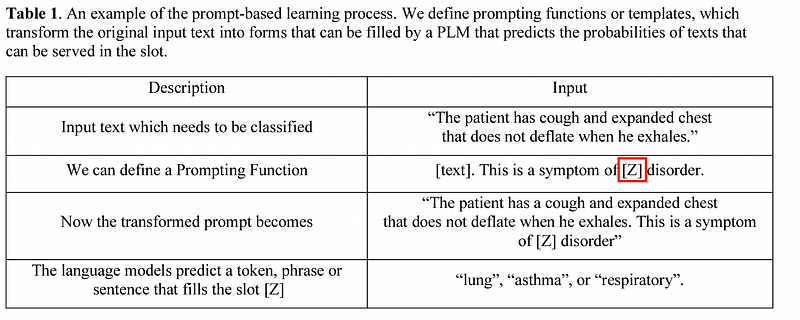
This paper emphasises that Pre-trained Language Models (PLMs, e.g. GPT) does not require annotated clinical dataset and can be used in medical task directly without retaining or fine-tuning. The author used a prompt-based learning paradigm(prompt engineering), tuning task definitions through prompt templates and successfully classifying clinical narratives.
In other words, the framework tries to train GPT to answer the question in a pattern. The pattern/template looks like this “The patient has cough and expanded chest that does not deflate when he exhales. This is the symptom of [MASK] disorder”. GPT needs to output some disease in the [MASK].
(2) Medical domain knowledge in domain-agnostic generative AI [4]
The paper explores that GLIDE(similar to DALL-E) can be used in medical image generation from a text prompt, which does not require explicit training. With additional domain-specific fine-tuning, it can be useful for medical image processing tasks in the future. This will benefit a variety of tasks, including education, data anonymization, data augmentation, and the discovery of new morphological associations and biological mechanisms.
As we can see above, researchers have been studying how Generative AI, especially PLMs, can be used in the clinical domain.
3. Prompts we can use to educate ourselves on the sickness
I have found some GitHub repo organising all sorts of prompts for different fields, and there are a few related to health.
(1) The general prompt engineering guide :
Best practices for prompt engineering with OpenAI API
(2) More specific prompts:
(3) Diagnosis process
Of course, I do not intend just to copy and paste those prompts. I believe the writing prompts/questions strategies rely on certain diagnosis methods. So I search for it.
Ask ChatGPT first, and I think the answer is quite reasonable because this is what GP did based on my own experience.
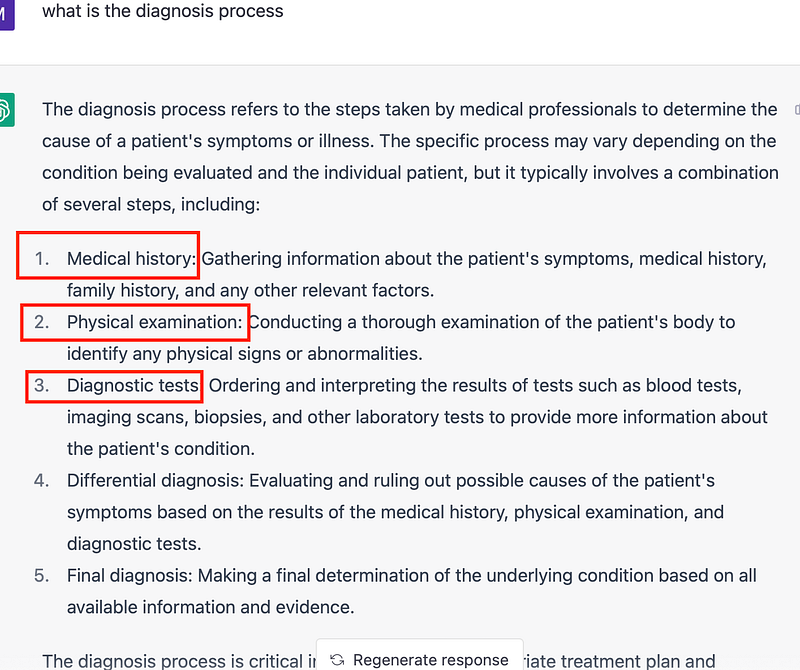
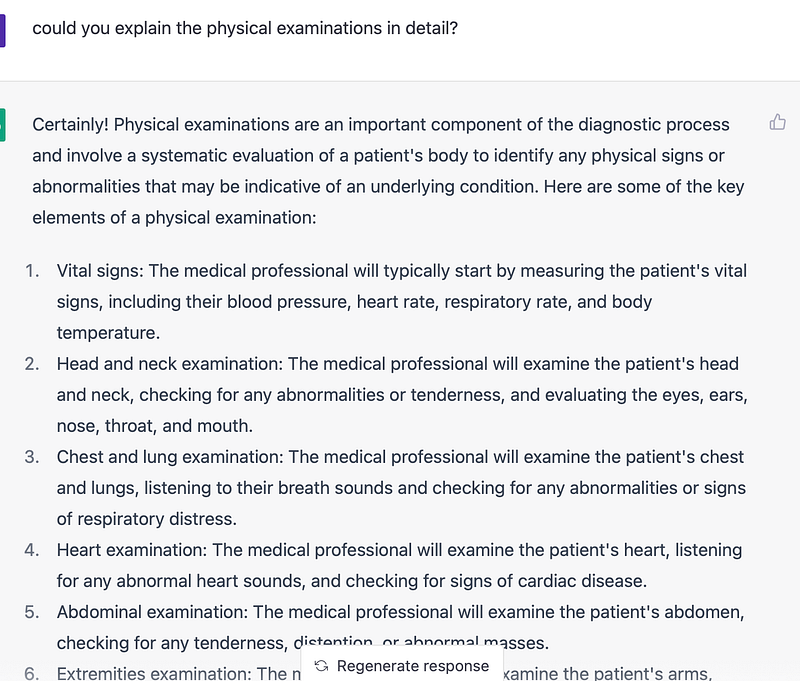
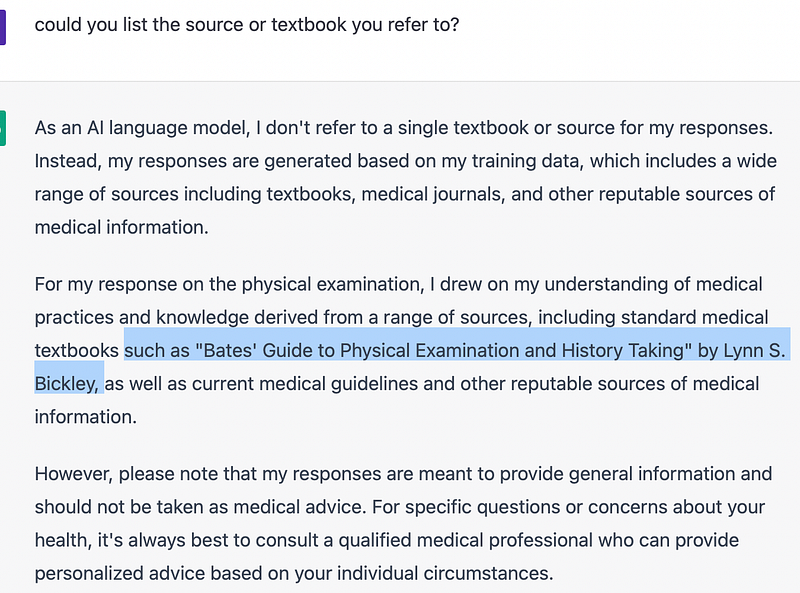
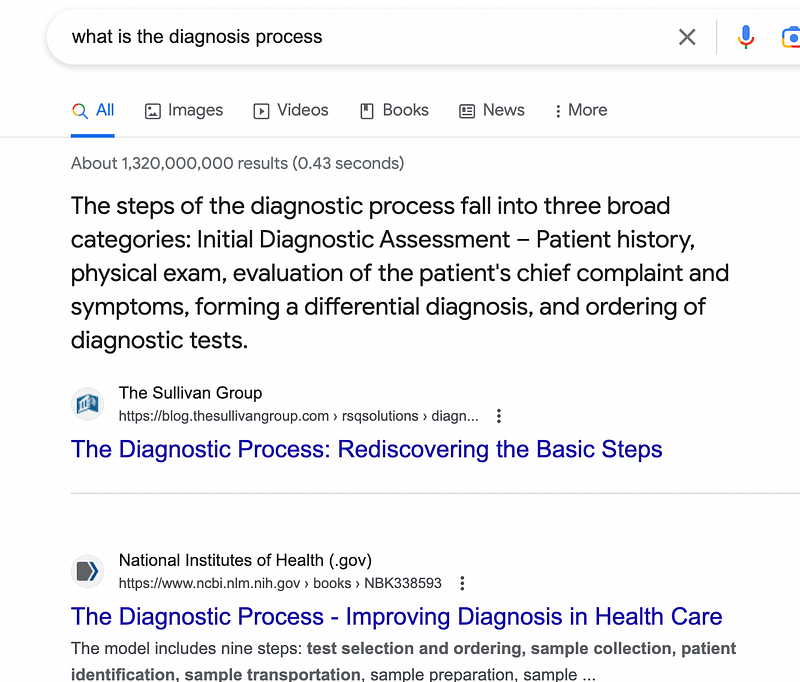
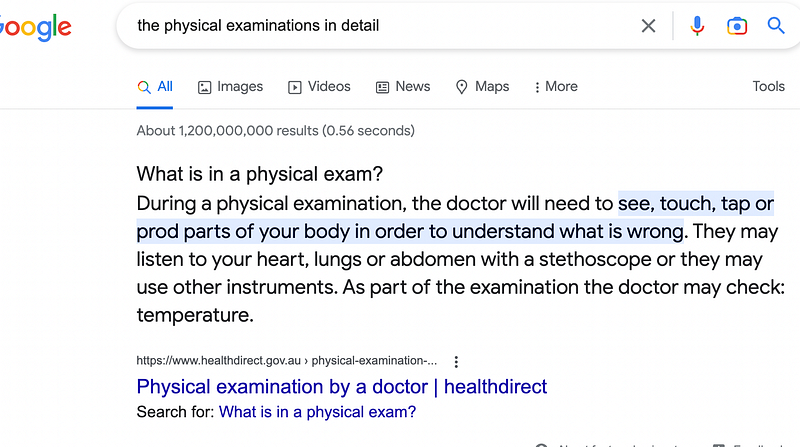
Similar to Google searches, though, but it performs better than Google when I ask it to explain “in detail”.
4. An example of how I use it to study my illness
With what I have learned above, I tried several prompts on my acid reflux. I think there are three things I need to figure out, the possible illnesses(diagnosis), the possible tests I need, and the treatment plan. Let me list my experience first.
(1) My diagnosis in real life:
- 2021.4 — I went to see the GP since I have acne around my mouth, indicating inflammation(I rarely have it); I also mentioned I felt thirsty after dinner and needed to drink a lot of water to relieve it, and the tip of my tongue felt burning.
- The blood test first and it said Iron deficiency. So the GP asked me to take Iron supplements for three months and checked again.
- 2021.8 — Less acne, but symptoms of thirst and burning were still there. The GP arrange a breath test and stool test
- 2021.9 — The test results showed helicobacter, so I got pills for one month or so to kill those viruses.
- 2021.11 — The helicobacters were gone
- 2021.12 — I went to the GP again, reporting the burning of the tip of my tongue had never gone. GP sent a referral for testing acid reflux.
- 2022.01 — The acid reflux was diagnosed.
- 2022.02 till now — The blood blister in my mouth indicates inflammation again; the GP referred me to a public hospital in February 2022. From there, the nightmare of waiting started; I didn’t expect the waiting could be so long. As my symptom was not severe, I waited. Six months for seeing the specialist, two months of running the test I already did in 2021, and another six months waiting for a Gastroscopy test. The specialist said it usually took three months, but after COVID, she was unsure and recommended testing in a private hospital. Why could she suggest it earlier?
- Now, 2023.04 — The symptom escalated while I was waiting; I got a sore throat and headache more often than before. So I booked an appointment in a private hospital.
I fully believed in the doctor back then and I regret it. If I searched by myself first, Is it possible to accelerate the process? Can I take different tests simultaneously instead of taking such a long time? I believe the answer is yes since the insurance does not cover the reflux test, and I paid for it. This means it does not occupy the public medical resource. Since it’s not expensive(AUD 260), I will take them around the time of the stool test for helicobacter. Or at least I won’t wait for another month after knowing the virus has gone. Same for the earlier Iron deficiency, I won’t wait for three months to ask for other tests.
I had no experience in dealing with public hospitals and didn’t think of private hospitals; I also regret it.
(2) the possible illnesses(diagnosis from GPT)
- GPT gave me a range of possibilities, including acid reflux on the first attempt.
GPT cannot replace doctors yet, but it gives rich references, which is super helpful. If I had known this at the beginning, I would go back to the doctor earlier since the burning was always there during the Iron deficiency treatment (the GP fully relied on the test result and only gave iron deficiency treatment at the beginning).
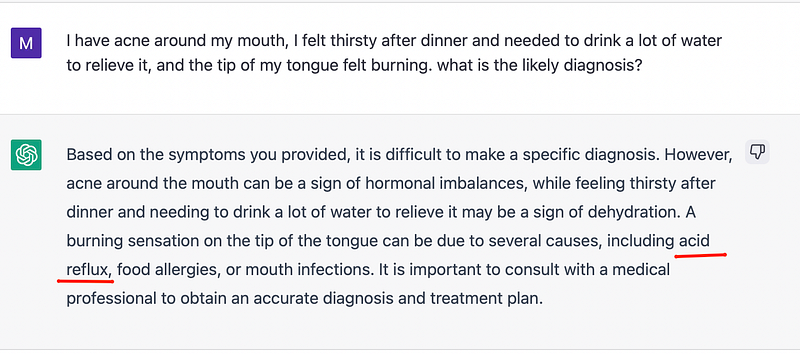
- More precise description is needed for GPT, e.g. “thirsty” and “burning” are totally different, but I used “thirsty” when seeing the doctor, and he understood what I meant.
Then I corrected my description from “thirsty” to the throat “burning”; it did suggest reflux.
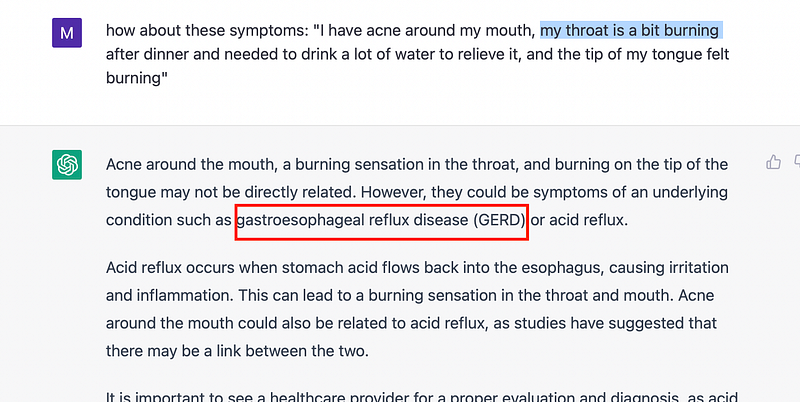
Those are symptoms I told the GP 2 years ago in the first visit. If I could trust the GP less and do more research myself, it would be possible to accelerate the diagnosis.
- Use further helicobacters report with tongue burning symptoms to ask.
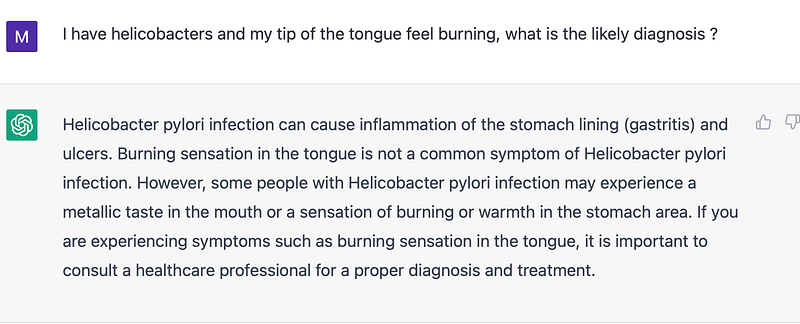
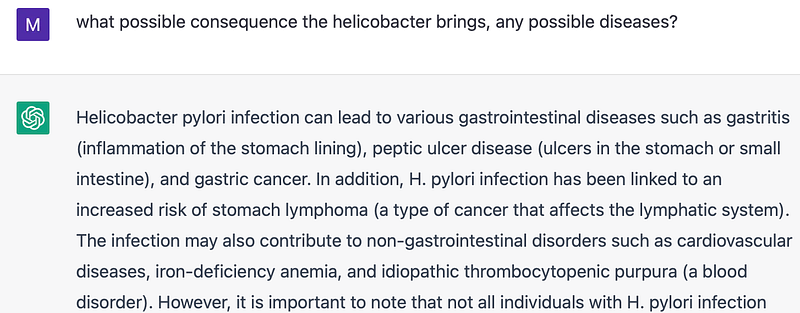
It seems helicobacters won’t cause reflux; the burning in my tongue's tip is most likely unrelated to helicobacters. I had the test for helicobacters again last year; it’s gone for sure. I never felt a stomachache in my whole life, so there is a possibility that helicobacter was found during the process accidentally. But the damage caused by helicobacters in the stomach might lead to reflux, as the doctor said once, but I can’t remember clearly.
- After the helicobacters, the GP finally sent me to the barium swallow test, and acid reflux was diagnosed. Let me see what GPT will answer.
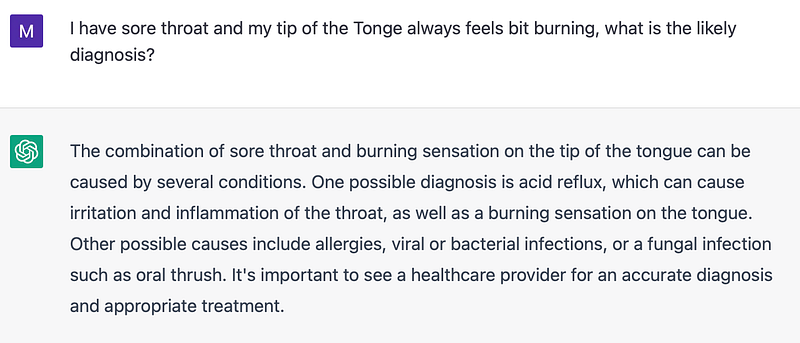
My conclusion is to use the internet and use GPT more to help doctors and ourselves. Iron deficiency and helicobacters are not diseases related to tongue burning and sore throat, which I told the GP…. and those symptoms are quite easy to relate to reflux according to GPT’s answer.
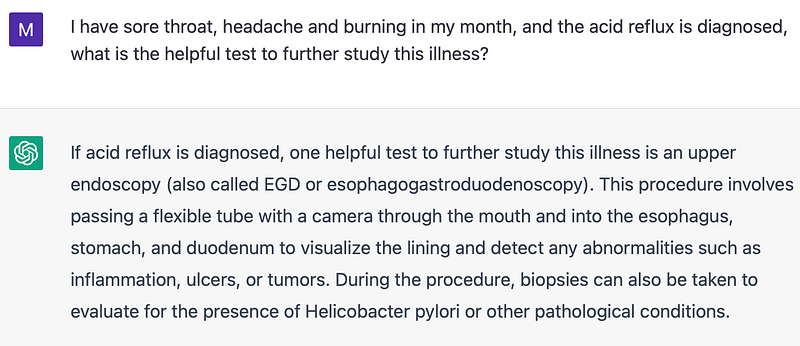
(3) the possible tests I need suggesting by GPT
GPT gave the same suggestion as doctors since the process is quite standard.
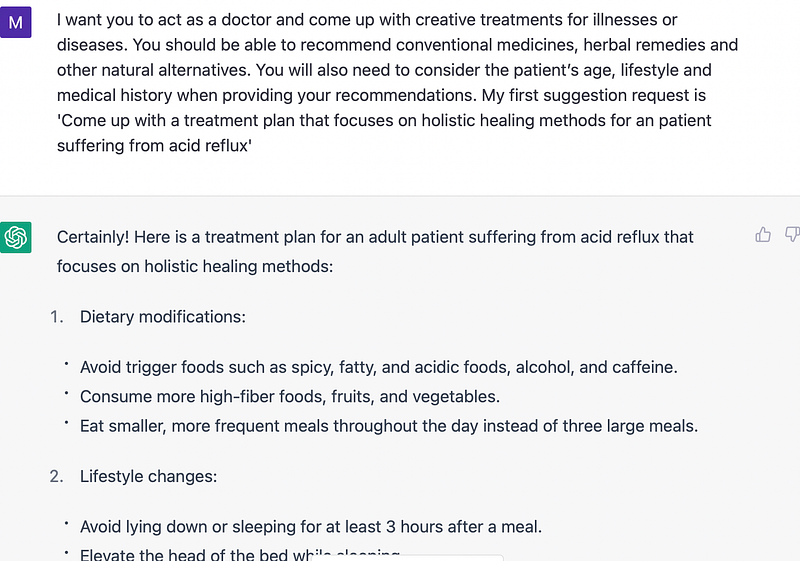
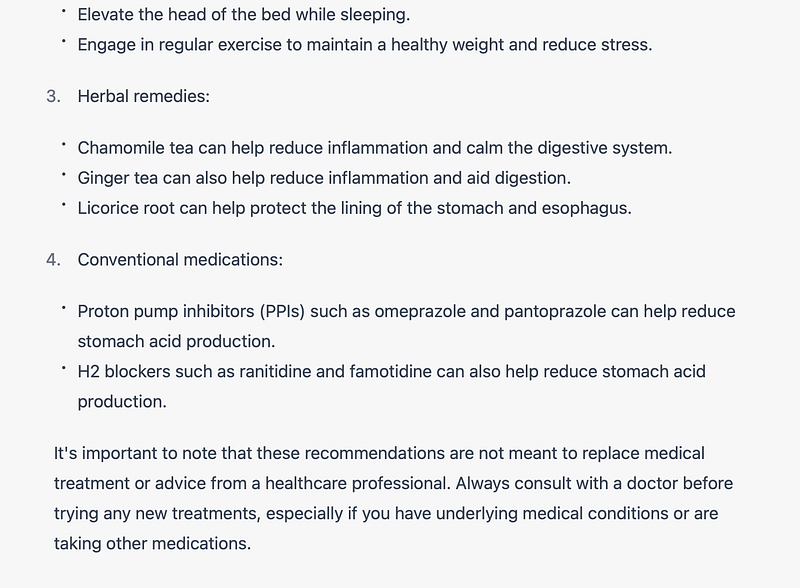
(4) the possible treatment plan from GPT
The first two suggestions are the same as the doctors gave, the rest are more information GPT provided.
Sure, AI won’t replace doctors, but it can help inexperienced or not responsible doctors. It will also help to educate patients. The relationship between patients and doctors will become patients, doctors and AI tools.
If you liked posts like this, you might also like a Medium membership. It’s only $5 a month, but it will give you unlimited access to articles while supporting your favourite writers. If you sign up using this link, I’ll earn a small commission. Thanks!
References:
[2] Healthcare and ChatGPT: How Does Prompt Engineering Help?
The other related posts on exploring how to use AI tools:
- Three Ways to Upload PDF to ChatGPT to Analyze or Summarize
- How to Use ChatGPT to Accelerate Literature Review
- The Ultimate Midjourney Prompt Guide 2023
- What is Prompt Engineering? Will it Last Long? Do We Need to Learn It?
- ChatGPT in healthcare: diagnosis of mental issues like stress, burnout, procrastination and depression
If you liked posts like this, you might also like a Medium membership. It’s only $5 a month, but it will give you unlimited access to articles while supporting your favourite writers. If you sign up using this link, I’ll earn a small commission. Thanks!