
Artificial Intelligence
ChatGPT Has Reportedly Been Banned in Italy
The Italian government issued a ban on ChatGPT due to data breaches.

As mentioned in a previous article, AI-generated content raised alarm bells in technology communities. They are believed to poison social networks. You may check this article titled Tech Giants Are Begging AI Developers to Slow Down.
In this story, I’d like to highlight an interesting and important development in Italy mentioned in various news sources and social media.
I am unsurprised as this new tool disrupts society, as we have yet to prepare for it fully. People have mixed thoughts and feelings about it. Some people support the ban, and some don’t like it for various reasons.
The Italian government has banned ChatGPT, an AI chatbot developed by OpenAI, citing the absence of an age verification system and a breach of the country’s privacy laws concerning the collection and processing of user data.
As you might know, privacy is a vital consideration in European countries. Therefore, the Data Protection Authority of Italy released a statement that says ChatGPT’s users are not informed about the collection and use of their data and that there is no legal basis for it.
The data collected is used to train the AI chatbot, but the regulatory body noted that the information provided by ChatGPT does not always match factual circumstances.
The terms of service limit the use of the chatbot to users over the age of 13, but there is no age verification system in place.
The Italian regulatory body mentioned a data breach on March 20 that affected “users’ conversations and information on payments by subscribers.”
OpenAI acknowledged the issue on March 24, saying that the system had been taken offline due to a bug in an open-source library that allowed some users to see titles from another active user’s chat history.
Italy is the first Western country to ban ChatGPT. It is reportedly blocked in other countries such as China, Russia, Iran, and North Korea.
The ban on ChatGPT by Italy may share some of the same reasons for blocking it as those countries, as it is currently governed by a coalition of right-wing and far-right parties who might take issue with public access to some factual data points that paint them in an unflattering light.
However, Italy is not alone in its concerns about the rapid growth of ChatGPT and other AI applications.
For instance, the New York City Department of Education said in January that it would restrict access to the software from school networks and devices.
I also heard that Getty Images banned uploading and selling AI-generated images.
As I mentioned in my previous story, a group of artificial intelligence experts, industry leaders, and Elon Musk recently published an open letter calling for a six-month pause on training AIs more powerful than GPT-4.
However, other agencies are taking more concrete steps, and the European Consumer Organization has called for an investigation into ChatGPT technology.
Ireland’s Data Protection Commission also intends to contact the Italian regulator for more information on the reasons for the ban, likely to formulate its policies and restrictions.
There is considerable concern over the explosive development of AI and its potential to cause harm in unpredictable ways.
Regulation is necessary, and further bans are almost certainly coming, but AI development is likely to continue, at least in the short term.
In January, Microsoft announced plans to invest $10 billion in OpenAI, and Google announced its own ChatGPT-like chatbot called Bard in February.
Final Words
The ban on ChatGPT by Italy serves as a reminder that AI development must be carefully monitored and regulated to avoid potential misuse and harm to individuals and society.
The concerns about AI are not new, and there is a growing awareness that regulations need to be implemented to ensure the responsible development and use of AI.
As AI continues to evolve and become more sophisticated, it is important to assess the potential risks and benefits of the technology and develop regulatory frameworks that balance innovation and safety.
To experiment with ChatGPT, I wrote an article promoting it. It is a helpful tool, but it is not perfect. I posted it to the Lampshade of Illumination, where AI-Written content is accepted.
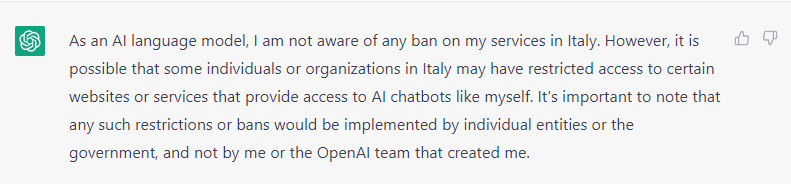
I was curious and asked ChatGPT why it was banned in Italy and it responded diplomatically.
If you enjoy my posts and would like to stay updated on the latest gaming-related news, technology advancements, design trends, and social media insights, I invite you to follow my profile.
I will continue to share my thoughts and insights on a wide range of topics in the world of entertainment and technology.
With that being said, thank you for reading my post, and have a good one.
About Me
I write articles in my field covering gaming, film-making, social media, and design. I am also a YouTuber. Thank you for subscribing to my account to get notifications when I post on Medium. I also created a new website to share my content for free and promote stories of writers contributing to my publications on Medium. Let’s connect on Twitter and LinkedIn.
I own two publications on Medium. One for video gamers and another for YouTubers and Podcasters. I also support Illumination Integrated Publications as a volunteer editor and participate in collaborative activities in the Slack Workspace. Writer applications for my publications can be sent via this weblink. Please add your Medium ID.
If you are new to Medium, you may join via my referral link. You may also consider being a Vocal+ member to monetize your content. I write for both platforms and repurpose my content to reach a larger audience. Here is more information about Vocal Media.
This post includes my Medium and Vocal Media referral links.


