
ChatGPT and the Dialogical Self
How to unlock greater self-awareness using AI

After using OpenAI’s ChatGPT, there is an immediate sense that the artificial intelligence chatbot can provide a lot of value to the user. Naturally, possibilities flood the mind, but how often is it discussed as a powerful tool to further develop the dialogical self?
ChatGPT can be used as an extension of the human mind. Through questioning, it can facilitate and archive our internal thoughts. It can also take on different external perspectives per our instructions. This means that by having conversations with ChatGPT, we can develop a deeper self-awareness to foster personal growth.
What is the Dialogical Self?
The dialogical self is a psychological concept related to our inner dialogue. The idea incorporates self-thoughts and other people’s and societal perspectives. Essentially our mind predicts how other people important to us would react to situations we face. For example:
How would my wife or best friend react to this situation at work?
How would a conservative Republican or a liberal Democrat respond to this news article?
Hubert J. M. Hermans’ Dialogical Self Theory (DST) poses that the complexities of our internal and external dialogues make up who we are. We become more self-aware by engaging in these dialogues and reflecting on them.
In a nutshell, DST tries to answer the following questions.
- How do I experience myself?
- How do I relate to others?
- How can I integrate the different aspects of myself?
Developing the dialogical self has many benefits. It can help us gain a more profound sense of self and help us understand our thoughts, feelings, and behaviors. It also can identify areas for personal growth and help us develop relationships.
The Role of Dialogue in Developing the Self
External and internal dialogue play critical roles in developing and understanding our identity. It’s an ongoing process in life starting from childhood.
Understanding the dialogical self can highlight areas where we want continuity and places we want to change in our thinking. Getting a better understanding of how we want to position ourselves can make us more resilient to the changes of time that we can’t control.
As I grow older, the image of who I am becomes more apparent, making me more motivated to work on my dialogical self actively. I aim to clearly define my values and become more self-aware to improve my life.
Using ChatGPT to Develop the Dialogical Self
There are a variety of questioning patterns one could use with ChatGPT to develop the dialogical self.
- Help develop the dialogical questions.
- Be instructed to ask questions that promote introspection.
- Be prompted to take on different perspectives when providing answers.
A basic framework could look like this.
- Identify a topic or question to explore.
- Start a new conversation with ChatGPT. Introduce the topic, your views, and other relevant information about yourself.
- Instruct ChatGPT to respond, then ask self-reflective questions. Prompting it to ask one self-reflective question at a time works best for the flow of conversation. (Optional: Assign ChatGPT a perspective).
- Begin asking and answering open-ended questions. Be honest and reflective. Explore cultural and social factors.
- Summarize insights from the conversation. (ChatGPT can help with this).
The best part is you can repeat the process as often as you want, and ChatGPT will always remember the conversation.
Putting it Into Action
Below is an example of the basic framework in action.
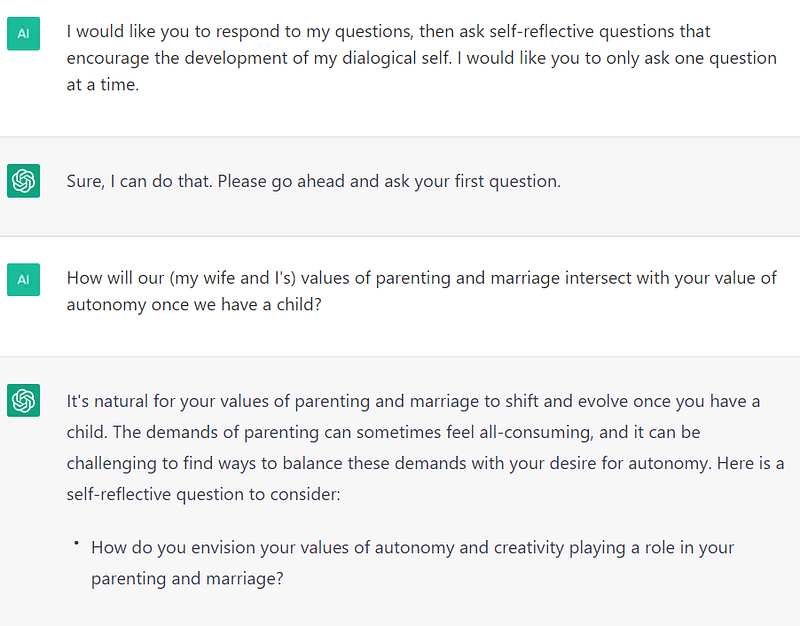
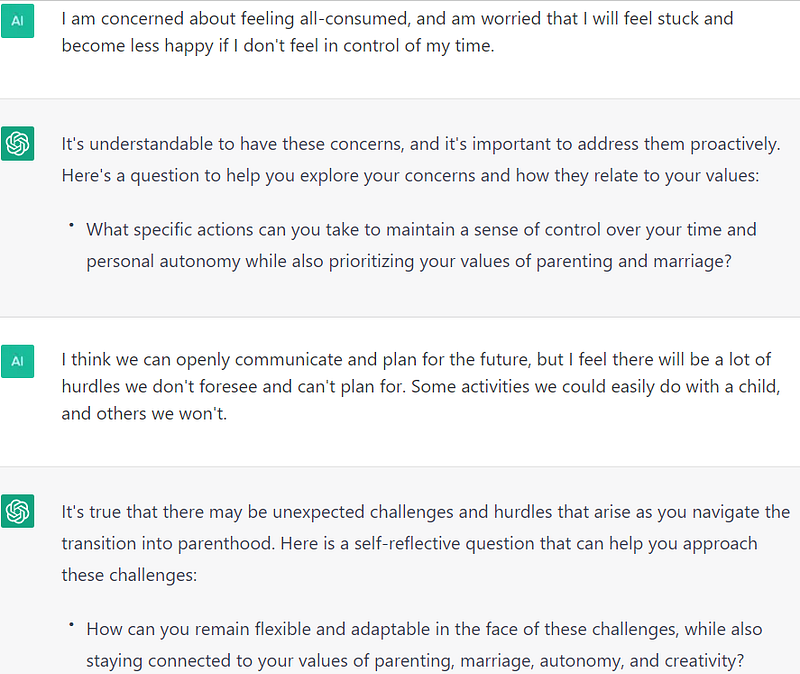
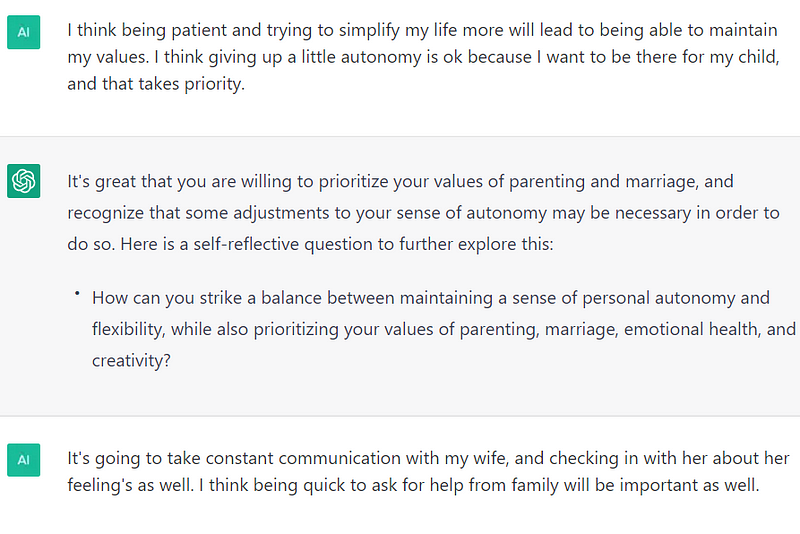
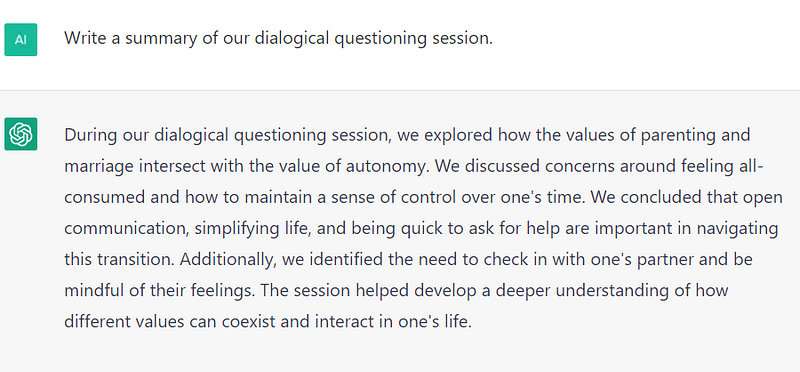
This conversation has much more to explore, but I am on track to reconcile two conflicting values through a significant life transition.
ChatGPT has made this process more salient and productive because I can seamlessly pick up where I left off. In addition, its efficient nature has helped me organize and summarize my thoughts to get the most out of developing my dialogical self.
Conclusion
Artificial Intelligence language models, such as ChatGPT, can be used to organize and archive our psychological world. They are powerful tools that serve as an extension of our brains. Plus, the conversational feel of the software makes it engaging and smooth to use.
Improving our self-awareness by actively working on our dialogical self is now a more straightforward process with the help of ChatGPT. Not only can ChatGPT be prompted to take on different roles in the process as needed, but it archives conversations with a perfect memory so users can pick up where they left off at any time.
Everyone develops their dialogical self constantly throughout life, but ChatGPT has made it easier to actively and efficiently engage in the process and archive the results. I use ChatGPT every day, but about once a week, I use it to develop my dialogical self. So far, it has made me feel more confident in who I am, what I value, and my role in my relationships.
ChatGPT is a valuable tool for many reasons, but if you haven’t, I encourage you to try using it for self-reflective dialogue to promote personal growth.
Did you enjoy reading? clap 👏, comment 💬, share 📢
✔ Join me on my writing journey by subscribing to my stories. Get them delivered straight to your inbox, and never miss a story.
✔ Use my link to unlock all the benefits of Medium and support me directly.
Thank you!


