
Changing the Potential of the Future
Connecting with the Universe through true belonging

spirit cries loudly recover me from your guilt trauma bonded friends shameful seeds sewn together seeking to numb emotions
secret shared hiding rooms of anonymity admit your defeat party without the party 12 step dance of clarity
two left feet don’t fit the soul needs a difference spirit within me dancing with the universe not an outside GOD’s commands
A stream of poetic consciousness flowed within minutes after reading and commenting on Marcus’s article 12 Step Programs’ God Problem. I sent the poem to him privately marked just for you. I had no intention of publishing it — it was my gift to him in response to his words. Later, he messaged me, stating that he would love to publish it in C & C with a proper explanation of the synchronicities that led to its genesis. (Be careful what you ask for, Marcus — the floodgates opened)
Contemplation feels like a heavy state of mind every year, without fail, in the latter part of December. It is the natural function my brain takes as if the calendar flips a switch within and sets the annual review in motion. Over the years, I learned to embrace it rather than fight it.
The cinematography plays out on the big screen of thoughts, dreams, wishes, and intentions. Did I manifest what I needed, wanted, or did the universe give me something better? Did I release things that no longer serve me? Did I walk the path with my values intact? Am I taking what I need into the new year and leaving the rest behind?
The review of my year was in full force when his article showed up in my feed and lined up nicely with my energetic coincidences already being played out in my life.
Within days of writing My Heart is With the Moon,
I grabbed my Moonology book, and it opened to these pages:
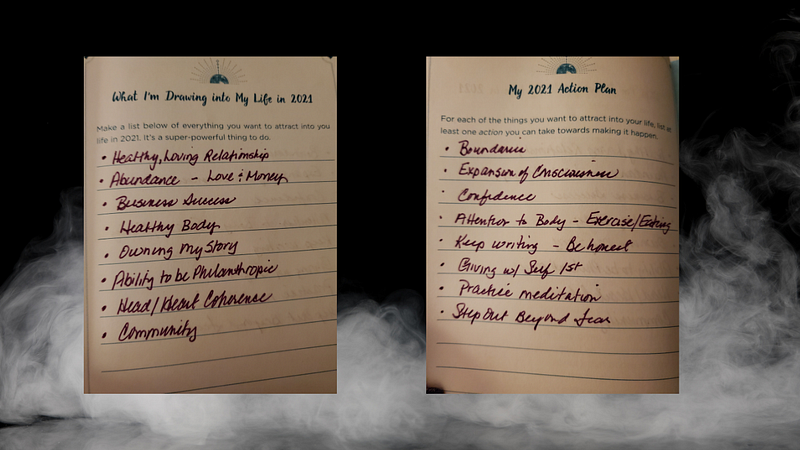
My 2021 Mantra
“Don’t ask what the world needs. Ask what makes you come alive and GO DO IT… because the world needs people who have come alive.” — Brené Brown
I admire Brené Brown. Her bravery to do the hard work and show up in the arena of life is an inspiration and a catalyst to the mantra I created for 2021. — Dare to Lead
The subtitle of Brene’s book, with the same name, is the intention I set. Brave Work. Tough Conversations. Whole Heart. Of course, in jules fashion, those fit my spirit of three. Brave work is represented by the cowardly lion, tough conversations by the scarecrow, and whole heart by the tin man.
As I explained in this post I wrote on my blog before I found Medium:
In January 2013, I published my first book that haunted my spirit for years. It was how I integrated the 12 steps of recovery with characters and scenes from the Wizard of Oz. I thought the day I published my book, I had arrived. The universe had a different plan for me. I wasn’t as solid in my recovery as I thought. I missed the most important lesson.

Recovery isn’t something you achieve; it is an ever-growing foundation that helps to create a lifestyle worth living. You see, many people that seek recovery have come to the point of admitting life has become unmanageable. Life feels out of control, whether forced by circumstances outside of themselves or an awakening of some kind.
One issue I found for myself, and yes, it is only my opinion, I got stuck believing that recovery was something outside of myself. It wasn’t until I realized that while many of the behaviors and actions changed, my inner relationship with myself hadn’t. I still didn’t trust myself. I still would slip, and my addictive thoughts and feelings still could run rampant at a moment’s notice. On the outside, I seemed to have it all together, but I was still living in fear of losing on the inside.
My deeper recovery did not begin to arrive until I changed my mindset and devoted my actions to manifest awareness of my present moments and stop judging myself. Honoring that I am a spiritual being living in human experiences rather than the other way around speaks the truth I need.
Click 3 Times evolved from a reoccurring nightmare I had for almost two decades. I, like Dorothy, cowered in a corner, silent, while the face of the wicked witch belonged to my alcoholic stepfather — my tormenter. My recovery depended on Glinda, the good witch’s words — “You’ve always had the power, my dear, you just needed to believe it for yourself!” Glinda was my inner wisdom.
We all need connections and true belonging
Initially created in 1935, the first anonymous program came from the synergy of two hopeless alcoholics, Bill W. and Dr. Bob. However, before they met, both had been in contact with the Oxford group, which emphasized universal spiritual values in daily living. Bill W. stayed sober by helping others, while Dr. Bob did not get sober until he met Bill W. and saw firsthand another sufferer succeeding. Bill W. attributed it to alcoholism being a malady of mind, emotions, and body. (1)
The synced energy of the original story will forever be instrumental to recovery. Yet, after eighty-plus years, the universal energy and values have changed and shifted. Divine oneness of our current human needs illustrates that the program needs an update to address the infection of addictions that our society currently faces.
Shame and trauma are the two left feet still attempting to dance in the halls of the 12-step rooms.
Shame:
spirit cries loudly recover me from your guilt trauma bonded friends shameful seeds sewn together seeking to numb emotions
secret shared hiding rooms of anonymity admit your defeat party without the party 12 step dance of clarity
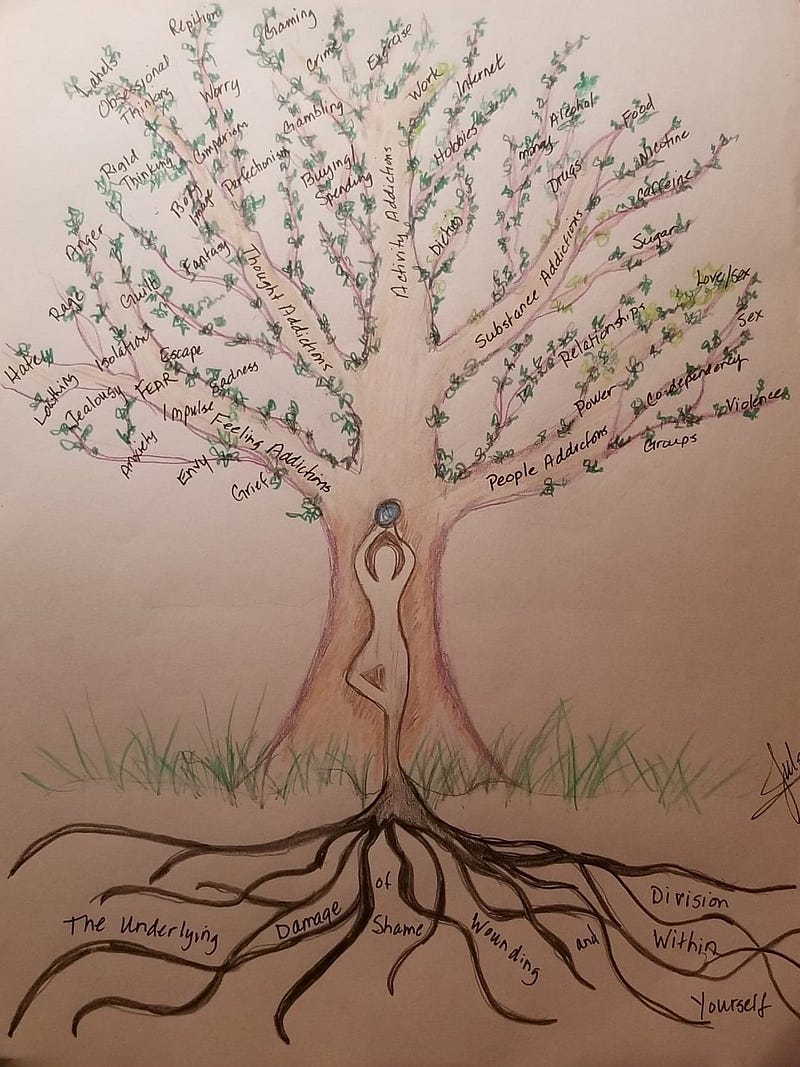
These three articles by Holly Kellums show the awareness that honor and respect the past intentions of the 12-step program along with the infectious culture of shame that keeps the trauma secrets bonded and the shame seeds growing. The roots of addiction (from the addiction tree) are based on the underlying shame, wounding, and ultimate division within oneself:
Trauma:
two left feet don’t fit the soul needs a difference spirit within me dancing with the universe not an outside GOD’s commands
“The effects of unresolved trauma can be devastating. It can affect our habits and outlook on life, leading to addictions and poor decision-making. It can take a toll on our family life and interpersonal relationships. It can trigger real physical pain, symptoms, and disease. And it can lead to a range of self-destructive behaviors.” — Peter Levine
One update the programs need is trauma-informed communication. Recognizing the symptoms of trauma and acknowledging its role in the individual’s life is the first step. Trauma symptoms are different for each individual based on the level of trauma and personal coping mechanisms before the trauma took place.
Marcus wrote Drilling Down to the Root Cause of Addiction and a second article drilling further that goes into the issues of trauma and disconnection.
“Trauma is not what happens to us, but what we hold inside in the absence of an empathetic witness.” — Peter Levine
The empathetic witness needs to fill the hearts of those in the rooms. When we are in the depths of trauma and its responses, we get stuck in a fixed mindset. Trauma-informed communication is needed to flip the switch to a growth mindset to move forward and change the initial thoughts and feelings from the trauma into supportive, loving, and non-judgmental action steps.
True Belonging
Brené Brown defines a leader as anyone who takes responsibility for finding the potential in people and processes and who dares to develop that potential. It is the process that I believe we need to change. History can be honored and respected for its purest intention. Nevertheless, daring to update the program’s potential is our responsibility for growth.
Another reason Brené Brown so inspires me came from reading her history. If you read Brené Brown’s history, she is 25 years sober, and she regularly attended meetings during the first year. In her article written on May 31, 2019, she discusses what being sober has meant to her. In my book, her work is daring to develop the potential in a process. Her research on vulnerability and the way she shares it is one way to be an empathetic witness.
History doesn’t need to repeat itself. When we know our past actions, we can evolve experientially to new stories yet keep the value and intention intact. The experiences of trauma, addiction, shame, and guilt and their effects on our thoughts and actions are different today. The power to believe the 12-step process for ourselves needs an individualized spiritual connection combined with true belonging.
True belonging is the spiritual practice of believing in and belonging to yourself so deeply that you can share your most authentic self with the world and find sacredness in both being a part of something and standing alone in the wilderness. True belonging doesn’t require you to change who you are; it requires you be who you are. — Brené Brown
If it pleases you to read them, allow me to share these related articles of mine.
- The start and growth of A.A. Alcoholics Anonymous. (n.d.). Retrieved December 24, 2021, from https://www.aa.org/the-start-and-growth-of-aa