
Experience, strength and harm
Bleeding Deacons Atop Spiritual Hilltops — A Culture of Recovery Shame
Desperate addicts and alcoholics are being shamed to death by some of the most prized members of AA and NA

Writing about recovery — in a way that people in recovery will actually read and people who are not in recovery can still understand — is no small feat.
This gap between the world of recovery and the world is so gigantic that it is almost impossible to speak both languages at once. And when I choose one language or the other, I am not speaking everyone’s language.
My goal, in writing about the culture of shame in recovery, is to blend the two with enough brevity to not be a bore and enough clarity to ensure that you aren’t confused.
We will continue to discuss some of the dynamics that appear to nurture this deadly culture of shame. In doing so, I will share many details of my experience as it relates to people in the recovery community — from the rooms to the treatment facilities to the tables of Oxford House.
To align with my purpose, I wrote a disclaimer providing clarity on what I intend to say about the fellowship and — most importantly — what I am not saying.
I express my love for the fellowship.
I have great love for the fellowship and each 12 step program, especially Alcoholics Anonymous — as those, who know me, know.
Alcoholics Anonymous, the fellowship, and the 12 steps saved and changed my life in a miraculous way. I am forever grateful and my love and gratitude for all of you — even those I have never met — is immeasurable.
Then, I provide a full disclaimer to my case, speaking directly to those in recovery.
If you are a part of the recovery community, I ask that you read my short disclaimer, to all members of 12-step oriented communities, before reading my work further.
You can move on without it, if you wish. But I assure you that you will not understand me enough to read my words with an open mind. As much as I appreciate anyone reading my work for any reason and any time, I can say that moving on without my disclaimer would be a waste of your time.
Unless, of course, you just want to troll or hate. In this case, ignoring my disclaimer and berating me with multiple assumptions would be a great plan.
Either way is fine with me.
Bleeding Deacons Atop Spiritual Hilltops
We will start where we left off.
In the first story, we bring light to the culture of recovery shame that is leaving addicts and alcoholics around the world hopeless and alone.
This is where we left off.
If you are a person in recovery who is still denying my blame on recovery shame, I appreciate the sentiment more than I can express and respect it to the fullest.
I simply invite you to ask yourself one question, with the brutal honesty that you know the program demands, and the answer is between you and you — to do with what you will.
Why are so many of us dying for so few of us to live?
There is one answer to this question that rises above all the others.
Because we let them
This is a bold statement and a hard pill to swallow — especially for those of us who have spent years of our lives, in the trenches of recovery and addiction, pouring our heart and soul into helping others find recovery to save their lives.
It is hard for us —who have devoted much of our lives to helping the sick and suffering addict and alcoholic — to imagine that we are doing anything to hinder people’s recovery.

We have driven people 300 miles at 3 in the morning, because all the treatment centers were full but some guy we don’t know found a bed out of town and needs a ride — to save his life.
It doesn’t matter who he is, how many times he has relapsed, how bad off he is or what he did to get himself in the situation.
We may have never even met him.
We have spent entire nights awake working with others who seek recovery, knowing we had to work at 5 in the morning.
We travel the nation — speaking, organizing, facilitating events and sharing our stories.
We have used our last 7 dollars to buy people literature and gone home to eat ramen noodles.
Thousands of hours have been taken from our families and normal friends — hours that they never understood. These are hours, nights, and far distances that no-one in our lives outside of recovery could ever understand.
But we travel these distances anyway and the world sees that.
So to think that it is us destroying our people leads to an unbearable level of cognitive dissonance. It is almost impossible to comprehend.
Perhaps we are like the frog in the water who doesn’t know it’s being cooked or the fish who doesn’t know its wet.
But regardless of how this has happened, there is only one way that the culture of recovery shame can survive and that is with the permission of the people in the fellowship.
If we wish to figure out how to stop this culture of shame from rearing its ugly head in the communities of 12-step recovery, we must first explore why we allow it to escalate to this point in the first place.
Bleeding Deacons
There are too many bleeding deacons and not enough elder statesmen, as outlined in Tradition Two of Alcoholics Anonymous.
The bleeding deacon is one who remains convinced that the group cannot get along without him, who constantly connives for re-election to office, and who continues to be consumed with self-pity. A few deacons hemorrhage so badly that they get drunk. At times the A.A. landscape seems to be littered with bleeding forms. Nearly every old-timer in our society has gone through this process in some degree.
This was written decades ago and I know that everyone isn’t as big of a fan of Bill’s writing as I am.
I will translate this to the rooms of the 20th century, but first let me be clear on something — as Bill states above, nearly everyone who achieves long-term sobriety in the program goes through this to some degree.
This going through it to some degree does not equate to what we are seeing today that is a great facilitator of shame. Perhaps where in 1953 the landscapes of recovery were littered with bleeding forms from time to time, they have now taken over and adjusted the environment to suit their selfish needs.
How would one describe a bleeding deacon of the 20th century?
If you are in recovery, you know the ones. They have all the right answers and they know the best way for everyone to live the program — their way.
Most of their conclusions, and the demands they place on other less experienced members, are rooted in recovery rhetoric and their own experience strength and hope — as opposed to the program as it is written.
But basically, they are so right about how everyone else should recover that if you don’t believe what they believe, you are going to die. And, they are not afraid to tell you that. Over and over.
They might have 20 years clean, 37 sponsees and travel the nation, but many times still live the way they did before, replacing substances with meetings and replacing the streets with the rooms.
This is the all powerful sponsor God who is cheered and revered by the whole community but still steals coffee when he takes his sponsees out for breakfast.
Atop his spiritual hilltop, he vies for and showers himself with praise and perceived power — power over the weak and desperate newcomer and power in the recovery community.
It is the so-called wise old-timer who, instead of recovering, has used the rooms and the people in them to stay clean and sober for 44 years, but has never recovered. She shames people for not making a meeting every day to sooth her insecurity around the fact that she has to.
These are the elite of the rooms who speak of spiritual principles they never practice while constantly shaming the ones who they see as lesser than them.
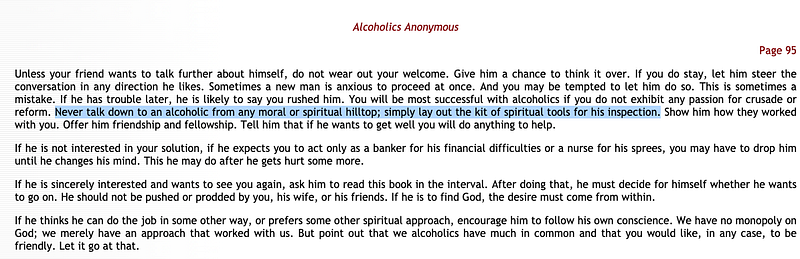
We are talking about the ones who sit on that spiritual hilltop that was referenced in the chapter Working With Others of the Big Book. These are people who have been on that hilltop for a very long time.
Elder Statesmen
Bill goes on to explain how balance was achieved in the ‘50s.
Happily most them survive and live to become elder statesmen. They become the real and enduring leadership of A.A. Theirs is the quiet opinion, the sure knowledge, and the humble example that resolves a crisis. When sorely perplexed, the group inevitably turns to them for advice. They become the voice of the group conscience. They are, in fact, the true voice of Alcoholics Anonymous. They do not drive by mandate; they lead by example. This is how Tradition Nine was evolved. This is why A.A. can never be organized under any known form of government.
In this passage, Bill’s words speak for themselves. No additions are necessary and I know you can imagine the leadership qualities described, regardless whether you are a person in recovery or not.
It appears as if the elder statesman is more outnumbered by the bleeding deacon than the early days, 12-step when success rates in AA were so unbelievably high.
The 12 steps didn’t get their center spot in the world of recovery for no reason. They have become the most accepted and encouraged recovery modality of all time because they worked.
If we take a look at the difference between then and now, it is clear where our error lies. The recovery community is overrun with bleeding deacons and the elder statesmen can only be found when searched for like a needle in a haystack.
There are too many bleeding deacons and not enough elder statesmen in the 12-step community today. From atop their spiritual hilltops, these bleeding deacons sow seeds of discord and shame.
Newcomers are treated as inferior and told if they don’t do what they are told by the old-timers, they will drink or use and surely die.

Relapsers are treated like newcomers and shamed for relapsing by being stripped of community trust and privilege — regardless of how long they had in continuous recovery before the relapse, what type of relapse it was, or the cause.
People who require medication, that their recovery communities senior members do not approve of, are suffering. They are committing suicide after quitting medication that they need for mental health issues and fatally overdosing after quitting replacement therapy drugs that could have saved their lives.
Bleeding deacons have robbed the program of its most vital ingredient — sponsorship. Over the years, they have created check lists and requirements that newcomers must satisfy before they are allowed to sponsor.
In many corners of the recovery community, they even require members to have a certain amount of time clean and in the program. This is of course based upon their version of what the program means. Some even ask for a year or years in the program before allowing members to sponsor.
This is despite the fact that the founder of the 12 steps was about to drink at 6 months sober, and only maintained his sobriety by picking up his first sponsee — Bob. That goes without mentioning the fact that Bob relapsed and neither Bill or Bob — who co-sponsored each other — got a new sponsor.
Wow, it sure is a good thing that Bill and Bob didn’t have a flock of bleeding deacons controlling their recovery life, for if they did the program would not even exist and they would have likely died drunk.
For the people in recovery today, there is a little bit of deacon in the best of us and a little bit of statesman in the worst of us.
Just like you told me that I wasn’t responsible for my addiction but I was responsible for my recovery, I will tell you this.
We are not responsible for this culture of bloody shame that cuts the life of our members — especially newcomers — off at the knees, but we are responsible for fixing it.
If the landscape of AA has been ravaged by bleeding deacons over decades, that is not on us. What is on us is what we do about it today.
For the people who are not in recovery and have never struggled with addiction, it is on you too. This is not a problem of solely people in recovery — this is a problem of our country and our world.
Countless lives are lost to addiction and alcoholism every year. The number of people suffering and the number of deaths is rising while the recovery rate declines.
At least 25 people in America, have died, of opioid overdose alone — just in the time it has taken me to write this piece — and around 2 or more people have fatally overdosed, in America alone, in the time it took you to read it.
This is all of our problem and it’s time we all started talking about it.
Written by Holly Kellums


