avatarMatt Williams-Spooner, Ph.D.

Free AI web copilot to create summaries, insights and extended knowledge, download it at here

4208

Abstract

In a unipolar world, liberal hegemony becomes possible. Liberal hegemony means that a hegemonic nation-state imposes liberalism on the world, or at least a sizeable chunk of it.</p><p id="99e4">Many argue that the world was bipolar during the Cold War, with different spheres of influence for the US and USSR. This is debatable, as the USSR was always poorer, weaker, and less technologically developed than the US.</p><p id="d843">In this period, the US also dominated global systems of trade and finance in ways that the USSR never did. Despite the power of the Soviets, the US had much greater influence, and acted like a hegemon. But however you see the Cold War, when the USSR dissolved in 1991, the US was undeniably a hegemon.</p><p id="2708">Throughout the post-WWII period, liberalism became a worldwide ideology. In some cases, the US even wrote liberal constitutions for its defeated enemies, <a href="http://spice.fsi.stanford.edu/docs/lessons_on_the_japanese_constitution">as happened to Japan</a>.</p><p id="d752">But, as we’ve seen since WWII, global liberalism has changed the justifications for war without reducing the frequency of war. In fact, the liberal hegemon itself, the US, <a href="https://english.cctv.com/2021/09/16/VIDElEWL3yNyXZgojPDjb8jI210916.shtml">has been at war for over 90% of its history</a>.</p><p id="9616">Liberal nations state that their interventions are to protect and expand the reach of human rights. We see this enshrined in the <a href="https://www.un.org/en/genocideprevention/about-responsibility-to-protect.shtml#:~:text=138.,through%20appropriate%20and%20necessary%20means.">UN’s principle of the ‘responsibility to protect’</a>. This is also currently the stated goal of US support for Ukraine against Russia.</p><h1 id="12ef">Which ‘isms’ have been most influential?</h1><p id="ac26">Mearsheimer argues that human history has been shaped more by realism and nationalism than liberalism. For example, to Mearsheimer, the broad tolerance of slavery and racism throughout history suggests that people are not intuitive liberals.</p><p id="77dc">This point is hard to argue with. There’s certainly no denying the history of slavery and racism. And as we’ve discussed in prior articles, the idea of innate, universal, individual human rights is <a href="https://readmedium.com/how-protestantism-and-bans-on-cousin-marriage-made-the-west-psychologically-weird-7660f59ebf6">familiar to the WEIRD world, but is unusual by historical standards</a>, and is not unanimously accepted even today.</p><p id="6e40">To be fair, notions of individualism and individual rights are not unique to the WEIRD world. For example, anthropologists and archaeologists have found evidence of this among various indigenous societies, such as the Native Americans of California. But nonetheless, it’s true that liberalism has been a minor force in history compared to realism and nationalism.</p><p id="bac7">Despite these trends, there was a brief moment at the end of the Cold War when many thought liberalism had won decisively. Francis Fukuyama famously argued that we had reached the end of history, as liberalism had settled all ideological battles once and for all, and wars would no longer be necessary.</p><figure id="4523"><img src="https://cdn-images-1.readmedium.com/v2/resize:fit:800/1*qBaw29WW3UfGpT_QJ44oWg.png"><figcaption>Publicly available at <a href="https://www.jstor.org/stable/24027184">JSTOR</a></figcaption></figure><p id="c701">With the benefit of hindsight, we see that Fukuyama’s predictions about the triumph of liberal democracy were deeply naive. Fukuyama’s vision for permanent peace through a liberal world order failed for many reasons, but a few stand out.</p><p id="bb7b">First, people will never fully agree on what constitutes a good life. As a result, there will always be potential sources of tension and conflict.</p><p id="26dd">Second, there are many historical grievances between groups. Fear of a liberal hegemon may temporarily hold these forces at bay. But if grievances are not addressed, they are likely to fuel new conflicts in the future.</p><p id="ff77">Third, liberalism fails to provide a group-based identity, whereas nationalism

Options

does. <a href="https://readmedium.com/ccbe-part-14-how-to-escape-the-tragedy-of-the-commons-and-benefit-society-7f6535219e75?source=friends_link&amp;sk=b7740ddf83f5f6c3bde60f6cbf0dce89">As we discussed last time</a>, membership in a group with a clear identity is essential to cooperation. This puts nationalism, and its ideological sibling, realism, at a major advantage compared to liberalism.</p><p id="b869">These points help to explain why nationalism and realism tend to prevail over liberalism, at least in the absence of a liberal hegemon.</p><h1 id="147d">Major evolutionary transitions</h1><p id="59e2">So, what does all of this point to? <a href="https://readmedium.com/ccbe-part-14-how-to-escape-the-tragedy-of-the-commons-and-benefit-society-7f6535219e75?source=friends_link&amp;sk=b7740ddf83f5f6c3bde60f6cbf0dce89">As we saw previously</a>, we can cooperate effectively at certain scales, like communities, businesses, schools, churches, or fishing grounds.</p><p id="dbca">We can also cooperate as a nation, but we mostly do this when we’re at war with another nation. Nationalism can be muzzled, but only by the threat of force from a liberal hegemon like the US. This isn’t much to crow about.</p><p id="ae80">Without an enemy to coalesce against, cooperation within and between nations seems to be a tall order. This speaks to the difficulty of coordinating at the highest levels of organisation.</p><p id="9b26">But as organisms, we and our biological cousins show that complex coordination can be done. What can we learn from our biology? Let’s return to the concept of <a href="https://readmedium.com/cooperation-competition-in-biology-and-evolution-part-3-2-3a3ebe65c0bd">major evolutionary transitions</a>.</p><figure id="505d"><img src="https://cdn-images-1.readmedium.com/v2/resize:fit:800/1*[email protected]"><figcaption>Different major evolutionary transitions from past to present. Image from <a href="https://commons.m.wikimedia.org/wiki/File:Major_Evolutionary_Transitions_digital.jpg">Wikimedia Commons</a></figcaption></figure><p id="c024">This occurs when lower-level units start to function collectively as a higher-level unit. Eukaryotes like us are one example, as the <a href="https://readmedium.com/cooperation-and-competition-in-biology-and-evolution-part-3-1-5db53c7d9fb8">union between a bacterium and archaeon gave rise to all complex life</a> on Earth (no offence to non-eukaryotes like bacteria).</p><p id="8e2f">In a certain sense, we need to have another major evolutionary transition. Except this time, the goal would be to function as a whole Earth, rather than different nations warring and jockeying for power.</p><p id="c472">But hold on. Doesn’t this sound like Fukuyama’s liberal utopianism? Can we really hope to function as a whole Earth? Aren’t we just doomed to fight because of the coordination problem?</p><p id="1c1a">After all, eukaryotes are a major achievement in cooperation, but <a href="https://readmedium.com/cooperation-competition-in-biology-and-evolution-part-3-2-3a3ebe65c0bd">they only evolved once in history</a>. And the ubiquity of cancer shows that <a href="https://readmedium.com/cooperation-and-competition-in-biology-and-evolution-part-10-new-ideas-about-causes-of-and-b2cef4bece2b">our cells can still go rogue and forsake the collective</a>. If the coordination problem is a tricky hurdle for nature itself, what hope do we have?</p><h1 id="4bfb">Next time</h1><p id="1b62">To address these questions, we’ll discuss a new project from evolutionary biologist, David Sloan Wilson. It’s called <a href="https://www.prosocial.world/">ProSocial World</a>, and its goal is to promote global cooperation by cultivating a whole Earth ethic.</p><p id="a73c">The goal is admittedly lofty. But their approach is based on the best evolutionary science we know, and they’re passionate about their work. It’s a heavy lift, but the world has been changed many times by just such people.</p><p id="b135">We’ll discuss ProSocial World and their work next time, when we’ll also bring the series to a close. We’ll try to synthesise what we’ve covered so far, and finish with some useful conclusions. Until then!</p></article></body>

IDEOLOGY AND INTERNATIONAL RELATIONS

CCBE – Part 15: How nationalism, realism, and liberalism shape world affairs

A brief introduction to the principles that govern cooperation and competition between nations

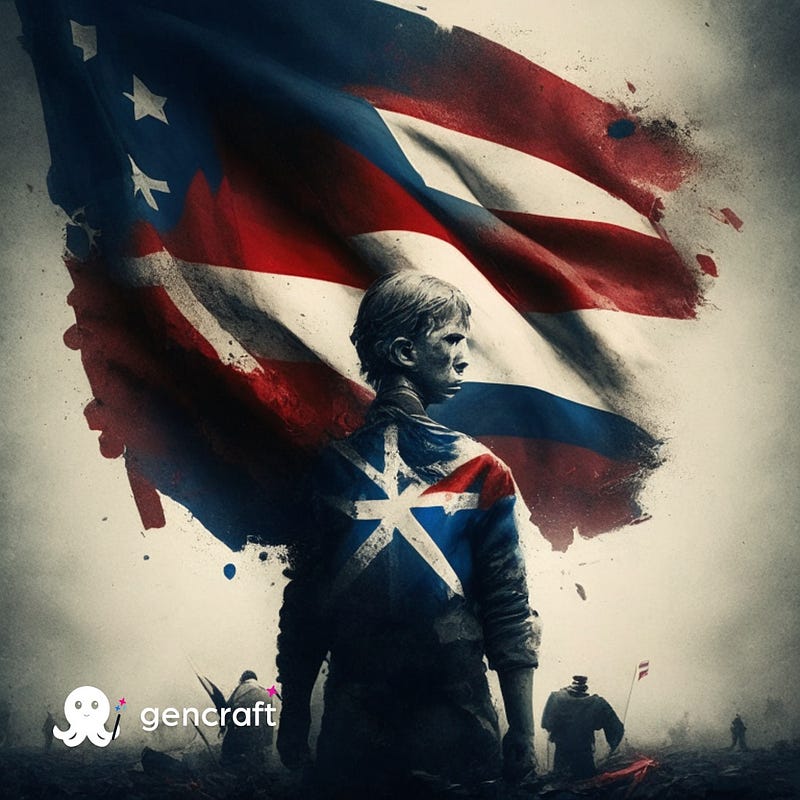
AI-generated images for ‘nationalism’ seem to be a mix between Saving Private Ryan and Captain America

Today, we’ll discuss three ‘isms’ that dominate world events. They are nationalism, realism, and liberalism.

We’ll briefly explain our three ‘isms’, and unpack what they teach us about cooperation and competition between and within nations.

To wrap up, we’ll connect back to evolution and biology, linking to the idea of major evolutionary transitions.

What are nationalism, realism, and liberalism?

Nationalism means to prioritise the interests of your nation. It’s a somewhat modern concept, as the history of nation-states is fairly short. But nationalism springs from a tendency towards tribalism that runs deep in human history.

Realism emphasises the roles of competition and conflict in international relations. It focuses on nation-states as the key actors that shape world affairs, and views security as their foremost concern.
AI-generated images for ‘political realism’ resemble a Graeco-Roman Cold War

To obtain security, nation-states are thought to pursue their own self-interest above all else. This perspective is closely related to the notion of realpolitik, and realism counts Machiavelli as one of its intellectual founders.

Liberalism can be difficult to encapsulate, as it means different things to its various advocates and critics. But highlighting core features will be enough for our purposes. Perhaps the most essential feature of liberalism is its insistence on innate, universal rights for individuals.

Due to this focus, liberalism is seen as a more cooperative philosophy than nationalism and realism. This is because nationalism and realism stress the roles of power and self-interest. They also neglect (or deny) innate and universal human rights, especially for enemies. Though in practice, liberal states do this as well.

AI-generated images for ‘liberalism’ are more confusing, and at least a little disturbing

When do the different ‘isms’ dominate?

John Mearsheimer is one of the world’s most influential and highly-regarded scholars on international relations. For example, he accurately predicted the war in Ukraine at a public lecture in 2015.

Mearsheimer points out that different ‘isms’ become dominant depending on the number of power centres around the world.

In multipolar worlds, realism tends to dominate. Societies may feign liberalism while practising realism. We see this when nations hypocritically condemn others for crimes that they themselves committed. This fairly closely describes the world order prior to WWII.

In a unipolar world, liberal hegemony becomes possible. Liberal hegemony means that a hegemonic nation-state imposes liberalism on the world, or at least a sizeable chunk of it.

Many argue that the world was bipolar during the Cold War, with different spheres of influence for the US and USSR. This is debatable, as the USSR was always poorer, weaker, and less technologically developed than the US.

In this period, the US also dominated global systems of trade and finance in ways that the USSR never did. Despite the power of the Soviets, the US had much greater influence, and acted like a hegemon. But however you see the Cold War, when the USSR dissolved in 1991, the US was undeniably a hegemon.

Throughout the post-WWII period, liberalism became a worldwide ideology. In some cases, the US even wrote liberal constitutions for its defeated enemies, as happened to Japan.

But, as we’ve seen since WWII, global liberalism has changed the justifications for war without reducing the frequency of war. In fact, the liberal hegemon itself, the US, has been at war for over 90% of its history.

Liberal nations state that their interventions are to protect and expand the reach of human rights. We see this enshrined in the UN’s principle of the ‘responsibility to protect’. This is also currently the stated goal of US support for Ukraine against Russia.

Which ‘isms’ have been most influential?

Mearsheimer argues that human history has been shaped more by realism and nationalism than liberalism. For example, to Mearsheimer, the broad tolerance of slavery and racism throughout history suggests that people are not intuitive liberals.

This point is hard to argue with. There’s certainly no denying the history of slavery and racism. And as we’ve discussed in prior articles, the idea of innate, universal, individual human rights is familiar to the WEIRD world, but is unusual by historical standards, and is not unanimously accepted even today.

To be fair, notions of individualism and individual rights are not unique to the WEIRD world. For example, anthropologists and archaeologists have found evidence of this among various indigenous societies, such as the Native Americans of California. But nonetheless, it’s true that liberalism has been a minor force in history compared to realism and nationalism.

Despite these trends, there was a brief moment at the end of the Cold War when many thought liberalism had won decisively. Francis Fukuyama famously argued that we had reached the end of history, as liberalism had settled all ideological battles once and for all, and wars would no longer be necessary.
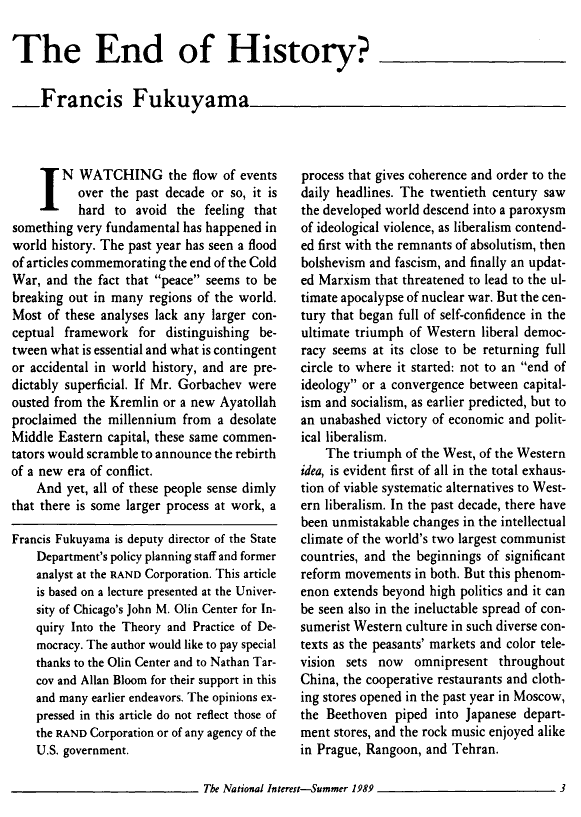
Publicly available at JSTOR

With the benefit of hindsight, we see that Fukuyama’s predictions about the triumph of liberal democracy were deeply naive. Fukuyama’s vision for permanent peace through a liberal world order failed for many reasons, but a few stand out.

First, people will never fully agree on what constitutes a good life. As a result, there will always be potential sources of tension and conflict.

Second, there are many historical grievances between groups. Fear of a liberal hegemon may temporarily hold these forces at bay. But if grievances are not addressed, they are likely to fuel new conflicts in the future.

Third, liberalism fails to provide a group-based identity, whereas nationalism does. As we discussed last time, membership in a group with a clear identity is essential to cooperation. This puts nationalism, and its ideological sibling, realism, at a major advantage compared to liberalism.

These points help to explain why nationalism and realism tend to prevail over liberalism, at least in the absence of a liberal hegemon.

Major evolutionary transitions

So, what does all of this point to? As we saw previously, we can cooperate effectively at certain scales, like communities, businesses, schools, churches, or fishing grounds.

We can also cooperate as a nation, but we mostly do this when we’re at war with another nation. Nationalism can be muzzled, but only by the threat of force from a liberal hegemon like the US. This isn’t much to crow about.

Without an enemy to coalesce against, cooperation within and between nations seems to be a tall order. This speaks to the difficulty of coordinating at the highest levels of organisation.

But as organisms, we and our biological cousins show that complex coordination can be done. What can we learn from our biology? Let’s return to the concept of major evolutionary transitions.
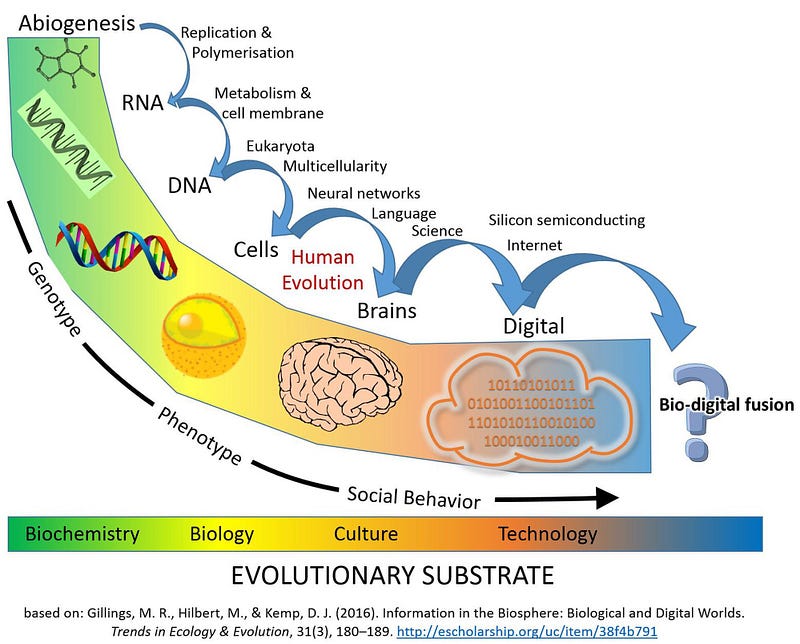
Different major evolutionary transitions from past to present. Image from Wikimedia Commons

This occurs when lower-level units start to function collectively as a higher-level unit. Eukaryotes like us are one example, as the union between a bacterium and archaeon gave rise to all complex life on Earth (no offence to non-eukaryotes like bacteria).

In a certain sense, we need to have another major evolutionary transition. Except this time, the goal would be to function as a whole Earth, rather than different nations warring and jockeying for power.

But hold on. Doesn’t this sound like Fukuyama’s liberal utopianism? Can we really hope to function as a whole Earth? Aren’t we just doomed to fight because of the coordination problem?

After all, eukaryotes are a major achievement in cooperation, but they only evolved once in history. And the ubiquity of cancer shows that our cells can still go rogue and forsake the collective. If the coordination problem is a tricky hurdle for nature itself, what hope do we have?

Next time

To address these questions, we’ll discuss a new project from evolutionary biologist, David Sloan Wilson. It’s called ProSocial World, and its goal is to promote global cooperation by cultivating a whole Earth ethic.

The goal is admittedly lofty. But their approach is based on the best evolutionary science we know, and they’re passionate about their work. It’s a heavy lift, but the world has been changed many times by just such people.

We’ll discuss ProSocial World and their work next time, when we’ll also bring the series to a close. We’ll try to synthesise what we’ve covered so far, and finish with some useful conclusions. Until then!

Politics
International Relations
Science
History
Society
Recommended from ReadMedium