avatarMatt Williams-Spooner, Ph.D.

Free AI web copilot to create summaries, insights and extended knowledge, download it at here

3968

Abstract

ng%2C%20no%20mitotic,its%20separation%20in%20M%20phase">The technical name is mitosis, and it’s a eukaryotic thing that’s different from the process of bacterial replication.</a> But in multicellular organisms like us, which spread our genes through sex, mitosis only propagates genes within the organism.</p><h1 id="c8b9">Multicellularity is a triumph of biological cooperation</h1><p id="8080">This means that the vast majority of our cells never get the opportunity to give their genetic material to future generations. They live, work, and die for the good of the cellular collective, like ants for their nests and bees for their hives.</p><p id="35ee">There are even molecular ‘programs’ that command compromised cells to commit suicide for the benefit of the organism as a whole, known as apoptosis. (We’ll cover this properly in the future, but for now we should caution to be wary of <a href="https://www.youtube.com/watch?v=JFgFjdCo2Js&amp;t=182s">the metaphors we live by</a>, especially <a href="https://youtu.be/qmyfQY4TaVc">the computer metaphors</a> in biology.)</p><figure id="c99e"><img src="https://cdn-images-1.readmedium.com/v2/resize:fit:800/0*8lOD59SLEqpeUJIu.png"><figcaption>Diagram illustrating a healthy cell (left) compared with a cell undergoing programmed cell death (apoptosis, right). A cell is broken down into chunks, hilariously known as ‘blebs’. The blebs are then consumed by a type of clean-up cell known as macrophages, part of the immune system. Image from <a href="https://upload.wikimedia.org/wikipedia/commons/thumb/1/1f/Apoptosis-blank.png/629px-Apoptosis-blank.png">Wikimedia Commons</a></figcaption></figure><p id="d1e1">You could question this as an example of cooperation. After all, the egg or sperm cell has the same DNA as the other cells of their host organism. Since that’s the case, are cells that don’t get to participate in reproduction really missing out on anything from an evolutionary standpoint?</p><p id="edab">True, from our perspective we can see the equivalence, but we’re in a position of knowledge that’s far beyond the reach of any cell. Given that individual cells aren’t even sentient, they can’t appreciate that the egg or sperm cells of their host are basically taking care of reproduction for the whole team. In that light, the willingness of most of our cells to live, work and die for their host organism, without directly passing any genes of their own to future generations, is a profound achievement in biological cooperation.</p><p id="84a4">As an interesting side point, cells in the adult human brain don’t divide (known as being ‘post-mitotic’), which can leave the brain more vulnerable to long-term damage than other organs of the body. We won’t talk more about brain damage in this series, but we will cover research on brain damage and rehabilitation in the future.</p><h1 id="032c">The yin and yang of cooperation and competition in biology and evolution</h1><p id="8502">All in all, it seems like a big win for cooperation, but competition is never far away. For example, given the potential benefits, you may expect that other bacteria and archaea soon joined the party with endosymbioses of their own. This is partly true in the case of plants and certain algae, which use water, carbon, and sunlight in photosynthesis to produce sugars, ATP, fats, and the building blocks of proteins (‘amino acids’).</p><p id="dc5b">The ancestors of plants and algae developed this ability when they ingested a second type of bacterium, now known as chloroplasts, which are the engines of photosynthesis.</p><p id="dc25">Perhaps unsurprisingly, given their shared bacterial heritage, there are similarities and differences between the chloroplasts and mitochondria, as we’ll see next time when we talk about cellular respiration.</p><p id="8eb0">But eukaryotes gaining a new type of bacterium as a different organelle isn’t quite what we’re asking about. Sure, plants and algae managed to gobble

Options

up a second bacterium and use it as a clever new organelle, but they were already eukaryotes.</p><p id="e230">What about new partnerships between archaea and bacteria? Are there multiple eukaryotic family trees from different, independent endosymbioses between archaea and bacteria? Strangely, despite the benefits on offer, the answer seems to be no.</p><figure id="6cac"><img src="https://cdn-images-1.readmedium.com/v2/resize:fit:800/0*-C-XUn13ecDsOzxJ.png"><figcaption>The union between a bacterium and an archaeon gave birth to the eukaryotes. Humans aren’t specifically mentioned, but we would occupy part of the animal branch of the eukaryotic tree. Some time later, the union between a eukaryote with a second bacterium, now known as chloroplasts, gave rise to plants and algae. Source: <a href="https://upload.wikimedia.org/wikipedia/commons/thumb/0/04/Fpls-02-00028-g011.png/664px-Fpls-02-00028-g011.png">Wikimedia Commons</a></figcaption></figure><p id="4133">As Nick Lane discusses in <i>Power, Sex and Suicide</i>, the eukaryotic merger appears to have only happened once. Whatever conditions enabled the birth of the eukaryotes, they must be extremely rare. This seems to suggest that, although the potential benefits of cooperation are enormous, competition (or at least noncooperation) is a much stronger tendency in biology and evolution.</p><p id="1bc8">In keeping with that idea, it may come as no surprise that, despite their many successes as a team, tensions remain between eukaryotes and their mitochondria. For instance, a type of signal from mitochondria plays an important role in the biological message to trigger cell death. This signal involves what are called ‘free radicals’, large amounts of which tell the cell that it’s time to commit suicide.</p><h1 id="e24b">Next time</h1><p id="e89d">This means that mitochondria are the secret to eukaryotic life and also a potential noose around its neck. But what happens if the cell is told to commit suicide and says no? We’ll pick this up <a href="https://readmedium.com/cooperation-and-competition-in-biology-and-evolution-part-6-mitochondria-metabolism-and-oxygen-56863b61c6b6">next time</a> when we talk about metabolism, cellular respiration (the cell’s equivalent of breathing), the history of oxygen on Earth, free radicals, and what all this has to do with cancer.</p><figure id="2ba2"><img src="https://cdn-images-1.readmedium.com/v2/resize:fit:800/1*vHpfoQAaRUGw276euNpwtw.png"><figcaption>Diagram of a free radical, image from <a href="https://upload.wikimedia.org/wikipedia/commons/3/3f/Free-radicals-oxygen.jpg">Wikimedia Commons</a></figcaption></figure><h1 id="245b">Bonus: why plants are green and we could be purple</h1><p id="eeff">For the fans of obscure facts, here’s something cool and weird that most people probably don’t know: the bacterial ancestor of our mitochondria was purple, as are our mitochondria today. In fact, if you could remove the other pigments from our bodies, we would be purple because of our mitochondria.</p><p id="66e6">Even more, because our mitochondria actually change colour depending on their level of activity, we would change colour as we exerted ourselves. Our colour would give some indication as to our energetic state, like a biological mood ring for your metabolic status.</p><p id="d875">How about plants? Why are they green? Because they evolved thanks to endosymbiosis with a second bacterium, now known as chloroplasts, and that second bacterium was green. Billions of years later, chloroplasts remain green today, and give green plants their colour.</p><p id="3852">As eukaryotes like us, if you removed their other sources of colour, like the chloroplasts, green plants would also be purple because of their mitochondria, and change colour based on exertion. But that’s only a thought experiment, as removing those other sources of colour would quickly kill eukaryotes like us and plants. Thanks for reading!</p></article></body>

BIOLOGY, ENERGY, AND EVOLUTION

Mitochondria, evolution, and the invention of sex

How bioenergetics help to explain the evolution of complex life and the invention of sex
The invention of sex introduced new forms of cellular and genetic cooperation in the race to survive. Image made using Gencraft

Recap

When a bacterium found itself inside an archaeon around 2 or so billion years ago, they struck up a partnership that gave birth to the third domain of life: the eukaryotes. This is at least a little ironic, since it probably happened because the archaeon originally wanted to ‘eat’ the bacterium and/or the bacterium was trying to infect the archaeon.

Even though their relationship may have started on the rocks, they turned out to be a great team, exemplifying a type of cooperation known as a major evolutionary transition.

This occurs when lower-level units, like bacteria and archaea, shift from a competitive or neutral dynamic to a cooperative dynamic. This shift then allows the lower-level units to function collectively as a higher-level unit, as happened in the birth of the eukaryotes.

In turn, this enabled life to break free of the constraints that still keep prokaryotes small and (mostly) unicellular to this day — and the cooperative achievements of the eukaryotes didn’t stop there.

Today

As we’ll discuss today, different sexes also emerged for the first time in the eukaryotes. And when you consider some of the underlying biology, the implications for cooperation are pretty impressive.

A brief overview of genetic inheritance

As French biologist Francois Jacob put it, “The dream of every cell is to become two cells.” At least part of the idea is meant to be that a cell which replicates itself is doing good evolutionary work by spreading its genes to the next generation of the species. But we don’t spread genetic material between generations by replicating.
Illustrating how prokaryotic cells multiply through replication. Image made using the AI-based image generator, Gencraft

Instead, we combine the DNA of two different people to create a new person. Children receive their DNA packaged in 23 pairs of chromosomes, with one set of 23 chromosomes from each parent. The DNA from each parent is a random blend of the DNA that they got from their parents, which was a random blend of the DNA they got from their parents, and so on.

When we’re born, that means our parents actually provide us with a mix of our grandparents’ DNA. There’s a strong element of chance in this shuffling of the genetic deck, which helps to explain why traits can persist across multiple generations or disappear and then reappear in later generations. Our bodies are made of around 30–40 trillion cells, and only one type is allowed to pass genetic material to our offspring: eggs in women and sperm in men.

In fairness, many cells will propagate their genes during the normal process of cell division. The technical name is mitosis, and it’s a eukaryotic thing that’s different from the process of bacterial replication. But in multicellular organisms like us, which spread our genes through sex, mitosis only propagates genes within the organism.

Multicellularity is a triumph of biological cooperation

This means that the vast majority of our cells never get the opportunity to give their genetic material to future generations. They live, work, and die for the good of the cellular collective, like ants for their nests and bees for their hives.

There are even molecular ‘programs’ that command compromised cells to commit suicide for the benefit of the organism as a whole, known as apoptosis. (We’ll cover this properly in the future, but for now we should caution to be wary of the metaphors we live by, especially the computer metaphors in biology.)
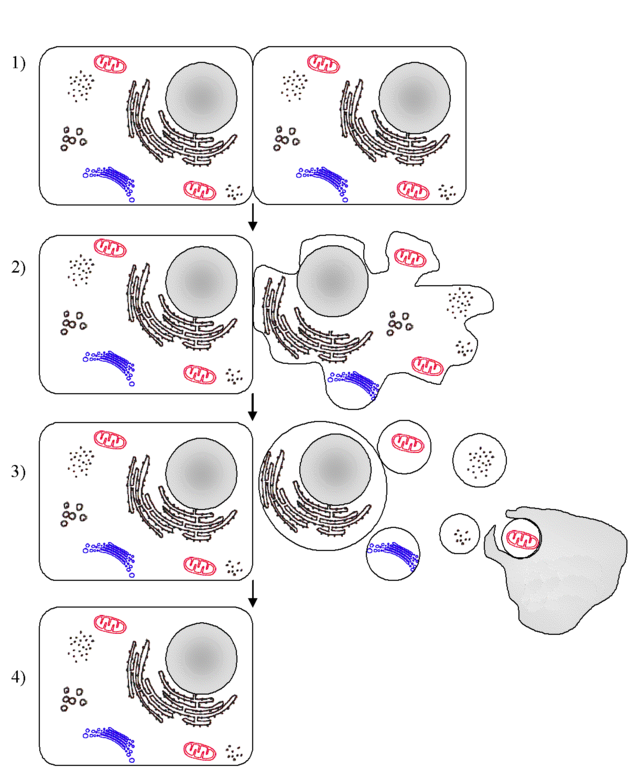
Diagram illustrating a healthy cell (left) compared with a cell undergoing programmed cell death (apoptosis, right). A cell is broken down into chunks, hilariously known as ‘blebs’. The blebs are then consumed by a type of clean-up cell known as macrophages, part of the immune system. Image from Wikimedia Commons

You could question this as an example of cooperation. After all, the egg or sperm cell has the same DNA as the other cells of their host organism. Since that’s the case, are cells that don’t get to participate in reproduction really missing out on anything from an evolutionary standpoint?

True, from our perspective we can see the equivalence, but we’re in a position of knowledge that’s far beyond the reach of any cell. Given that individual cells aren’t even sentient, they can’t appreciate that the egg or sperm cells of their host are basically taking care of reproduction for the whole team. In that light, the willingness of most of our cells to live, work and die for their host organism, without directly passing any genes of their own to future generations, is a profound achievement in biological cooperation.

As an interesting side point, cells in the adult human brain don’t divide (known as being ‘post-mitotic’), which can leave the brain more vulnerable to long-term damage than other organs of the body. We won’t talk more about brain damage in this series, but we will cover research on brain damage and rehabilitation in the future.

The yin and yang of cooperation and competition in biology and evolution

All in all, it seems like a big win for cooperation, but competition is never far away. For example, given the potential benefits, you may expect that other bacteria and archaea soon joined the party with endosymbioses of their own. This is partly true in the case of plants and certain algae, which use water, carbon, and sunlight in photosynthesis to produce sugars, ATP, fats, and the building blocks of proteins (‘amino acids’).

The ancestors of plants and algae developed this ability when they ingested a second type of bacterium, now known as chloroplasts, which are the engines of photosynthesis.

Perhaps unsurprisingly, given their shared bacterial heritage, there are similarities and differences between the chloroplasts and mitochondria, as we’ll see next time when we talk about cellular respiration.

But eukaryotes gaining a new type of bacterium as a different organelle isn’t quite what we’re asking about. Sure, plants and algae managed to gobble up a second bacterium and use it as a clever new organelle, but they were already eukaryotes.

What about new partnerships between archaea and bacteria? Are there multiple eukaryotic family trees from different, independent endosymbioses between archaea and bacteria? Strangely, despite the benefits on offer, the answer seems to be no.
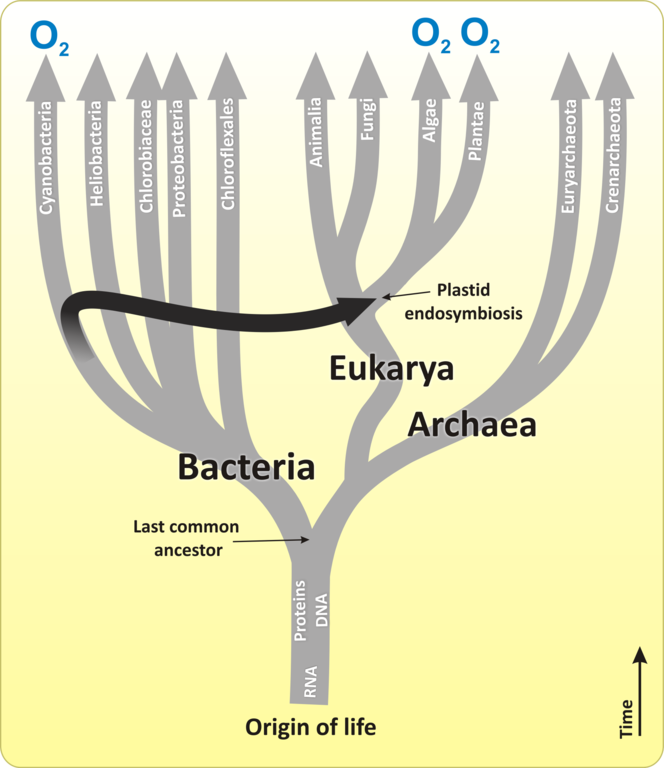
The union between a bacterium and an archaeon gave birth to the eukaryotes. Humans aren’t specifically mentioned, but we would occupy part of the animal branch of the eukaryotic tree. Some time later, the union between a eukaryote with a second bacterium, now known as chloroplasts, gave rise to plants and algae. Source: Wikimedia Commons

As Nick Lane discusses in Power, Sex and Suicide, the eukaryotic merger appears to have only happened once. Whatever conditions enabled the birth of the eukaryotes, they must be extremely rare. This seems to suggest that, although the potential benefits of cooperation are enormous, competition (or at least noncooperation) is a much stronger tendency in biology and evolution.

In keeping with that idea, it may come as no surprise that, despite their many successes as a team, tensions remain between eukaryotes and their mitochondria. For instance, a type of signal from mitochondria plays an important role in the biological message to trigger cell death. This signal involves what are called ‘free radicals’, large amounts of which tell the cell that it’s time to commit suicide.

Next time

This means that mitochondria are the secret to eukaryotic life and also a potential noose around its neck. But what happens if the cell is told to commit suicide and says no? We’ll pick this up next time when we talk about metabolism, cellular respiration (the cell’s equivalent of breathing), the history of oxygen on Earth, free radicals, and what all this has to do with cancer.
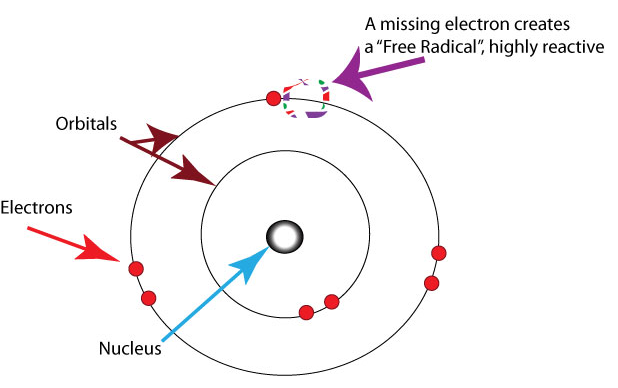
Diagram of a free radical, image from Wikimedia Commons

Bonus: why plants are green and we could be purple

For the fans of obscure facts, here’s something cool and weird that most people probably don’t know: the bacterial ancestor of our mitochondria was purple, as are our mitochondria today. In fact, if you could remove the other pigments from our bodies, we would be purple because of our mitochondria.

Even more, because our mitochondria actually change colour depending on their level of activity, we would change colour as we exerted ourselves. Our colour would give some indication as to our energetic state, like a biological mood ring for your metabolic status.

How about plants? Why are they green? Because they evolved thanks to endosymbiosis with a second bacterium, now known as chloroplasts, and that second bacterium was green. Billions of years later, chloroplasts remain green today, and give green plants their colour.

As eukaryotes like us, if you removed their other sources of colour, like the chloroplasts, green plants would also be purple because of their mitochondria, and change colour based on exertion. But that’s only a thought experiment, as removing those other sources of colour would quickly kill eukaryotes like us and plants. Thanks for reading!

Science
Energy
Biology
Evolution
Life
Recommended from ReadMedium