
The 15 Greatest Human Innovations in All of History
No innovations or inventions in human history have been more important than these fifteen

Humans are great innovators which is why we are great inventors, and every invention and innovation we come up with is greatly important for human advancement — no matter how big or small. But some are so profound that they change everything — normally because they lead to an explosion of further inventions and innovations.
Here are the fifteen inventions and innovations that have changed the world more than any other.
15. Evidence-based medicine

The medical advancements of the 1800s were such that the United Kingdom went from a population of 4 million at the beginning to a population of 40 million by the end. That’s a tenfold increase in just one hundred years.
The vast majority of that increase was born from the fact that medical practitioners had worked out how to stop children from dying with such ridiculous frequency — so the Victorians were not having more children than their ancestors, they were actually having less, it was just the children they were having were no longer dying in such numbers. The historical child mortality rate before the year 1800 was 45% — that means one out of every two children born died before reaching adulthood.
Despite these great advances in medicine, in the year 1900, a lot of people were still dying from disease and illness, and the child mortality rate was still high — 13%, so over one in ten children born did not make it to adulthood. The reason was despite the advancements, medicine was still pretty much a quack game. It lacked a real evidence-based approach.
All of that was changed by a Boston doctor named Ernest Amery Codman, who in the early 1900s proposed something called the End Result System. His system was designed solely to record the clinical consequences of a doctor’s efforts i.e. did the treatment given by the doctor work — think the way the coronavirus vaccines were tested, before they were released for wider use, the vaccine makers had to prove that the vaccines worked i.e. prove their efficacy. In the past, doctors did not have to prove anything.
At first, there was a big push back by the medical society against this system, but eventually, due to the public big style siding with Codman, the essence of his ideas were adopted in hospitals all around the globe and by the medical world in general. More than that, his evidence-based approach has revolutionised every single industry on the planet, even sports use the essence of the approach to improve player performance.
All in all, the formation of evidence-based medicine is one of the greatest innovations in human history, not only because it revolutionised countless other industries, but because it has saved more lives than any other innovation ever.
14. The programmable computer

English mathematician and inventor Charles Babbage is the man credited with inventing the first automatic digital computer. Proposed in the 1830s, it was called the Analytical Engine. It was born out of a previous invention of his called the Difference Engine — a mechanical computer designed to aid navigational communications.
However, due to funding issues, the Analytical Engine was never completed, and it would take until 1936 when Alan Turing proposed the Universal Computing Machine — now known as the Universal Turing Machine — for computer technology to properly take hold.
The machine helped the Allies win World War II. What followed was the Manchester Baby — the world’s first stored-program computer. It was built by Frederic C. Williams, Tom Kilburn, and Geoff Tootill at the University of Manchester, England, in 1948. With its invention and proof of concept, the computing revolution was born which to date has brought us to the point of having a computer that fits in our pockets i.e. smartphones.
The profound world-changing benefits of the invention of computers are so profound, that it is indisputable that they are one of the most important and world-changing innovations in human history.
13. The Telegraph

What is it that connects all of us to each other? Phone lines. And where did the phone line system originate? The Telegraph system. Telephones, the Internet, instant messaging, all of our modern communication systems, are basically just advancements of the Telegraph. That’s why when in the 1830s/1840s Samuel Morse invented the Telegraph, he laid the foundations for a technological and societal revolution.
The more people can communicate with each other, the more they are able to hear of any wrongs going on in the world and call them out, more than that, the more they are able to get enough support from enough people to be able to stop those wrongs and bring about change.
The human race grows through the sharing of knowledge, the more of us who share knowledge and the more of us who can digest the knowledge that people share, the faster the rate that all of us can grow.
So the invention of the Telegraph — which eventually led to the invention of the telephone by Alexander Graham Bell in 1885, and the invention of the World Wide Web by Sir Tim Berners-Lee — not only laid the foundations for an explosion in freedoms and the democratisation of our societies, not only gave us a greater ability to call out wrongs and stop those wrongs, not only gave us the ability to better promote change for the better, but it also laid the foundations for an explosion in technological advancements — because more people were able to share what they knew with each other. And sharing what you know is one of the greatest tools for advancement there is.
That’s what makes the Telegraph one of the most important inventions in human history, because it laid the foundations for a world in which we can all share what we know — with everyone.
12. Electricity

Prior to the work of English scientist William Gilbert in 1600, electricity was nothing more than a curiosity to the intellectuals of the world, who wondered what caused electric eels to shock them and what caused lightning. But when Gilbert published De Magnete — which contained the results of his studies into electricity and magnetism — the foundations for a technological revolution were laid.
Over the next couple of centuries, many would further contribute to the advancement of the knowledge of electricity and magnetism — Otto von Guericke, Robert Boyle, Stephen Gray, and C. F. du Fay along with Benjamin Franklin being the most notable names.
It was Joseph Swan along with Nikolai Tesla, and Thomas Edison that truly laid the foundations for the world in which we all now live i.e. a one powered by electricity. Joseph Swan was responsible for developing and supplying the first incandescent lights used to illuminate homes and public buildings — in 1880 his house, Underhill, Low Fell, Gateshead, England, was the world’s first to have working light bulbs installed. Thomas Edison created the DC current, while Nikolai Tesla laid the foundation for the AC current which largely powers the world today.
All in all, the three of them along with many many more laid the foundations for a world powered by electricity. And just to emphasise how important their innovative work was for the modern world, imagine all the power got switched off.
That’s why electricity is one of the most important innovations in human history.
11. The steam-powered engine
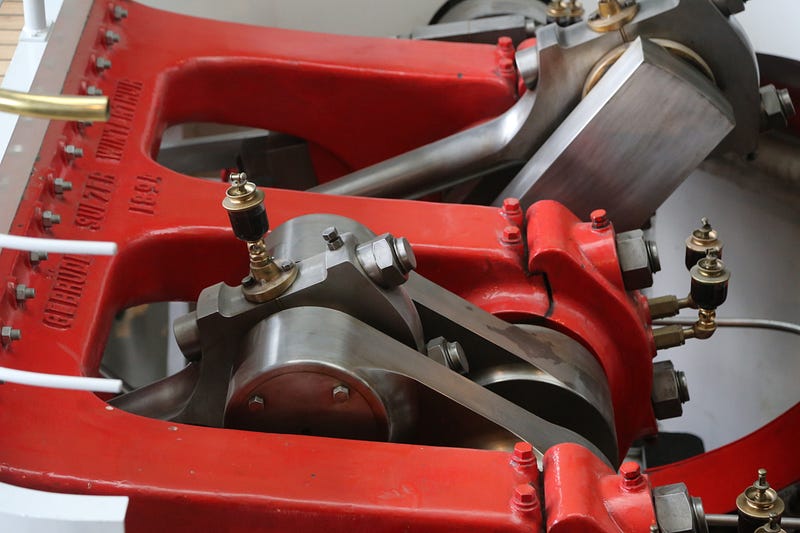
The first steam-powered “engine” was described back in 50/70 A.D. by a Greek mathematician and engineer by the name of Hero of Alexandria. It was called the aeolipile and was pretty much useless as anything other than a proof of concept.
It would take close to a further two thousand years for somebody to come up with a functional steam engine that was actually useful, and the mining industry was the spark for that creation. In 1712 Englishman Thomas Newcomen created the first commercially viable piston steam engine, its purpose was to drain mines of water and to provide reusable water for water wheels at factories.
With proof that the steam-powered engine was a viable proposition, the foundations were laid for the industrial revolution that would change the world so many times over it is crazy.
To truly understand just how important the invention of the steam-powered engine was, just think about how many things are powered by engines and then imagine we did not have those engines.
That’s why the steam-powered engine is one of the most important innovations in human history.
10. Smelting

The first known mine in human history is believed to have been in southern Africa between 20,000 40,000 years ago. It was a coal mine. The problem was, there was nothing the people back then could do with that coal other than use it as fuel for a fire to keep warm or to cook food with.
That was more than what they could do with other mined minerals, for example, the only metals available were those found in an already metallic state — copper was the most abundant — even then they could not mould those metallic metals into anything useful. Imagine finding a lump of copper or iron ore, but not being able to manipulate its shape or structure. That was how things were.
That was until the Egyptians and Sumerians came along and worked out how to smelt gold and silver around 4000 BC. The profoundness of this innovation is immense. For the first time in history, gold and silver could be traded because they could be moulded into something useful.
Over time, people began to mine other minerals, from bronze to tin, to iron ore. This led to the creation of the mining industry, and the mining industry is what laid the foundations for the entire modern world i.e we dig something up, we turn it into something useful, then we build something with it.
Without the discovery of smelting, we could not do that. Meaning smelting is arguably what even laid the foundation for modern chemistry i.e. because it taught us that we could manipulate minerals and turn them into other things.
That’s why smelting is one of the most important innovations in human history.
9. Boats

Nobody knows when boats were invented, the oldest known boat was found in the Netherlands — constructed sometime between 8200 and 7600 BC, it was a dugout made from the hollowed tree trunk of a Pinus sylvestris.
Also, somehow humans managed to cross the ocean and get to Australia sometime around 40,000 and 60,000 years ago. It was most likely that boats were used rather than some land bridge appearing that we don’t yet know of, but nobody can say for certain.
Whenever they were invented, the foundations for world change were laid because what is the world without boats? Flat, because without boats when you reached the ocean the horizon was the end of the world. That means without boats, none of the continents of Earth would ever have been “discovered.”
Also, without boats, there would be no fishing industry, and without a fishing industry, we would lack a vital food source that has played an immense part in our advancement — farming provides food, so does fishing. That extra source of food provides an extra level of food security.
It is not just discovering continents and securing a new source of food security that the invention of boats brought about. The most important benefit boats brought us was the ability to transport and trade goods with the world.
Think about how the majority of traded goods get transported today. On boats. That reason along with the other said reasons is why boats are one of the most important innovations in human history.
8. Roads

You don’t need roads to walk places, nor do you need roads to use a horse, but you do need roads if you wish to transport heavy goods any distance. Could you imagine the world we live in being able to function if you could not transport heavy goods any distance?
The first paved roads are believed to have been constructed back in 4000 BC by the Babylonians as a means to make it easier to manoeuvre their sleds through towns. The sleds were not the moving over snow kind, they were the kind that people used to transport goods over land before the invention of the wheel.
Though it was the Romans who laid the foundation for the modern world road system, creating relatively smooth surfaces which their chariots could swiftly move over, giving their armies the ability to transverse more quickly throughout the Empire. But also giving their traders the ability to trade with greater frequency throughout the Empire.
It is that ability to trade more goods over increasing distances and to move more quickly between locations that make roads so important. Basically, roads make the world a much smaller and more interconnected place. That’s why they are one of the most important in human history.
7. The wheel

The wheel was first invented around 4500 BC, before its invention the way humans moved things around was by dragging them on sleds. That made transportation of food and other goods extremely difficult.
The wheel changed that. It’s believed that the first wheels were simply logs that were attached beneath sleds, but eventually people realised that wheels with axles were a much smarter option.
The invention of the wheel allowed for the creation of carts which made transportation of foods and goods much easier. By making the transportation of those foods and goods easier, it made it easier for tribes to trade with each other, it also made surviving a little bit easier. Every time surviving gets made easier through innovation good things happen for humans.
The wheel also laid the foundations for things like the Windmill, the waterwheel, clocks, gear systems, the steam and combustion engines, so so much more.
This is why the wheel is hands down one of the most important inventions in the entirety of human history.
6. Agriculture a.k.a. farming

One of the biggest factors holding back all animals in the animal kingdom is how much time they have to spend looking for food and water. Literally, animals in the animal kingdom spend all their time and effort looking for food and water.
In approximately 9500 BC, at different places independently across the globe, for one species that changed. Humans discovered agriculture a.k.a. farming. Farming made food more accessible, it also made access to it more reliable.
It did two other things else as well, firstly, it allowed a greater expansion in the division of labour — fewer people are needed to work a farm than are needed to source food other ways, so farming is less labour intensive than other ways of sourcing food like foraging and hunting.
This means a tribe could get enough food using fewer people allowing others in the tribe to focus on other things — for example, some could specialise in farming, some could specialise in the protection of the tribe, some could specialise in the building of shelter, some could specialise in teaching the young et cetera et cetera et cetera.
Secondly, it gave people more free time — hunting and foraging for food used to be a year-long task, farming is not, once the harvest is done, people are able to divert their attention to other things over the winter before getting ready in the spring to start the process of working the fields again.
Without the invention of agriculture, none of us would ever have been able to specialise in anything other than foraging for food and water, and so none of us would ever have found the time to create any of the innovations that we now have.
That, along with so many other reasons it is crazy, is why agriculture is one of the greatest innovations in human history
5. Fire

Nobody knows when we first learned to control fire, some claim a few hundred thousand years ago, some claim as far back as two million years ago. Whenever we did manage to master the control of fire, those who invented the methods for doing so laid the foundations for everything we have become.
The mastering of fire allowed us to change our diets for the better, it allowed us to improve our hunting methods, it allowed us to keep warm when it was cold, it allowed us to better protect ourselves from predators, it also gave us the ability to function at night.
That means the mastering of fire made surviving a lot easier. To top it all off, we had more free time because we were able to function at night. Meaning fire improved our health, improved our productivity, made us more powerful due to the improvement in weapons, and gave us more free time. It also laid the foundations for everything we have in society today — without a mastery of fire we could not have invented any of the technology that we now have.
Needless to say, that is why the tools to manipulate and control fire are one of the greatest inventions in the entirety of human history.
4. Mathematics

It is said that mathematics is the language of the universe, and it’s not hard to see why. Without mathematics, it would be virtually impossible for us to learn anything about the universe or to invent any form of real technology.
The Pythagoreans coined the term “mathematics” back in the 6th century BC and were the first people to treat maths as a demonstrator discipline, though it was the Greeks and the Romans who really laid the foundations for mathematics as a tool for advancement. The Greeks through their advancements in theoretical mathematics, the Romans through their practical use of mathematics for engineering and surveying amongst other things.
Virtually everything in this world has maths at its heart. It allowed for the creation of physics. It allowed Einstein to propose the theory of relativity. It allowed Isaac Newton to invent calculus. It allowed Charles Babbage to invent the computer. It even allowed William Playfair, a Scottish engineer, to invent graphical statistics — so the line graph, the bar chart, the pie chart, even timelines. Yes, charts are an invention. Crazy, I know.
Hell, mathematics even allowed for the invention of money — how can you manage an economy unless you have maths to work out how much everything should cost. Meaning we have mathematics to thank for the invention of our economies and every single finance-based institution ever created.
All in all, Mathematics is single-handedly one of the most important human innovations of all time, without its invention the world as we know it simply could never have been created.
3. The written word

How do you pass on knowledge: you write it down. Imagine if you could not write down that knowledge so that it could be passed on, the only way it could be passed on would be through word-of-mouth.
If the only way for knowledge to be passed on was through word-of-mouth, then we would still all be living like cavemen. Literally, the written word gives us the ability to write down our thoughts and then share those thoughts with large numbers of other people, both in the present and in the future.
Two people write down their thoughts and their discoveries, another person reads those thoughts, makes their own conclusions, and writes those conclusions down. Other people read them and on and on it goes, creating innovation after innovation after innovation.
The creation of the written word supercharged the ability to retain and pass on knowledge, and the more we are able to retain and pass on knowledge, the smarter and the more innovative all of us have the power to be.
That’s why the written word is single-handedly one of the most important innovations in the entirety of human history.
2. Language

Learning how to communicate with each other — so the invention of verbal communication — is one of the greatest innovations in human history. Not just because it gave us the ability to communicate with each other and to share knowledge with each other, but because it also gave us the ability to communicate with ourselves.
That voice in your head that you speak to yourself with, it is the same voice that you use to speak to other people with. So, when we invented language and learned to communicate with each other, we also learned to communicate with ourselves. And once we learned to do that, consciousness was born.
So, the invention of language not only gave us the ability to speak to other people, not only gave us the ability to speak to ourselves, it gave us the ability to think for ourselves. The moment that happened, we were able to think that we were alive and so we became self-aware.
That’s why language is one of the greatest inventions in human history. Its invention is the reason we are conscious.
1. Eusociality

One innovation separates us from the animal kingdom. We discovered something and they did not. Eusociality. Eusociality describes a cooperative group where people work for each other. Our entire society is built on the notion of everybody working for each other.
Think of it like this, at one point in human history all of us worked for ourselves, if ever there were other people around us, even when we worked with them, we would never work for them. One day some humans somewhere at some time worked out that this was stupid, and discovered that working for each other was far smarter than working either alone or just with each other.
Or rather, consider this, who has the best chance of thriving, a group that works solely on an individual basis even when working together, so one in which the people have to source on an individual basis their own food, their own water, one in which they have to protect themselves, do everything themselves; or a group which divides the labour and then shares the rewards, so some source the water and share it with the rest of the group, some source the food and share it with the rest of the group, some protect all of the group’s children, on and on I could go but I’m sure you get the point.
That’s why eusociality is hands down the single-handed most important innovation in the entirety of human history, because without it there would be no human history.
That’s all from me, thanks for reading! If you enjoyed this post, you may also enjoy the following:
27 of the Best Jokes to Brighten up Your Day
The Ten Craziest And Most Death-Defying Stage Acts Of All Time
Seven Immense Privileges of The Modern World
To learn more about me see this link, to support me click the link below:


