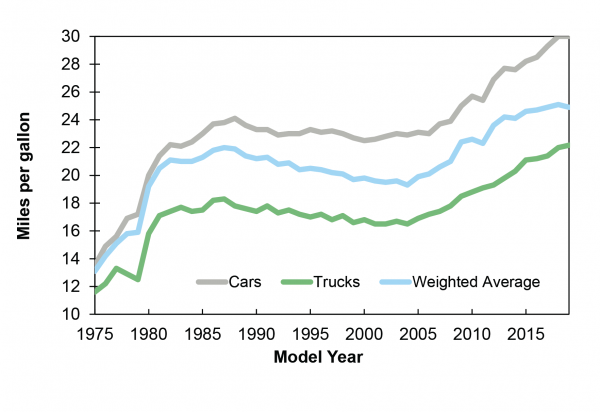
ce of factors including population growth, economic growth, urban sprawl, and periods of low fuel prices.” This one statement is incredibly important because it explains why we still haven’t made much of a dent in transportation emissions despite all the technological progress we see in the auto industry to make their cars less polluting.</p><p id="a417">As our population has continued to grow, we have witnessed urban sprawl accelerate due to a lack of <a href="https://caufsociety.com/lack-of-affordable-housing/">affordable housing in cities, stagnant wages</a>, and other factors. This pushes people further and further out, yet many of those same people still commute into the cities so their commutes become longer and longer. The <a href="https://www.vitalsigns.mtc.ca.gov/commute-time">average Bay Area commute</a> has risen from 24.3 minutes in 1980 to 30.6 minutes in 2018. Residents in Contra Costa County experience an average commute of 40 minutes or more traveling to nearby cities like San Francisco.</p><p id="d5d3">Since these suburbs aren’t normally well served by public transit, people are forced to drive long distances to get to work and often have to drive to get to grocery stores, gyms, schools, etc. All of this has resulted in the major increase in VMT, which has offset much of the improvement in average fuel economy. People are also <a href="https://css.umich.edu/factsheets/personal-transportation-factsheet">carpooling much less</a> than they did in the 1980s with over 76% of workers commuting alone. So clearly <a href="https://www.forbes.com/sites/bradtempleton/2019/08/06/carpool-cheats-may-be-helping-traffic-how-hov-lanes-can-fail/?sh=e5a47c83d5d1">building more carpool lanes isn’t helping</a>.</p><figure id="98c0"><img src="https://cdn-images-1.readmedium.com/v2/resize:fit:800/0*OxMSBKLp-0J_kBi4"><figcaption>Average fuel economy in the U.S. has risen since 1975, but not enough to offset the emissions impact of increased VMT. Source: <a href="https://css.umich.edu/factsheets/personal-transportation-factsheet">University of Michigan, Center for Sustainable Systems</a></figcaption></figure><p id="a182">Meanwhile, the size and weight of our vehicles have increased dramatically. Over the past 30 years, average vehicle weight <a href="https://css.umich.edu/factsheets/personal-transportation-factsheet">increased by 24%</a> due to the rapid growth of SUVs in terms of market share. Despite newer vehicles being better for air pollution, their <a href="https://www.theguardian.com/business/2020/feb/28/new-cars-producing-more-carbon-dioxide-than-older-models">average emissions are often higher than older models</a> as people demand larger, heavier vehicles.</p><figure id="d00f"><img src="https://cdn-images-1.readmedium.com/v2/resize:fit:800/0*zMrMDylDtUACB0OD"><figcaption>The market share of SUVs in the U.S. began to expand rapidly starting in the 1990s. Source: <a href="https://css.umich.edu/factsheets/personal-transportation-factsheet">University of Michigan, Center for Sustainable Systems</a></figcaption></figure><h1 id="cf48">Is a cleaner car culture really the answer?</h1><p id="998f">Increasing average fuel economy alone won’t be enough to drive down our transportation emissions sufficiently. Many EV advocates point to the <a href="https://www.eia.gov/todayinenergy/detail.php?id=51218">steady growth in EVs, hybrids, and plug-in hybrids</a> as the silver bullet to our transportation emissions problem. <a href="https://nypost.com/2021/09/11/ny-state-to-ban-the-sale-of-new-gas-cars-and-trucks-by-2035/">Several</a> <a href="https://www.latimes.com/california/story/2020-09-23/gavin-newsom-fracking-ban-california-zero-emissions-cars">states</a> are going all-in in pushing for electrification of our modes of transportation as a way to decarbonize this sector. But is it really as simple as swapping one technology for another?</p><p id="514a">Well, the first — and perhaps most important — question is would this transition to EVs be sufficient to hit our internationally agreed-upon targets of limiting global warming to 2°C? And the answer to that is — most likely not.</p><p id="9018">According to a recent <a href="https://www.nature.com/articles/s41558-020-00921-7">study</a> published in <i>Nature Climate Change</i>, up to 351 million EVs, or up to 90% of the light-duty vehicle (LDV) fleet in the U.S., would have to be on the roads by 2050 to stay within the 2°C threshold. This would require a 100% market share of EVs as early as 2035. With <a href="https://theconversation.com/the-myth-of-electric-cars-why-we-also-need-to-focus-on-buses-and-trains-147827">EVs only representing 0.3% of the LDV fleet as of 2020</a> and the International Energy Agency predicting we’ll only have half the fleet electrified by 2050, the viability of EVs as the silver bullet to addressing our transportation emissions seems a bit farfetched. As the authors of the study put it, “Ultimately, betting solely on EVs to bridge the US LDV fleet’s CO2 mitigation gaps is not realistic.”</p><p id="d7f5">Even if we were somehow able to deploy this many EVs by 2050, it would have major implications for electricity demand and raw materials used in EV batteries. Annual electricity demand could increase by <a href="https://www.nature.com/articles/s41558-020-00921-7">1,730 terawatt hours</a> (TWh), which is equivalent to 41% of 2018’s annual electricity generation in the U.S., and could double the peak residential demand. This could lead to reduced reliability of power systems and cause grid instability.</p><p id="8ab8">Such a rapid deployment of EVs would present serious supply chain issues for lithium and cobalt, in particular. Electrifying the U.S. LDV fleet by 2050 could use up 8% of the world’s lithium resources and 29% of the world’s cobalt resources without major improvements to battery recycling processes or changes to battery material composition, according to the same <a href="https://www.nature.com/articles/s41558-020-00921-7">study</a>. Besides supply chain disruptions, geopolitical tensions may arise due to the uneven geographic distribution of these critical materials similar to what we’re seeing with the <a href="https://readmedium.com/what-russias-invasion-of-ukraine-could-possibly-mean-for-climate-change-486dcfeda13a">current war in Ukraine</a> where countries are grappling with how to reduce their reliance on Russian oil and gas.</p><p id="0f24">Mining for materials like cobalt is harsh and dangerous work similar to mining for coal. Workers in these mines are often subjected to <a href="https://www.theguardian.com/global-development/2021/nov/08/cobalt-drc-miners-toil-for-30p-an-hour-to-fuel-electric-cars">exploitation and discrimination</a> such as in the City of Kolwezi in the Democratic Republic of the Congo (DRC). Despite the mining companies offering a source of employment for the local population, there is little sign of the benefits within the communities.</p><p id="a206">It’s important to note that companies like <a href="https://www.tesla.com/ns_videos/2020-tesla-impact-report.pdf">Tesla</a> are working to source these raw materials more responsibly and have long-term plans to eliminate cobalt from the production of their batteries, but it will be increasingly difficult to do so with <a href="https://www.worldbank.org/en/news/feature/2019/10/07/changing-mining-practices-and-greening-value-chains-for-a-low-carbon-world">skyrocketing demand</a> for these materials in the coming years.</p><p id="fbd9">EVs can undoubtedly help reduce our transportation emissions as <a href="https://www.theverge.com/2021/7/21/22585682/electric-vehicles-greenhouse-gas-emissions-lifecycle-assessment">average lifecycle emissions of EVs are lower</a> than for internal combustion engine (ICE) vehicles even in places more reliant on coal for their electricity supply. They also can help <a href="https://www.tesla.com/impact-report/2020">reduce air pollution</a> in the form of carbon monoxide, nitrous oxides, and fine particulates. But they come with their own host of environmental, technical, and human rights issues, in addition to not being sufficient of a solution to achieve our climate targets.</p><p id="6cc5">And most importantly, they perpetuate the same inefficient and wasteful system of transporting people around, often alone in their oversized cars, across vast distances that contribute to <a href="https://www.mentalfloss.com/article/530705/heres-how-much-traffic-congestion-costs-worlds-biggest-cities">costly traffic congestion</a> and <a href="https://www.cdc.gov/nchs/products/databriefs/db400.htm">numerous accidents and fatalities</a>. It’s clear that we have to move beyond our obsessive and destructive car culture, but how?</p><h1 id="7101">How we can move away from our car-centered culture</h1><p id="6e62">Nature is trying to teach us an invaluable lesson right now. That our current way of life is not sustainable and not viable on a planet with many other species competing for limited resources and <a href="https://readmedium.com/breaking-the-cultural-addiction-to-consumerism-45c76d8014c1">humans consuming the vast majority of those resources</a> faster than they can be replaced. Incremental changes to our way of life such as replacing gas cars with hybrids and EVs aren’t going to cut it.</p><p id="46c4">We have to start using a <a href="https://learningforsustainability.net/systems-thinking/">systems thinking</a> mindset to understand how to get us out of this mess we’ve created for ourselves. When we evaluate ways to address emissions from transportation, we must analyze the inter-relationships among transportation, land use, buildings, public health, resource availability, socioeconomic status, and other factors.</p><p id="4e98">If we approach climate solutions with too narrow of a mindset, the realized benefits will not be as optimal and widespread as they could be, or may ultimately lead to unintended consequences that do more harm than good.</p><p id="cf05">For example, EVs may help us reduce transportation emissions with enough adoption and build-out of the necessary charging infrastructure, but are EVs the best solution for reducing emissions in an equitable way that also improves public health, restores ecosystems, and helps us manage our limited resources in a responsible way?</p><p id="62e4">By applying systems thinking to climate solutions, we can ensure that we not only decarbonize our economy, but that we also transform the structure of our society for the betterment of everyone and the environment, rather than maintaining inefficient systems that primarily benefit the few at the expense of many.</p><p id="fedb">As a method for doing this kind of systems thinking, I suggest three guiding questions be used to help us prioritize our approach to potential climate mitigation solutions:</p><ol><li>Does the solution improve human well-being, particularly for those already most impacted by climate change and pollution?</li><li>Does the solution harmonize well with the natural environment and its inherent resource limits?</li><li>Does the solution provide substantial GHG emissions reduction potential with minimal adverse effects?</li></ol><p id="9bf7">In the case of our transportation systems here in the U.S., we can use these questions and systems thinking to develop ways to transport humans in a better way. Let’s look at a few examples from around the world that are doing exactly this.</p><p id="19
Options
74">Over in Berlin, Germany, a <a href="https://www.theguardian.com/world/2021/oct/06/berlins-car-ban-campaign-its-about-how-we-want-to-live-breathe-and-play">campaign group called Berlin Autofrei</a> has submitted a petition with over 50,000 signatures to create the “largest car-free urban area in the world,” covering a land area larger than Manhatten. “Car-free” is slightly misleading as some vehicles such as emergency vehicles and garbage trucks could still be issued <a href="https://www.fastcompany.com/90711961/berlin-is-planning-a-car-free-area-larger-than-manhattan">special permits</a> to traverse through the Ringbahn (a circular ring around the city connected by train stops), but most other vehicles would be banned from entering. This <a href="https://www.theguardian.com/world/2021/oct/06/berlins-car-ban-campaign-its-about-how-we-want-to-live-breathe-and-play">Guardian article</a> includes renderings of how some of Berlin’s car-friendly streets could be transformed to be more pedestrian- and bike-friendly if Berlin adopts the proposed law.</p><figure id="df7e"><img src="https://cdn-images-1.readmedium.com/v2/resize:fit:800/0*YqNW5NcAyCLQ7c_4"><figcaption>Photo by <a href="https://unsplash.com/@florianwehde?utm_source=medium&utm_medium=referral">Florian Wehde</a> on <a href="https://unsplash.com?utm_source=medium&utm_medium=referral">Unsplash</a></figcaption></figure><p id="2453">One of the primary reasons that prohibiting cars within the city could work is that <a href="https://www.bloomberg.com/news/articles/2019-02-28/berlin-plans-for-huge-investments-in-public-transit">Germany has invested heavily in its public transit systems</a>, as many European countries have. The <a href="https://www.fastcompany.com/90711961/berlin-is-planning-a-car-free-area-larger-than-manhattan">trains in Berlin run frequently</a> with many stops throughout the city that are well-connected so riders can easily walk or bike to a nearby stop.</p><p id="c51f">As a slightly less radical solution to making an entire city car-free, Barcelona is taking a different approach to make their city more friendly to pedestrians and bicyclists. The <a href="https://www.youtube.com/watch?v=ZORzsubQA_M">Vox video</a> below describes how Barcelona is creating <i>superilles</i> or “superblocks” that would cut off through traffic in groups of nine adjacent city blocks so that traffic is diverted around the perimeter. Strict slow speed limits are enforced within the superblock and underground parking replaces any on-street parking. This creates a much more walkable, sociable, cleaner, and less noisy environment. And contrary to many business owners’ perspectives, patronage of businesses actually increases within these superblocks.</p>
<figure id="ae24">
<div>
<div>
<img class="ratio" src="http://placehold.it/16x9">
<iframe class="" src="https://cdn.embedly.com/widgets/media.html?src=https%3A%2F%2Fwww.youtube.com%2Fembed%2FZORzsubQA_M%3Ffeature%3Doembed&display_name=YouTube&url=https%3A%2F%2Fwww.youtube.com%2Fwatch%3Fv%3DZORzsubQA_M&image=https%3A%2F%2Fi.ytimg.com%2Fvi%2FZORzsubQA_M%2Fhqdefault.jpg&key=a19fcc184b9711e1b4764040d3dc5c07&type=text%2Fhtml&schema=youtube" allowfullscreen="" frameborder="0" height="480" width="854">
</div>
</div>
</figure></iframe></div></div></figure><p id="62f2">You might be thinking to yourself, <i>sure maybe Berlin and Barcelona could pull this off but how could a typical American city built for cars possibly make this kind of transition?</i></p><p id="e6bd">One would never think the ultra-bike-friendly city of Amsterdam in the Netherlands was once a car-dominated city but it was. Thanks to the work of Sustainable Amsterdam, we can now see through a collection of <a href="https://www.fastcompany.com/3052699/these-historical-photos-show-how-amsterdam-turned-itself-into-a-bike-riders-paradise">photos</a> how it transformed itself from a car-centered city to a human-centered one. Just as the U.S. became a car-centered culture after WWII, so too did Amsterdam. Highways and parking garages started to be constructed while apartment buildings on the outskirts of the city were developed, contributing to urban sprawl. But people resisted these changes and protested in the streets. It took several years but over time the city experimented with the idea of making it more friendly to pedestrians and bicyclists such as instituting car-free Sundays — and eventually, with enough public pressure, it became the biker’s paradise it is today.</p><figure id="39ff"><img src="https://cdn-images-1.readmedium.com/v2/resize:fit:800/0*dml6TiTPDaCo8ofD"><figcaption>Photo by <a href="https://unsplash.com/@jacegrandinetti?utm_source=medium&utm_medium=referral">Jace & Afsoon</a> on <a href="https://unsplash.com?utm_source=medium&utm_medium=referral">Unsplash</a></figcaption></figure><p id="11d0">We’ve seen many American cities experiment in similar ways as a result of the COVID-19 pandemic. Four-lane streets in San Francisco became two-lane streets so that space could be made for outdoor dining. Other streets were completely closed off to cars for the most part such as <a href="https://www.edhat.com/news/downtown-state-street-closes-to-vehicles-for-outdoor-dining">State Street in Santa Barbara</a>, which created a pedestrian promenade. Los Angeles is planning to <a href="https://www.railwayage.com/news/la-metros-400b-30-year-transportation-blueprint-approved/">spend $400 billion</a> over 30 years to improve, expand, and upgrade its public transit system, and in the process, move away from being such a car-dominated city.</p><p id="57f3">Imagine if every American city was actively working to create better living conditions for their residents while also reducing transportation emissions by eliminating the need to drive a car everywhere.</p><p id="a5f9">As Peter Calthorpe discusses in his <a href="https://www.ted.com/talks/peter_calthorpe_7_principles_for_building_better_cities">TED talk</a>, there are so many co-benefits to building better cities beyond just mitigating climate change including protecting and restoring our environment, improving social well-being, fostering community connectedness, and increasing economic vitality and prosperity.</p>
<figure id="8d43">
<div>
<div>
<img class="ratio" src="http://placehold.it/16x9">
<iframe class="" src="https://cdn.embedly.com/widgets/media.html?src=https%3A%2F%2Fwww.youtube.com%2Fembed%2FIFjD3NMv6Kw%3Ffeature%3Doembed&display_name=YouTube&url=https%3A%2F%2Fwww.youtube.com%2Fwatch%3Fv%3DIFjD3NMv6Kw&image=https%3A%2F%2Fi.ytimg.com%2Fvi%2FIFjD3NMv6Kw%2Fhqdefault.jpg&key=a19fcc184b9711e1b4764040d3dc5c07&type=text%2Fhtml&schema=youtube" allowfullscreen="" frameborder="0" height="480" width="854">
</div>
</div>
</figure></iframe></div></div></figure><p id="3150">But as we build these better cities, we must also ensure they remain affordable so people aren’t pushed further out into the suburbs. <a href="https://www.sciencefriday.com/segments/can-mass-transit-solve-city-sprawl/">Building affordable housing near transit stops</a> is especially important so that those who most rely on transit are well served by it.</p><p id="0174">By encouraging smart growth principles such as <a href="https://scholarship.law.columbia.edu/cgi/viewcontent.cgi?article=1913&context=faculty_scholarship">mixed-use development, high-density housing, mass transit use</a>, <a href="https://www.ncbi.nlm.nih.gov/pmc/articles/PMC1497432/">limited roads, green spaces, and walkable neighborhoods</a> in how we plan our cities, we can substantially <a href="https://www.ted.com/talks/peter_calthorpe_7_principles_for_building_better_cities">reduce GHG emissions</a> (from buildings and transportation), VMT, and land use impacts. Simultaneously, we can increase families’ disposable incomes through reduced fuel and maintenance costs from driving, as well as reduced healthcare costs from less pollution and healthier lifestyles by encouraging biking and walking.</p><p id="953d">Many of these co-benefits can not be achieved by solely relying on transitioning our current vehicle fleet to EVs. It’s time to think much bigger and broader than swapping out one polluting car for one that doesn’t pollute as much. And we must be bold enough to challenge this dominant car culture.</p><p id="ed77">The American dream of owning a shiny new car should be replaced by a dream of living in a beautiful, vibrant, and diverse community where there is a greater sense of connectedness with nature and your neighbors. Where driving a car is not only not needed, but undesirable because the other modes of transport are phenomenally better. <a href="https://www.theatlantic.com/magazine/archive/2020/10/how-disaster-shaped-the-modern-city/615484/">And where the streets, once again, belong to the people</a>.</p><p id="176b">If you enjoyed this story, then you might also enjoy reading:</p><div id="1b70" class="link-block">
<a href="https://readmedium.com/climate-action-planning-at-the-local-level-2d02991c8513">
<div>
<div>
<h2>Climate Action Planning at the Local Level</h2>
<div><h3>An interview with the City of San Rafael’s Sustainability Program Manager</h3></div>
<div><p>medium.com</p></div>
</div>
<div>
<div style="background-image: url(https://miro.readmedium.com/v2/resize:fit:320/0*unGVo-xA4gRRt6hN)"></div>
</div>
</div>
</a>
</div><div id="f6e8" class="link-block">
<a href="https://readmedium.com/my-vision-for-a-better-future-7d0c36325e5b">
<div>
<div>
<h2>My Vision for a Better Future</h2>
<div><h3>If we’re serious about addressing the issues we face, a systemic transformation of our society is required</h3></div>
<div><p>medium.com</p></div>
</div>
<div>
<div style="background-image: url(https://miro.readmedium.com/v2/resize:fit:320/0*wiAb2_F4Cmsv7qBH)"></div>
</div>
</div>
</a>
</div><div id="d128" class="link-block">
<a href="https://readmedium.com/wheres-the-emergency-response-to-our-global-public-health-crisis-of-pollution-2d29d61b3740">
<div>
<div>
<h2>Where’s the Emergency Response to Our Global Public Health Crisis of Pollution?</h2>
<div><h3>Pollution isn’t just a local problem; it’s a planetary threat</h3></div>
<div><p>medium.com</p></div>
</div>
<div>
<div style="background-image: url(https://miro.readmedium.com/v2/resize:fit:320/0*20ChJZs7CCEZeUGq)"></div>
</div>
</div>
</a>
</div><p id="c9a8">To address the crises we face, we all need to work together and contribute our knowledge, ideas, and skills. If you share my vision of building a <b>better future together</b>, then please consider subscribing <a href="https://sean-youra.medium.com/subscribe"><b>here</b></a> to stay connected and be notified when I publish a new story.</p></article></body>
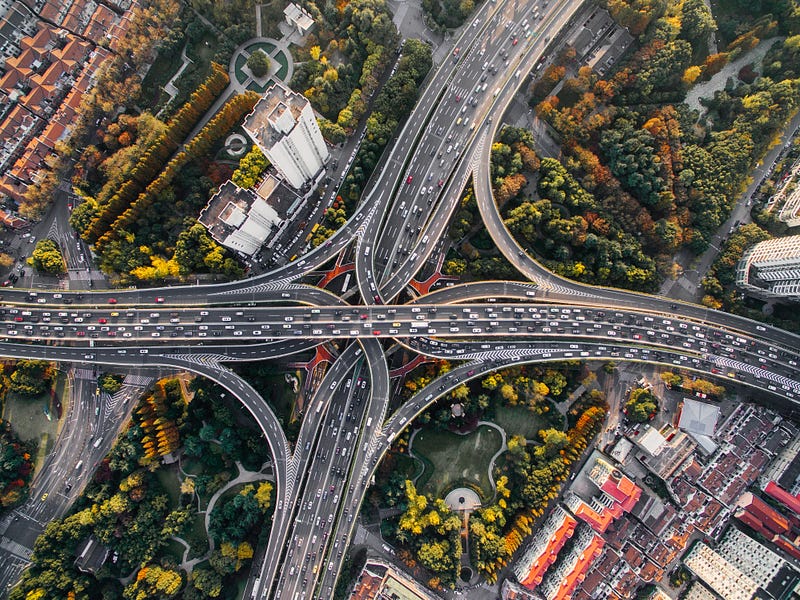
Car Culture Is a Huge Impediment to Climate Action
It’s time we take back our streets for the betterment of people and the planet
It didn’t always used to be this way though. Just look at New York in 1911.
So how did our cities change so drastically over the course of a few decades to resemble the urban landscapes of today where most of the space is devoted to cars?
The tale of Cincinnati’s transportation transformation is a similar tale to many American cities in the early to mid-20th century. In 1955, Cincinnati, Ohio was a well-connected city where most residents could get to wherever they needed in 30 minutes or less by walking, biking, or taking public transit via the streetcar system.
However, this all began to change with the Federal Aid Highway Act of 1956. Supported by the lobbying efforts of several industries including auto, trucking, cement, and construction, this bill authorized the construction of 41,000 miles of what would become the Interstate Highway System. This highway system would eventually run straight through the heart of cities like Cincinnati, creating a fragmented urban landscape in the process. You can see just how much Cincinnati and other cities changed over the following decades in the Vox video below.
Around this same time, suburban development began to rapidly expand across the country. This was a multi-faceted response arising from people wanting to escape the unfavorable conditions in large urban cities (e.g., air pollution, poor sanitation, noise) as well as the ability for (white Americans) to access more affordable mortgages thanks to the creation of the Federal Housing Administration (FHA). The FHA’s role was significant in both encouraging suburban development and racial segregation, as Robert Kirkman remarks in his article, “Did Americans Choose Sprawl?”:
“[…] not only did [the FHA’s] mortgage guarantees favor racially segregated suburban development, but it also provided mechanisms for regulating the quality of the housing supply and the form of subdivisions.”
Suburbs weren’t always the poorly connected enclaves of single-family homes we think of today either. In the late 19th century, the earliest suburbs had more urban elements in their design such as small lot sizes making them more walkable, and they often had transit access. But increasingly over the early 20th century, suburbs were designed for automobile access and to limit traffic in the neighborhoods through a patchwork of largely disconnected short streets with cul-de-sacs.
Another important factor in how we became a car-centered culture was the rise of mass consumption that also occurred post-World War II. As Harvard Professor Liz Cohen describes in the video below, factories that had produced tanks, planes, and weapons during the war, transitioned to producing mass consumer goods including cars.
Single-family homes and car ownership became status symbols in American culture and were emblematic of achieving the American dream. They represented the ultimate freedom to live where you wanted and go wherever you wanted. Except that freedom came with a major hidden cost.
The true costs of car culture
Unbeknownst to all those families moving to the suburbs and buying their shiny new automobiles, our world was slowly but surely warming.
Back during the early to mid-20th century when all these radical changes were happening with our transportation systems and land use, carbon dioxide (CO2) concentrations in the atmosphere were still within the range of historical levels going back hundreds of thousands of years. And then CO2 concentrations spiked in the following decades.
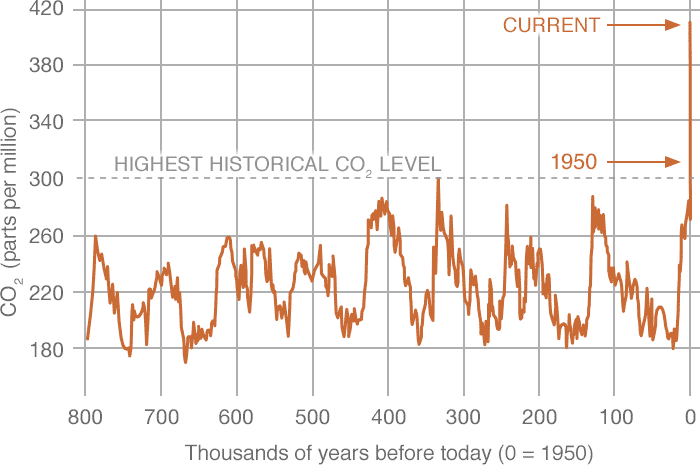
Proxy measurements of historical atmospheric CO2 (in ppm) concentrations. Source: NASA
As of 2019 (the latest data available), the U.S. transportation sector represents the largest source of emissions at 29%. It also happens to be one of the most difficult to decarbonize, as the chart of GHG emissions from transportation clearly shows.
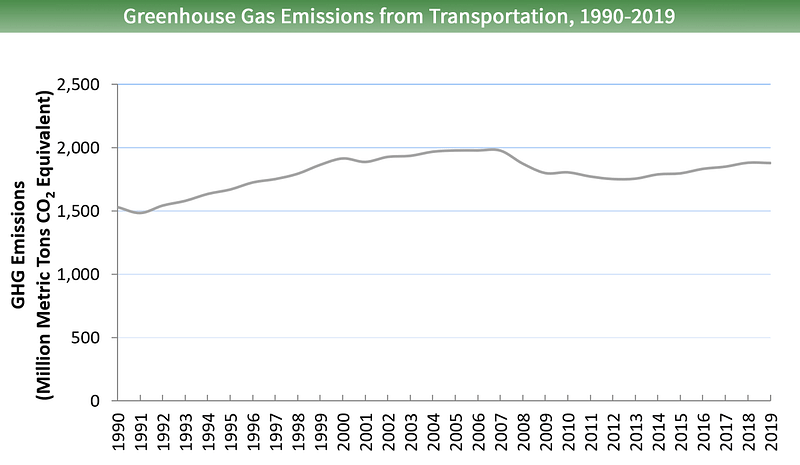
The overall emissions trend for transportation has actually increased over the past 30 years. Source: EPA
The majority of transportation emissions — and a significant portion of total U.S. emissions — come from passenger cars and light-duty trucks. But we all hear about how the fuel economy of these vehicles is improving and you see more hybrids and electric vehicles (EVs) on the streets every day, so shouldn’t we be seeing more of a decline in these emissions?
According to the EPA, “The number of vehicle miles traveled (VMT) by light-duty motor vehicles (passenger cars and light-duty trucks) increased by 48 percent from 1990 to 2019, as a result of a confluence of factors including population growth, economic growth, urban sprawl, and periods of low fuel prices.” This one statement is incredibly important because it explains why we still haven’t made much of a dent in transportation emissions despite all the technological progress we see in the auto industry to make their cars less polluting.
As our population has continued to grow, we have witnessed urban sprawl accelerate due to a lack of affordable housing in cities, stagnant wages, and other factors. This pushes people further and further out, yet many of those same people still commute into the cities so their commutes become longer and longer. The average Bay Area commute has risen from 24.3 minutes in 1980 to 30.6 minutes in 2018. Residents in Contra Costa County experience an average commute of 40 minutes or more traveling to nearby cities like San Francisco.
Since these suburbs aren’t normally well served by public transit, people are forced to drive long distances to get to work and often have to drive to get to grocery stores, gyms, schools, etc. All of this has resulted in the major increase in VMT, which has offset much of the improvement in average fuel economy. People are also carpooling much less than they did in the 1980s with over 76% of workers commuting alone. So clearly building more carpool lanes isn’t helping.
Meanwhile, the size and weight of our vehicles have increased dramatically. Over the past 30 years, average vehicle weight increased by 24% due to the rapid growth of SUVs in terms of market share. Despite newer vehicles being better for air pollution, their average emissions are often higher than older models as people demand larger, heavier vehicles.
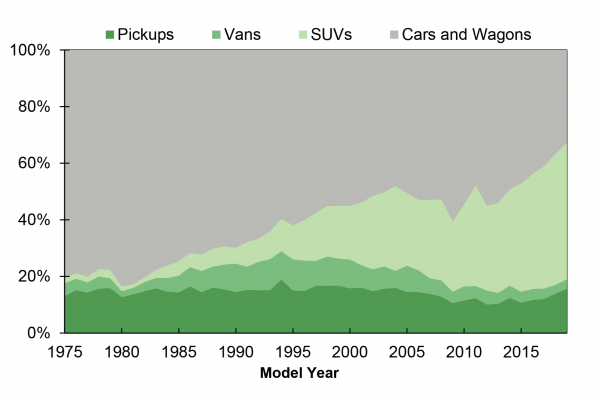
Increasing average fuel economy alone won’t be enough to drive down our transportation emissions sufficiently. Many EV advocates point to the steady growth in EVs, hybrids, and plug-in hybrids as the silver bullet to our transportation emissions problem. Severalstates are going all-in in pushing for electrification of our modes of transportation as a way to decarbonize this sector. But is it really as simple as swapping one technology for another?
Well, the first — and perhaps most important — question is would this transition to EVs be sufficient to hit our internationally agreed-upon targets of limiting global warming to 2°C? And the answer to that is — most likely not.
According to a recent study published in Nature Climate Change, up to 351 million EVs, or up to 90% of the light-duty vehicle (LDV) fleet in the U.S., would have to be on the roads by 2050 to stay within the 2°C threshold. This would require a 100% market share of EVs as early as 2035. With EVs only representing 0.3% of the LDV fleet as of 2020 and the International Energy Agency predicting we’ll only have half the fleet electrified by 2050, the viability of EVs as the silver bullet to addressing our transportation emissions seems a bit farfetched. As the authors of the study put it, “Ultimately, betting solely on EVs to bridge the US LDV fleet’s CO2 mitigation gaps is not realistic.”
Even if we were somehow able to deploy this many EVs by 2050, it would have major implications for electricity demand and raw materials used in EV batteries. Annual electricity demand could increase by 1,730 terawatt hours (TWh), which is equivalent to 41% of 2018’s annual electricity generation in the U.S., and could double the peak residential demand. This could lead to reduced reliability of power systems and cause grid instability.
Such a rapid deployment of EVs would present serious supply chain issues for lithium and cobalt, in particular. Electrifying the U.S. LDV fleet by 2050 could use up 8% of the world’s lithium resources and 29% of the world’s cobalt resources without major improvements to battery recycling processes or changes to battery material composition, according to the same study. Besides supply chain disruptions, geopolitical tensions may arise due to the uneven geographic distribution of these critical materials similar to what we’re seeing with the current war in Ukraine where countries are grappling with how to reduce their reliance on Russian oil and gas.
Mining for materials like cobalt is harsh and dangerous work similar to mining for coal. Workers in these mines are often subjected to exploitation and discrimination such as in the City of Kolwezi in the Democratic Republic of the Congo (DRC). Despite the mining companies offering a source of employment for the local population, there is little sign of the benefits within the communities.
It’s important to note that companies like Tesla are working to source these raw materials more responsibly and have long-term plans to eliminate cobalt from the production of their batteries, but it will be increasingly difficult to do so with skyrocketing demand for these materials in the coming years.
EVs can undoubtedly help reduce our transportation emissions as average lifecycle emissions of EVs are lower than for internal combustion engine (ICE) vehicles even in places more reliant on coal for their electricity supply. They also can help reduce air pollution in the form of carbon monoxide, nitrous oxides, and fine particulates. But they come with their own host of environmental, technical, and human rights issues, in addition to not being sufficient of a solution to achieve our climate targets.
And most importantly, they perpetuate the same inefficient and wasteful system of transporting people around, often alone in their oversized cars, across vast distances that contribute to costly traffic congestion and numerous accidents and fatalities. It’s clear that we have to move beyond our obsessive and destructive car culture, but how?
How we can move away from our car-centered culture
Nature is trying to teach us an invaluable lesson right now. That our current way of life is not sustainable and not viable on a planet with many other species competing for limited resources and humans consuming the vast majority of those resources faster than they can be replaced. Incremental changes to our way of life such as replacing gas cars with hybrids and EVs aren’t going to cut it.
We have to start using a systems thinking mindset to understand how to get us out of this mess we’ve created for ourselves. When we evaluate ways to address emissions from transportation, we must analyze the inter-relationships among transportation, land use, buildings, public health, resource availability, socioeconomic status, and other factors.
If we approach climate solutions with too narrow of a mindset, the realized benefits will not be as optimal and widespread as they could be, or may ultimately lead to unintended consequences that do more harm than good.
For example, EVs may help us reduce transportation emissions with enough adoption and build-out of the necessary charging infrastructure, but are EVs the best solution for reducing emissions in an equitable way that also improves public health, restores ecosystems, and helps us manage our limited resources in a responsible way?
By applying systems thinking to climate solutions, we can ensure that we not only decarbonize our economy, but that we also transform the structure of our society for the betterment of everyone and the environment, rather than maintaining inefficient systems that primarily benefit the few at the expense of many.
As a method for doing this kind of systems thinking, I suggest three guiding questions be used to help us prioritize our approach to potential climate mitigation solutions:
Does the solution improve human well-being, particularly for those already most impacted by climate change and pollution?
Does the solution harmonize well with the natural environment and its inherent resource limits?
Does the solution provide substantial GHG emissions reduction potential with minimal adverse effects?
In the case of our transportation systems here in the U.S., we can use these questions and systems thinking to develop ways to transport humans in a better way. Let’s look at a few examples from around the world that are doing exactly this.
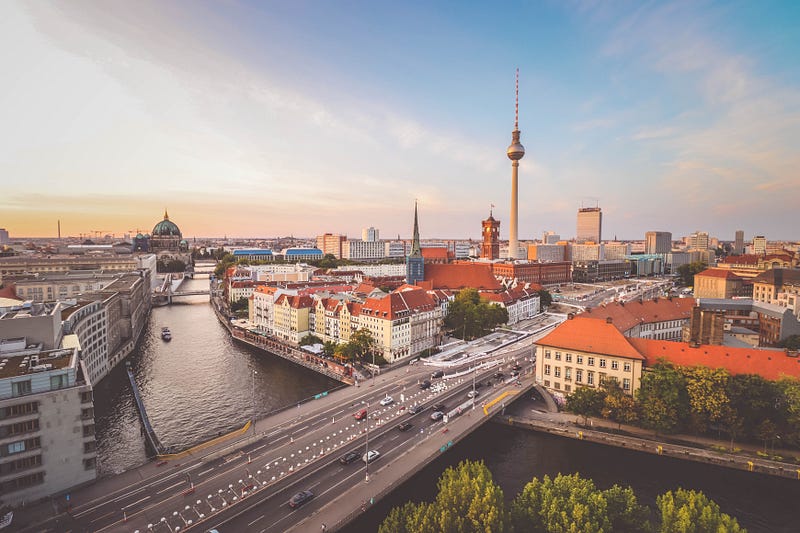
Over in Berlin, Germany, a campaign group called Berlin Autofrei has submitted a petition with over 50,000 signatures to create the “largest car-free urban area in the world,” covering a land area larger than Manhatten. “Car-free” is slightly misleading as some vehicles such as emergency vehicles and garbage trucks could still be issued special permits to traverse through the Ringbahn (a circular ring around the city connected by train stops), but most other vehicles would be banned from entering. This Guardian article includes renderings of how some of Berlin’s car-friendly streets could be transformed to be more pedestrian- and bike-friendly if Berlin adopts the proposed law.
As a slightly less radical solution to making an entire city car-free, Barcelona is taking a different approach to make their city more friendly to pedestrians and bicyclists. The Vox video below describes how Barcelona is creating superilles or “superblocks” that would cut off through traffic in groups of nine adjacent city blocks so that traffic is diverted around the perimeter. Strict slow speed limits are enforced within the superblock and underground parking replaces any on-street parking. This creates a much more walkable, sociable, cleaner, and less noisy environment. And contrary to many business owners’ perspectives, patronage of businesses actually increases within these superblocks.
You might be thinking to yourself, sure maybe Berlin and Barcelona could pull this off but how could a typical American city built for cars possibly make this kind of transition?
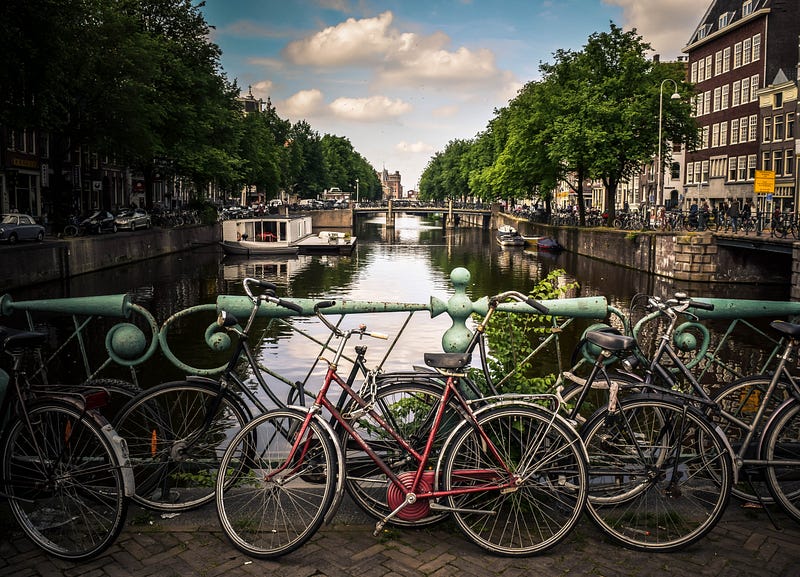
One would never think the ultra-bike-friendly city of Amsterdam in the Netherlands was once a car-dominated city but it was. Thanks to the work of Sustainable Amsterdam, we can now see through a collection of photos how it transformed itself from a car-centered city to a human-centered one. Just as the U.S. became a car-centered culture after WWII, so too did Amsterdam. Highways and parking garages started to be constructed while apartment buildings on the outskirts of the city were developed, contributing to urban sprawl. But people resisted these changes and protested in the streets. It took several years but over time the city experimented with the idea of making it more friendly to pedestrians and bicyclists such as instituting car-free Sundays — and eventually, with enough public pressure, it became the biker’s paradise it is today.
We’ve seen many American cities experiment in similar ways as a result of the COVID-19 pandemic. Four-lane streets in San Francisco became two-lane streets so that space could be made for outdoor dining. Other streets were completely closed off to cars for the most part such as State Street in Santa Barbara, which created a pedestrian promenade. Los Angeles is planning to spend $400 billion over 30 years to improve, expand, and upgrade its public transit system, and in the process, move away from being such a car-dominated city.
Imagine if every American city was actively working to create better living conditions for their residents while also reducing transportation emissions by eliminating the need to drive a car everywhere.
As Peter Calthorpe discusses in his TED talk, there are so many co-benefits to building better cities beyond just mitigating climate change including protecting and restoring our environment, improving social well-being, fostering community connectedness, and increasing economic vitality and prosperity.
But as we build these better cities, we must also ensure they remain affordable so people aren’t pushed further out into the suburbs. Building affordable housing near transit stops is especially important so that those who most rely on transit are well served by it.
Many of these co-benefits can not be achieved by solely relying on transitioning our current vehicle fleet to EVs. It’s time to think much bigger and broader than swapping out one polluting car for one that doesn’t pollute as much. And we must be bold enough to challenge this dominant car culture.
The American dream of owning a shiny new car should be replaced by a dream of living in a beautiful, vibrant, and diverse community where there is a greater sense of connectedness with nature and your neighbors. Where driving a car is not only not needed, but undesirable because the other modes of transport are phenomenally better. And where the streets, once again, belong to the people.
If you enjoyed this story, then you might also enjoy reading:
To address the crises we face, we all need to work together and contribute our knowledge, ideas, and skills. If you share my vision of building a better future together, then please consider subscribing here to stay connected and be notified when I publish a new story.