
CREATIVE NON-FICTION
Can Authoritarianism Be Subtle?
Or is it just that it feels different to the marginalized?
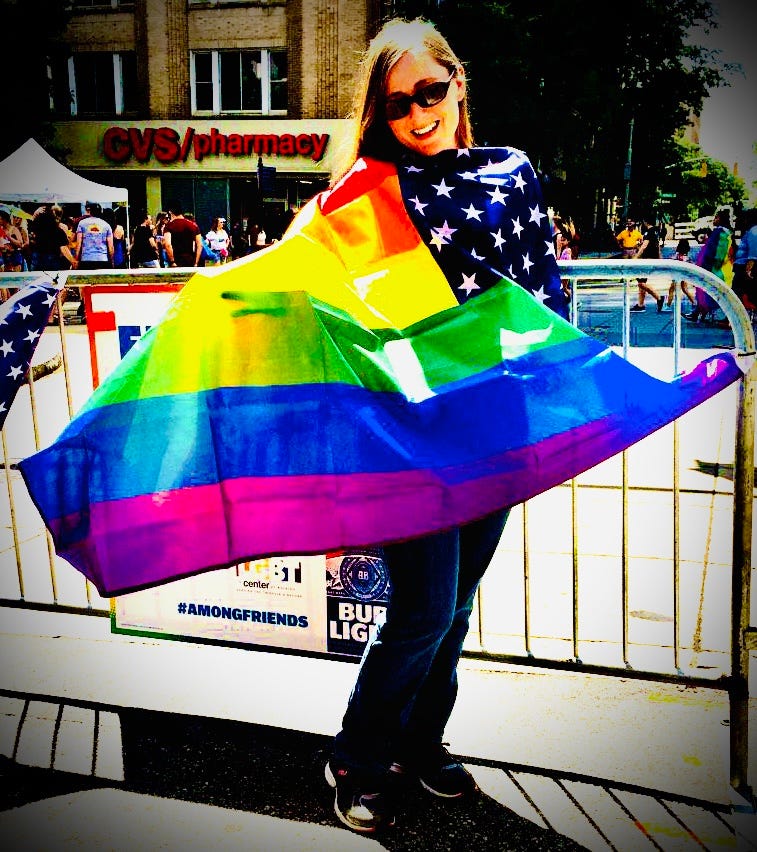
CW: Sex/sexuality, AIDS, critical race theory, slavery mentioned in passing
The picture above got me into a lot of trouble about 4 years ago.
I texted it to a family member who had asked me how I was doing while I was busy enjoying a Pride Parade. The picture was apparently passed around a bit and caused quite a s***storm, poking at some sore spots left over from my coming out to family as the polyamorous spouse of a trans feminine person not too long before the photo was taken. In response, my phone would soon blow up with some very ugly texts about my “lifestyle choices.”
Some texts were insults. Others were downright threatening. One family member would demand that I get a divorce immediately. My refusal to do so would eventually cause me to lose access to several family members, including children who I love very much.
One family member would demand that I get a divorce immediately. My refusal to do so would eventually cause me to lose access to several family members, including children who I love very much.
This circumstance, while upsetting, isn’t on the surface related to my government.
You could say it’s the fluke of an individual’s family life. My culture did impact this moment though. My culture made this experience acceptable.
This harassment and even the eventual loss of family connections in its wake was certainly minor compared to some of the things happening now in other parts of the world or even in other states of my own country. There are places where a picture like this could easily get me killed quite quickly and brutally.
Rainbows can be dangerous things in places where they aren’t wanted.
Perhaps I should also have been grateful in that moment that laws in North Carolina had improved even by the time this picture was taken. By then, it was legal for trans people to use the restroom without risking arrest for a mismatch discovered between birth certificates and the symbols over the bathroom doors.
The ability to use the correct bathroom without fear of arrest seems like a pretty basic thing to take for granted in a free country, but trans people think of these things often, even in a country that takes great pride in modeling “freedom” to the world. The cultural implications of the North Carolina “Bathroom Bill” still affect both my wife and I when using the restroom publicly, long after that law was repealed.
A country’s worth should be measured in how it views and treats the most marginalized. We should worry as much for the LGBTQ+ people in danger in Afghanistan or Cameroon as those in Ukraine and Texas.
A country’s worth should be measured in how it views and treats the most marginalized. We should worry as much for the LGBTQ+ people in danger in Afghanistan or Cameroon as those in Ukraine and Texas. We should remember the part that colonialism has played in the exportation of hateful, anti-LGBTQ+ attitudes. We should be open to so many refugees around the world who need a safer place to stay, not because we are generous, but because we have an obligation to address the terrible wrongs of our not-at-all distant history as a country.
Those who study the atrocities of history often write about and discuss the preliminary signs of the terror that was coming.
I think this is meant to motivate the reader to study those peripheral hints that something terrible was about to happen. Don’t many of us study the ugliest parts of history in hope that what we learn could protect us in the event that it all happens again?
What if the real sign that something is terribly wrong is invisible? What if it’s the words you never see in a textbook, instead of the headlines announcing more violence to come?
What if the real sign that something is terribly wrong is invisible?
I’ve studied the Holocaust in school and privately, considering it my responsibility to understand, in case I ever have to do my part in helping to prevent this from happening again. Somehow, in all of my reading, in all of the movies I’ve seen about it, I’ve never known, prior to reading this article by Emma Holiday, about the pink triangles that my people wore in the camps. I never knew before reading the comments that my other people, the Americans, turned people like me over to the German Civil authorities at the end of WWII, treating our people as criminals instead of victims.
They didn’t teach this in any of my schools or colleges.
I’ve sat in classrooms with nearly a hundred different teachers and professors over the years, yet no one thought to mention the pink triangles handed over to brutal futures by my people.
One of them, in high school, instead marked my answer wrong on a test because I wrote that slavery caused the Civil War. I was supposed to reference the textbook reading assignment about war provocations that made white people in the American South feel more comfortable. Perhaps an excess in unchallenged comfort explains why we can still find Confederate monuments to slavery down here.
The absence of uncomfortable truths in a country’s textbooks is one of those signs of authoritarianism that we need to look out for.
Another sign is the deliberate obfuscation of truths to protect the egos of a dominant class attempting to assert its power over the marginalized.
It isn’t Southern (or Northern) white comfort that we should be concerned about as we teach children what happened in our history. Truth should be our primary concern, if we are to say that authoritarianism has no place here.
Any quick study of the recent debate surrounding critical race theory will make it clear that this education problem is not new in the United States. We are a country that has always struggled to reckon with the atrocities of our history in any meaningful way.
While my people were dying of AIDS everywhere, I was a child being taught in school that condoms couldn’t protect me from anything.
I was never told about the statistical chances of infection through various forms of protected and unprotected sex. Instead, I was taught that abstinence until marriage was the only form of safety in sex that existed. All other sex was described as equally dangerous and queer marriage wasn’t legal. Had I received a more accurate lesson, I would have made some very different decisions early in my sex life.
I was taught that abstinence until marriage was the only form of safety in sex that existed. All other sex was described as equally dangerous and queer marriage wasn’t legal.
To the dominant members of society, these signs of authoritarianism may feel “harmless”.
It’s difficult to tangibly feel the absence of knowledge, if what you don’t know isn’t affecting your life directly. If what you were never taught in school renders you non-functional in relationships, if your sexuality is relegated to a perversion never to be discussed in sex education, if the history of your people is never accurately conveyed, you feel that authoritarianism a little more acutely.
Perhaps you could criticize my use of words like “authoritarianism” in a country where I am currently free to write an article like this. As a North Carolinian, I am under no illusions that I will keep freedoms just because I have them at this moment. What almost happened on January 6, 2021 is some recent evidence that freedom can be stolen quite suddenly.
Freedom is a muscle. You have to exercise it, or it will atrophy.
Interested in signing up for the Medium to access all of our writers’ fantastic articles for only $5/month? If you would like part of your membership fees to support me and other Medium writers at no additional cost to you, sign up here or click on the membership link of your favorite writer to support them!

This story is a response to the Prism & Pen writing prompt, Let’s Write About How Queer People Live Under Authoritarianism.


