
Can AI tools like Stable Diffusion Read Our Minds By Decoding Brain Activity?
Unraveling the Mysteries of Mind-Reading with AI
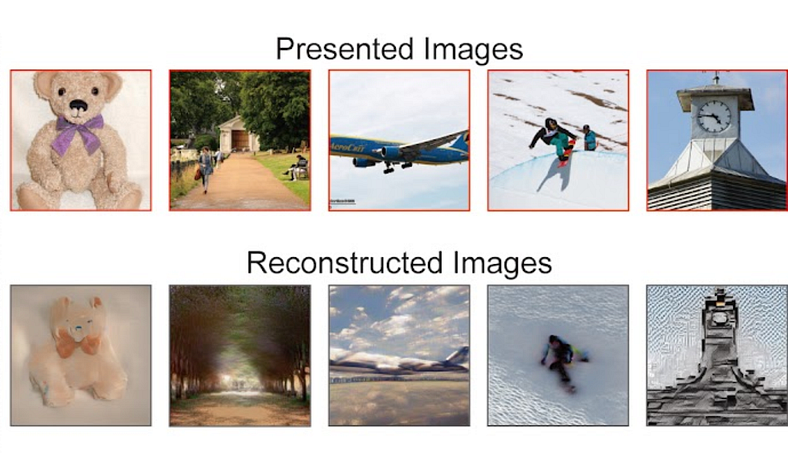
Twitter loves stuff like this: “Scientists fed brain scans to the AI image generator Stable Diffusion to reconstruct what people see in their brains!”
But is it true that AI tools like Stable Diffusion can be used to read people’s minds?
And how would that even be possible?
Scanning The Brain
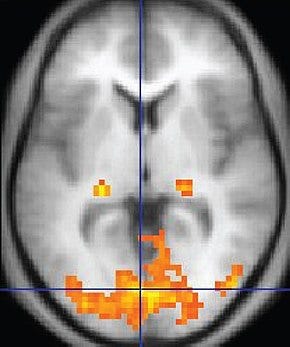
To decipher our brains, we obviously need to record what’s going on in there. Fortunately, there is fMRI (short for functional magnetic resonance imaging), a tool to measure brain activity by measuring and visualizing the blood flow of cells: When a cell is more active than usual, it needs more energy, i.e. oxygen, and therefore the blood flow of that cell or cell region changes.
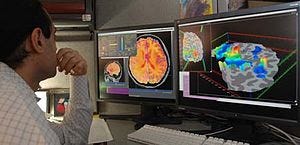
Here’s what fMRI scans look like:
Decoding The Brain
Our brains constantly produce our conscious experience by interpreting a myriad of sensory information and aggregating layers of memories and subconscious needs into emotions, constructing the subjective experience of “being in a world”.
A daunting task indeed to look at this experience as a whole and try to make sense of all the brain activity that comes with it.
A much more motivating approach is to look at a single aspect of this conscious experience and find out how to decode the specific brain activity that corresponds to it.
For example, we know that brain activity is different depending on what we are doing: Different emotions cause our brains’ cells to become active in different ways, and different regions of the brain show increased activity depending on whether we talk, listen to music, meditate, etc.
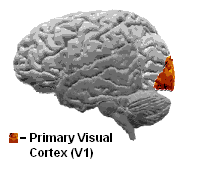
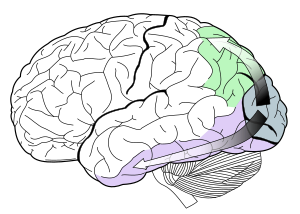
One very well-studied part of the brain is the one that is particularly active when we are processing visual information.
Say hello to your visual cortex:
Using AI To Decode The Brain
The use of AI to decode the visual cortex was known way before AI image generators like Stable Diffusion pushed the boundaries of AI creativity.
Although it has been possible to reconstruct images from brain activity ten years ago, the results did not have a high resolution and often lacked semantic accuracy. Here’s an example of how AI used brain activity to reconstruct movie scenes that people were watching:
Now, what about the claim that Stable Diffusion reconstructed images from brain activity?
The according paper by Nishimoto et al. was published in December 2022 already but recently found new attention as it got accepted at this year’s “Computer Vision and Pattern Recognition Conference” (CVPR). No less a premiere: For the first time in scientific research on the visual cortex, the open-source AI imaging tool Stable Diffusion was used to help decode fMRI scans.
How does Stable Diffusion decode the visual cortex?
Short answer: It doesn’t.
Long answer: Stable Diffusion is an AI model trained on 5 billion image-text pairs. This training allows the model to understand relationships between text descriptions and the corresponding images. It was not trained on the relationship between visualizations of brain activity and the corresponding images presented to the subjects.
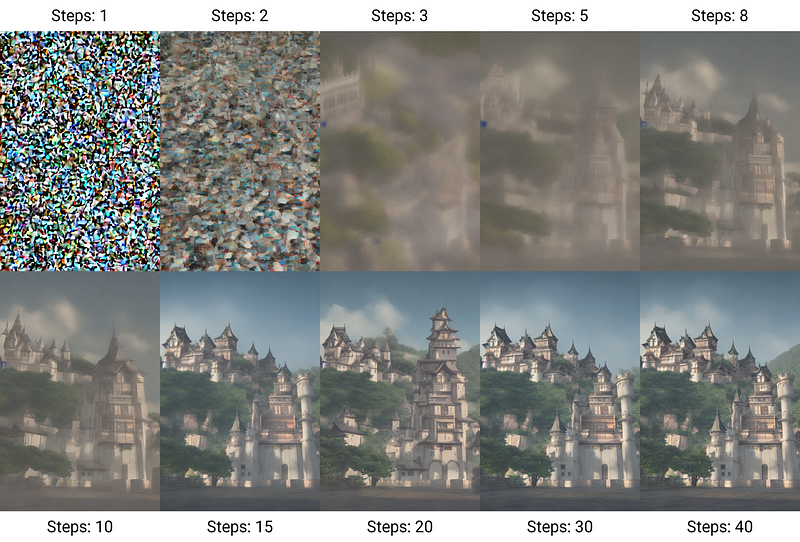
Let’s recap what Stable Diffusion does when it is generating images: it all starts with a random noise pattern. This noise pattern is then cleaned up by the AI model step-by-step until it looks like the thing an initial text prompt asked for.
Interestingly, Stable Diffusion has been trained to generate music instead of images by teaching the model the relationship between visual representations of sounds (spectrograms) and their corresponding text descriptions.
Reading “High-resolution image reconstruction with latent diffusion models from human brain activity,” which is the title of the paper published by Nishimoto’s team, one could easily get the idea that the scientists taught Stable Diffusion how to interpret brain activity in a similar way the model has been taught to generate music.
But that is not what happened.
It sounds pretty cool though.
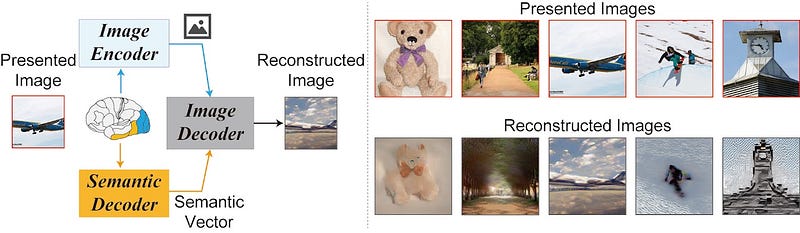
Nishimoto et al. took a dataset that included both the images that have been shown to people and the brain activity (fMRI scans) of those people while they were looking at those images. This data was then used to train two AI models to generate visual and semantic representations of the fMRI data. In a final step, they fed Stable Diffusion those preliminary representations and found it to dramatically improve constructing images with higher resolution and better semantic fidelity.

So, Stable Diffusion does a lot of amazing things, but it is not reading our minds.
Yet.
Because given the insane speed at which AI and neurotechnology are developing, this doesn’t even seem out of reach …
➡️ For more information about AI & Creativity, follow me on Twitter or Medium (use my referral link to get full access to all my articles and those of thousands of other writers).
➡️ If you like my content, why not leave a “clap” at the end of this article, so more people can see it?


