
“Cabaret”: An Audacious Cinematic Masterpiece Turns 50
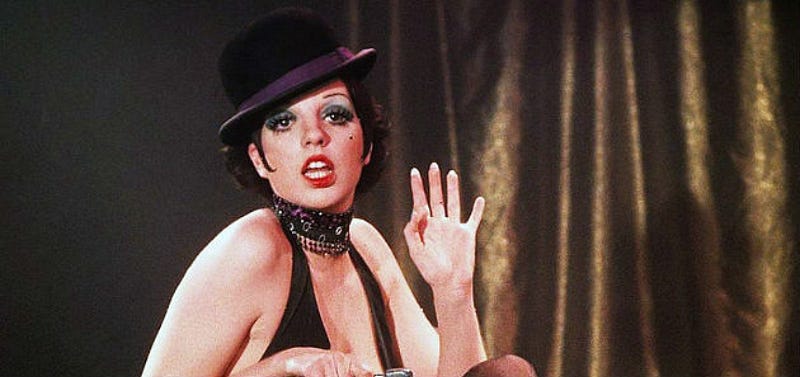
Today marks the 50th anniversary of the release of Bob Fosse’s mind-bogglingly transgressive and dazzlingly staged 1972 musical Cabaret. The film won a jaw-dropping 8 Academy Awards and has firmly established itself as an all-time classic, but it is all too easy to lump it in with other musicals of the era and forget that this tale of bisexual and transgender performers struggling in Berlin during the rise of Hitler is a singular achievement that remains daring even by today’s standards.
How I Discovered Cabaret
I was very young when I became obsessed with Hollywood History. The obsession was fueled by a book my parents bought me one year about the history of the Academy Awards. I pored over every page, reading about legendary filmmakers and actors (many of who died before I was born) and making a mental note of all of the films I would watch someday.
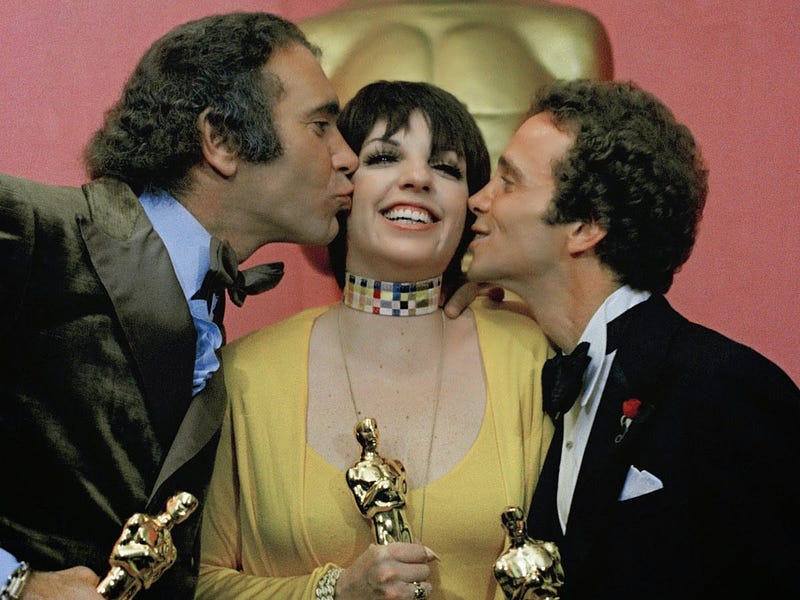
One of the most fascinating ceremonies I read about was undoubtedly the 45th Academy Awards, which was held on March 27, 1973. I naturally assumed the year had been dominated by The Godfather, a film that my father heralded as the greatest film ever made and one the American Film Institute had just ranked the 3rd greatest in a primetime telecast. Although that mafia masterpiece did win three major awards — Best Adapted Screenplay for the film’s director Francis Ford Coppola and the novelist Mario Puzo, Best Actor for Marlon Brando, and Best Picture — the real powerhouse that year was a film called Cabaret. That film won a stunning 8 Academy Awards including Best Director for Bob Fosse, Best Actress for Liza Minnelli, and Best Supporting Actor for Joel Grey.
By the late 1990s, movie musicals had become passé. (It would be a few years before the one-two punch of Moulin Rouge! and Chicago revived the genre.) Also by that time, Liza Minnelli had become little more than a punchline. (It would be a few years before she owned her chaotic image on the brilliant comedy series Arrested Development and had a triumphant return to Broadway with her award-winning one woman show.) The idea that a musical headlined by Liza Minnelli beat out The Godfather for Hollywood’s top awards was unconscionable to me.
Intrigued, I rented the film from my local library and watched it one weekend night when my parents were working the night shift. When I reached the end credits, I was frozen in shock. Not only was it one of the greatest films I had ever seen, but it was also one of the most shocking and transgressive films I had ever seen. And it was a musical released 12 years before I was born that was rated PG.
I have seen Cabaret about 5 times since then (including a viewing last week in preparation for this article), and it never ceases to captivate me, fascinate me, and utterly floor me.
Cabaret: The Road to the Big Screen
Cabaret was released in theaters on February 13, 1972 — exactly 50 years ago to the day that I am publishing this article. It was a critical and commercial smash upon its release, but its road to the big screen was not a straightforward one.
The film was rather loosely based on the 1966 stage musical of the same by the legendary duo of composer John Kander and lyricism Fred Ebb. The show swept the Tony Awards the following year, winning 8 awards from 11 nominations. (Fun fact: one of its Tony wins was for Joel Grey, who would go on to reprise the role in the film and win an Oscar.) The musical was based on the 1951 play I Am a Camera by John Van Druten, which itself was a critical and commercial success, winning Julie Harris a Tony for originating the role of Sally Bowles (a role which Liza Minnelli would make even more famous). I Am a Camera was based on a semi-autobiographical 1939 novel by Christopher Isherwood called Goodbye to Berlin, which recounted his relationship with 19-year-old cabaret singer Jean Ross in the Weimar Republic.
So to recap, the film was an adaptation of a stage musical that itself was an adaptation of a stage play that itself was an adaptation of a novel.
The rights to film the stage musical were purchased in 1969 by the production company Allied Artists, who brought ABC Pictures on as a partner. Cy Feuer, a Hollywood and Broadway powerhouse who already had 5 Oscar nominations and 5 Tony nominations under his belt, was attached to produce the film. The studio wanted a big name like Gene Kelly or Billy Wilder to direct the film, but Bob Fosse lobbied hard for the gig and won it.
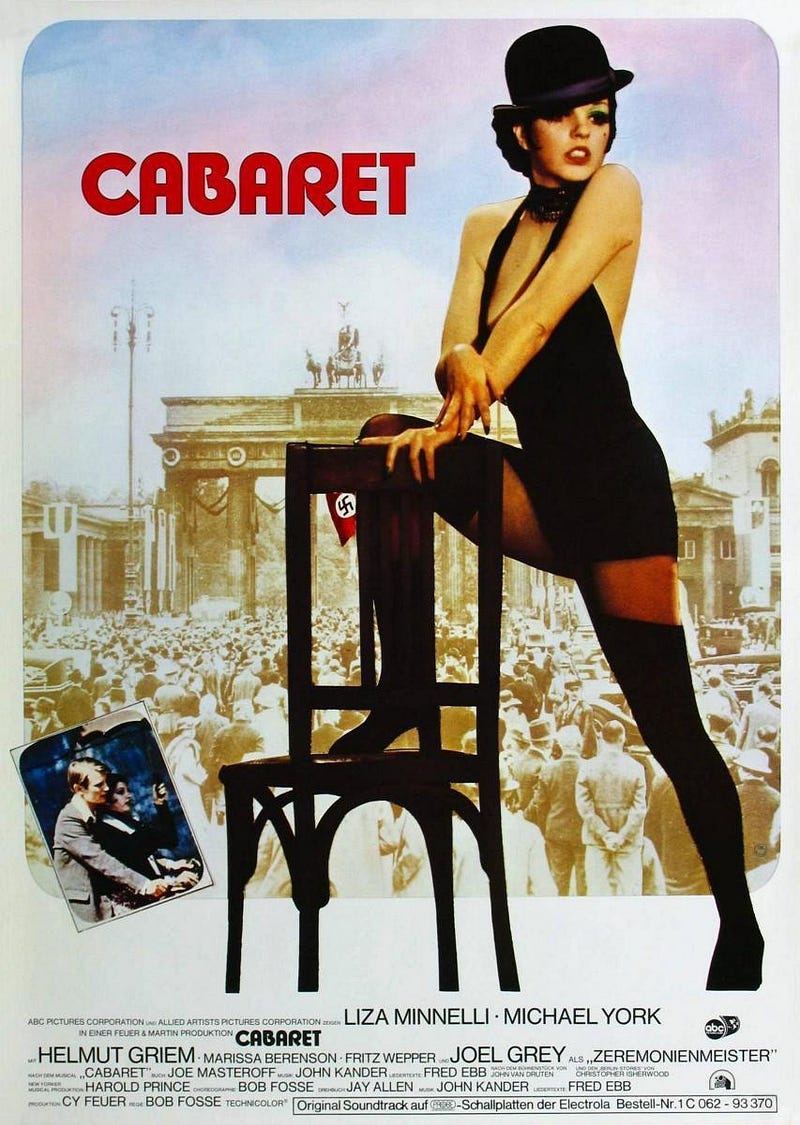
Fosse was already a Broadway legend, having won 4 Tonys from 10 nominations by the time the film went into production. However, he was a risky quantity in Hollywood as his recent directorial debut Sweet Charity was a critical and commercial bomb. The film, which was an adaptation of the stage musical he directed, received some acclaim for Shirley MacLaine’s star turn but otherwise dismissed by critics and moviegoers.
The screenplay was written by Jay Presson Allen. She had previously written Marnie, the 1964 psychological thriller directed by Alfred Hitchcock and headlined by Sean Connery and Tippi Hendren, and The Prime of Miss Jean Brodie, the 1969 British drama that won Dame Maggie Smith her first Academy Award. Despite her pedigree, Fosse was frustrated by the screenplay she delivered and brought on Hugh Wheeler to heavily revise it. Wheeler was a friend of Christopher Isherwood’s and worked with Fosse to retain much of the edgier elements of the story that were excised for the original theatrical adaptations. (Fun fact: Despite writing much of what ended up on screen, Wheeler was credited as a research consultant and only Allen was nominated for the screenwriting Oscar).
Producer Cy Feuer had cast Liza Minnelli and Joel Grey before Fosse came on board as the director. Minnelli was becoming a hot commodity having leveraged her royal lineage (she is the daughter of Oscar-winning director Vincent Minnelli and legendary performer Judy Garland) into an acting career that had already won her the Tony for Best Actress in a Musical (for 1965’s Flora the Red Menace) and scored her an Academy Award nomination for Best Actress (for 1969’s The Sterile Cuckoo). Grey was selected to reprise his acclaimed, Tony-winning role in the film. It was Fosse who hired Michael York to portray the film’s other main character.
The film was shot on location in West Germany with a film crew that was largely hired there. Another amusing fun fact about the film is that the indoor scenes were shot on the same soundstage where Gene Wilder was filming Willy Wonka and the Chocolate Factory and Fosse would reportedly complain at length that they would run over and delay the shooting schedule for Cabaret.
The Audacious Plot and Themes of Cabaret
HBOMax, which is currently the streaming home of Cabaret, summarizes the film as follows: “A starry-eyed singer and the club’s master of ceremonies try to bring happiness and decadence to the lives of Berliners as Nazism threatens to destroy their lives.”
Although this tagline is technically accurate, it is wildly misleading. It gears viewers up for an inspiring story of brave and inspiring artists going toe-to-toe with the Nazis. Anyone going in with that expectation will be absolutely shocked by what unfolds.
The film takes place in Berlin in 1931 as the Weimar Republic was coming to an end. Poverty is rampant and anger and desperation regarding the economy is high. Jews and communists are being singled out for harassment and there is growing buzz about the rise of a political leader named Adolph Hitler.
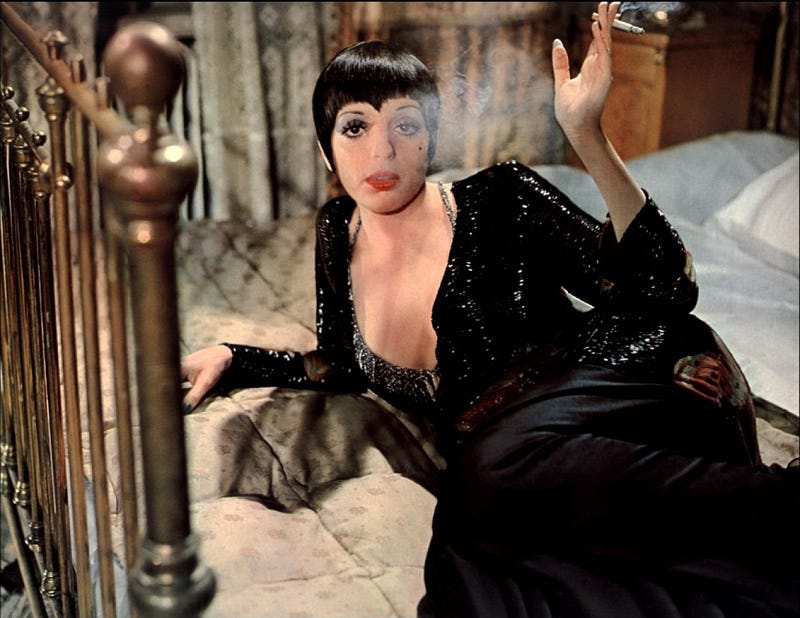
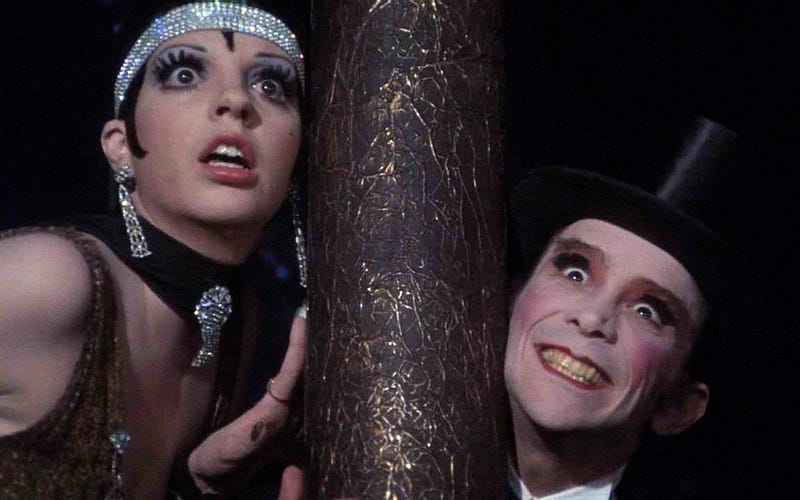
But social concerns are far from the mind of our protagonist, Sally Bowles (Liza Minnelli). She is a cabaret performer living in a seedy boarding house. She is supposedly the daughter of an American diplomat, although the degree to which Sally’s autobiography is based in truth is never clear. She is a headliner at the Kit Kat Club, an edgy night club that puts on musical numbers and skits that transgress social norms at every turn. The club is overseen by an unnamed Master of Ceremonies (Joel Grey) who is an utterly bizarre and captivating individual that remains an enigma throughout the film.
The catalyst for the film’s plot is the arrival of straitlaced Brit Brian Roberts (Michael York). He arrives at Sally’s boarding house looking for a room and plans to make his way in Berlin by giving English lessons to wealthy patrons. Sally is immediately smitten with him and he eventually relents, even though he makes it clear that every attempt he has had at a sexual relationship with a woman in the past has been disastrous (suggesting that he is gay).
A playboy baron named Maximillian von Heune (Helmut Greim) visits the Kit Kat Club and becomes enamored with Sally. She turns up the charm to the max, eager to be lavished with expensive gifts and go on grand adventures. Maximillian is all too willing to oblige and also lavishes a jealous Brian with attention and gifts. In one of the film’s most jaw-dropping moments, it is revealed that Maximillian was having a sexual relationship with both Sally and Brian. Maximillian abruptly leaves town and leaves them 300 marks and a dismissive note. Sally thought Maximillian would transform her life, but he treated her and Brian as little more than prostitutes and disappeared.
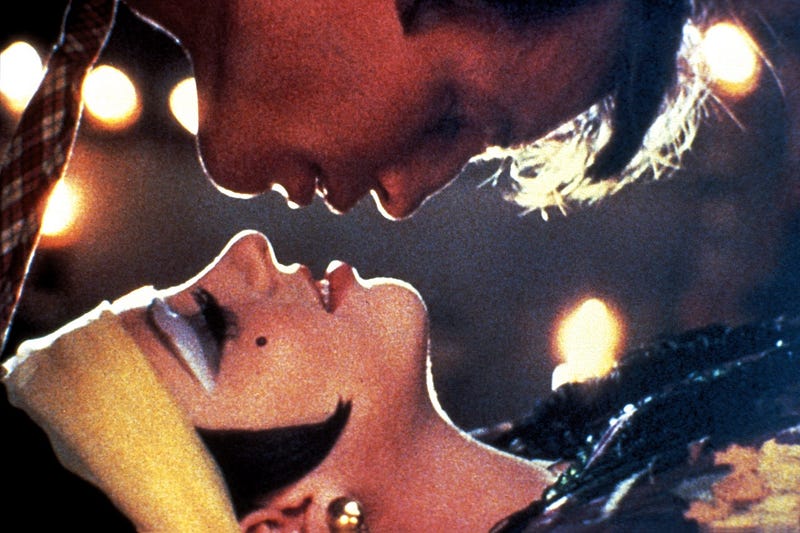
The relationship between Sally and Brian, which was doomed from the start, struggles under the weight of this disastrous love triangle. The final blow to their relationship comes when Sally discovers that she’s pregnant (possibly by Brian, possibly by Maximillian). She and Brian agree to embrace a more traditional life and start a family, only for her to shift course and have an illegal abortion. The film ends with Brian leaving Berlin and Sally doubling down on her decadent and chaotic lifestyle.
A major subplot of the film involves two individuals who come into Sally and Brian’s lives. The first is Fritz Wendel (Fritz Wepper), a destitute gigolo who meets with Brian to improve his English so that he can woo wealthy foreign women. The second is Natalia Landauer (Maria Berenson), a German Jewish heiress who also seeks Brian’s services. Fritz pursues Natalie relentlessly, but she is adamant that it can never work because he is not Jewish. In one of the film’s many daring twists, it is revealed that Fritz is actually a Jew posing as a Protestant to escape anti-Semitism. He embraces his Judaism and marries Natalia.
Throughout the film, the violence of the Nazis escalates. Jarring cutaways show horrific hate crimes against Jews and communists and anyone who defies them (including Brian). And in the film’s most powerful scene, a serene lunch at a biergarten is interrupted by an Aryan youth choir breaking out in a pro-Nazi propaganda song (“Tomorrow Belongs to Me”).
Upon rewatching the film last week, two things occurred to me for the first time. One was that it’s just as plausible that Maximillian disappeared because he was fleeing before the Nazis took power (as the wealthy and well-connected were able to do) as it was that he was simply bored of Sally and Brian. The second is that if Fritz and Natalia did not find a way to emigrate shortly after their wedding, they would most certainly have been sent to concentration camps. The sociopolitical context of Cabaret is rich and often subtle, which makes repeated viewings of the film remarkably rewarding.
Taking a step back, it is truly astounding to think that a major Hollywood film released five decades ago tackled the themes that this film did. It tackles polyamory, bisexuality, gender fluidity, and sex work with a boldness that most films wouldn’t attempt. It featured an abortion as a key plot point a year before Roe v. Wade ensured abortion rights in the United States. The film also tackles Anti-Semitism head-on, depicting horrific hate crimes and showing with fascinating nuance how anti-Semitic beliefs spread through Germany largely unchallenged.
I truly believe that if Cabaret were released today, its plot alone would be considered daring. And I have yet to even touch on the bold artistic innovations with which it tells its story.
The Exquisite Artistry of Cabaret
The strikingly effective visual storytelling that earned Fosse his Best Director Oscar is evident in a comparison of the opening and final shots. The film opens with a distorted image that gradually comes into focus to reveal the Master of Ceremonies heavily made up face. We then see a joyful and diverse crowd crowd seated at the Kit Kat Club. The film’s closing shot is similar, but this time the audiences is dominated by Nazis and the air is full of fear. It is truly chilling.
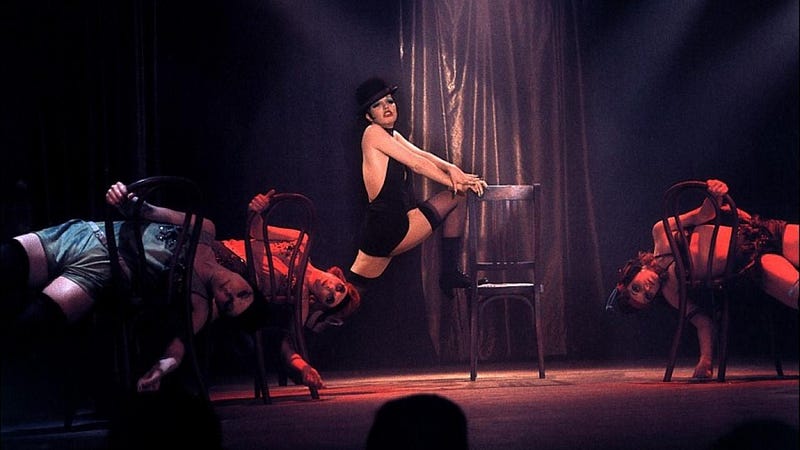
One of Fosse’s most innovative and successful decisions when mounting the film for the screen was to keep the musical numbers firmly grounded in reality. Rather than having the characters break out in song to express their feelings or advance the plot, every musical number is organically integrated into the film. With the exception of “Tomorrow Belongs to Me,” every musical number is performed on stage at the Kit Kat Club. The result is a musical that feels gritty and atypically grounded in reality.
Much ado was made about the significant overhaul of the film’s musical arrangement, which excised several key songs from the stage production and added in several new ones. But they all works spectacularly. Each of the musical numbers serve to express a characters’ inner turmoil or examine a theme or plot point. The opening number “Wilkommen” provides an introduction to the decadence of the Kit Kat Club and the Weimar Republic in general. “Mein Herr” establishes the character of Sally Bowles, or at least the character Sally Bowles is trying to play. “Maybe This Time” shows us the devastating insecurity and fragility beneath Sally’s exterior. “Money, Money” shows how the economic tragedy of the Weimar Republic allowed for Nazism to rise. “Two Ladies” playfully skewers the bisexuality and polyamory existing in the central love triangle. “If You Could See Her” is a deeply uncomfortable number that shows how anti-Semitism has spread even to the liberal hedonists that perform at the Kit Kat Club. And the titular closing number finds Sally doubling down on her life of decadence, even if it means her own destruction.
The numbers are staged spectacularly. The standouts are undoubtedly Sally’s three big solo numbers. “Mein Herr” with its remarkably sexy, iconically Fosse chair dance is one of the most captivating and impressive musical sequences ever put on film. “Maybe This Time” is a heart-wrenching torch song that gives Liza a cinematic musical moment to rival her mother Judy Garland’s legendary performance of “The Man That Got Away” in A Star is Born. And the titular closing number is not only one of the best vocal performances ever captured on film, but also one of the most powerful film endings of all time.
The other songs are memorable as well, if less impactful. “Wilkommen” is the definition of mood-setting and it’s an ear-worm for the ages. “Money, Money,” “Two Ladies,” and “If You Could See Her” are playful comic numbers that go more for laughs than awe and shift the mood of the film. And then there is the outlier of them all, “Tomorrow Belongs to Me.” The only song not performed on stage at the Kit Kat Club is perhaps the film’s dramatic apex and plays like a stunning (and horrifying) counterpart to the iconic scene in Casablanca when Rick’s patrons drown out the Nazi songs with their stirring rendition of the French National Anthem. Here, none of the patrons rise to challenge the Nazi’s songs. Rather, we simply see the reactions of a deeply worried old man, a radicalized young woman, and our protagonists who simply slip out the back to avoid it all.
The acting in Cabaret is top-notch. But, while Michael York, Helmut Griem, Marisa Berenson, and Fritz Wepper are perfectly cast and embody their roles flawlessly, this film really belongs to the two Oscar-winning performances by Grey and Minnelli.
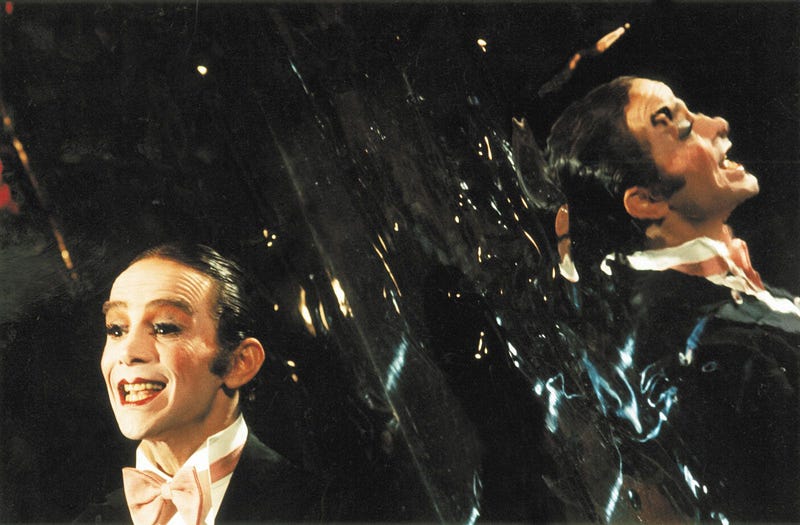
Grey’s performance is a singular one in the history of cinema. He has nearly 20 minutes of screen time and won an Oscar, but he is not actually a character. He is never named and we only see him off stage for a brief wordless moment. He is enigmatic and alternates between adorable and grotesque. No performance like this has ever been nominated for an Academy Award and it seems unlikely that one ever will be again. It’s a testament to Grey’s spectacular talent that he not only won the Oscar, but did so over Al Pacino’s legendary turn as Michael Corleone in The Godfather.
Then there’s Liza. Quite simply put, it is one of the greatest performances in film history. She is easily on my top 10 list of most deserving Best Actress winners of all time. The first time I watched the film, I cringed at how over-the-top she went in the film’s initial scenes. She plays Sally like a character in a madcap farce even when those around her are acting in a grounded drama. But I quickly realized it was a purposeful and brilliantly executed decision to show Sally’s artifice, showmanship, and underlying mental health issues. But it is truly in Sally’s moments of quiet devastation when she shines. Key moments include her sitting in the dark after being stood up by her father via telegram, when she contemplates the pros and cons of following through with her pregnancy (“I guess babies love you automatically, don’t they?”), and the confused hand gesture with which she dismisses Brian when he confronts her about why she had an abortion after stating how excited she was to be pregnant. Even without the all-time classic song-and-dance numbers she executes it’s an all-time great performance.
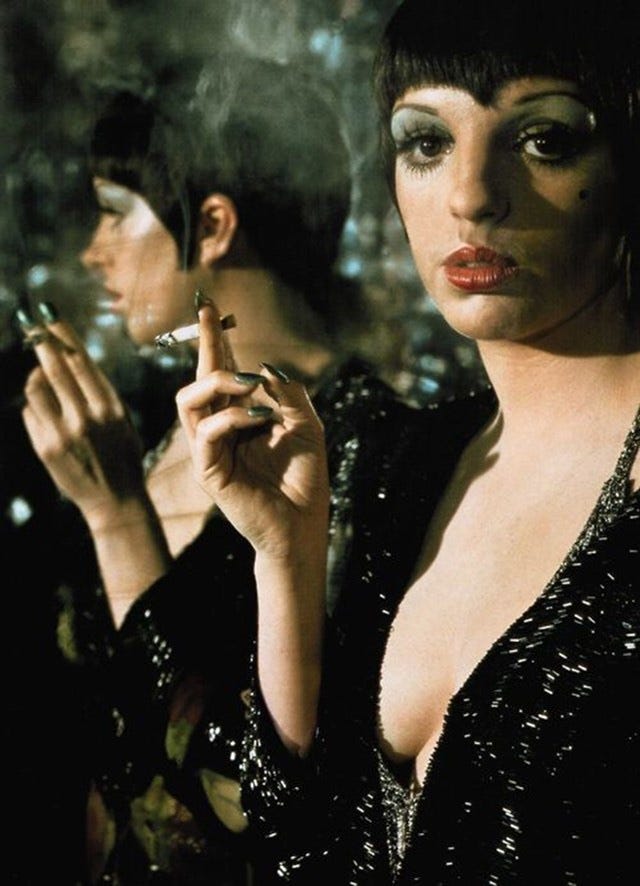
The film’s production values are superb, as evidenced by its multiple Oscar wins in technical categories. In particular, Geoffrey Unsworth’s cinematography gifts us with some of the most memorable images ever committed to film, including the aforementioned opening and closing shots, the bizarre and inventive points of view of the musical numbers, and the upside down kiss between Sally and Brian. Equally impressive is David Bretherton’s editing, which jarringly juxtaposes the film’s unfolding plot with horrifying scenes of the Nazis rise. The film is as impressive technically as it is thematically.
The Legacy of Cabaret
The film’s reception upon its release was rapturous. It was nominated for 10 Oscars and won 8 — the aforementioned trophies for Fosse, Minnelli, and Grey, as well as Best Art Direction, Best Film Editing, Best Score, Best Cinematography, and Best Sound. It continues to hold the record for the most Oscars ever received by a film that lost Best Picture. It also swept the BAFTA Film Awards, the National Board of Review Awards, and the Golden Globe Awards. The film was also a hit with audiences, grossing $42.8 million (nearly 10x its $4.6 million budget and nearly $300 million when adjusting for inflation).
Unlike many films that are enthusiastically received but age poorly, it is held in high esteem by contemporary critics and historians. For example, the American Film Institute ranked the film as the 63rd best American film ever made and the 5th best musical and ranked the closing number “Cabaret” as the 18th best song from an American film. And in 1995, the film became the 12th live action musical selected by the Library of Congress for preservation in the United States National Film Registry due to being deemed “culturally, historically, or aesthetically significant”.
In sum, Cabaret is one of the best acted, most technically impressive, transgressive, and important films ever made. There is no better time to discover it or revisit it than on its golden anniversary.
Follow the author of this article on Medium and Twitter.
Read recent articles about movies written by this author:


