
Bruce Springsteen Is a Living Lesson for the People Who Think of Themselves as ‘White’
My Impromptu Conversation with ‘The Boss’
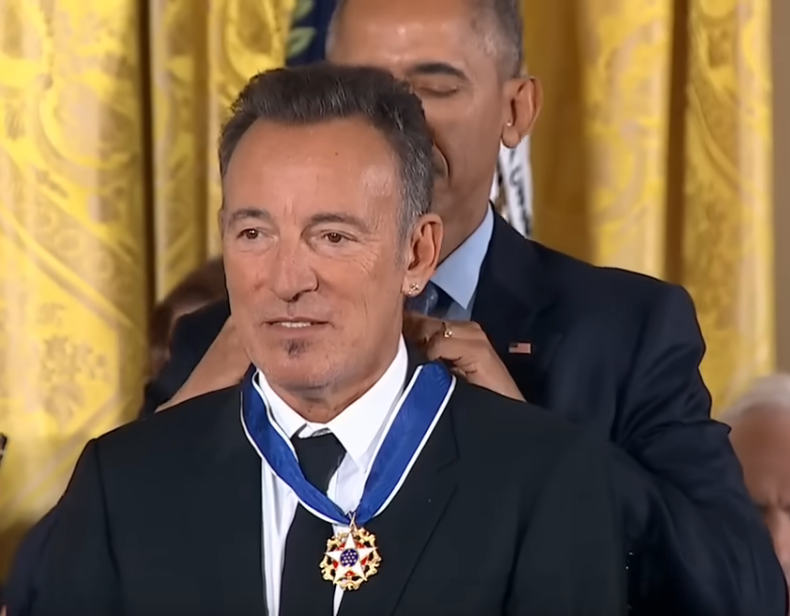
Bruce Springsteen defies the racial identity corresponding to the racial category assigned to him at birth. Although he has to “check the box” like all of us when forms have to be filled, he does not consider himself to be a ‘white’ person nor a member of a so-called ‘white race.’
He considers himself simply, to be human, and he uses his talents to communicate that in every way. And that, more than anything else, is what makes Bruce Springsteen a special American treasure.
He serves as a living lesson to the people who identify with him the most.
My impromptu interaction with Bruce made me realize that he is aware that being human is difficult in a world where our identities are determined and shaped by skin color. He understands that being human requires work. Hard work. You have to work to be human when the world is telling you to be something else.

I literally ran into Bruce Springsteen in the music aisle at a local bookstore.
It was our shared love of music that brought us to the same spot. I was struck by his incredibly humble, laid-back, and friendly demeanor.
The Boss even took time from his schedule to send a note with his blessings:
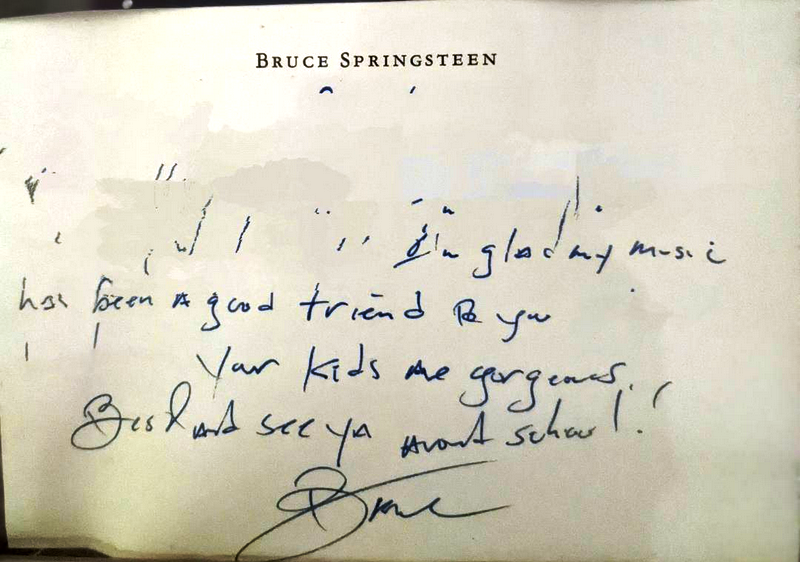
During our unplanned greet, he told me that he was in town for a breather as he was in the midst of an international tour. He said he had performed in Sweden the day before and was flying back out to Norway to continue the tour the next day. I recall thinking to myself;
“this guy’s a rock n’ roll superstar performing onstage in front of tens of thousands of delirious fans in sold-out arenas all around the world and he’s standing in front of me all by his lonesome in this quiet space holding a basket with CD’s and DVD’s, wearing a bandana, with no shades, no body guards or entourage, wearing crumpled jeans and a checkered shirt with rolled up sleeves talking to me like he’s just going back to work tomorrow to plant some more trees or something.”
He was about as unpretentious and pedestrian as you can imagine.

Bruce never knew anything about my background or what I did to earn my keep. He never knew that he was having a friendly chat with one of the first Black clinical neuropsychologists on the planet or that I was a peer-reviewed author on groundbreaking research in the field. I was as pedestrian-looking as he was.
He doesn’t know that I write about the psychological nature of the Racial Hierarchy social construct.
He doesn’t know that the main theme in my writings is how the creation of race, as a social construct, has served to dehumanize people.
He doesn’t know that I write to get people to understand that the social construct of race, and its corresponding hierarchy, has created an anti-Black psychological identity.
To be blunt, I doubt if Bruce knows that the category of ‘white’ was invented and legislated to be anti-Black. Bruce doesn’t hide that he wasn’t particularly fond of school (neither was I), and you would need to know American and Colonial history, minus all the patriotic embellishment, to understand that this is the essential foundation and purpose for the creation of the ‘white’ racial category let alone the creation of race itself as a social construct.
I doubt if he knew that George Washington owned hundreds of Black-African slaves and that he wasn’t particularly kind to them:
But then again, even if he was a studious standout, what could he really know? They don’t teach this stuff in school anyway. Rather, the delusion of a superior ‘whiteness’ is embraced and communicated through a process of subliminal racial indoctrination:

As part of this anti-Black indoctrination (which, by the way, impacts on all of us in some form regardless of our skin color), scientific contributions by Black Americans to our modern world are routinely ignored while athletic or entertainment prowess are celebrated as the only thing that Black people are good for.
For example, we all learned about Thomas Edison, (I had many school field trips to his lab in West Orange) but not once were we told about Lewis Latimer, his Black American lab assistant who made the light bulb functional for household use and who worked in that very same lab that I visited while in elementary school.
We were never taught about Granville T. Woods. How many of you know that subway trains run on the third rail thanks to his ingenuity:
We have all heard about Dolly Madison but how many of you know about Grace Wisher, the 13 year-old Black indentured servant who was a major contributor to the creation of the Star-Spangled Banner flag:
In fact, how many Americans are even aware that no one on the planet can get through a 24-hour day without relying on something invented or improved upon by a Black American? Here’s a list of just some of these inventions that we use everyday:
3 of the original nine patents that all PC’s are based on, technology basis of the internet, cellphones, smartphones, digital and video calling, GPS, video game consoles, flushing toilet, stove, refrigerator, AC, heat furnace and radiator, doorknob, lock, peephole, telegraph, mop, broom, dustpan, iron, ironing board, dry cleaning, home security system, garbage can, house clock, most kitchen utensils, clothes hanger, traffic light, mailbox, blood plasma, method of inoculation.
Oh, and one more thing, every time you get in your car you can thank Black American Richard Spikes. He invented & developed the automatic transmission & gear shift for automobiles, which he patented in 1932. He also invented and patented the safety brake system and a brake testing machine. (He invented the beer keg Tap as well). #BlackExcellence

Now I don’t know how much Bruce knows about all this if anything. But to him, I don’t think it really matters because he’s already manged to transcend the evil of race and is busy preaching lessons on humanity to his choir.
It’s the choir that needs to heed his spiritual calling and do the work required to become human.
I found Bruce Springsteen to be a spirit who rolls up his sleeves and goes off to work using his God-given talents and skills for the positive. And yeah, he’s blessed with a very nice living, but don’t let that get in the way and fool you.
Bruce is a Living Legend, but he’s a greater Living Lesson. He doesn’t identify as a ‘white person’ or a member of a so-called ‘white-race.’
He’s just happily human.
“You can get killed just for living in your American skin” Bruce Springsteen ‘41 Shots’
This song is about Amadou Diallo, a Guinean immigrant who was killed in his New York City doorway when New York City police shot at him 41 times after mistaking his wallet for a gun. Springsteen felt the shooting was an egregious over-reaction by the police, who killed an innocent man.
The song sparked enormous media coverage when it was part of The Boss' tour-ending 10-night stand at Madison Square Garden in 2000. The performances of the song in New York resulted in protests by the New York City Police Department and the Police Benevolent Association, who saw it as an attack on the NYPD (some cops refused to work security at the shows).
Thank you for reading.
© 2023 Andrew P. Brown III, PhD. All rights reserved.
Additional Material:


