Breastfeeding: A (Sort Of) Success Story
The 487th time is the charm
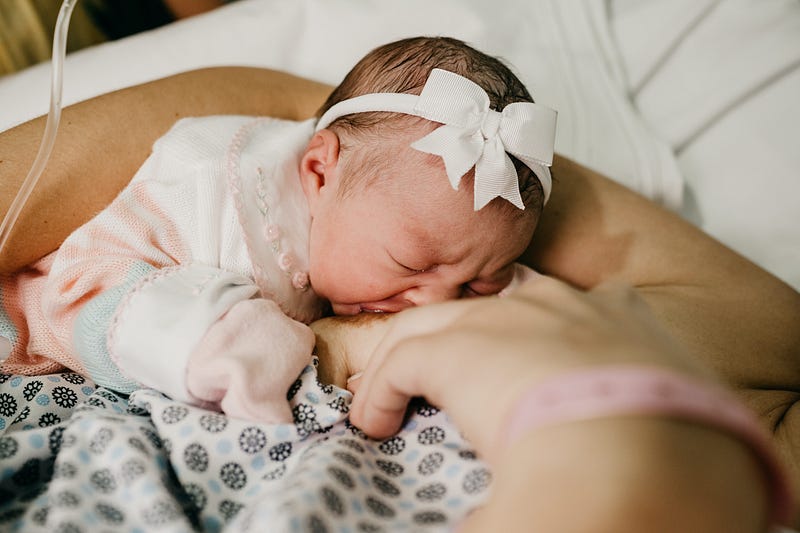
I regarded the prospect of breastfeeding my son the same way I imagine that Elizabeth Taylor approached the issue of marriage — with a minimum of preparation and a sunny confidence that everything would work itself out.
Both of us were bound to be disappointed.
After an initial promising nibble, my son was moved to the nursery, and then, unfortunately, to the neonatal intensive care unit. The doctors suspected a bacterial infection and mandated a 10-day course of antibiotics. We had to go home without him.
Once I did get to hold him again, I asked for a lactation specialist to help me get back on the breastfeeding wagon. But even with the screens she erected, I felt self-conscious, and her maneuvering of him and me to obtain the right positioning just felt like a really awkward game of Twister.
I kept trying, but I was easily frustrated. I rented a pump and used it sporadically. By the time I returned to work, my milk ducts were dry and I was suffering from a huge case of mommy guilt. Today, however, my son is a happy, healthy 15-year-old who is hopefully never going to use my lack of lactation against me.
But still. I’d seen the pictures in magazines of infants cozily nestled against their mother’s breasts and talked to friends whose breastfed children saw nary the inside of their pediatrician’s office except for their regularly scheduled check-ups. When I got pregnant a second time, I decided I was going to breastfeed or go down swinging.

I attended a six-hour class at the hospital where I would deliver. Most of the moms in the class were first-timers, but there were a couple of women like me. We learned Breastfeeding Dos (Feed on demand — check; Keep baby in your hospital room — 10–4; Let housework slide — can’t stop what you never started) and Don’ts (No bottles for three months, no pacifiers).
We practiced with agreeable rubber babies and pillows brought from home. We learned about studies touting the reduced risk of certain diseases if babies were exclusively breastfed for a year. A year seemed impossible. My goal was six months. If I got there, I’d make a new goal. I was excited. I was informed. I was as prepared as I was going to be. The mind was more than willing. It was the spirit who yearned for a really long nap.
But my newborn daughter didn’t get the memo.
I pressed ahead, ordered a pump for my room to stimulate production, and tried to master the football hold with a real, live baby. For the first couple of feeds I was cautiously optimistic. At some point though I started to panic a little.
She was getting fussier. She didn’t seem to be full. Hadn’t they told me her stomach wasn’t any bigger than her tiny fist? By the third go-round, she was screaming into my nipple like an angry rocker with a major grudge. It was four o’clock in the morning.

In one fell swoop, I gave her a bottle with formula, tried a pacifier on her, and sent her to the nursery so I could get some sleep. The next morning, a lactation consultant answered my SOS call. “Just relax,” she kept telling me as she gently pushed my shoulders down.“Just keep at it.”
And I did. All through the next week until my nipples were bleeding and I was delirious with lack of sleep. After breastfeeding I would pump and then feed my daughter again by syringe or spoon. I kept detailed records of ounces pumped, and observations about the success of our mutual endeavor. (Maybe some suckling on the right side?) Sometimes I felt like things were going well. Sometimes I let my mother give her a bottle while I cried into my pillow.
At her two-week check-up, my daughter hadn’t gained back her birth weight. I had a couple more weeks to get it going or I would need to start on formula. I attended a new mother lactation support group. In some ways, it was just what I needed. Twenty some odd women who were having the same problems I was. There were helpful tips and lots of tears as we commiserated about our feelings of inadequacy, our fear that we had already failed our children.
The thing was, most of these moms got over the hump, or at least it seemed like they did. The war stories started to seem like a competition I was bound to lose. My little one still refused to latch on half the time, and then when she did, she wasn’t drinking much. I would rejoice over what I thought was a good feed, only to discover on the baby scale that she had taken less than an ounce.

I decided that getting breast milk down her would be my first priority. I pumped and bottle-fed her and got her weight up. But I still wasn’t letting go of the dream. Although even I knew it was overkill, I purchased a Supplemental Nursing System, used by adoptive mothers and others with major lactation difficulties.
In the accompanying video, the expert serenely demonstrated how the tube that runs from a feeding bottle hanging around your neck might be attached securely to your breast. But for me it proved to be harder than finding (and threading) a needle in a haystack.
I could never even get the tube in the right place to begin with and my milk just made the tape less adhesive. By then, my daughter was three months old and I wondered if we were past the point of no return. If we hadn’t gotten it by now, we probably weren’t going to.
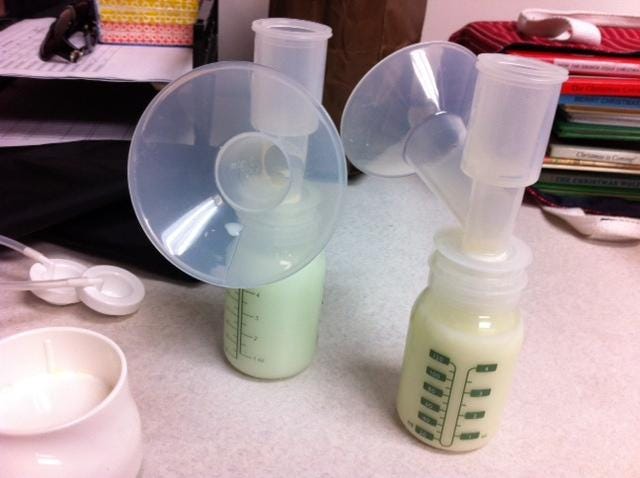
On the bright side, I had pumped so much my freezer was full of frozen breast milk and a strong wind would set me to leaking. I had a toddler to care for. I officially gave myself permission to fail. If my baby wanted to use my breast only as a pacifier, so be it.
And it was only then, when I truly started to relax, that something fell into place.
At first, I didn’t even notice it. My daughter didn’t take as much from the bottle after time on the breast. I could feed her in the middle of the night and she’d drift back to sleep, perfectly content.
Was she pulling harder, or was the milk easier to come by because I wasn’t obsessively pumping? I didn’t care which came first, the chicken or the egg, because after so much work — this was blissfully effortless. As the first year drew to a close, we were still at it.
The warm fuzzies I got when my daughter smiled up at me were as good as I hoped they would be. I didn’t give up the pump entirely and I did supplement with formula. And I never could get my groove on to feed her in public except for that one time on the plane when I would have stripped naked to make her stop crying.
But it didn’t matter. We had finally found our way, and it was more than good enough for the both of us.
Betsy Denson, 2022
Author’s note: A modified version of this piece originally appeared in Houston Baby more than 10 years ago. In revising it I was amazed that I cared so much about trying. Today’s me would have (hopefully) been a lot more chill about the process — and probably let things go a lot sooner.