
Book Review — The Coddling of the American Mind by Greg Lukianoff & Jonathan Haidt
Greg & Jon took me on an enlightening journey that I honestly wasn’t expecting
As someone who is anti-censorship, I was very curious to read the perspectives of two left-leaning academic minds who’ve seen firsthand how so-called “cancel culture” is playing out across college campuses.
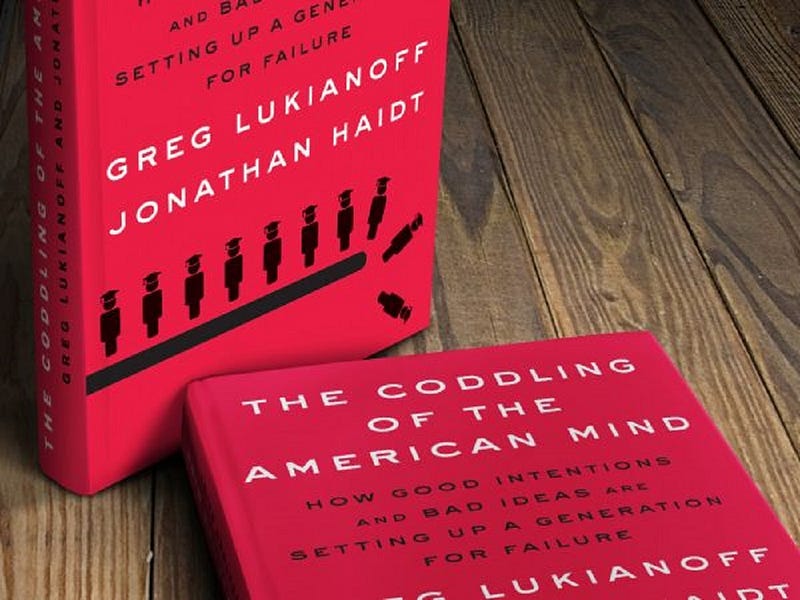
The Coddling of the American Mind: How Good Intentions and Bad Ideas Are Setting up a Generation for Failure provides us with 269 pages documenting the cautionary tales presented when neoliberalism, political correctness, and bureaucracy collide.
WHY YOU SHOULD READ THIS BOOK
Greg Lukianoff, the President of FIRE (Foundation for Individual Rights in Education), along with Jonathan Haidt, a renowned NYU psychology professor, divide their book into four main sections spread out over thirteen chapters. In their introduction, they define “fragility” as having morphed into a call-out culture of what they deem to be “vindictive protectiveness.” As proponents of cognitive behavioral therapy (CBT), they redefine the term “coddling” by outlining what they’ve observed to be “problems of progress.”
What I appreciate the most about this book is how it strives to empower Millennials (aka “Generation Y”) and Centennials (aka “Generation Z”) without infantilizing us. They also endorse the alternate term of “iGen” to refer, collectively, to members of Gen Z — borrowing the descriptor from psychologist Jean Twenge. For ease of reference, I’ll refer to that plural noun, serving as a synonym for Zoomers, as “iGens” throughout this review.
STYLE / FORMAT
Lukianoff and Haidt combine both their personal experiences and anecdotes from academia with documented cases of college professors, employees, and students themselves getting demonized by mob mentality. Their goal in highlighting these incidents is clearly summoning all sides of topical debates to present their arguments thoughtfully — with no physical harm or criminal threats to bystanders and the loved ones of those being criticized.
This isn’t to say I’m in agreement with every idea they express. For example, I disagree with how, in Chapter 10, they seem to overly glorify the concept of “dignity culture.” I’m also skeptical of the authors’ endorsement of New Zealand’s “No Rules School” in Chapter 12, as well as their paranoia about the alleged overuse of the word “safety.” However, these minor quibbles are outweighed by a plethora of valuable content.
The first of their book’s four formally divided parts begins with its first enumerated chapter.
Chapter 1 — when exploring what they define as “fragile,” the authors credit economic theorist Nicholas Taleb’s theories of “antifragility.” According to the authors, “trauma” has become corrupted, as a word and a concept, over the past two decades. This dynamic led them to coin the term “safetyism” (which I’d never heard, before reading this book). They start off by describing a blanket ban on peanut-adjacent products imposed by the school that Haidt’s own son attended (where school officials ignored the actual science behind immunology). Then, Haidt and Lukianoff explore the controversy surrounding Wendy McElroy at Brown University where the fight over “safe spaces” first emerged onto the national scene in a problematic way. The authors suggest that iGens (aka “Zoomers” or “Centennials”) are experiencing these ramifications even more intensely than Millennials did during their college years.
Chapter 2 — using Buddha’s metaphor of “the rider-and-the-elephant,” Lukianoff and Haidt maintain that it’s healthy and responsible to question our emotions. CBT, they say, can keep this metaphor at bay by breaking down “schemas” (as defined by psychiatrist Aaron Beck) while disassembling cognitive distortions. They acknowledge how cultural psychologist Derald Wing Sue originally coined the term “microaggression” to combat the disenfranchisement of BIPOC students. However, this term is now applied more broadly to the point where everyone has been conditioned to assume the worst in everybody else.
Haidt and Lukianoff use political author Shadi Hamid’s approach to mitigating microaggressions as a way for students and teachers to avoid weaponizing misunderstandings. They challenge the assumption that bigotry is about impact rather than intent, and warn us how such blanket cynicism could have the inverse unintended effect of disenfranchising people with autism or speakers of English as a second language. The most prominent “cancel culture” example they discuss, in this chapter, is the 2015 demonization of student Zachary Wood when he invited Suzanne Venker to speak at Williams College.
Chapter 3 — the authors delve into the forced resignations of Mary Spellman from Claremont McKenna College, and Erika and Nicholas Christakis from Yale University, respectively. Next, Lukianoff and Haidt explain the concept of tribalism by pointing to the research of social psychologist Henri Tajfel and neuroscientist David Eagleman on ingroup/outgroup identities. “Identity politics,” they maintain, can be centered on either a common purpose or tribalism; but it gets complicated to attempt to do both. A good way to build bridges is by humanizing members of dissenting factions, much in the way civil rights activists Martin Luther King Jr. and Pauli Murray did.
The problem arises when we embrace philosopher Herbert Marcuse’s theory of “tolerance that discriminates” or “liberating tolerance” in hopes of achieving a reversal of power. When criticizing CRT scholar Kimberlé Crenshaw’s theory of intersectionality, they emphasize how it is more so certain observers’ interpretations of Crenshaw’s theory that can be harmful — not necessarily her theory itself. Instead, Haidt and Lukianoff endorse an intersectional model by feminist scholar Kathryn Pauly Morgan to better illustrate the theory — although they take issue with Morgan’s use of the term “colonized population” as a way in which she sets up a binary of good versus evil. Citing the work of Queer activist Trent Eady, they shine a light on the harm of call-out culture and virtue-signaling. They close the chapter by retelling the story of BLM organizer Hawk Newsome, who won over a live MAGA crowd by appealing to their common humanity.
Chapter 4 — this chapter ushers in Part Two of the book, exploring concepts such as “catastrophizing,” “concept creep,” “fortune-telling,” and “labeling.” Lukianoff and Haidt archive a cacophony of public figures at universities who’ve been victimized by the escalating tensions between Antifa and the Alt-Right: UC-Berkeley, Middlebury College, Pomona College, William & Mary, U-Oregon, and Reed College have all served as backdrops for violent clashes between fringes of the Far Left and the Far Right.
Chapter 5 — the authors look at how sociologist Emile Durkheim’s theory of “collective effervescence” explains the nature of (metaphorical) witch hunts. Many professors enable groupthink, either through open letters or silent complacency. As a result of this, some of the professors thrown under the bus have included Rebecca Tuvel at Rhodes College, Amy Wax and Larry Alexander at the University of Pennsylvania, and, in perhaps the most extreme case, Bret Weinstein at Evergreen State College. These injustices were caused by “institutionalized disconfirmation,” where professors with cognitive biases overrepresent their ideological cohorts within a given profession (e.g., hyper-liberal professors or hyper-conservative law enforcement officers).
Chapter 6 — proceeding into Part Three, Haidt and Lukianoff recall the 1990s as having marked increased American trends in media diversification, self-segregation of various demographic groups, disunity over current events, and sectarianism (aka “negative partisanship”). Cycles of “affective polarization” occur when left-leaning campus culture and right-leaning talk radio feed off of each other. The most conservative offenders of this cycle engage in doxing, such as the campaigns against Lisa Durden, George Ciccariello-Maher, Keeanga-Yamahtta Taylor, and Sarah Bond. This epidemic of affective polarization (what I alternately dub as “sectarian privilege”) is epitomized by Turning Point USA’s watchlist and hate crimes from white supremacists.
Chapter 7 — to illustrate the harm that call-out culture causes to one’s mental health, Lukianoff powerfully discloses his own suicidal tendencies from back in 2007. Between 2007 and 2012, the authors observed a trend where iGens became addicted to iPhones and social media platforms; this contributed to more mental anxiety and sheltered existence. They cite Twenge’s belief that overuse of electronic devices and screens will lead to FOMO (“Fear of Missing Out”) and FOBLO (“Fear of Being Left Out”). Comparatively, iGens have been given fewer freedoms by their parents than even Millennials received. Female iGens have reported depression and anxiety in higher percentages than male iGens, probably due to the saturation of beauty-based social media marketing geared specifically toward women and girls.
Chapter 8 — the authors trace the roots of safetyism by contrasting the public scorn toward Lenore Skenazy’s “free-range parenting” movement with the general reverence toward John Walsh’s activism to protect missing children. This created the trend of “paranoid parents” that began in the 1990s and ended up harming iGens and younger Millennials more than previous generations. When parents absorb this mindset of paranoia, a gap forms between actual risk versus imagined risk. They explore sociologist Annette Lareau’s theory of “concerted cultivation,” where middle-class safetyists (aka “helicopter parents”) deprive their children of unsupervised time, bulking them up with arranged playdates and extracurricular activities. In a different vein, working-class children are exposed to chronic adversity that makes them feel like fish-out-of-water when they arrive at college — and, compared to their wealthier peers, they have a harder time negotiating with institutions to gain positive outcomes for themselves.
Chapter 9 — Lukianoff and Haidt endorse playtime as an opportunity for kids to enrich themselves with social skills, curiosity, and stress management. They speak to psychologist Peter Gray’s definition of “free play” as children’s exploration that is spontaneous, vigorous, and experimental. Research shows that outdoor free play and risk-taking has plummeted from one generation to the next, across the three generations of Xers, Millennials, and iGens. An uptick in analytical skills designed for college prep has appeared in Kindergarten curriculums, at the expense of emphasizing social skills or imaginative play. Parents tend to panic about lower grades earlier, and it becomes a “college admissions arms race.”
They also concur with Gray’s advocacy of free play as a way to ingrain conflict management skills in kids. When teenagers head into college with this lack of leadership skill or sovereignty, Haidt and Lukianoff maintain that it creates university environments where students demand that administrators and bureaucrats regulate speech if some students find that speech to be objectionable. Here, the authors tie their theory of safetyism to this decline in free play.
Chapter 10 — to spotlight an example of bureaucratic disconnect, Lukianoff and Haidt cite a tone-deaf 2015 form letter penned by Christine Greer (the Dean of Students at Northern Michigan University) reprimanding students to avoid “suicidal” talk after confiding in counselors about being sexually assaulted. This illustrates a disturbing trend where administrative hirings at universities often exceed the rate of faculty hirings. College administrators’ fear of liability can result in overreaction and overregulation — behavior that then gets modeled by students in the form of ridiculous demands. The authors distinguish overreaction from overregulation in that the former catastrophizes present-day behavior whereas the latter seeks to curb future behavior.
They examine how the post-9/11 “See something, say something” climate gave rise to “bias reporting systems.” With this mentality, concept creep has lowered the bar for what types of speech or behavior constitutes “harassment.” They look at a case study involving the public persecution of Laura Kipnis, who wrote an article criticizing Northwestern University’s sexual misconduct policies. Finally, the authors analyze a temporal metamorphosis from an honor culture to a dignity culture to a victimhood culture.
Chapter 11 — politically, Gens Y & Z (along with a specific segment of Baby Boomers who came-of-age around the time of MLK’s assassination) tend to vote Democratic more often than they vote Republican. In the past decade, the murders of Trayvon Martin and Michael Brown shifted youth activism focus from economic to social issues. While recognizing this, Haidt and Lukianoff invoke two forms of “intuitive justice.” The first, “distributive justice,” is based on “equity theory” and measures proportionality as it relates to outcomes; the second, “procedural justice,” focuses on objectivity and transparency of a process, as well as fair treatment of all parties involved.
The authors go on to praise the existence of Title IX in promoting gender equality for women, but they take issue with some of its flawed bureaucratic implementations (such as “roster management,” or the case at UVA where members of its men’s rowing team had to pay a gender-based $1,000 club fee after being denied varsity status). They liken such inverted exercises in “table-turning” as being a misandrist counterpart to the “bro culture” we see displayed in places such as Silicon Valley.
Chapter 12 — in Part Four, the authors encourage parents to prepare kids to be resilient via progressive risk-taking (i.e., smaller-to-larger) and trial-and-error life lessons. Lukianoff and Haidt endorse child freedom coupled with common sense when teaching kids how to interact with the general public. Young people should be on the lookout for other kids within their communities with whom they can establish informal youth networks.
The authors also implore parents to consider sending their kids to summer camp, teaching them the art of productive debate, or applying CBT and mindfulness in relatable ways (based on psychologist Robert Leahy’s model). Haidt and Lukianoff emphasize how intellectual humility is valuable so children learn to acknowledge when they’re wrong, and there should be a shift from “common-enemy identity politics” to “common-humanity identity politics.” Schools, they say, should bring back daily recess (in places where it’s been eliminated) while making homework simple yet meaningful. They point to Long Beach’s Intellectual Virtues Academy, which offers its students opportunities such as debate club, media literacy, post-graduation service-learning, and exposure to heterodoxy.
Chapter 13 — combined with the conclusion, this final chapter sees Lukianoff and Haidt recommend the following goals:
- Universities should consider implementing free speech codes, similar to that written by Geoffrey Stone for the University of Chicago
- Stop responding to public outrage that doesn’t involve physical safety
- Punish demonstrators who literally block access to a speaker’s forum
- Develop affirmative action for “gap year” students in college admissions
- Include heterodoxy (aka “viewpoint diversity”) as part of the intersections of diversity
- Teach students how to avoid confirmation bias or ad hominem attacks while proactively teaching critical thinking skills
- Redefine “identity politics” in healthier ways, modeled after the philosophies of Timur Kuran, Amy Chua, and Jonathan Rauch
The Coddling of the American Mind gets to the root of rampant ageism that has developed against Generations Y & Z. There are so many people, within our broader society, who need to read this book…
It’s a must-read for incoming college students, as well as Centennials (“iGens”) and Millennials who’ve graduated with degrees in the last decade. People from these cohorts will be raising the next generation of college students — Alphas (aka “Coronials”), and the generations that will end up being the successors to Gen AA.
But it’s also an important read for their parents…and for current college administrators. It can impel institutions of higher education, as well as K-12 schools, to treat upcoming generations of children with more dignity and value.
The likes of Bill Maher, Piers Morgan, Frank Bruni, Charles Blow, and Meghan McCain need to read this, to check themselves when they become immersed in their own ageism (i.e. anti-Millennial and anti-Zoomer disparagement).
Reading about the accounts and travails of so many victims of “cancel culture” makes me wish I could have brought any of them to my own college campus as speakers during the aughts. I hope that Haidt and Lukianoff consider writing a follow-up book that hones in on the differences between “cancel culture” and “accountability culture.” Such an anthology could expand the emphasis beyond just college campuses, and explore how principles of “safetyism” have seeped into larger society — for example, the past public outrage campaigns leveled against public figures such as Natasha Tynes and Ellie Kemper.


