
Let’s Talk About Sectarian Privilege
Of all the “-isms,” political affiliation tends to fall through the cracks
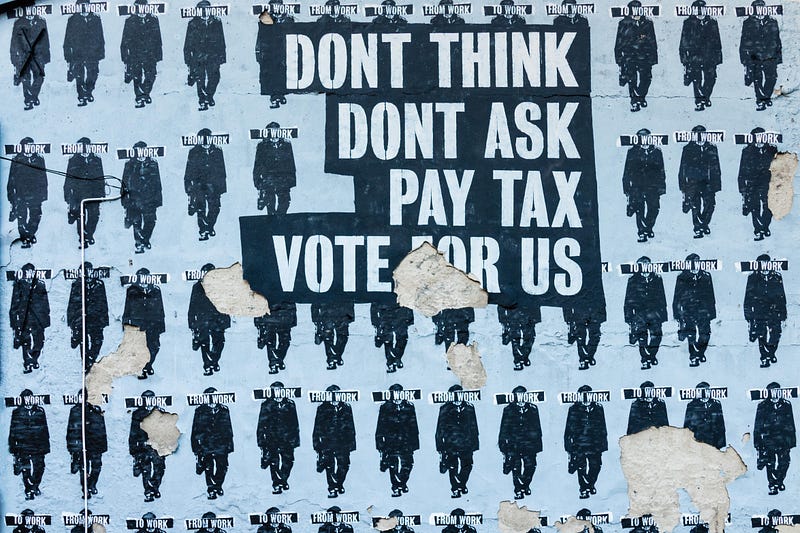
Privilege has become a dirty word in today’s climate. The most common attributes we associate with the concept of unearned advantages tend to be race, sex, gender identity, sexual orientation, class (socioeconomics), and skin tone. Increased awareness of other characteristics — such as religion, age, disability, citizenship status, and geographic residence — has also been slowly finding its way into the mix.
But within this highly-polarized society, there is one variable noticeably absent from the popular debates over privilege. This variable deserves its own reckoning: political affiliation. As practically everyone across the ideological spectrum wrestles with fears of worst-case scenarios, we have to grapple with the skeletons of our two-party system.
It’s a toxic epidemic that I christen as “sectarian privilege”…and, as with most iterations of privilege, the people who’d be likeliest to deny its existence are the ones who’ve benefitted the most from it. In the U.S., that would be entrenched, powerful, self-indulgent members of the Democratic and Republican Parties. This could include elected officials and party leaders, but also many loyal members of these parties’ rank-and-file.
First, allow me to clarify my choice of wording. Dictionary.com defines “sectarianism” as:
- of or relating to sectaries or sects
- narrowly confined or devoted to a particular sect
- narrowly confined or limited in interest, purpose, scope, etc.
- a member of a sect
- a bigoted or narrow-minded adherent of a sect
“Sects” are routinely recognized as having the components of a religion or a cult. Since “religious privilege” already refers to those who attempt to weaponize theism against (or in favor of) others, its alternate referential meaning (“cult”) would be more applicable to the abuse of ideological discourse. This dynamic is especially relevant when we look at a “sect” under the lens of “any group, party, or faction united by a specific doctrine or under a doctrinal leader.”
To clarify: this isn’t to suggest that all members of the Republican or Democratic Parties demand sectarian loyalty from their membership. In fact, there are Democrats and Republicans who are strong voices for internal reform. But when that binary aggression does rear its ugly head, such a manifestation bears quite a few similarities to those of a cult. For our purposes today, I will discuss its effect within the context of the United States. Obviously, “sectarian privilege” could just as easily apply to single-party rule or multi-party governmental systems in countries outside of America.
Some skeptics might stop me, here, and ask why we shouldn’t just call it “partisan privilege” or something less inflammatory. While “partisan” might sometimes be technically synonymous with “sectarian,” it doesn’t do justice the goal of holding partisans accountable for damage they’ve inflicted upon our world. Calling it “partisan privilege” normalizes toxicity of modern-day politics. It implicitly absolves partisan people of the cultish traits they embody.
The Cult Research & Information Center is a data hub led by former cult member Dr. Janja Lalich, who escaped Marlene Dixon’s late-Twentieth Century sect of Marxist-Leninism. Dr. Lalich describes the following cult-like traits that tend to be associated with sectarian thinking:
- Adoration of a leader (or multiple key leaders)
- Individuals in leadership positions dictating the behavior of their members
- An environment where dissent is squashed in favor of groupthink
- Elitist “us-vs.-them” mentalities
- Lack of accountability
- Recruitment based on group identity
- Accumulation of large sums of money for internal use
- Significant amounts of time spent working and socializing with members
- Fear of leaving the group, due to anticipated repercussions
Sectarian leaders would insist their actions are for “the greater good.” But denial isn’t a river in Egypt. Too often, muscly Republicans or Democrats will exert control over their followers through blackmail, dirty lobbying, bribery, merit-reward coercion, and other forms of propaganda tied to cult-of-personality. Fortunately, we (as Americans) are gradually making headway in discouraging this rampant sectarianism within our current two-party system.
But will it happen quickly enough?

As with so many social attributes including (but not limited to) race, biological sex, age, socioeconomic class, ableness, sexual orientation, gender identity, religious worship, and nationality, “-isms” can be divided into three basic subcategories: systemic, social, or cultural. The pitfalls of sectarianism are no exception.
Systemic Sectarianism
How does sectarian privilege destroy our systems by allowing local, state, and federal governments to exploit people based on their political affiliation?
Analyst and statistician Richard Winger is a leading advocate of ballot access reform in the United States. He releases quarterly updates of the changes to ballot access requirements that are passed by state legislatures. Going into the Second Quarter of 2021, a bit of good news occurred when signature-collection requirements were relaxed for Independent candidates in Michigan and Montana. However, such requirements were unfortunately increased for Independent candidates in Iowa and Arkansas, while new filing fees were also imposed upon Independent candidates in South Carolina.
Typically, requiring higher quantities of valid signatures is a threshold designed to keep Independent candidates (or candidates from minor political parties) off of a state’s ballot, in deference to Republican and Democratic nominees within that state. Another requirement, the fee for a candidate to file so they can appear on primary or General Election ballots, is also intended to favor well-funded Democrats and Republicans (and their wealthy donors). These statutes vary from one state to the next — sort of like a psychedelic “patchwork quilt” of election laws.
Historically, the two major parties have alternated in creating these structural barriers to retain a “duopoly” of power for themselves. At present, the GOP is abusing its control of state legislatures and Governor’s Mansions to use Independents as pawns against its most visible enemy (Democrats). Iowa Republicans clearly hope they can assist their own future nominees by shutting out contenders from the Libertarian Party. Montana Republicans, on the other hand, hope to empower the Green Party as a way of splitting opposition votes that might otherwise come mostly from Democratic nominees. The move by Georgia Republicans (through S.B. 202) to accelerate the timeline for runoff elections might, ironically and unexpectedly, end up benefitting Libertarian nominees in Georgia’s November elections by removing the legal arguments previously utilized to set up stricter ballot access standards for minor party candidates in Georgia.
Present-day Republican thirst for one-party rule also includes the erection of stricter Voter ID requirements, early voting limitations, and fewer dropboxes for absentee ballots — with Georgia’s new laws being the most prominent example. Partisan gerrymandering along racial lines, as well as allegations of Census undercounting, appear to be a part of this coup attempt. Hence, my own view as to why the Democratic Party is a necessary ally during the 2022 midterms — at least, in this short-term window.
But, if that voter-mobilization does happen in order to successfully neutralize a permanent GOP power grab: what will that mean, over the long term?
Partisan rancor is nothing new. Through FairVote, allies of Winger have been documenting these systemic barriers for decades. Along with ballot access and campaign-finance dysfunction, Johns Hopkins alumna Dana Ettinger makes the case to end sectarian exclusion of Independent candidates continuing to be locked out of public televised debates and opinion polling. Realistically, debate access and inclusion by pollsters often feed off of one another — to the detriment of third-party and Independent candidates — as part of a vicious cycle. If the scales do significantly tip back in the Democrats’ favor, what makes us think their party would relinquish that hypothetical power by suddenly becoming hospitable and duteous toward reasonable requests from any “non-Republican” minor parties?
Although Republican actions in the present are far more egregious than what we’ve seen in past decades — it still doesn’t change the reality that, if you put yourself on an election ballot by placing an “R” or a “D” after your name, you have privilege. If you advance your financial circumstances in life via either of the two major parties, you have privilege. And if you propel yourself to fame and prestige by riding either major party establishment into long-term power, you have boffo privilege.
Social Sectarianism
Unlike when powerful people from dominant groups are specifically responsible for systemic and institutional failings, the social ills attached to any “-ism” can be perpetuated by minority groups. In terms of extremes created by sectarianism, an onus here can be extended to members of established third parties (such as the Green Party and the Libertarian Party) as well as nonaffiliated political players. Many of these actors who fall outside of the Democratic and Republican Parties focus more on what they’re against than what they support.
We won’t end white supremacy, misogyny, heteronormativity, or exploitation from the billionaire class with proposals based on shallow, flawed, reductionist messaging. We can’t just toss around generalized, sterile, academic concepts…and hope people will listen. Power-sharing will only happen when the mass public has been persuaded that an alternative remedy embodies justice, prosperity, and logic. In that same vein, we can’t expect to curb Democratic and Republican corruption if we don’t acknowledge and honor the virtues of individual Democrats or Republicans who are willing to make a difference.
As observed by journalist Alan Greenblatt, party leaders have groomed Americans to distrust one another for decades. They leverage wedge issues, personal attacks, and demographic attributes to convince people that differences in and of themselves make somebody a threat to one’s existence. In an editorial for IndustryWeek, electronics mogul John Mitchell calls out Democrats and Republicans alike for rejecting sensible solutions by getting bogged down in pettiness amongst themselves. This, in turn, makes America less competitive on a global scale with the absence of long-range policy planning.
I’d argue that, just as Republicans and Democrats have a responsibility to act like grownups — so do Greens, Libertarians, Socialists, Constitutionalists, Reformists, Natural Lawyers, and nonpartisans. For those of us who clearly see the corruption of oligarchy for what it is, we must bypass the halls of Congress to promote solutions amongst neighbors and relatives.
Media gatekeepers and pundits are undeniably guilty of helping to fan the flames of discord amongst Americans. Now more than ever, we possess the power of social media to call out their complicity and shine a spotlight on their performative deception. Citizen leaders should pressure individual legislators to take to the airwaves as mavericks who summarize necessary changes…and then rally us for turning them into a reality. If enough noise is made, the mainstream media will take notice.
Cultural Sectarianism
The abuses and extremism of individuals ultimately begets groupthink and herd mentality. But the same can be said for good ideas and cathartic enthusiasm. Medium writer Mitchell Peterson recently wrote a piece calling out both Republicans and Democrats for their reckless, corporate-friendly overspending.
When it comes to sectarian groupthink, two major perversions have been downright awful. In elections, too much emphasis gets concentrated at the very top of the ticket. For example, in the 2016 Presidential Election, supporters of Hillary Clinton and Donald Trump scapegoated Jill Stein and Gary Johnson, respectively, for narrow margins of loss in several states. However, all four of these candidates’ campaigns failed to energize voters with groundbreaking platforms. Instead, they focused on the personalities (or defects therein) of Clinton, Trump, Stein, and Johnson. This did an immense disservice to downticket candidates from all political backgrounds.
In the following 2018 and 2020 election cycles, Democrats then proceeded to run largely on the virtue of being Not!Trump. But none of this resulted in sustained Democratic congressional majorities, despite Joe Biden’s victory. Not coincidentally, during this four-year period, a stark divide persisted between attitudes of national pride and one’s likelihood of supporting (or being sympathetic to) Trump himself. Had Democrats taken a more holistic approach to popularizing downballot candidates in 2016 and 2018, they might have progressed beyond the narrow and precarious congressional majority they currently hold in the aftermath of 2020. Ultimately, Democrats sacrificed potential synergy in favor of a shortsighted assumption that people would categorically reject the Republican brand.
Along with overreliance on one standard-bearer to carry the weight of their entire party, Democrats and Republicans have failed on another level — they exhibit self-righteousness toward anyone who dares to challenge their prewritten narratives.
It’s a badly-kept secret that Democratic elitists cleared the field for Hillary Clinton ahead of the 2016 primaries. And it’s undeniable that Republican opportunists are continuing to make excuses for Donald Trump’s pathology — even in the face of the January 2021 insurrection. But the major parties’ gaslighting of dissenters goes back for decades. Barack Obama’s folksy showmanship. George W. Bush’s faux-patriotism. Al Gore’s bullying tactics. Ronald Reagan’s feelgood smoke-’n-mirrors rhetoric. If you didn’t get onboard with these performances, you (as an American voter) were tarnished as compromising “the greater good.”
Why do these group identity wars saturate our society? Linda Feldmann of the Christian Science Monitor believes that people tie their own religious beliefs to divisive matters, such as the Trump-fueled insurrection. Social media influence and geographic proximity, she says, only tell half the story. There is also the ecstasy that voters derive from the sensation of winning. Some people who’ve turned away from organized religion will use that catharsis as a substitute, while others embrace their theistic spirituality when confronting political causes. Feldmann acknowledges how many voters take offense when their politics are likened to a “religion” because such insinuation either challenges their lack of spiritual belief or cheapens their presence of spiritual belief. Also, she points out how nontheists tend to be underrepresented in state legislatures, whereas traditional theists are overrepresented.
As Feldmann highlights, when quoting Nate Cohn of The New York Times:
“Whether religious or political, sectarianism is about two hostile identity groups who not only clash over policy and ideology, but see the other side as alien and immoral. It’s the antagonistic feelings between the groups, more than differences over ideas, that drive sectarian conflict.”
When those of us who fall outside of this warring duopoly try to talk some sense into them, we get berated for failing to “pick a side.” We get told we are viewing ourselves as arrogantly “above everyone else” by not identifying with either major political party. We’re painted as apathetic complainers or overly-idealistic slackers. They berate us as either “closeted” members of their own parties…or merely “uninformed.” They’ll character-assassinate us as “wishy-washy” low-info voters who “don’t stand for anything.”

So that brings us to how we can combat such gaslighting. It’s up to us, the unaffiliated voters and independent thinkers, to be clear about what we stand for and what we desire — rather than just our own broad narrative of being “not them.”
What Are the Solutions?
We need legislative remedies to expand access for candidates other than Democrats and Republicans. Some of these reforms should include:
- Limit the percentage-threshold for signatures a candidate must have verified — indexed by state, county, and district populations — when a candidate applies to qualify for a local or statewide ballot
- Place a federal cap on filing fee amounts that individual states can impose for candidates who want to appear on the ballot
- Ban (and criminalize) any paid lobbying activities from being conducted within at least ten years after an elected legislator has vacated office
- Generate an automatic Voter ID to be issued anytime someone changes residence, with carryover data pulled from one’s preexisting Driver’s License or State ID
- Establish a national Early Voting Holiday to precede November General Elections (which should also warrant a federal holiday of their own)
- Require all 50 states to authorize pre-election drop boxes in proportion with the population of each county within a state
- Impose (via federal legislation) nonpartisan independent redistricting committees, such as those in Iowa and Arizona, to redraw district maps in every state following each Census
- Mandate verifiable paper trails for any electronic voting machines (with the corresponding guarantee of a paper ballot option) in every election precinct regardless of state or county
- Reform the bipartisan Commission on Presidential Debates, so the rules and formats of debate forums are improved by using the recommendations of debate coaches
In the absence of federal legislation, smaller-scale iterations of these changes will need to be implemented at the state levels. Maine already uses statewide ranked-choice voting, and Alaska recently adopted a modified system that incorporates a top-four primary. Many large cities — such as San Francisco, Memphis, Santa Fe, Austin, Minneapolis, and New York City — utilize various forms of instant-runoff voting for their citywide elections.
There should be cultural engagement amongst passionate citizens for merging actual systemic electoral reform with the ambience of how Americans view politics socially. This new wave of activism can use a persuasive approach by appealing to the self-interest of showboaters such as Joe Manchin, Kyrsten Sinema, Susan Collins, and Lisa Murkowski — incumbents who benefit from systemic sectarianism even while posturing as “mavericks.” Illustrate for them how, if they push for this cultural shift, they will become heroes back home. Tell them they’ll be enshrined as legends of transcending partisanship if they help to revolutionize the way our country votes.
We must draw upon the foreshadowing of past leaders like George Washington, Theodore Roosevelt, and others who warned us about the dangers of becoming too dependent on political parties.
The sectarian chickens within our civic world are now coming home to roost.


