
Book Review — The Aftermath by Philip Bump
Philip Bump documents the meteoric rise of the Baby Boomer generation — along with the impact that Boomer-fueled trends may have on younger generations
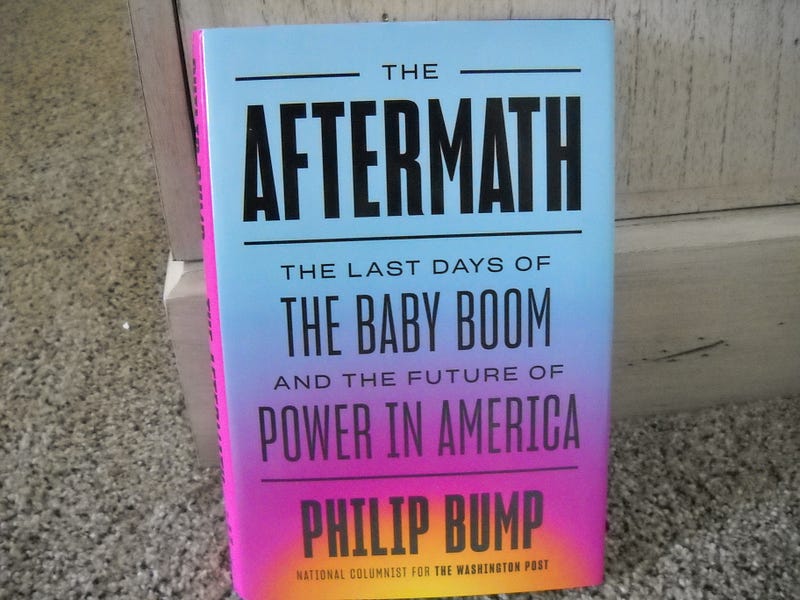
The best remedy for ageism is intergenerational literacy. Being mindful of this purpose, I was more than eager to delve into a compendium characterizing one of the most well-known generations of these past two centuries: The Baby Boomers.
I think it’s fair to say that Boomers and Millennials are the two most highly-stigmatized (and unfairly so!) generations in the modern era. Two summers ago, I’d already written a review of Anne Helen Petersen’s 2020 book, Can’t Even, which makes a case for empathy toward her and my shared generation (Millennials). Therefore, I felt it was long-overdue for me to do the same on behalf of Boomers.
Released earlier this year, The Aftermath: The Last Days of the Baby Boom and the Future of Power in America centers the Baby Boomer generation when looking at how age-based battles may play out in the coming decades. Journalist and columnist Philip Bump — who has been a prominent writer for both The Washington Post and The Atlantic — shepherds us along an incredible time warp that illustrates how Boomer culture came into being.
WHY YOU SHOULD READ THIS BOOK
On paper, the Baby Boomers appear to have been born during a time period spanning almost two decades. However, even amongst Boomers themselves, there are divides between the youngest and oldest members of their generational cohort. We also see sharp divisions between Boomers when it comes to political ideology, economic class, racial experiences, and so many other facets of life.
Thus, it’s high time we, as a society, begin appreciating the diversity within each generation. Given the caricatures and negative stereotypes associated with Baby Boomers in general, reading Bump’s compilation of intergenerational history will go a long way toward building those positive bridges.
STYLE / FORMAT
Bump accumulates 351 pages of quantitative analysis and qualitative narration. He features ten main chapters, divided into two primary sections. The author prefaces this body of work with an Introduction that lays the foundation for his research.
The strength of validity for Philip Bump’s academic content, here, is his transparency in having consulted with (and directly cited!) a broad spectrum of other authors, researchers, and data scientists. I would have liked to have seen a bit of reference from Bump to hypothetical “microgenerations” at the edges of the nineteen-year time period during which the “baby boom” was defined as having occurred. That being said, he employs grace and proficiency while contextualizing the American history that has contributed to Boomers’ formative years along with the developments affecting their golden years.
Introduction — as an informal prologue, the author predicates the significance of the Baby Boomer generation by citing how 98% of present-day Americans cannot recall a time in history when Boomers weren’t alive. This is the generation that redefined consumer power, albeit amidst a schism of political motivations. The Obama Coalition and the Tea Party movement represent a Twenty-First Century fissure into fierce opposing factions, and Boomers of disparate ideologies led each side. An added dynamic was how middle-aged Boomers were suddenly competing with their own children in the workplace. Donald Trump won over a major share of Boomers plus older generations by weaponizing immigration and the Black Lives Matter movement. Bump prefaces the book’s main body by saying that his predictions and projections have been made after consulting with an array of experts — starting with Landon Jones, the author of 1980’s Great Expectations.
Chapter One — entitled “A Baby Tsunami,” Bump ushers in Part One (“The Boom”), whereupon he credits Landon Jones with constructing our understanding of Baby Boomers by designating Kathleen Casey Kirschling as the very first Boomer. Her celebrity status is based on the arbitrary whims of whoever decided the Boomer generation would begin based on the birthday of the first American child recorded to have been born on New Year’s Day of the first calendar year (1946) when the “baby boom” began to spike. Prior to 1946, U.S. birth rates had already been exceeding those of the previous decades; but 1946 was the first year in which this vivid increase seemed to start a pattern.
By the late-1950s and early-1960s, market researcher Eugene Gilbert found that 92% of households had TVs, coinciding with the American teenager becoming a significant consumer. Other generational cohorts that surround the Baby Boomers lacked the clear pattern of linear increase in birth rates that we saw between 1946 and 1964. Authors and policy wonks Neil Howe and William Strauss adopted Douglas Coupland’s “Generation X” moniker for the first post-Boomer generation, but even Gen X would have less-defined borders for its cohort. Bump embraces sociologist G. William Domhoff’s view that power is relative amongst Boomers; by the year 2020, around 60% of Congress was Boomer or Boomer-adjacent in age, with a similar trend existing throughout statehouses.
Statistically, Boomers hold a higher percentage of America’s wealth and homeownership than their raw population size warrants. However, there is also a greater number of Boomers overall — in comparison to other generations — which has increased the odds that the most successful Boomers would accumulate a lopsided amount of wealth. When coupled with modern-day wealth inequality, this reality may feel like more of an imbalance than it actually is.
Chapter Two — entitled “All Things Must Pass,” the author visits The Villages in Sumner County of Florida, where senior housing for Boomers has exploded. To its residents, The Village feels more like a community than assisted living. As numbers have surged for retirement care, many Boomers fall through the cracks between wealthy and impoverished. Despite the increase in deaths of older Americans, there is no shortage of “death workers” due to the combination of cremation and resourceful cemetery space. Between the present day and the year 2060: Even as Baby Boomers die out, the 65+ age group of America’s population is projected to increase with each succeeding decade.
Bump highlights the caveat that Census statistics are imperfect due to the clunky distinctions made between race and ethnicity. Still, additional projections show that younger populations will most likely be less racially- or ethnically-White than older populations. What exactly qualifies someone to be considered “White” is a notion with no widespread consensus. Regardless of demographic considerations, the exploding senior citizen population anticipated across the upcoming decades has necessitated the conversion of underused schools into low-income housing for seniors.
Chapter Three — entitled “How to Spot a Boomer,” Bump illustrates the ageism directed against Baby Boomers by chronicling the viral rise of Peter Kuli’s 2019 TikTok song, “Ok, boomer.” That same year, Internet searches peaked for Americans of all ages trying to figure out to which generation they belonged — although the edges of most generations can be blurred. Many of those online searches, in fact, were conducted by Boomers wanting to determine whether younger folks were making fun of them. Approximately 80% of protestors in the aftermath of George Floyd’s murder were GenXers, Millennials, Zoomers, and Alphas, which has been similar to trends for other peaceful demonstrations.
Bump reiterates the observation that younger generations statistically have fewer White people amongst their ranks than Baby Boomers do. Part of this might have to do with how the birth of the Boomer generation coincided with U.S.-based white supremacists choosing to include Eastern European and Southern European descendants as “White” in order to bloat their own racial category on paper. Between 1924 and 1970, immigration into the United States had been concentrated amongst Western Europeans. Also, college enrollment flourished during the 1960s and 1970s due to Boomers rejecting menial work in favor of educational pursuits. On balance, Boomers have tended to embrace organized religion at lower rates than have Hemingrebels, GI-Gens, and Traditionalists — but still more frequently than have Xers, Millennials, Zoomers, and Alphas. These shifts were profiled by New Journalism pioneer Tom Wolfe, who dubbed Baby Boomers as “the Me Generation” (alluding to trends such as the Hare Krishnas representing a shift toward the individual over the collective good).
Harvard political scientist Robert Putnam referred to Traditionalists as “the long civic generation” rather than “the Silent Generation.” Putnam found that church attendance and participation in community events began to drop as Boomers reached adulthood, and those decreases have continued with each new subsequent generation. However, when compared with the generations surrounding them, Boomers are also likelier to be union members or veterans as well as having strong partisan affiliations and living in less densely-populated areas. Bump reasons that the foundation for so much sniping between Boomers and Millennials is due to each of their generation’s similar percentage sizes and parallel experiences of seeing the world around them drastically reshaped during their respective youths.
Chapter Four — entitled “The Politics of the New Generation Gap,” the author starts off this chapter by painting a portrait of domestic terrorist Floyd Ray Rosebury, who threatened Washington D.C. in August 2021 by claiming to have had a bomb in his vehicle. Although Rosebury himself is technically a GenXer, Bump reminds us how Rosebury embodies the stereotype of rural White Boomer Republican men who drive pickups. He contrasts that caricature with the diverse upbringings of the four presidents whom Bump considers to be Boomers — Donald Trump, George W. Bush, Bill Clinton, and Barack Obama. Bump’s assessment, here, is a bit faulty when we take into account how Trump, Bush, and Clinton were all born close to the “Silent Nester” microgeneration (straddling the youngest Traditionalists and oldest Boomers) while Obama was born at the front of “Generation Jones” (the microgeneration comprised of the youngest Boomers and oldest GenXers).
Bump also reflects upon how Rick Santelli unintentionally triggered the Tea Party movement due to conservative perception of Obama as embracing socialism. Folks who sympathized with the Tea Party linked their anti-immigration views with racism that they often harbored toward Obama himself; this was cohesively channeled into a pushback against what they viewed as younger people wielding political power without having “earned” it. He goes on to interview Sally Bradshaw, a Republican activist who’d tried to construct an inclusive approach for the GOP after Mitt Romney’s 2012 presidential loss. Such a revamp would have encompassed reasonable immigration reform; but, instead, the party ended up lurching toward MAGA, which drove Bradshaw herself to quit the Republican Party.
Next, Bump uses the 1925 Ku Klux Klan march in D.C. as a historical marker for White people fearing a loss of institutional power to Black and Brown people in America. Over the course of a century, that has morphed into a “White people vs. BIPOC” framework. We saw this manifest with GOP political strategist Lee Atwater wielding Willie Horton-esque dog-whistles to help Trump in much the same way he’d dispatched them on behalf of Ronald Reagan and George H.W. Bush. Most profoundly, on Page 123, Bump implies that what so many academics refer to as “whiteness” would actually be synonymous with the concept of white privilege.
Toward the end of this chapter, Bump discusses how Independent voters who consistently vote with one of the two major parties are often called “leaners.” Of this group, White “leaners” usually lean Republican in their voting habits. The decrease in America’s White population between the 2010 and 2020 Censuses can be attributed at least partially to more survey options from which participants could choose. That yielded greater specificity than past Census estimates. Additionally, there is a correlation between having a college degree and self-identifying as politically liberal. Trump’s ascent to the White House made evangelicals more tolerant of moral shortcomings in candidates. An increasing number of Americans live in counties where one party has an advantage of 20–50 points skewed in its favor, which leaves us with a colorful set of red/blue/purple regional clusters. Bump concludes the chapter by looking at the gender gap within the Boomer generation that divides MAGA (led by men) from The Resistance (led by women).
Chapter Five — entitled “The Post-Boomer Cultural Era Has Arrived,” Bump segues into Part Two (“The Aftermath”) by exploring the phenomenon of how the rock music enjoyed by Boomers throughout their youth began to fade as new musical releases of the Twenty-First Century supplanted them. However, individual classic rock songs have held up as vintage favorites in people’s memories. Recent decades have seen Boomer spending concentrated on things such as health care, entertainment, and pets rather than transportation. Teenaged Boomers were at the forefront of popularizing car radios and television sets; so, for many of them, it’s a culture shock to not be driving the digital revolutions of the newest century.
Another mind-boggling development for many Boomers has been how quickly younger generations can disseminate songs and dances over the Internet. Young people have grown adept at filtering out Internet misinformation; this has evolved from the “culture wars” manufactured by resistant conservatives during the 1990s, when Gen X controlled pop culture. Now, Gen Y and Gen Z are taking the reins in that area, which makes Boomers perplexed as to why certain things are no longer deemed acceptable. Since we’re culturally past the peak of Boomer influence, many from their generation have boomeranged a lot of that resentment back onto Millennials.
Chapter Six — entitled “Who Will Inherit the Economic Boom?,” the author finds that, when surveyed, Baby Boomers want their children and grandchildren to have Social Security and other safety nets. Statistical estimates of Boomer wealth are probably inflated when the assets of their live-in progeny get included; add to this all of the liability or expenses that they absorb on behalf of their children and grandchildren. This dynamic is offset by the reality of wealth concentration in which Boomers hold more wealth (compared to other generations) collectively, but not usually on an individual basis. On a family-by-family basis, kids tend to emulate the wealth levels of their own parents. When we combine that with the racial wealth gap, the raw numbers can be deceptive. On top of that, more Boomers are relying on Social Security payments over traditional pensions than did older generations. This is problematic if we consider a future where the number of younger workers has substantially decreased.
Boomers were the last generation to outearn their parents — with Gen X being the first generation to see escalated costs of college tuition and higher interest rates for student debt. However, numerous Boomer parents also take out loans (through the Parent Plus program) to help their kids. Home ownership also began decreasing with Gen X, since Boomers own more homes — and are therefore more resistant to allowing new housing developments to be greenlit. They have done this to protect the value of their own homes, but it comes at the expense of younger people who wish to buy homes. Such hardships amongst younger generations are compounded by the sheer number of Boomers alongside of how younger people are finding employment in places where there tend to be fewer home ownership opportunities available. In order for future housing sales of Boomers’ homes to be successful, the rate of Xer/Millennial/Zoomer home ownership must keep up pace in terms of supply/demand as well as the desirability of home locations.
Politically, Bump looks at how older voters are less likely to support public funding of education. He posits that more immigration into the United States would help to generate greater revenue for social support programs that aging people love to utilize. In addition, inequitable property tax rates also cause intergenerational resentment.
Chapter Seven — entitled “The Importance of What We Don’t Know,” Bump documents how human life expectancy keeps increasing because we’re getting better at preventative medicine and spotting cancers earlier. By contrast, we are less likely to predict death from addiction or accidents (which lower-income people are more likely to endure). The actual life expectancy of Boomers, however, is trending downward.
Bump brings up climate change as another unknown variable, since Boomers are more likely to live in heat-intensive coastal areas — and their bodies are more vulnerable to extreme heat. Complicating climate change mitigation efforts, white supremacy has fueled unprecedented voter suppression by Republicans, enabled by Tea Party and MAGA loyalists. There’s a correlation between those who believe in replacement theory and those who support violence to achieve desired political means. We can look at the actions of the KKK, post-Reconstruction, to get a glimpse of how fascism thrived in so many parts of the U.S. With that awareness, our focus should be on preventing those trends from ballooning or accelerating.
Chapter Eight — entitled “The Importance of What We Don’t Know About Ourselves,” the author expands upon the previous chapter by outlining how racial statistics in America have a long history of being compiled based on white supremacy. This leads to a lack of consensus as to what is even meant by “whiteness,” with former U.S. Supreme Court Justice George Sutherland ruling in 1922’s Ozawa v. United States how nebulous the term “Caucasian” is in respect to the wide diversity of skin tones within each racial group. Historically, immigrants into the U.S. wanted to be considered “White” for the status rewards associated with the term. In the present, American descendants of Hispanic immigrants often try to distance themselves from their Latino heritage. Bump uses the example of his wife’s multiracial identity being simultaneously European, Chicana, and Indigenous; she alternately selects “White,” “White Hispanic,” or “Native American” when filling out Census forms. Princeton sociologist Douglas Massey predicts that more Hispanics will choose to self-identify as “White” due to interracial marriages and the general lightening of skin tones with successive generations.
Bump reports that darker-skinned people of color who face colorism are less likely to self-identify as “White,” although some dark-skinned members of BIPOC communities will self-identify as “White” in search of increased status. The late philosopher Charles Wade Mills refers to how “whiteness” is more about power relations than it is about racial heritage or skin tone per se. Bump likens this to negative stereotypes that specific generational cohorts receive; potentially, racial categories could be entirely different 40 years from now. This possibility also means it’s unclear to what degree our perception of so-called whiteness will have changed.
Chapter Nine — entitled “A New American Politics,” Bump recalls how, after the Twenty-Sixth Amendment passed, Boomer voters enlarged from a minority to a plurality between the years of 1972 and 1984. In more recent years, even as voter turnout has increased amongst GenXers, Millennials, and Zoomers — so has additional Boomer turnout. From the ages of approximately 14 to 24, liberal Boomers were shown to have solidified their Democratic leanings. Some of them pulled away from Democrats during the Reagan years, but not with overwhelming numbers. By contrast, Millennials and Zoomers have overwhelmingly turned out for Democrats ever since The Great Recession and the rise of MAGA. When we add climate change, Black Lives Matter, #MeToo, and gun violence to that, the GOP could be in long-term trouble amongst younger generations without a course-correction. The only potential saving grace for the GOP could be the gains it might make amongst White men from the Millennial and Zoomer generations as well as with Hispanic voters of all age demographics.
Further exploring recent Republican electoral successes, Bump looks at GOP voter outreach in Texas and Florida. He recommends that Democrats should deemphasize rigid group identity to keep from bleeding voters of color amongst Millennials, Zoomers, and future generations. How Republicans deal with immigration will determine whether they retain the Latine voters whom they’ve gained in the past decade. Republicans tend to perform more strongly when they emphasize cultural issues, whereas Democrats tend to perform more strongly when they emphasize common sense policies. Bump also finds that, to the surprise of many, racial segregation actually makes overall ideological representation more diverse since the gap between White Republican voters and BIPOC Democratic voters is already so huge.
When examining voting behaviors of Independent voters, Bump finds that Independents often identify as “Independent” because they hate one of the two major parties more than they like the other major party. Younger voters increasingly identify as Independents out of anger over systemic corruption; yet, that doesn’t lead to a reduction in partisanship, in terms of how they vote if they perceive one party as being more egregious than the other. Bump reminds institutional partisans that bringing people together into a temporary coalition doesn’t mean that such an organization will necessarily have long-term staying power. Electoral alliances of convenience or necessity still won’t extinguish genuine emotions in voters themselves.
Chapter Ten — entitled “Getting from Here to Wherever ‘There’ Is,” Bump reiterates how Florida politics have provided a snapshot of the Baby Boomer generation since the late-1980s. Now, there’s a fork in the road. In the decade ahead of us, voting trajectories nationwide could emulate the liberal leanings of states such as California or New Mexico in favor of Democrats. Or, more states could go the way of Republican gerrymandering as seen in Wisconsin, Ohio, and Georgia. One outlier amidst these statistics could be Florida itself, since the Floridian population was uniquely skewed by an influx of White Baby Boomers who vote Republican. Another uncertain factor in Florida is whether its Hispanic voter registration will continue to underperform Florida’s actual Hispanic population growth. Bump notes that the ten states that are most expected to ethnically resemble America by 2060 all gave their Electoral Votes to Biden over Trump in 2020.
Ultimately, says Bump, the direction in which new trends flow will depend on these four variables: Racial self-identification of future Americans, the rate of immigration creating new American workers, the extent to which Americans lose faith in our institutions, and to what degree Americans allow themselves to continue becoming radicalized. All of this is unpredictable and malleable. Bump closes out the book by reflecting on his in-person interview with Kathleen Casey Kirschling — how she is both hopeful and fearful, wanting to see future generations enjoy the parts of life that she has been able to reap.
Bump does a great job of analyzing historical trends and juxtaposing them alongside of current trends. He acknowledges past and present trajectories without making any definitive proclamations that voting behavior of Boomers and their benefactors will follow one firm path or the other. Electoral politics shall move in a given direction according to how politicians and their surrogates use the data that’s available to all of us.
The Aftermath is filled with copious graphs and charts that Bump provides in order to “show his work” when reporting the data he has gathered. I’ll admit that some of them were hard for me to follow. But Bump’s objective tone demonstrates how he is trying to make sense out of the socioeconomic trends without imposing his own will on speculation as to which trajectories might arise.
Philip Bump manages to paint a portrait of one of America’s most stigmatized generations while filtering bias from reality. He writes from his perspective as a GenXer, but he neither glorifies nor demonizes his own generation — nor does he inflict these value-judgments onto any other generation.
By connecting the history of the Baby Boomer cohort with the paths available to post-Boomer generations, Bump exposes how shallow the mantra of “Ok, Boomer!” can be when we place value on intellectual honesty and historical context.
Click here to subscribe to my stories.


