
Book Review — iGen by Jean Twenge
Psychologist and SDSU professor Jean Twenge offers her thoughts and research evaluating how “iGens” (Zoomers) can be mentored by older generations
Embracing intergenerational literacy means being open to learning (and challenging our assumptions) about all generations. This has been the purpose driving my “Jigsaw Gens” series. After authoring one on my own generation, I thought it was only appropriate for me to delve into the cohort born immediately after mine: the Zoomers (aka “Gen Z”).
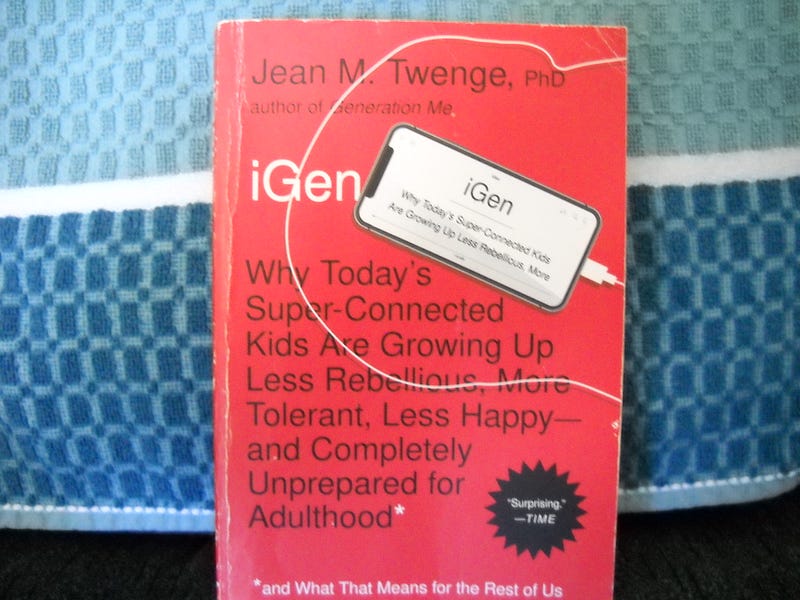
In this spirit, I read and reviewed Jean Twenge’s 2017 book iGen: Why Today’s Super-Connected Kids Are Growing Up Less Rebellious, More Tolerant, Less Happy — and Completely Unprepared for Adulthood. Twenge, a psychologist and SDSU (San Diego State University) professor, takes a lot of valuable information about Generation Z and intersperses it with flimsy conclusions drawn from her previous work.
The scope of Twenge’s reductionism — juxtaposing authentic testimonials and raw data alongside of her own ageist bigotry — hit me so hard I felt compelled to write an expanded critique of it:
But, for those of you who don’t have the patience to endure a twenty-minute read, I’ve pared it down to an abridged version of my book review.
WHY YOU SHOULD READ THIS BOOK
There’s no doubt that Zoomers (Gen Z) and Millennials (Gen Y) are about to become far more important than they’ve ever been in modern times. Although this particular book of Twenge’s is dated — her surveys usually only include respondents from the very oldest segment of the Zoomer generation — it can offer a jumping-off point for further exploration into Gen Z culture.
So don’t take Twenge’s proclamations as gospel. Please don’t.
Rather, try to view it as an academic exercise that can partially aid our society in understanding what Zoomers have been through, historically, as a generation — and where they’re headed. Because Twenge dubs Gen Z as “iGen” throughout this book, I’m going to alternately use the descriptor of “iGens” as a synonym for “Zoomers” throughout this review.
STYLE / FORMAT
Twenge structures ten chapters bookended by both an Introduction and a Conclusion. This is 313 pages of content, total. She includes a bibliography and an Acknowledgements section.
When evaluating her data, Twenge draws numerical conclusions that she attempts to link to content-based appraisals. Some of her conclusions are solid, or based on common sense; others are highly questionable, to put it mildly.
She does employ a neat marketing gimmick of using the “I” in “iGen” to alliterate each of the main attributes belonging to Zoomers that are associated with each of the book’s ten primary chapters — although I find Twenge’s choice of the “insecure” descriptor (for iGens) as being unduly inflammatory toward them.
Introduction — entitled “Who is iGen, and How Do We Know?,” the author favors 1995 through 2012 as the range of years during which iGens were born. Her reasoning for this is a bit scattershot, since Twenge fails to touch upon the concept of “microgenerations” (those who straddle the cusps of any two generations’ adjacent edges) amidst her commentary.
She does a reasonably good job of explaining how she arrived at the moniker of “iGen” as a synonym for Generation Z; but her excessive use of the awkward descriptor “iGen’ers” throughout the rest of the book is extremely distracting. Twenge would have been better off calling them “iGens” — as I choose to do, in this very book review.
That may seem nitpicky of me to say, but it’s a repetitive twinge of disappointment in the shadow of a generational nickname (“iGen”) that is really quite creative. Inspired by Gen Z’s affinity for the iPhone, Twenge uses the rest of her introductory chapter to preview how the “I” in “iGen” will relate to Zoomers’ upbringing and their modern zeitgeist, as reflected in the forthcoming chapters.
Chapter One — entitled “In No Hurry, Growing Up Slowly,” Twenge criticizes the overprotective nature of how adults have raised iGens. She observes this generation as having delayed experiences when compared to the generations who came before them: sexual promiscuity, dating, teen pregnancy, learning to drive, walking outdoors alone, staying home alone, working part-time, volunteering, completing homework, receiving allowances, and signing up for extracurriculars at school. All of these things are being done less often and later in life by iGens, which Twenge attributes to their lack of independence and the absence of money management skills.
Alcoholism, drug abuse, runaways, and physical violence have also decreased amongst iGens — with the exception of those who engage in binge-drinking after their adolescent vices were suppressed. Twenge laments this lack of adult-level responsibility given to Zoomer teens. She establishes this setup from which she (perhaps unconsciously) infantilizes their generation.
Chapter Two — entitled “Internet: Online Time — Oh, and Other Media, Too,” the author gives us a rundown of the various ways smartphones have fueled addictions amongst iGens. Whether it’s casual communication with peers or negative body image, Internet culture exploits these teenagers with the allure of social media and digital apps. I mostly agree with Twenge’s analysis of unhealthy cyberspace behaviors, here.
Chapter Three — entitled “In Person No More: I’m with You, But Only Virtually,” Twenge laments how in-person dating and socialization have decreased amongst iGens. Again, the culprit here appears to be smartphones and the Internet as a substitute for human connection. With the threats of depression and suicide looming for iGens, I also find myself largely in agreement with these points.
Chapter Four — entitled “Insecure: The New Mental Health Crisis,” the author shows genuine compassion for the mental health needs of iGens. Loneliness and FOMO (Fear of Missing Out) are big problems for iGens — leading to lack of sleep or self-harm. This chapter, as a whole, would have been very effective had it not been for the opening salvo of passive-aggressive contempt Twenge begins to narrowly lob at Millennials.
Chapter Five — entitled “Irreligious: Losing My Religion (and Spirituality),” Twenge observes how religious participation has dropped significantly amongst iGens — and even for the Millennials before them. A racial gap exists with church attendance between Black Zoomers and White Zoomers. Twenge attributes this visible trend to the rise in individualism, as well as how so many houses-of-worship have made themselves persona non grata amongst young people by doubling-down on theocratic anti-LGBT dogma.
Chapter Six — entitled “Insulated But Not Intrinsic: More Safety and Less Community,” the author explores the reasons why safetyism has taken hold in the mindsets of iGens. This generation is increasingly more cautious when it comes to everything ranging from recreational drugs to drinking to driving to physical aggression. The downside, says Twenge, is that an increasing demand from iGens for “safe spaces” and “trigger warnings” compromises their ability to learn resilience and coping skills. In her view, this will hinder iGens’ long-term ability to confront fears and interact with the rest of the world.
I think Twenge broaches an important discussion, here. What’s the balance between combating hate speech while protecting free speech? If college campuses are meant to share new ideas, then this ideal collapses when students are widely censoring themselves and others. However, once again, Twenge’s generalizations of Baby Boomers, GenXers, Millennials, and iGens are overly-simplistic and trite. Her lackluster predictions about the scarcity of political contributions from iGens (and, for that matter, from Millennials) end up being proven false over the course of the six years since this book was originally published, leaving Twenge with egg on her face.
Chapter Seven — entitled “Income Insecurity: Working to Earn — But Not To Shop,” Twenge frames iGens as serious workers who possess burgeoning diligence. She weighs the effects of low wages and high inflation coupled with surging college debt in the aftermath of The Great Recession. These factors, she reasons, have enhanced the caution in which iGens had already been steeped.
There are two big flaws with this chapter. First, Twenge uses it as a rather gratuitous excuse to take more potshots at Millennials and our purported “narcissism.” But, secondly (and perhaps even more disturbingly), Twenge is making these projections about iGens based on a very limited data set as part of research that only included the very eldest sliver of the Zoomer generation as a whole.
Chapter Eight — entitled “Indefinite: Sex, Marriage, and Children,” the author wades through the sexual and romantic habits (or lack thereof) that iGens have broached. Tentatively, she indicates that teen promiscuity is on the decline. The reasons for this range from solo porn consumption to emotional detachment to rising poverty rates to good old-fashioned caution. As a result, Twenge projects that both Gen Y and Gen Z will be getting married and having children a lot later in life than their elders did.
Chapter Nine — entitled “Inclusive: LGBT, Gender, and Race Issues in the New Age,” Twenge praises how both Millennials and iGens have been more accepting and supportive of LGBT+ Americans. As she touched upon in Chapter Five, these more progressive social beliefs have resulted in lower church attendance or the absence of spiritual identities — especially for iGens. Twenge finds race relations to be more of a mixed bag for iGens, with there being less consensus within the Gen Z cohort on matters such as gentrification or affirmative action.
Once again, Twenge twists her pre-selected data as a pretense for taking digs at Gen Y. This is all the more baffling since she appears to be implicating iGens — not Millennials — as the ones who have embraced the restriction of free speech on college campuses.
Chapter Ten — entitled “Independent: Politics,” the author prepares us to expect the unexpected in terms of what Zoomers’ politics will look like. She foresees iGens having liberal and progressive tendencies on issues such as climate change, student debt reduction, child care, abortion, capital punishment, and marijuana. Democrats might perk up upon hearing this; however, Twenge cautions them to keep in mind that iGens could be poised to take more conservative stances on health care, gun control, and local solutions. For this reason, she theorizes that there might be room for potential alliances between iGens and the Libertarian Party.
Overall, Twenge seems convinced that iGens are likelier to embrace local organizing and community-based activism rather than top-down mandates from the federal government. Yet, at the time of this book’s publication, she expressed skepticism that iGens would actually follow through with becoming engaged and effective young citizens. As we’ve seen from the results of the 2018, 2020, and 2022 elections, Twenge appears to have greatly underestimated the Zoomers in this regard.
Conclusion — entitled “Understanding — and Saving — iGen,” Twenge navigates solutions for how to continue raising this generation that has never known a world without the Internet. She urges parents to think twice about buying their Zoomer teenager a smartphone. She calls for serious discussions between iGens and their parents about the risks of voyeurism, online exhibitionism, and cyberbullying.
It’s clear that Twenge certainly has maternal concern for iGens’ mental health and maturity levels. However, some of her parenting tips should be taken with a grain of salt depending on the individual adolescent’s needs. Moreover, her continuing habit of writing off Millennials as a lost cause is absolutely unnecessary — and artificially ageist.
Is this book worth reading? The documented interviews that Twenge had conducted with teenagers during the 2010s were informative insofar as getting some candid glimpses into the mindsets of adolescent iGens. But, as I brought up earlier in this book review — her good-faith compilation of research data implying generational trends is of limited use. Twenge tries to use it as “evidence” for her generalizations and allegations; but she makes very flimsy cases for correlation when there could be other confounding factors. Furthermore, her sample size of iGens themselves is way too small…only covering less than one-third of their generation.
Twenge’s animosity toward Millennials — and her cherrypicked reverence for pre-Millennial generations — ultimately weighs down what could have been an intriguing glimpse at the first members of a still-not-even-fully-defined generation (Gen Z). It’s evident that Twenge has bought into the caricature of Gen Y as the de facto redheaded stepchildren of the generational spectrum. She centers her own biases and experiences as a parent, as a college professor, and as a GenXer.
If there is going to be any hope of intergenerational collaboration in the coming decades, it certainly won’t happen with charlatans such as Jean Twenge at the helm.
Click here to subscribe to my stories.


