
Bleb
Let’s blab a blurb about this word
Today’s New York Times Spelling Bee letters:
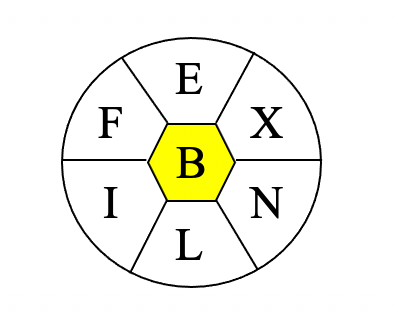
E, F, I, L, N, X, and center B (all words must include B).
Merriam-Webster says…
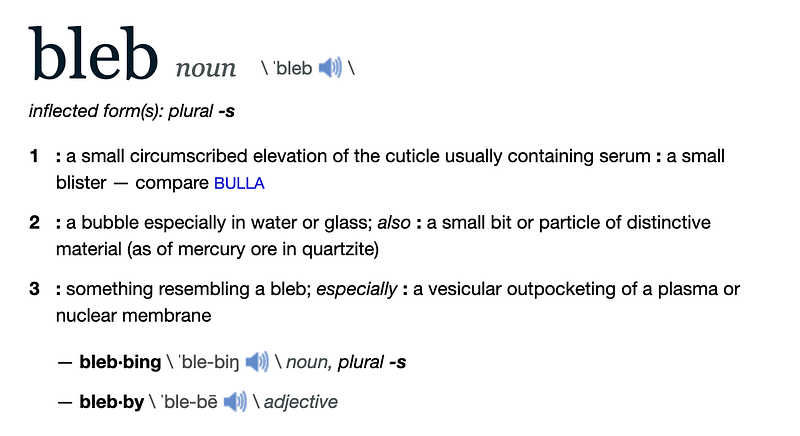
Silly little dictionary! Don’t you know bleb can’t possibly be a word if the New York Times says it ain’t?
For further fascinating facts, check out the Spelling Bee Master.
What’s your favorite dord* from today’s puzzle?
My Two Cents
We have three definitions that were ignored today by the New York Times; in other words, three meanings that were considered obscure enough to be rejected in the Spelling Bee puzzle. Yes, they are all related, and the third one is something you’re not likely to notice happening in your body.
If you do feel your cell membranes blebbing, please contact (1) your local doctor and (2) your local newspaper. Or better yet, contact the New York Times so they can regret treating the word bleb with such disdain.
Today’s list of dords* (from which I pick the rejected word I’ll discuss) was much shorter than your typical day, and I knew it would be the case the second I saw the puzzle. One of the letters was X, and the center letter was B; that leads to a low maximum score of 104 and a Genius score of 73. (Genius is the rank immediately below the maximum.)
Leben was also included in the list, but I wrote a column about that delicious word on February 16.
So bleb it is.
Through the looking glass
We’ll start with the most technical and boring of the three meanings. I promise it gets prettier and more interesting as we move along, so please bear with me. Or raccoon with me, if you prefer that mammal.
At the basic cellular level, blebs are tiny bulges that form on the outer layer, or plasma membrane. The cell membrane is made from lipids, including cholesterol. That’s one of the reasons your body needs cholesterol. So next time someone lays into you for eating one of those cardiac-arresting burgers, you can inform them that you’re just getting your daily dose of cholesterol so you can bleb.
Blebs are caused by an increase of pressure inside the cell through either a break in the inner part, or cortex, of the membrane, or if a spot of cortex detaches from the membrane.
Scientists used to think that blebs were associated with either mitosis (cell division) or apoptosis. The latter is euphemistically known as “programmed cell death”, which also sounds like one of those scary headlines you sometimes see from the alt-right when universal health care is discussed.
But your body is deeply philosophical and knows that death is part of the circle of life. Granted, the very last part (unless you believe in ghosts), but still a part of it. And apoptosis is something the body regulates very carefully in order for you to keep living. So don’t complain!
The typical example is during your development as an embryo. Your fingers and toes pop out as a result of apoptosis.
Here is a basic diagram of the process of apoptosis that showcases blebbing:
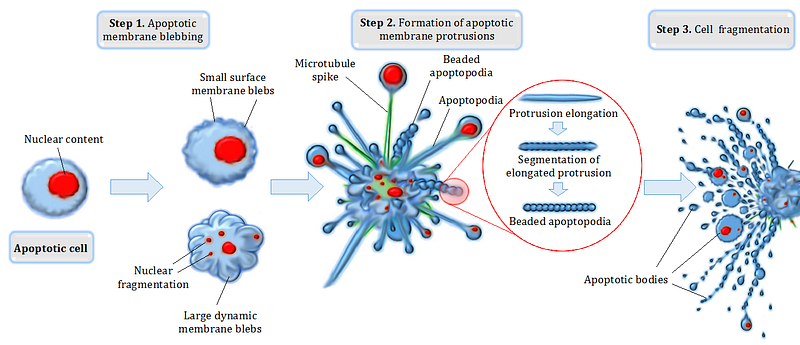
I know! It looks like one of those events that happens at the beginning of a Marvel movie in which the Avengers will eventually be assembled to save the day.
Scientists discovered, however, that blebbing had another useful function. It helps certain cells move. In particular, it’s been found that certain cancer cells use blebbing as a means of locomotion. No, they don’t dance to the awesome 1980s Kylie Minogue beat. They spread around and try to take over your body.
There is a really cool picture of a lung cancer cell that I wanted to show you, but the license clearly states that it can be used only for noncommercial purposes. And since this article will generate me a whopping 38 cents by the end of the month, I’m disqualified from copying and pasting it. However, I think I am allowed to include the link to the original web site where I saw it. Here you go. The purple poppers are the blebs.
What do you call a tiny blister filled with serum?
A bleb. Duh! That’s the word we’re talking about today. Please try to pay attention.
That’s the simple medical definition of a bleb. As opposed to, for example, blisters filled with pus or blood. Those are not blebs and please don’t call them that; they are sensitive and may be offended… and pop.
Blebs can be dangerous if they happen to happen in your lungs, because if they burst, you will get something called spontaneous pneumothorax, or air between your lungs and the chest wall. As a reminder, air in your chest is supposed to be inside the lungs, not outside.
Please rush to the hospital if your blebs do that to you. They’ll take a nice picture of your chest, and you’ll have something to show off to your friends next time you gather for some beers. Like this one, but maybe without the blue arrow.
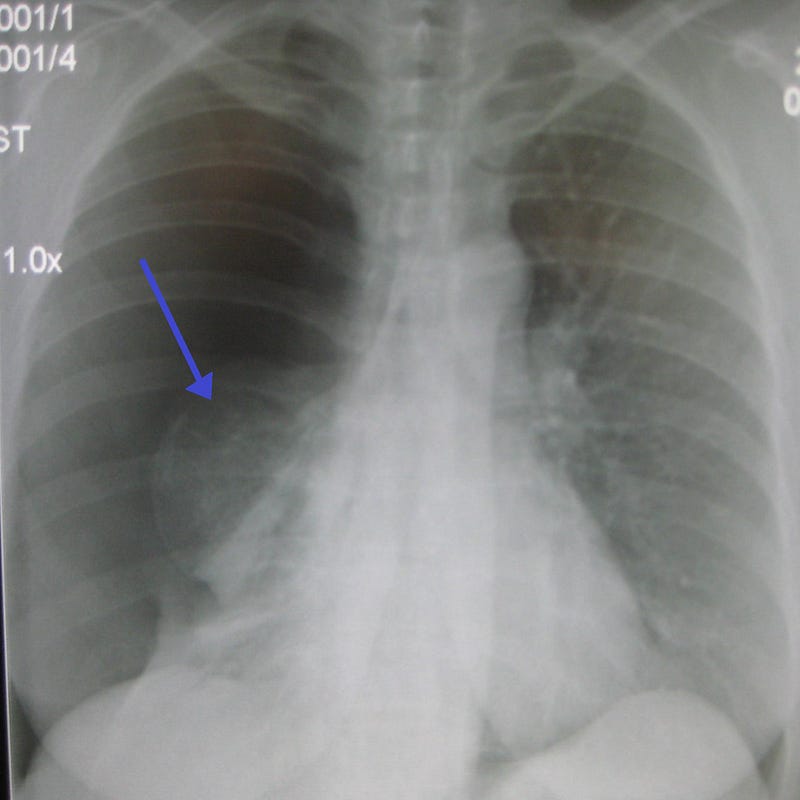
Oh, boy. If Dr. Heilman happens to be Jewish, well, then he has a terrible last name.
Blebs are also featured in their own Hollywood production, called blue rubber bleb nevus syndrome. Or BRBNS, as its friends like to call it. A genetic mutation causes the formation of abnormal blood vessels that affect the skin and GI tract, pocking them with dark blebs.
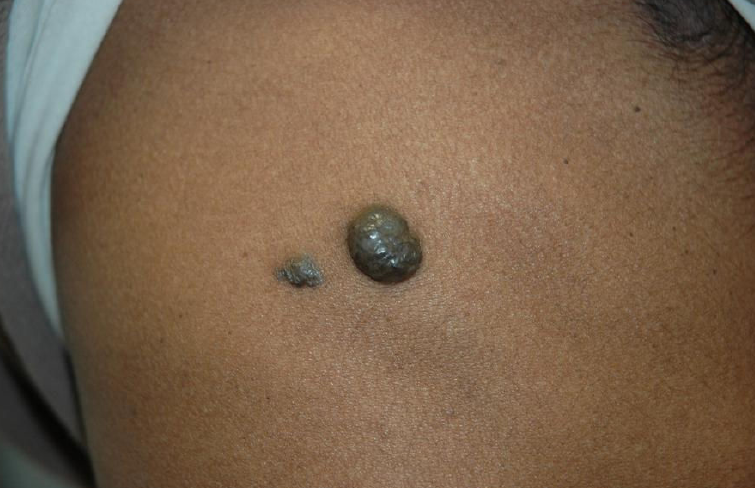
I also found a photo of blebs on intestines, but I figure many of my three readers might have just eaten dinner, so I won’t include it. If you haven’t eaten dinner, or want to be grossed out anyway, you can google it. Or duckduck it, if you don’t want Google to know you have a fetish for bleb-marked guts.
Rock of ages
Finally, in geology and mineralogy, blebs are small materials trapped in minerals. These are officially called inclusions, and because they are blebby, they are small and bubble-like in appearance. Here, let’s throw yet another photo at’cha today:
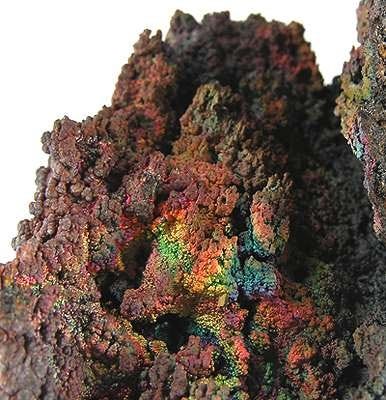
According to Wikipedia — and maybe Rob Lavinsky — this is a geothite with blebs of green malachite. Not to be confused with Malachai, from Children of the Corn. The two can easily be distinguished thus:
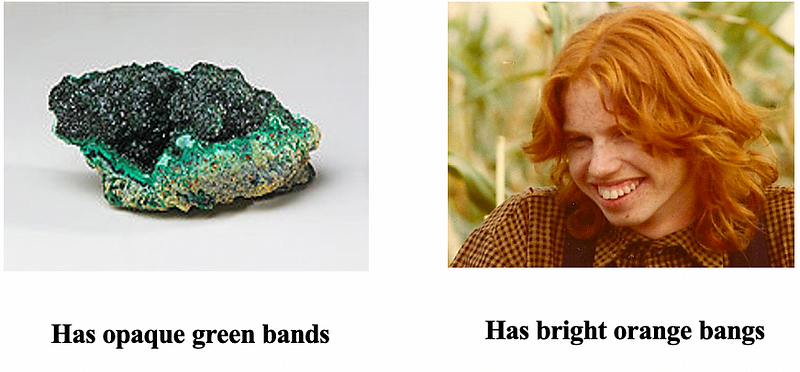
(Fun fact, the original short story by Stephen King was first published in Penthouse magazine.)
Okay, there we have it. Three very elaborate and lengthy explanations for the three definitions of bleb.
All for nothing, as usual.
Because the editors of the Spelling Bee puzzle took one look at bleb and decided it was a dord.*
You can check out my previous entry on another dord* here:
*What the heck is a dord, you ask? Here’s the answer: