avatarPatricia Jeanne

Free AI web copilot to create summaries, insights and extended knowledge, download it at here

9176

Abstract

society.</p><p id="3ac4"><a href="https://en.wikipedia.org/wiki/Strange_Fruit">Strange Fruit</a> is a powerful protest that metaphorically referenced lynching African Americans. It’s widely recognized as one of the most influential protest songs of the 20th century. Initially a poem, it was written and composed by <a href="https://en.wikipedia.org/wiki/Abel_Meeropol">Abel Meeropol</a> (under his pseudonym Lewis Allan) and recorded by <a href="https://en.wikipedia.org/wiki/Billie_Holiday">Billie Holiday</a> in 1939. <a href="https://youtu.be/Web007rzSOI?si=Jtcgw8dsQDEAnn7w">Billie Holiday — <i>Strange Fruit</i></a><i> (1939 YouTube recording)</i></p><p id="8035"><a href="https://en.wikipedia.org/wiki/Black_and_Blue_(Fats_Waller_song)">(What Did I Do to be So) Black and Blue</a> is a 1929 jazz standard introduced in the Broadway musical <a href="https://en.wikipedia.org/wiki/Hot_Chocolates"><i>Hot Chocolates</i></a> by <a href="https://en.wikipedia.org/wiki/Edith_Wilson_(singer)">Edith Wilson</a>. In the show, Wilson originally sang the song from a bed with white sheets, but the bed was removed after the first show due to judgment that it was too suggestive. <a href="https://en.wikipedia.org/wiki/Louis_Armstrong">Louis Armstrong</a> later performed and recorded the song several times omitting the opening verse. <a href="https://youtu.be/2LDPUfbXRLM?si=QOf2zj8qJWFM3bAw">Louis Armstrong —<i> Black and Blue</i></a> <i>(1929 YouTube recording)</i></p><p id="101e"><a href="https://en.wikipedia.org/wiki/The_Bourgeois_Blues">The Bourgeois Blues</a> was written by Lead Belly, born Huddie Ledbetter. When Lead Belly went to Washington, D.C. to record with Alan Lomax, he experienced severe racial discrimination which inspired the song. The term “bourgeois” refers to the middle-class pretensions that supported segregation. <a href="https://youtu.be/Dk6Y9uIwiMI?si=Q8-BgKWctGMznoJA">Lead Belly —<i> The Bourgeois Blues</i></a> <i>(1939 YouTube recording)</i></p><figure id="05ac"><img src="https://cdn-images-1.readmedium.com/v2/resize:fit:800/1*o-vJGRlOnVAdMimVJ_wQDg.jpeg"><figcaption>Marian Anderson, Shirley Verrett, James Carter & Prisoners, and Mahalia Jackson. All are licensed under Wikimedia Commons. Source: Author</figcaption></figure><p id="d4ca"><a href="https://en.wikipedia.org/wiki/Deep_River_(song)">Deep River</a> was first mentioned in print in 1867, when it was published in the first edition of <i>The Story of the <a href="https://en.wikipedia.org/wiki/Fisk_Jubilee_Singers">Jubilee Singers</a>: With Their Songs</i>, by J. B. T. Marsh. By 1917, when Harry Burleigh completed the last of his several influential arrangements, the song became very popular in recitals. Like many of the songs referred to as “Negro spirituals” at the time, it focuses on spiritual freedom, often code for personal freedom. <a href="https://youtu.be/2bytFrsL4_4?si=pp1-zX6PMZft-FHE">Marian Anderson — <i>Deep River</i></a><i> (1925 YouTube recording)</i></p><p id="b6ba"><a href="https://en.wikipedia.org/wiki/Oh,_Freedom">Oh! Freedom</a> was first recorded in 1931 by the E. R. Nance Family as “Sweet Freedom”. Writer and radio producer Richard Durham used it as an opening in his 1948–1950 radio anthology <a href="https://en.wikipedia.org/wiki/Destination_Freedom"><i>Destination Freedom</i></a><i>. </i>It is often associated with the Civil Rights Movement, with <a href="https://en.wikipedia.org/wiki/Odetta">Odetta</a>, who recorded it as part of the “Spiritual Trilogy”, on her <i>Odetta Sings Ballads and Blues</i> album, and with Joan Baez, who stood with Martin Luther King (MLK) and <a href="https://youtu.be/oaWmg658bFw?si=xr1Cp6XuwpPtq4HR">performed the song</a> during the 1963 March on Washington. <a href="https://youtu.be/XKlgL4SkkqA?si=iqsqi-v6ViZEXiOK">Shirley Verrett —<i> Oh! Freedom</i></a> <i>(1966 YouTube recording)</i></p><p id="6a6c"><a href="https://en.wikipedia.org/wiki/We_Shall_Overcome">We Shall Overcome</a> is a gospel song associated heavily with the U.S. civil rights movement. The origins of the song are unclear; it was thought to have descended from “I’ll Overcome Some Day,” a hymn by Charles Albert Tindley, In 1947, the song was published under the title “We Will Overcome” in an edition of the <i>People’s Songs Bulletin.</i> <a href="https://youtu.be/TmR1YvfIGng?si=Yxe0srJtsAE-cP00">Mahalia Jackson —<i> We Shall Overcome</i></a><i> (YouTube recording)</i></p><p id="90b6">The modern version of <a href="https://en.wikipedia.org/wiki/We_Shall_Overcome">We Shall Overcome</a> was first said to have been sung by tobacco workers led by Lucille Simmons during the 1945–1946 Charleston Cigar Factory strike in Charleston, South Carolina.</p><p id="85fd"><a href="https://en.wikipedia.org/wiki/Joan_Baez">Joan Baez</a> performed We Shall Overcome during the 1963 <a href="https://en.wikipedia.org/wiki/March_on_Washington_for_Jobs_and_Freedom">March on Washington for Jobs and Freedom</a>, then again for the Obamas in the White House.</p><figure id="da78"><img src="https://cdn-images-1.readmedium.com/v2/resize:fit:800/1*dK90-A8PsjdEHkMyPSh8JA.jpeg"><figcaption>Alan Lomax, Muddy Waters, Robert Johnson, and Woody Guthrie. All Wikimedia Commons licensed. Source: Author</figcaption></figure><h2 id="3b6b">Recordings and musicians gain wider distribution</h2><p id="1ccf"><a href="https://en.wikipedia.org/wiki/Alan_Lomax">Alan Lomax</a> was an ethnomusicologist born in 1915. At age 17, he worked with his father who collected folklore music for the Library of Congress and co-authored <i>American Ballads and Folk Songs</i> (1934) and <i>Negro Folk Songs as Sung by Lead Belly (1936).</i></p><p id="0a13">The 1938 <a href="https://en.wikipedia.org/wiki/House_Un-American_Activities_Committee">House Un-American Activities Committee</a> investigation focused on suspected foreign allegiance, especially communism. They fabricated a link, so the Library of Congress folklore music cataloging program was halted in 1947. Lomax fled the US after being investigated by the FBI. He returned ten years later after Joseph McCarthy’s death and the end of the unfounded investigation.</p><p id="1b6f">Returning from the UK in 1957, Lomax embarked on a recording trip throughout the American South. Lomax’s recordings played an important role in preserving folk music traditions and helped start both the American and British folk revivals of the 1940s, 1950s, and early 1960s.</p><p id="15da">In his late 70s, Lomax completed the long-deferred memoir <i>The Land Where the Blues Began</i> (1993), linking the birth of the blues to <a href="https://en.wikipedia.org/wiki/Debt_peonage">debt peonage</a>, <a href="https://en.wikipedia.org/wiki/Racial_segregation_in_the_United_States">segregation</a>, and <a href="https://en.wikipedia.org/wiki/Forced_labor">forced labor</a> in the American South.</p><p id="140a">Lomax’s greatest legacy is in preserving and publishing recordings of musicians in many folk and blues traditions around the US and Europe. Among the artists Lomax is credited with discovering and bringing to a wider audience are blues guitarist <a href="https://en.wikipedia.org/wiki/Robert_Johnson">Robert Johnson</a>, protest singer <a href="https://en.wikipedia.org/wiki/Woody_Guthrie">Woody Guthrie</a>, folk artist <a href="https://en.wikipedia.org/wiki/Pete_Seeger">Pete Seeger</a>, and country blues singers <a href="https://en.wikipedia.org/wiki/Lead_Belly">Lead Belly</a> and <a href="https://en.wikipedia.org/wiki/Muddy_Waters">Muddy Waters</a>, among many others.</p><p id="dd18">“Alan scraped by the whole time, and left with no money,” said Don Fleming, director of Lomax’s Association for Culture Equity. “He did it out of the passion he had for it, and found ways to fund projects that were closest to his heart”.</p><h2 id="d1d0">Record producers often used white artists to record Black Music</h2><p id="6a15">As the <a href="https://www.loc.gov/item/ihas.200038862/">Library of Congress</a> website notes,</p><blockquote id="fbf0"><p>Although black singers and musicians were well known, in its early years, the recording industry was not looking for known artists. At its inception, beginning in the 1890s, it was the song that sold a record and not (with some exceptions) the artist.</p></blockquote><blockquote id="de31"><p>There was no need to seek out famous stage artists. The Berliner, Edison, and Columbia companies of the 1890s had established a cadre of professional white “recorders” able to render both up to the minute hits as well as old favorites — and for a lower fee than a famous performer required. These white recorders could also reproduce the works of African-American performers with “authentic” dialect. So why hire Ernest Hogan, Cole and Johnson, Williams and Walker, and others when the in-house talent could do the job? Besides, many artists famous for their strong stage voices did not record as clearly as the professional record makers.</p></blockquote><p id="f54c">Despite being among the most prominent Black artists of the time, <a href="https://en.wikipedia.org/wiki/Ernest_Hogan">Ernest Hogan</a>, the duo <a href="https://en.wikipedia.org/wiki/Bob_Cole_

Options

(composer)">Bob Cole</a> and <a href="https://en.wikipedia.org/wiki/J._Rosamond_Johnson">J. Rosamond Johnson</a>, and the duo <a href="https://en.wikipedia.org/wiki/Williams_and_Walker_Co">Williams and Walker Co</a> received at best about a tenth of the amount as their white counterparts when performing. Songs by Black artists often went unpaid with unsubstantiated promises of future wealth and fame. Or, songwriters were paid a miniscule amount without royalties.</p><p id="bc46">With legal recourse usually inaccessible to Black people, the songwriters and performers were ripe for exploitation.</p><p id="2704">All three of these successful groups performed in minstrel or vaudeville shows with white performers wearing <a href="https://en.wikipedia.org/wiki/Blackface">blackface</a> and were referred to as “coons.” <a href="https://en.wikipedia.org/wiki/Williams_and_Walker_Co">Williams and Walker Co</a> referred to themselves as “Two Real Coons” as opposed to the white performers in blackface, though the term was offensive to most negros at the time.</p><h2 id="4a37">Others who helped bring early Black musicians into prominence</h2><p id="fd6b"><a href="https://en.wikipedia.org/wiki/John_Wesley_Work_III"><b>John Wesley Work III</b></a><b> </b>was a Black ethnomusicologist, composer, and scholar. He was born in Tennessee in 1901 to a family of professional musicians. His grandfather, John Wesley Work, was a church choir director in Nashville, where he wrote and arranged music for his choirs. Some of his choristers were members of the original <a href="https://en.wikipedia.org/wiki/Fisk_Jubilee_Singers">Fisk Jubilee Singers</a>.</p><p id="2ace">John Wesley Work III was instrumental in preserving African American folk music. He collected, studied, and promoted traditional Black music, including spirituals, work songs, and folk songs. His field recordings and academic work helped bring attention to the rich musical traditions of African Americans in the South.</p><p id="d226"><a href="https://en.wikipedia.org/wiki/John_Wesley_Work_Jr.">John Wesley Work Jr.</a>, John Wesley Work III’s father, was credited with publishing “Wade in the Water” (above), and “Go Tell it on the Mountain.” While uncommon for the time, Work, Jr attended Harvard and taught History and Latin at Tennessee’s Fisk University.</p><p id="b9b5">All three generations of the Work males were important in maintaining, writing music for, and promoting the famed <a href="https://en.wikipedia.org/wiki/Fisk_Jubilee_Singers">Fisk Jubilee Singers</a> who helped fledgling Fisk University avert bankruptcy in 1871. The original ensemble were children of freed slaves and chose the name “Jubilee” referencing the freeing of Jews in Leviticus.</p><p id="ad9d"><a href="https://en.wikipedia.org/wiki/Harry_Oster"><b>Harry Oster</b></a><b> </b>was the firstborn son of Russian-Polish Jews who emigrated to Cambridge, Massachusetts. In 1959 Oster went with New Orleans jazz historian Richard B. Allen to the Louisiana State Penitentiary, also known as Angola prison, to record African American Blues, Spirituals sung by choirs and soloists, sermons, and personal interviews.</p><p id="32c5">Oster recorded inmate <a href="https://en.wikipedia.org/wiki/Robert_Pete_Williams">Robert Pete Williams</a> for the first time. Williams was pardoned and went on to have a successful music career. Others included <a href="https://youtu.be/Wau7qO4_kgo?si=YYHK3Q5GkWFcRy2z">Roosevelt Charles,</a> <a href="https://youtu.be/tBmSvfD0UQs?si=jlEX6hNQlZTkFRjf">Hogman Maxey</a>, <a href="https://youtu.be/WkCJp4iltVg?si=y0reD1k5vBt1yagJ">Otis Webster,</a> and <a href="https://youtu.be/c9h6nBsamzM?si=ewr_EXHhtY4NI7JW">Robert Guitar Welch</a>. Oster went on to produce and distribute Black artist’s music accompanied by Oster’s own hand-made lithographs. At the end of the 1960s, his catalog was sold to <a href="https://en.wikipedia.org/wiki/Arhoolie_Records">Arhoolie Records</a>.</p><p id="ac85"><a href="https://en.wikipedia.org/wiki/Zora_Neale_Hurston"><b>Zora Neale Hurston</b></a><b> </b>was a Black woman born in 1891. An author, anthropologist, and filmmaker, Hurston recorded and portrayed racial struggles in the early-20th-century American South and published research on<i> </i>hoodoo<i>.</i> Hurston met Charlotte Osgood Mason, a philanthropist and literary patron, who supported Black writers <a href="https://en.wikipedia.org/wiki/Langston_Hughes">Langston Hughes</a> and <a href="https://en.wikipedia.org/wiki/Alain_Locke">Alain Locke</a>, who recommended Hurston to her; however, she also tried to direct their work. Hurston prevailed and shone a light on Black music while writing over 50 short stories, plays, and essays.</p><p id="858a"><a href="https://en.wikipedia.org/wiki/Samuel_Charters"><b>Samuel Charters</b></a> was a music historian, writer, and record producer born in 1928. He was a pioneering figure in the blues revival during the 1950s and 1960s. His book “The Country Blues” was instrumental in sparking a renewed interest in acoustic blues music.</p><h2 id="c756">The impact and contributions of early Black performers</h2><p id="9ae3">The contributions of Black artists impacted most genres and influenced many of America’s most well-known musicians.</p><p id="123b">Blues artists Robert Johnson, Muddy Waters, and Lead Belly inspired future generations including Jimi Hendrix, Bob Dylan, the Rolling Stones, Eric Clapton, Jeff Beck, Janis Joplin, the Beatles, Robert Cray, John Mayer, Ray Charles, and BB King.</p><p id="1e31">Without the influence of Black artists and those who helped promote the distribution of their music, many of the most familiar guitar riffs, blues and jazz inspirations, and leaps in music history would not have been possible.</p><p id="e77f">Early slaves and Black performers throughout America’s history demonstrated effective underground communication methods and tactics in their struggle to attain freedom and equality.</p><p id="0645">The advances made against oppression were largely through non-violent protests and civil disobedience. They were necessary, and often painful. Frequently, two steps forward were met with a shove pushing back by those fearing an unpredictable future. Ignorance of someone who looked or acted differently than what was accepted as normal has always met resistance. And yet, Rosa Parks refused to sit at the back of the bus, Black people staged peaceful sit-ins at all-white lunch counters, interracial Freedom Rider groups rode buses together, and Black children attended all-white schools for the first time.</p><p id="36be">The widely reported and televised images of peaceful resistance garnered national sympathy and a disdain for bigotry not realized before.</p><p id="07e2">In 1963, Martin Luther King made his famous “I Have a Dream” speech during the March on Washington for Jobs and Freedom. Several of the previously cited old Negro Spirituals were performed, but this time, their meaning was clear. Freedom wasn’t just a spiritual goal through Christ; the lyrics called for freedom from oppression and discrimination, without changing a word.</p><p id="aeda">Thanks to editor <a href="undefined">Andrew Rodwin</a> for always adding value.</p><p id="6926">Copyright © Patricia Jeanne 2024</p><div id="57a4" class="link-block"> <a href="https://readmedium.com/the-best-thank-you-i-never-got-internationally-91d07651f11a"> <div> <div> <h2>The Best Thank You I Never Got, Internationally</h2> <div><h3>Attitudes between the haves, have-nots, and nervous middle</h3></div> <div><p>medium.com</p></div> </div> <div> <div style="background-image: url(https://miro.readmedium.com/v2/resize:fit:320/1*kdpzfwb8sYunejKWRoPbGg.jpeg)"></div> </div> </div> </a> </div><div id="2edb" class="link-block"> <a href="https://readmedium.com/the-kids-we-saved-following-brain-injuries-0c2335ab3ea6"> <div> <div> <h2>The Kids We Saved Following Brain Injuries</h2> <div><h3>Tough detours in life sometimes benefit others</h3></div> <div><p>medium.com</p></div> </div> <div> <div style="background-image: url(https://miro.readmedium.com/v2/resize:fit:320/0*ZkzryOY19V8ZJUO8)"></div> </div> </div> </a> </div><div id="983d" class="link-block"> <a href="https://readmedium.com/the-making-of-politics-tv-and-movies-fd5a8eaa90ef"> <div> <div> <h2>Making movies With Will Farrel, Wm Shatner, Woody Harrelson, and Politicians</h2> <div><h3>“Karen, Wake Up! We’re About to be Colonized!”</h3></div> <div><p>medium.com</p></div> </div> <div> <div style="background-image: url(https://miro.readmedium.com/v2/resize:fit:320/1*vhL4ErLIyJLQaBDsJzI8kQ.jpeg)"></div> </div> </div> </a> </div></article></body>

BLACK HISTORY IN MUSIC

Black History’s Influence on Modern Music — Slave & Early Coded Resistance Songs

The songs that helped usher in change
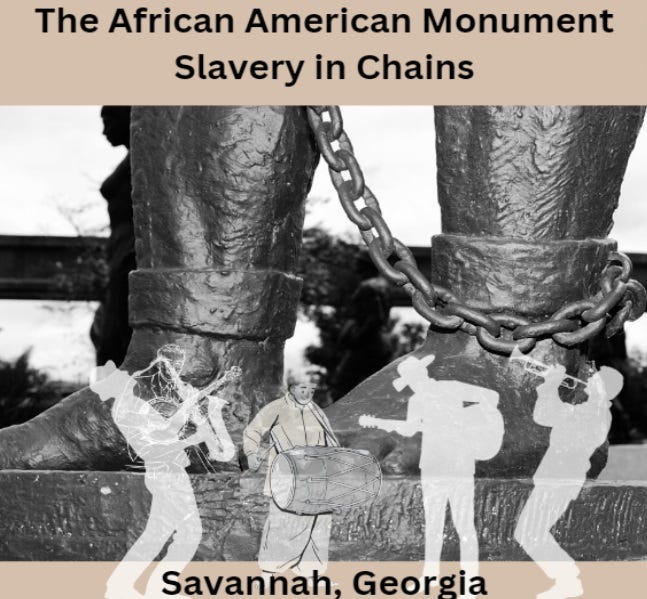
The African American Monument, from Wikimedia Commons. Source: Author

Long before Jimi Hendrix performed his electric guitar rendition of The Star Spangled Banner at Woodstock in 1969, the roots of protest songs were planted by Black musicians struggling to be free.

Since the first African Americans were brought to America in the 1600s, music has played an important role. The influence of slave laborers and the period following the Civil War contributed to or led to many popular genres, including spirituals, folk, blues, jazz, rock, and more.

When speaking frankly brought repercussions, hidden meanings in metaphors and coded references helped inspire and inform slaves, prisoners, and those fighting for civil rights.

The Underground Railroad

The Underground Railroad was most active between the early 19th century and the Civil War’s beginning in 1861. This informal network of secret routes and safe houses was established to help enslaved African Americans escape to free states and Canada.

Coded songs, the display of quilts in windows with specific panels, and the timing and positioning of laundry hanging on clotheslines were used to coordinate escapes. Many of these songs are spirituals, so references to personal freedom could be masked.

Lyrics like, “Set me free,” “I’ll fly away,” “Coming for to carry me home,” and “Set my people free,” could be attributed to religion.

Frederick Douglass was an escaped slave and abolitionist author. In his 19th-century autobiography, Narrative of the Life of Frederick Douglass, an American Slave (1845), Douglass gives examples of how the songs sung by slaves had multiple meanings. References to Jerusalem, Israelites, or Egypt may have signaled specific places, people, or directions. Songs referencing rivers, railroads, or crossing specific terrain alluded to routes.

Some of the spirituals were variations on hymns or poems which may have been written much earlier, but there’s little published information available on the internet for songs preceding 1800.
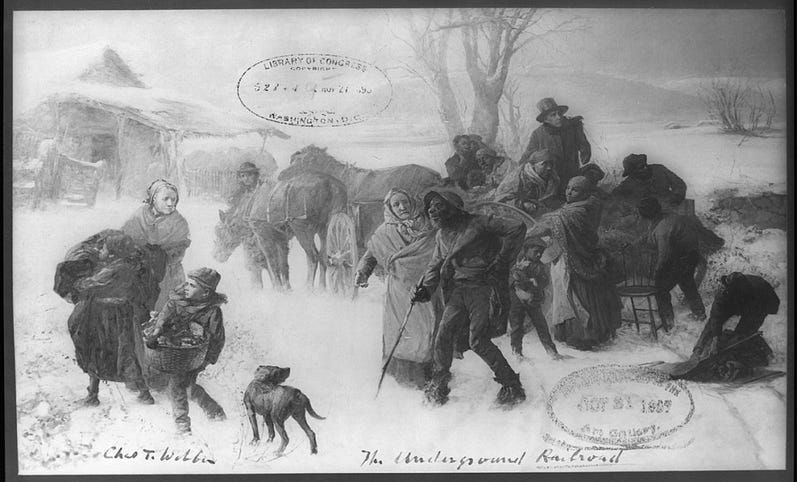
The Underground Railroad in 1893. Source: Wikimedia

Resistance songs from 1800 through 1910

Lift Every Voice and Sing was a poem written by James Weldon Johnson in 1900 and later set to music by his brother J. Rosamond Johnson. It was named the “Negro National Anthem” by the National Association of Colored People (NACCP) in 1917. Lyrics are available here. Tasha Cobbs Leonard — Lift Every Voice and Sing (YouTube recording)

Steal Away (to Jesus) is an often-cited coded Negro spiritual intended to alert others when a slave escape or secret meeting would soon take place. The Fisk Jubilee Singers were comprised of a talented chorus. Initially, they primarily recorded spirituals, then added songs by Stephen Foster. The ensemble continues today. Steal Away was composed by Wallace Willis, a slave of a Choctaw freedman sometime before 1862. Fisk Jubilee Singers — Steal Away To Jesus (YouTube recording)

Wade in the Water directed fleeing slaves to avoid bloodhounds by masking their scent in bodies of water. The lyrics were first co-published in 1901 in New Jubilee Songs as Sung by the Fisk Jubilee Singers by Frederick J. Work and his brother, John Wesley Work Jr., an educator at the Fisk historically black college in Nashville, Tennessee. However, the song is likely older but was not published prior to 1901. Work is also credited with Go Tell It on the Mountain. The Brotherhood — Wade in the Water (YouTube recording)

Follow the Drinking Gourd sent slaves north to Canada by following the Big Dipper celestial body. According to legend, the song was used by a conductor of the Underground Railroad, called Peg Leg Joe, to guide fugitive slaves. The first published records appeared in 1910, though it’s thought to be much older. Eric Bibb — Follow the Drinking Gourd (YouTube recording)

Go Down Moses was identified as a coded signal when an escape was imminent, so the 1872 song was outlawed by slave owners. The song refers to both the freedom of the Israelites and to runaway enslaved people. Louis Armstrong — Go Down Moses (YouTube recording)

Swing Low, Sweet Chariot was often a signal the time had come to flee. The earliest known recording was in 1894, by the Standard Quartette. In 2002 the Library of Congress honored the Fisk Jubilee Singers’ 1909 recording by adding it to the United States National Recording Registry. In 2008 they were awarded a National Medal of Arts. Fisk Jubilee Singers — Swing Low, Sweet Chariot (1909 YouTube recording)
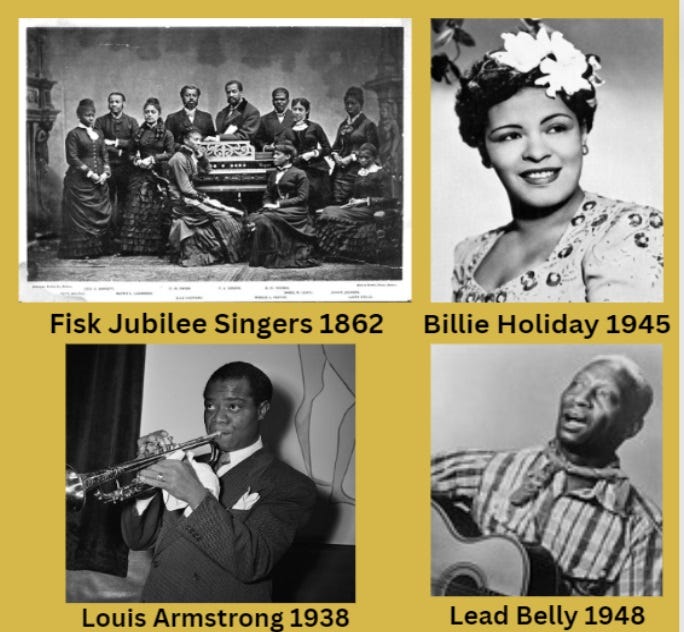
Fisk Jubilee Singers, Billie Holiday, Louis Armstrong, Lead Belly. All are licensed under Wikimedia Commons. Source: Author

Resistance songs from 1911 through 1949

During the period following the height of the Underground Railroad and the exodus of slaves, Black people were still often oppressed and unable to attain the American Dream. Freed slaves often worked as sharecroppers or indentured servants without adequate opportunities for education, jobs, medical care, or housing. Workers often had to pay for company housing, shop at the “company store,” and pay exorbitant fees for necessities.

The result was a never-ending cycle of poverty when the cost of living exceeded wages and few opportunities existed.

Often in desperate situations, Black people were frequently arrested and jailed for minor or non-existent crimes and served harsh sentences. Prisoners provided slave labor without pay, often working in factories, on railroads, and other menial labor jobs.

Despite the end of slavery, systemic racism, discriminatory laws, and socio-economic barriers severely limited the opportunities for African Americans to obtain adequate education, purchase property, and enjoy equal participation in American society. The promise of “40 acres and a mule” as reparations for former slaves was largely unfulfilled, leaving many in ongoing generational poverty. Discriminatory practices under Jim Crow laws and unequal application of the law left families without adequate resources when the primary earner was incarcerated for long periods, often while awaiting trial.

During the early part of the 1900s, Black performers were often not allowed to travel, eat, or sleep as their white counterparts did. Black performers were frequently barred from staying in the hotels where they performed, and traveled and were housed separately.

In the early 1900s, it was not expected songs performed in front of Black audiences might be heard by white audiences. Some of those listed use metaphors and analogies, while others are more straightforward in their critique of American society.

Strange Fruit is a powerful protest that metaphorically referenced lynching African Americans. It’s widely recognized as one of the most influential protest songs of the 20th century. Initially a poem, it was written and composed by Abel Meeropol (under his pseudonym Lewis Allan) and recorded by Billie Holiday in 1939. Billie Holiday — Strange Fruit (1939 YouTube recording)

(What Did I Do to be So) Black and Blue is a 1929 jazz standard introduced in the Broadway musical Hot Chocolates by Edith Wilson. In the show, Wilson originally sang the song from a bed with white sheets, but the bed was removed after the first show due to judgment that it was too suggestive. Louis Armstrong later performed and recorded the song several times omitting the opening verse. Louis Armstrong — Black and Blue (1929 YouTube recording)

The Bourgeois Blues was written by Lead Belly, born Huddie Ledbetter. When Lead Belly went to Washington, D.C. to record with Alan Lomax, he experienced severe racial discrimination which inspired the song. The term “bourgeois” refers to the middle-class pretensions that supported segregation. Lead Belly — The Bourgeois Blues (1939 YouTube recording)
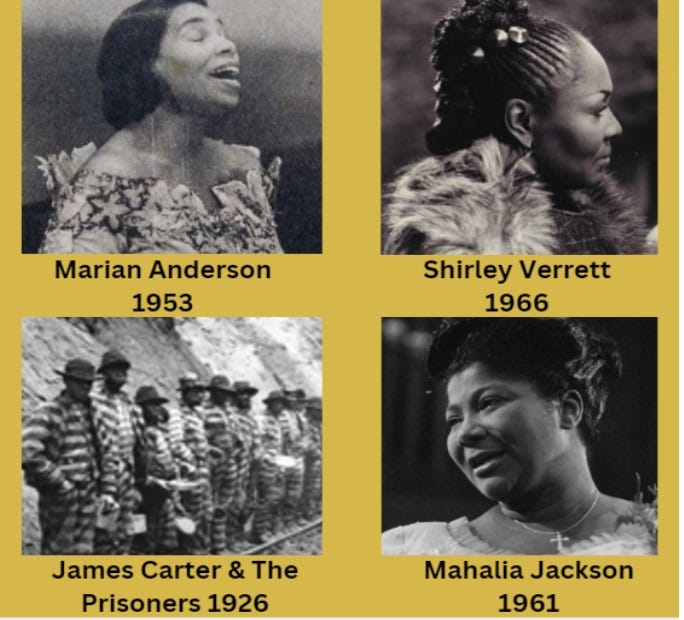
Marian Anderson, Shirley Verrett, James Carter & Prisoners, and Mahalia Jackson. All are licensed under Wikimedia Commons. Source: Author

Deep River was first mentioned in print in 1867, when it was published in the first edition of The Story of the Jubilee Singers: With Their Songs, by J. B. T. Marsh. By 1917, when Harry Burleigh completed the last of his several influential arrangements, the song became very popular in recitals. Like many of the songs referred to as “Negro spirituals” at the time, it focuses on spiritual freedom, often code for personal freedom. Marian Anderson — Deep River (1925 YouTube recording)

Oh! Freedom was first recorded in 1931 by the E. R. Nance Family as “Sweet Freedom”. Writer and radio producer Richard Durham used it as an opening in his 1948–1950 radio anthology Destination Freedom. It is often associated with the Civil Rights Movement, with Odetta, who recorded it as part of the “Spiritual Trilogy”, on her Odetta Sings Ballads and Blues album, and with Joan Baez, who stood with Martin Luther King (MLK) and performed the song during the 1963 March on Washington. Shirley Verrett — Oh! Freedom (1966 YouTube recording)

We Shall Overcome is a gospel song associated heavily with the U.S. civil rights movement. The origins of the song are unclear; it was thought to have descended from “I’ll Overcome Some Day,” a hymn by Charles Albert Tindley, In 1947, the song was published under the title “We Will Overcome” in an edition of the People’s Songs Bulletin. Mahalia Jackson — We Shall Overcome (YouTube recording)

The modern version of We Shall Overcome was first said to have been sung by tobacco workers led by Lucille Simmons during the 1945–1946 Charleston Cigar Factory strike in Charleston, South Carolina.

Joan Baez performed We Shall Overcome during the 1963 March on Washington for Jobs and Freedom, then again for the Obamas in the White House.
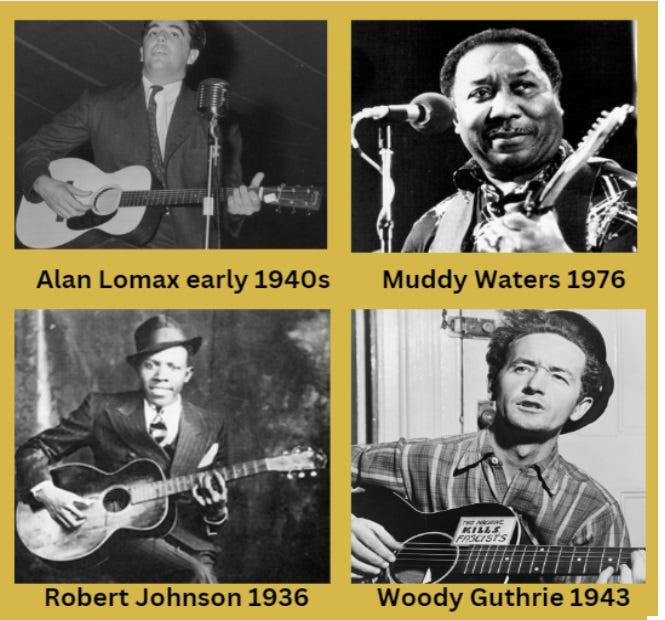
Alan Lomax, Muddy Waters, Robert Johnson, and Woody Guthrie. All Wikimedia Commons licensed. Source: Author

Recordings and musicians gain wider distribution

Alan Lomax was an ethnomusicologist born in 1915. At age 17, he worked with his father who collected folklore music for the Library of Congress and co-authored American Ballads and Folk Songs (1934) and Negro Folk Songs as Sung by Lead Belly (1936).

The 1938 House Un-American Activities Committee investigation focused on suspected foreign allegiance, especially communism. They fabricated a link, so the Library of Congress folklore music cataloging program was halted in 1947. Lomax fled the US after being investigated by the FBI. He returned ten years later after Joseph McCarthy’s death and the end of the unfounded investigation.

Returning from the UK in 1957, Lomax embarked on a recording trip throughout the American South. Lomax’s recordings played an important role in preserving folk music traditions and helped start both the American and British folk revivals of the 1940s, 1950s, and early 1960s.

In his late 70s, Lomax completed the long-deferred memoir The Land Where the Blues Began (1993), linking the birth of the blues to debt peonage, segregation, and forced labor in the American South.

Lomax’s greatest legacy is in preserving and publishing recordings of musicians in many folk and blues traditions around the US and Europe. Among the artists Lomax is credited with discovering and bringing to a wider audience are blues guitarist Robert Johnson, protest singer Woody Guthrie, folk artist Pete Seeger, and country blues singers Lead Belly and Muddy Waters, among many others.

“Alan scraped by the whole time, and left with no money,” said Don Fleming, director of Lomax’s Association for Culture Equity. “He did it out of the passion he had for it, and found ways to fund projects that were closest to his heart”.

Record producers often used white artists to record Black Music

As the Library of Congress website notes,

Although black singers and musicians were well known, in its early years, the recording industry was not looking for known artists. At its inception, beginning in the 1890s, it was the song that sold a record and not (with some exceptions) the artist.

There was no need to seek out famous stage artists. The Berliner, Edison, and Columbia companies of the 1890s had established a cadre of professional white “recorders” able to render both up to the minute hits as well as old favorites — and for a lower fee than a famous performer required. These white recorders could also reproduce the works of African-American performers with “authentic” dialect. So why hire Ernest Hogan, Cole and Johnson, Williams and Walker, and others when the in-house talent could do the job? Besides, many artists famous for their strong stage voices did not record as clearly as the professional record makers.

Despite being among the most prominent Black artists of the time, Ernest Hogan, the duo Bob Cole and J. Rosamond Johnson, and the duo Williams and Walker Co received at best about a tenth of the amount as their white counterparts when performing. Songs by Black artists often went unpaid with unsubstantiated promises of future wealth and fame. Or, songwriters were paid a miniscule amount without royalties.

With legal recourse usually inaccessible to Black people, the songwriters and performers were ripe for exploitation.

All three of these successful groups performed in minstrel or vaudeville shows with white performers wearing blackface and were referred to as “coons.” Williams and Walker Co referred to themselves as “Two Real Coons” as opposed to the white performers in blackface, though the term was offensive to most negros at the time.

Others who helped bring early Black musicians into prominence

John Wesley Work III was a Black ethnomusicologist, composer, and scholar. He was born in Tennessee in 1901 to a family of professional musicians. His grandfather, John Wesley Work, was a church choir director in Nashville, where he wrote and arranged music for his choirs. Some of his choristers were members of the original Fisk Jubilee Singers.

John Wesley Work III was instrumental in preserving African American folk music. He collected, studied, and promoted traditional Black music, including spirituals, work songs, and folk songs. His field recordings and academic work helped bring attention to the rich musical traditions of African Americans in the South.

John Wesley Work Jr., John Wesley Work III’s father, was credited with publishing “Wade in the Water” (above), and “Go Tell it on the Mountain.” While uncommon for the time, Work, Jr attended Harvard and taught History and Latin at Tennessee’s Fisk University.

All three generations of the Work males were important in maintaining, writing music for, and promoting the famed Fisk Jubilee Singers who helped fledgling Fisk University avert bankruptcy in 1871. The original ensemble were children of freed slaves and chose the name “Jubilee” referencing the freeing of Jews in Leviticus.

Harry Oster was the firstborn son of Russian-Polish Jews who emigrated to Cambridge, Massachusetts. In 1959 Oster went with New Orleans jazz historian Richard B. Allen to the Louisiana State Penitentiary, also known as Angola prison, to record African American Blues, Spirituals sung by choirs and soloists, sermons, and personal interviews.

Oster recorded inmate Robert Pete Williams for the first time. Williams was pardoned and went on to have a successful music career. Others included Roosevelt Charles, Hogman Maxey, Otis Webster, and Robert Guitar Welch. Oster went on to produce and distribute Black artist’s music accompanied by Oster’s own hand-made lithographs. At the end of the 1960s, his catalog was sold to Arhoolie Records.

Zora Neale Hurston was a Black woman born in 1891. An author, anthropologist, and filmmaker, Hurston recorded and portrayed racial struggles in the early-20th-century American South and published research on hoodoo. Hurston met Charlotte Osgood Mason, a philanthropist and literary patron, who supported Black writers Langston Hughes and Alain Locke, who recommended Hurston to her; however, she also tried to direct their work. Hurston prevailed and shone a light on Black music while writing over 50 short stories, plays, and essays.

Samuel Charters was a music historian, writer, and record producer born in 1928. He was a pioneering figure in the blues revival during the 1950s and 1960s. His book “The Country Blues” was instrumental in sparking a renewed interest in acoustic blues music.

The impact and contributions of early Black performers

The contributions of Black artists impacted most genres and influenced many of America’s most well-known musicians.

Blues artists Robert Johnson, Muddy Waters, and Lead Belly inspired future generations including Jimi Hendrix, Bob Dylan, the Rolling Stones, Eric Clapton, Jeff Beck, Janis Joplin, the Beatles, Robert Cray, John Mayer, Ray Charles, and BB King.

Without the influence of Black artists and those who helped promote the distribution of their music, many of the most familiar guitar riffs, blues and jazz inspirations, and leaps in music history would not have been possible.

Early slaves and Black performers throughout America’s history demonstrated effective underground communication methods and tactics in their struggle to attain freedom and equality.

The advances made against oppression were largely through non-violent protests and civil disobedience. They were necessary, and often painful. Frequently, two steps forward were met with a shove pushing back by those fearing an unpredictable future. Ignorance of someone who looked or acted differently than what was accepted as normal has always met resistance. And yet, Rosa Parks refused to sit at the back of the bus, Black people staged peaceful sit-ins at all-white lunch counters, interracial Freedom Rider groups rode buses together, and Black children attended all-white schools for the first time.

The widely reported and televised images of peaceful resistance garnered national sympathy and a disdain for bigotry not realized before.

In 1963, Martin Luther King made his famous “I Have a Dream” speech during the March on Washington for Jobs and Freedom. Several of the previously cited old Negro Spirituals were performed, but this time, their meaning was clear. Freedom wasn’t just a spiritual goal through Christ; the lyrics called for freedom from oppression and discrimination, without changing a word.

Thanks to editor Andrew Rodwin for always adding value.

Copyright © Patricia Jeanne 2024

Slavery
Black Music
Musical Influences
African American History
Brain Labs
Recommended from ReadMedium