
AMERICAN IMPRESSIONS
The Best Thank You I Never Got, Internationally
Attitudes between the haves, have-nots, and nervous middle
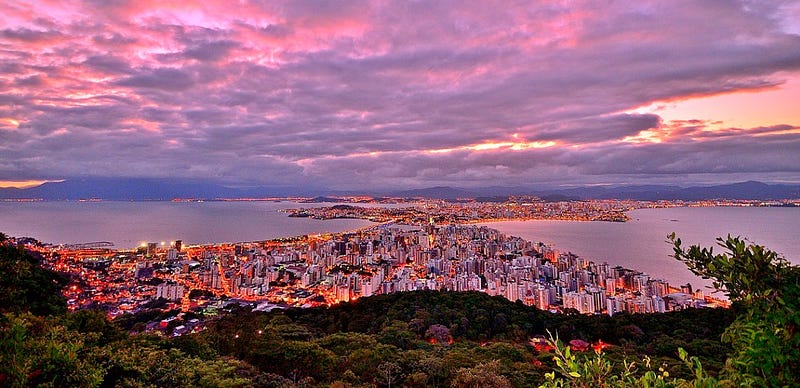
This is a story of the proverbial Have’s, Have-Nots, and the majority of us who fall somewhere in the middle. My friend and I were privileged to be able to visit a foreign country for a few months, but wouldn’t be considered elite by most American standards.
Working vacation in Brazil
I visited Forquilhinha, near Florianopolis, Brazil about twenty years ago. Maria’s large extended family lived in remote areas surrounding São Paulo, so we planned an extended working vacation there.
We first spent a week in Rio de Janeiro where we visited beautiful Copacabana beach. Maria’s flashy jewelry caught the attention of a knife-wielding thief who ran off when I yelled for help and nearby volleyball players interceded. The mugger got her watch after holding a butcher knife to her neck.
Dressed more carefully, we flew to São Paulo, then on to the hilly city of Florianopolis with its incredible views.
In Florianópolis, I discovered about a third of those in high school or college spoke some English. Old reruns of classic American television shows played on TV constantly, sometimes dubbed, but usually not. Americans in foreign countries often learn new languages by watching soap operas because expressions and slower talking help provide context. American TV and videos are having the same impact worldwide.
After another week, we headed to our home base of Forquilhinha. The 80-mile drive from Florianópolis took nearly three hours and felt bitterly cold. The actual temperature was likely around 5°C (45°F), but wind and humidity can make cool weather feel cold in different locales.
On our way to the tropical Rio Vermelho State Park in Santa Catarina, I was uncomfortable enough to stop and buy a space heater. It seemed like a bad idea to Maria, who asked if I was trying to be ironic when I asked for fiero (Spanish for rude, ugly, powerful — possibly American tourist) instead of fuego (fire) when searching for the word fugo in Portuguese.
“This might make you look weak. We’re not in the US anymore,” Maria said.
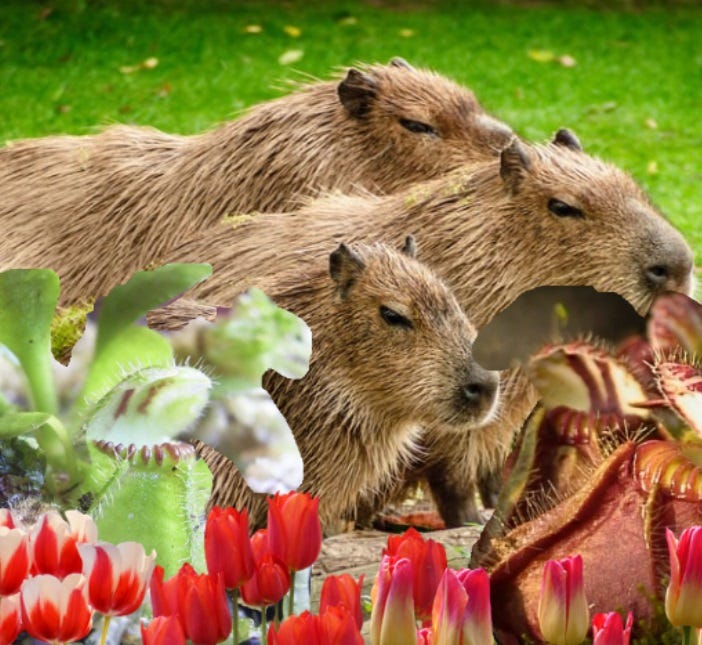
“No kidding. That giant rat capybara rivaled our golden retriever. And the overgrown Venus flytrap could probably eat a kitten.” I feigned fright and laughed.
When we arrived in Forquilhinha (pop. 20,000) I was struck by Maria’s sisters’ side-by-side Danish architecture homes. I wondered why they planted flowers in between the cement tire tracks in the driveway. Installing a swimming pool on top of a home that didn’t appear sturdy enough to support it confused me.
“They’re wealthy, and showing off,” Maria explained.
The modest homes were similar to small, average homes found throughout the Midwest.
I was the first, and possibly only American residents might meet.
Maria’s sister Zelda came outside to meet us. She grasped my hands and studied my soul, staring intensely into my eyes. After about 30 seconds, I glanced away and she hugged me fiercely.
Once inside, I was impressed with a large painting of two stars with cascading smaller stars flowing down the canvas.

Zelda explained the painting was created by a local nun to represent the generations borne of her grandmother. Greta, the family matriarch, sat bundled in layers nearby, always rocking silently. A welcoming party of relatives sang German songs, fried empanada-type snacks, and chatted happily.
What struck me most profoundly about Maria’s large family was their beauty due to racial diversity and generosity of spirit.
Brazil’s colonization involved extensive intermixing between European colonizers, enslaved Africans, and Indigenous populations. This created a more fluid racial mixture compared to the US, where segregation and the one-drop rule claimed any person with an ancestor considered a negro or African American was also Black and not allowed to marry a white person. This law enforced a sharper racial divide in America and wasn’t outlawed until 1967. Unlike the US, Brazil never had federal laws against interracial marriage. While some social disapproval existed, it was less formalized and widespread.
Maria’s grandparents fled the Weimar Republic as it became Nazi Germany under Hitler. Early settlers of Forquilhinha emigrated from Schleswig-Holstein in Northern Germany bordering Denmark, integrating architectural preferences that reminded me of gingerbread houses.
Tulips growing next to monster pitcher plants resembling huge Venus flytraps illustrated the sharp contrasts found in this part of Brazil. The oddities continued as Maria’s dark-complected niece railed against American politics next to her very Slavic-looking white laid-back uncle dressed similar to a 1930s American cowboy. In the 1960s in America, Arquilina would have likely been mistaken for a “Black radical,” and her brother a “good ole’ boy” from Texas.
I spent about three months living with Imelda, one of Maria’s sisters, and her young daughter next door to Zelda’s much larger family. As a native English speaker often searching for a Spanish word, and then translating it to Portuguese, communication could be challenging. Yet many close bonds were formed as we shared meals, sang old Beatles songs, and laughed over fashion styles. Maria’s college-aged cousins shared their tech ideas, eager to see the project I was working on.
Becoming immersed in other cultures helps us appreciate the commonalities all humans share. The languages we speak aren’t necessary to communicate emotions or obvious reactions. When I was given a strong tea made from freshly picked bitter leaves to help with stomach issues, everyone recognized my revulsion as I gagged and coughed. They also witnessed my discomfort when I was tricked into singing a solo of the Beatles song Yesterday.
Despite the cultural and language differences, I felt almost like family.
Ugly, privileged Americans
I frequently heard, “I’ve never met an American before.” Often, the speaker looked suspicious but was quickly put at ease. “É gente de bem” (you seem normal with good intentions) was usually their final impression.
Yet I took a couple of liberties.
Since I still had to work, I’d often excuse myself in the evening. “It’s an American thing,” Maria and I would say, a bit lazily.
My most extravagant purchases during those months included jewelry I didn’t show, the space heater, warm clothes, and non-essential food and drinks. As a result, I had cash left over.
Family laws and cultural and religious norms were very different in Brazil.
Maria’s sister Ariana was a divorced nun paying child support for her deceased ex-husband’s second wife’s kids. Ariana’s greatest wish was a pilgrimage to visit European churches. She made reservations in hopes of joining a group leaving the following month but worried about finances. Maria and I wanted to help.
The day before we left Brazil, Ariana joined us. When we offered her money, Ariana was resistant. She and her family hosted us in Florianópolis where she’d gone to some expense and missed work.
“Maria, tell her to refuse my gift is to refuse my friendship,” I finally said.
The sentiment was manipulative, driven by my inability to effectively communicate. Ariana deserved to realize her lifelong dream.
I understood as Maria told Ariana, “Não se preocupe, ela tá bem de vida pra isso.” (Don’t worry, she can afford it.)
Ariana took the money, and we all agreed to keep the gifts private.
This same tactic is used by many countries to gain influence as infrastructure improvements, financial aid, and military installations follow. Though I had no ulterior motives, I regretted the heavy-handed emotional exploitation almost immediately.
About an hour before Maria and I left Forquilhinha, I positioned the space heater in front of Greta and demonstrated how to use it.
Her smile spoke volumes. She appreciated the respect, gift, and agency.
The aftermath
Transactional relationships are rarely satisfying, in my experience.
Zelda came to the US to visit Maria about a year later. My circumstances changed as my daughter and I took in three orphaned kids. After I became their permanent legal guardian, we moved to a larger house in a calm, quiet neighborhood with a nice view.
As we lounged at the community pool, Zelda said she wanted to move to America and become my housekeeper. I felt my position shift in her eyes as I became an opportunity. I laughed and told her I’d only taken the kids so they would clean the home. Plus, I couldn’t afford help considering how quickly my savings were evaporating.
When Maria and I asked about Ariana’s European tour of cathedrals, Zelda told us the trip was good, but Ariana had complained about climbing hundreds of stairs to access some of the old churches. With a less than friendly look toward me, she added, “I hope she doesn’t sue rich Americans for her knee troubles!”
I felt uncomfortable as if our relationship was redefined.
Growing up in the Pacific Northwest, it was clear certain certain topics were off-limits at dinner with grandparents and great-grandparents. Politics, money, religion, and sex were issues to be avoided. Yet it was clear my grandfather wielded the most power and expected to be honored.
These taboos were cultural and not shared in Brazil. Asking for financial assistance wasn’t viewed as shameful. My own biases needed reevaluation.
Less positive American impressions
I was inspired to write this after watching Anthony Baxter’s documentary about the people of Aberdeen, Scotland who lost access to running water after the Trump Organization started construction on the golf course there.
In the video, Donald Trump Sr and Jr both often complain about the sight of modest nearby homes. Don Jr stupidly offers to give the golf course to anyone who can remove the eyesores.
Whether cutting the neighbor’s water lines was accidental or not is in dispute, but the fact water has not been restored and residents who’ve complained have been harassed, wrongfully arrested on trumped-up charges, etc, is not. Eight years after the pipes were ruptured, despite legal rulings and requirements, the residents remain without running water. One flies a Mexican flag each time the Trumps visit.
The residents of Aberdeen, Scotland were promised jobs and an economic boost with increased tourism that has not materialized.
Upper and lower-class experience
Much like when I was growing up, there have been financially hard periods, more comfortable times, and most frequently getting by without enough savings.
Working with industry leaders, I’ve been in privileged situations with people who rarely if ever mingle with everyday people. They’re given special access to venues and services and have their needs met by others.
When I needed a risky thoracic spine surgery in 2006 I was referred to the Spine Group of Beverly Hills where founder Dr. John Regan pioneered minimally invasive surgical techniques. The now-closed Doctor’s Hospital of Bel Air offered a “five-star hotel environment with a menu designed by Wolfgang Puck.” The food was good, but the surgery went badly. Both lungs were compromised and I developed a staph infection. My parents came to stand vigil and help my daughter.
My dad is most comfortable hobnobbing with common folk and found the hospital with its live piano music, original artwork, and deferential treatment troubling. Nearby hotels, homes, and even grocery stores were intimidating.
“I’ve never seen so many expensive cars and limos in my life! I offered to return a man’s grocery cart from the parking lot and he acted like I was going to rob him!” Dad looked insulted and shocked.
“You’re not supposed to approach or talk to anyone. His bodyguard and driver might have had the day off. You probably scared him.”
The very wealthy live in insulated bubbles, removed from most. This may be necessary for security, their preference, or a combination of both.
I’ve also worked with homeless people. Once society’s earmarks of success are stripped away, they too are constrained and wary.
The relationships on each end of the spectrum are extremes, but share something in common. Both feel forcibly constricted, marginalized, and unable to mingle easily where and how most people do regularly.
Wealthy people may be targets of scams, kidnapping, and extortion. Paparazzi and adoring fans can be overwhelming and dangerous.
Where and how a person can go, with whom, and when, are restricted in both extremes.
Conclusion
Maria, Zelda, and Ariana, as well as their five siblings, 27 children, and numerous grandchildren and future generations, wouldn’t exist without the modest woman whose star shines brightest in the image. She could have easily perished in Germany. Among her offspring are people working in politics, a tech founder, several educators, a nurse, a nun, a doctor, a filmmaker, and countless others who’ve made important contributions. They’ve mattered to loved ones, their communities, and society.
I met most of them as I navigated some treacherous roads that appeared on no maps, over single-lane bridges I insisted on getting out to examine first, and in crazy traffic where road signs were ignored. Almost all the relatives were fascinated to meet an American and had preconceived ideas. When I didn’t behave like a crazy person on a sensational “Jerry Springer” type show, infatuated with a toothless sibling, their opinions changed.
But I did accidentally run over a few tulips parking the car.
Overall, I feel good about the impression this American made on the people I met. I helped in small ways and treated them with the respect and consideration they deserved.
My impression Zelda was looking for a transactional relationship could have been handled better. She was likely surprised by what appeared to be a privileged lifestyle.
While I was in Forquilhinha, I bought and paid for food and drinks and outings for the families, but was cautious to avoid being robbed again. I focused on helping Zelda’s son in his academic and career pursuits since he had interests in a field where I was well established. Helping him become successful paid dividends in the family’s future. Had they been in dire straits I’d have viewed it differently.
The key to navigating perceived power imbalances lies in effective communication and an appreciation for other cultures. A slightly uncomfortable discussion (for me) outlining our circumstances and dedication to helping build an infrastructure for the family’s success could have made the relationship stronger. Meeting critical needs is important, but an investment in a stronger foundation helps future generations. This is the underlying basis for US foreign policy.
Greta, the family matriarch, never said “Thank you,” for the heat, but didn’t need to. We had mutual respect, and it didn’t require further discussion.
Learning more about America’s position in the world, the policies we have and are likely to enact, and recognizing our influence and responsibility on the world stage helps when difficult situations need to be diffused. Understanding the other person’s, or country’s culture and beliefs makes a big difference going forward.
When traveling, in person or digitally, try to make a good impression.
Thanks to editor extraordinaire Andrew Rodwin for his help, and for asking a couple of important questions.