
POLITICAL PERFORMANCE ART
Making Movies With Will Farrel, Wm Shatner, Woody Harrelson, and Politicians
“Karen, Wake Up! We’re About to be Colonized!”
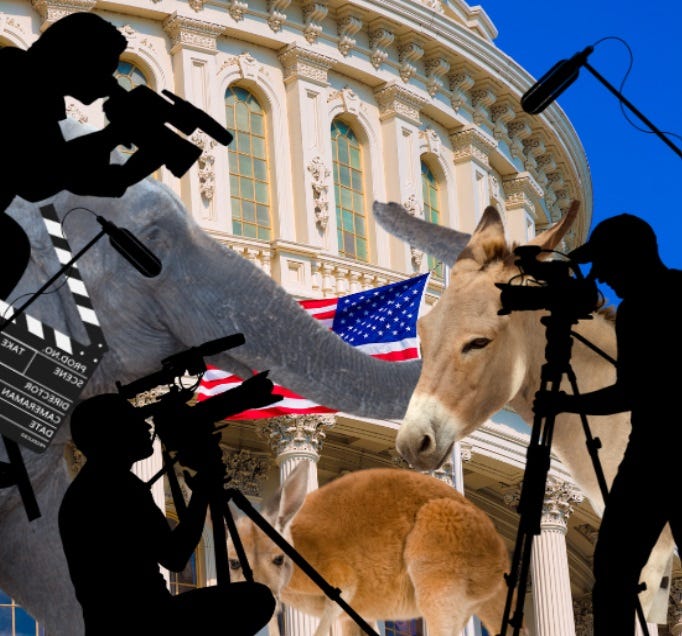
The equation: 1960s Madison Avenue + Hollywood + Politics = Empty Suit Pied Piper
Manufactured outrage, apocalyptic terror, and shameless righteous acts are running in the 2024 race for President.
It’s not an Arnold Schwarzenegger blockbuster, but it is choreographed.
Understanding my experience in movies, TV, politics, and technology may be helpful.
Sensational language choices intended to trigger
Is there a conspiracy among politicians? Is there collusion? You decide.
Words and labels are dangerous. They carry weight when they’re distorted.
Both of our polarized political teams make voting for the other guy seem like a mortal sin. An apocalypse will surely come if we get it wrong.
Donald Trump uses “J6 hostages” to refer to those now incarcerated as a result of their own actions on January 6, 2021.
People who are taken hostage usually haven’t been through the legal system.
Wannabe authoritarians not constrained by term limits generally have long-term plans spanning decades, if not longer. Are they conspiracists plotting revolutions, or strategic planners?
Does your company have a mission statement and future growth plans? Your boss could be Ghengis Khan reincarnated!
Does your family collude when adding items to your revolutionary conspiracy to buy groceries in support of capitalism? Lock ’em up!
It’s time to get sane again.
We’re being led Back to the Future
As children, we learn acting out playtime fantasies is fun. Using our imagination helps foster creativity, which leads to curiosity, discovery, and innovative problem-solving. If imagination and creativity were restricted in childhood, learning and growth would be nearly impossible. People need to imagine solutions to their problems. We take on the role of inventors each time we make strategic decisions. Sometimes, we take on other roles as we hype ourselves up for important performances.
For various reasons good and bad, but mostly just different, I was a curiosity as a child. I often wanted to be invisible.
When the head of Security wanted to take my picture for my photo ID at work, he needed 3 tries and had to tell me a dumb joke. I shrink inside myself when a camera comes out, and it shows.
Now, we’re told not to smile when getting photo IDs for tech industry jobs that may be tied to government projects. Edward Snowden made an impression.
The world of make-believe
Because I’m so camera-shy, friends are surprised to hear I’m in movies and on TV, without credit. I don’t belong to the actor’s union, but you may have seen me. My daughter was an actress who dragged me to multiple screenings as an audience member.
It takes small, sometimes hardly noticeable steps to go from being in the audience to playing the audience and then appearing in a supporting role. It’s similar to the steps taken after reading the first text on your phone before finding yourself hooked on polarizing YouTube videos or Twitter paid subscription posts.
Nobody sets out to become addicted to fame, drugs, or social media. Algorithms feed increasingly sensational, polarizing views automatically, herding us into separate categories.
Living in Southern California, we’ve come into contact with numerous celebrities and stars. The really great actors can come across as plastic people; empty vessels who allow an imprint of a whole new persona. Like changing their cowboy boots for a pair of high heels, they do what’s needed to fit the role.
Name-dropping and credentials
Who the heck am I to say so? Decades of managing systems development for some of the largest companies you have, and will never, hear of. Disney’s on the list, as well as Big Tech. Helping develop systems for the non-profit Red Cross and social/political causes also involved interesting encounters and discussions.
These are a few of the people I’ve talked with —
- William Shatner of Star Trek fame is a nice guy who’s probably worn heels. He wore cowboy boots as we swapped horse stories in Del Mar.
- Will Farrel is a goofball but smart, and so are Andy Richter and Woody Harrelson. My daughter and I appear in several audience scenes in the 2008 film “Semi-Pro” — a disco-meets-professional-basketball comedy.
- Ed Asner was very smart and interested in political activism. LA’s on-air radio talent at KLOS were too.
- Jackson Browne, Bonnie Raitt, and Don Henley were all impressive.
People doing their jobs
The Orange County, California annual political activists and volunteers holiday parties were filled with celebrities. Singers, artists, video producers, politicians, script and print writers, and the important people who support them rubbed elbows. Autographs on checks or otherwise weren’t allowed, and everything was off the record.
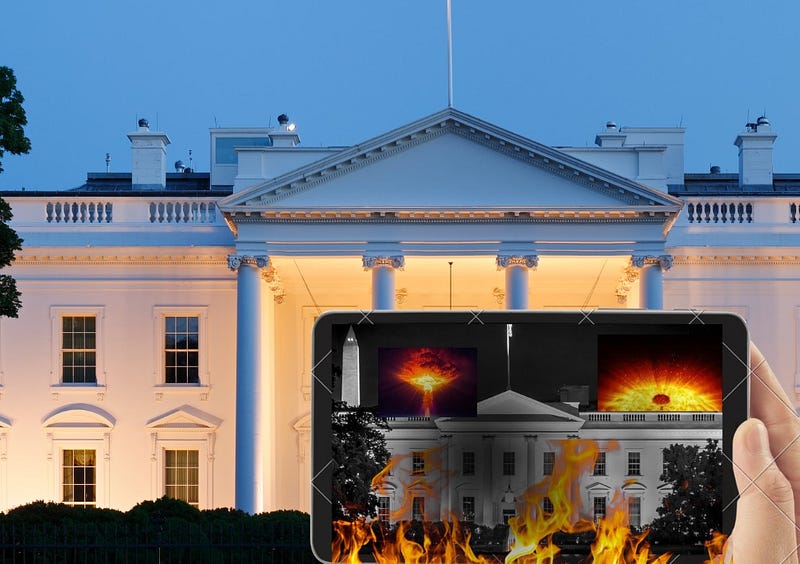
At the first party I attended, my youthful idealistic bubble exploded like a nuclear bomb. Republicans, Democrats, and Independents mixed with communists and hard-core activists I’d seen on the news leading protests.
I elbowed my friend, a smart tech founder and microbiologist. “What the actual…” and got a quick reaction. “It’s called adulting. Behave — you represent something bigger than your naive teenage hopes here.” “But I want to…” “Stop! Would you ask Bill Gates to fix your hard drive at a tech conference? Okay, bad example. Gordon Ramsey to be your sous chef?”
I left him in the corner and won the housewarming prize — dinner at a fancy restaurant where we dined under the grins of an old photo of President Reagan shaking the owner’s hand.
We all played our respective roles politely and set politics aside.
The thing successful politicians, their support staff, and actors all share is the ability to perform whatever function is needed. There’s a scene in West Wing when Rob Lowe is asked to create a position paper on gun control. He asks, “For, or against?” This clearly represents the chameleon-like role hired “talent” (often a derisive term) plays both on and off-camera.
Crowd Scenes
There are a few crowd scenes in Semi-Pro where it appears the stadium is full of fans watching a game. There were perhaps 300 people present to make those scenes. We swapped seats and added and removed scarves, hats, wigs, and jackets. The pros changed their makeup. We slumped, cheered, and faded in and out of view. Mostly, we were extremely bored for a long day. Cross-words, knitting, reading, and gossiping were common diversions when the crowd handlers weren’t enticing us with games, challenges, food and drink, and jokes.
When a friend’s brother made a horror flick it was more fun. Think “Walking Dead.” Dragging a leg while covered in goop is playtime. Pretending to be shot by the bad guys is a game most kids play. Twenty of us created a safari scene that became hundreds of people fleeing a monster wildebeest. Outside of Irvine, California.
Other crowd scenes: intro to politics and social engineering
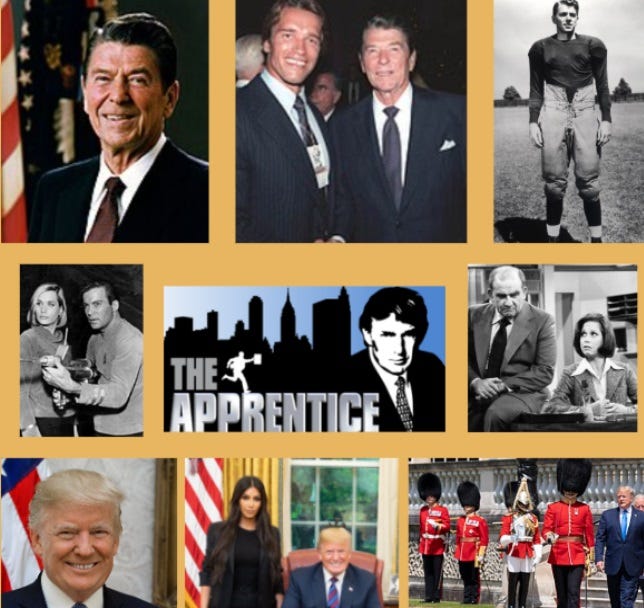
I was a child working in my parent’s restaurant from the time I could hold a broom. Ronald Reagan — a Hollywood actor — was elected California Governor, then later, the President of the United States. I felt in my bones this was a bad idea.
Ronald Reagan was a good actor, and he delivered the script as written for California, and then the nation. The results of his “wasteful spending” policy cuts included closing vital mental health facilities and slashing social welfare programs.
Every night, I handed out leftover food to the line of people who formed at the backdoor of my family’s restaurant. As a girl of 10, I helped disoriented women to the bathroom, standing guard. It was emotionally and spiritually shocking and spurred my interest in politics and social engineering. I began to research 1960s Madison Avenue’s manipulative advertising schemes and subliminal messaging in TV ads.
Technology ups the ante
I became interested in computers, programming, and systems development when I started manipulating computerized school records. These systems and the people who use them are easy to manipulate, I thought.
I’ve worked with dozens of companies, local governments, and non-profit groups analyzing their operations and identifying their goals. The goal was the same — maximize rewards in the form of sales, donations, or engagement. Avoid risks like system vulnerabilities, data theft, and competition. “Keep the patient breathing” at all costs.
There were things I refused to do, fairly often. The ability to inform and steer the conversation comes with responsibilities. This is why responsible scriptwriters don’t give specific, actionable instructions for blowing up power plants.
China, Russia, and many others who wish to sow discord and cause political polarization are stacking social media with masked ads, bots, and tweaking AI recommender algorithms to promote isolation and nationalism. Programs feed written scripts Americans unknowingly consume every day through texts, tweets, stories, memes, and videos.
The US economy is dependent on foreign cooperation. The wealthiest companies in America employ millions of people worldwide and depend on trade with cooperative countries. We’ve outsourced most manufacturing, especially computer components and medications.
Dealing with the devils and their details
My family had a unique opportunity for entertainment. Instead of watching The Tonight Show, we attended TV shows. We saw Ellen, Bill Mahr, and numerous other tapings. Tickets were free.
Often, the interviewers and performers stopped and started discussions, debates, and sketches. This meant Dennis Miller (previously on Saturday Night Live and his own talk show), Arianna Huffington (of the Huffington Post), and politicians shut up during heated debates when the cameras stopped rolling, then immediately got back into character when the discussion “went live.”
The same is often true for shows taped in New York, like The Daily Show. There may be a comedian or other stand-in to keep the audience engaged, but not always. The people who earn money in front of a camera are performers doing their jobs. Sometimes they’re grouchy. But they always have a script or notes to fall back on, with producers and show-runners.
Political Theatre in 2024
Many of the most successful politicians have little knowledge of the policies they promote. Positions are carefully crafted behind the scenes by researchers, analysts, and writers who are cued to jump into earpieces when a politician answers, “That’s a very good question,” or goes off-script. Not surprisingly, upon reflection, the candidate has a thoughtful response moments later.
Republican presidential candidate Nikki Haley was recently asked a question during a town hall meeting. The interaction went viral.
Jeffrey Harvey wrote a comprehensive piece describing the former Governor and United Nations Ambassador’s missed opportunities.
Yet, when asked at a recent New Hampshire town hall “What was the cause of the United States Civil War?”, Haley responded as follows:
“I think the cause of the Civil War was basically how government was gonna run — the freedoms what people could and couldn’t do.
She tried to duck and complained it was a hard question. After an embarrassing exchange in which she refused to invoke the “s-word”, she finally asked, “What do you want me to say about slavery?”
Nikki’s trying to straddle an impossible line without alienating anyone.
Last week, she was less offensive in her exchange than in previous years when she compared the Southern State’s secession efforts to a fight for tradition versus change:
Many were unhappy with Haley’s answer that dodged slavery.
I was surprised the experienced Trump appointee to the UN and former Governor wasn’t prepared.
Where’s her handler? I wondered. Why isn’t she wearing an earbud?
Perhaps she was trying to be authentic and relatable in her inauthentic, unrelatable responses.
I want to see and hear politicians provide thoughtful, informed, authentic views. They should care enough about our history and laws to become fully educated. Candidates should think long and hard about the issues faced by Americans, and reveal how they will govern.
“What was the reason for the Civil War?”
Slavery, and the United States of America.
Now starring in political theatre
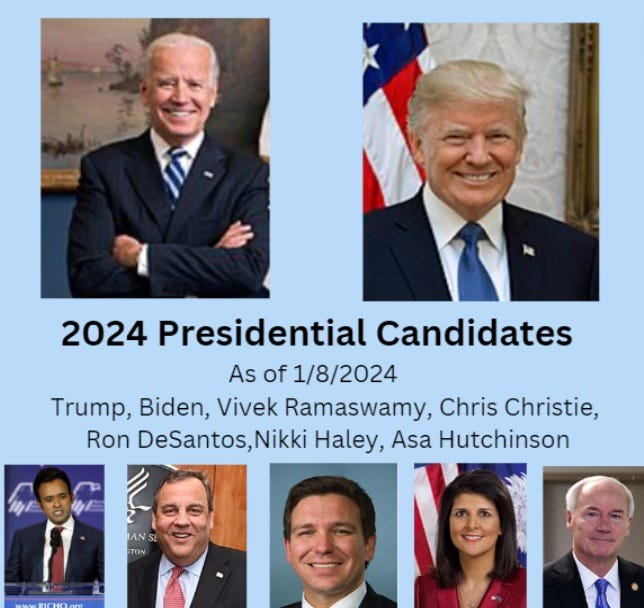
CNN polls rank the leading Republican 2024 presidential candidates as Donald Trump, Ron DeSantis, Nikki Haley, Vivek Ramaswamy, Chris Christie, and Asa Hutchinson.
We’re being entertained by Trump as he appeals to the very wealthy and powerful with promises of limited government via authoritarianism. The general public doesn’t seem to notice his ambitions serve only himself, despite his empty assurances. The lowest common denominator is spoiling for a good fight, seemingly oblivious to the fate of others who have taken up Trump’s ill-advised, selfish power grabs and cons.
Vivek Ramaswamy has studied “The Apprentice” star’s playbook, as any good apprentice should. If Trump is the “Teflon Don” with very little sticking to him, Vivek is rather like Vaporware — something imagined, but not yet realized. Developers can attribute whatever variable-handling qualities they choose to their ideas that will never make it to beta (BETA — “Beyond Technical Expertise Anyway”).
I suspect Ramaswamy is hoping to land on Fox or in another high-visibility, high-earnings role.
The well-funded Heritage Foundation (Project 2025) and other think tanks, super PACs, and organizations hope voters won’t recognize the doomsday script they’re producing for January 2025. The majority of backers and contributors are white, wealthy, powerful men. They hope to sell a 1950s version of patriarchy and superior race theory dating back to the Catholic’s 1600s Manifest Destiny when all heretics were fair game.
“Karen, wake up. We’re starring on the World Stage.”
The term “sheeple” is apt as we’re manipulated with sensationalism and fear.
As the public is entertained by outrageous behavior in politics, candidates are hoping their messages sink in. Often, they appeal to the largest masses. To do their bidding, they also strike a chord with those willing to become part of the rioting, shrieking, fearful mob. Literal or metaphorical.
Many politican’s performances are as manipulative as directing actors.
Like a pack of hungry lions, politicians need to sacrifice a few among the weaker, more impressionable herds to further their agendas.
The problem with this proven hunting tactic of separating, isolating, and controlling, is the next larger species witnesses the slaughter.
Transphobia is a convenient diversion. The population is small and weak in power. Most people will never encounter this tiny percentage of the population, and likely wouldn’t know it if they did.
The other plot point is a tried and true trope — enemy immigrants. The script hasn’t changed in nearly 400 years since most American ancestors arrived.
Gun rights, law and order, and resource wrangling are more of the same.
If we don’t have an enemy and/or something to fear, we’ll invent one. Politicians and leaders know this and are fearful of becoming targets.
Conclusion: Voter Awareness:
We’re not stupid, but we’re exhausted and disgusted.
Being under-informed about what’s happening in the world makes us reactionary as we lose perspective. Each political and news event generates noise. We’re triggered by earthquakes, wars, terrorist attacks, and influencers — proclaimed, or not. It’s hard to step back and get a good look at the overall theme of our own lives, our family’s future, and the next issue coming our way.
Isolated events, like Alaska Airlines’s recent airborne rupture, make us subconsciously grow wary and worried.
We become overwhelmed and easy to manipulate.
I want to see and hear politicians provide thoughtful, informed, authentic views. They should care enough about our history and laws to become fully educated. Candidates should think long and hard about the issues faced by Americans, and reveal how they will govern.
What we say and how we say it matters. Candidates should be required to tell the truth, with context, and choose words from grown-up vocabulary.
The distinctions between actors, influencers, and politicians grow murkier with each passing election.
Voters need more from candidates and representatives. We should expect an understanding of the issues, better word choices, more sanity, and fewer scripted performances.
We pay for cable or video subscriptions to be entertained. We deserve more from our government.
More light-hearted satire —