
Electile Dysfunction 2024
Nikki Haley Knows Better. Why Is She Pandering to America’sWorst?
The corrosiveness of American conservatism and Nimarata Randhawa’s sunken place
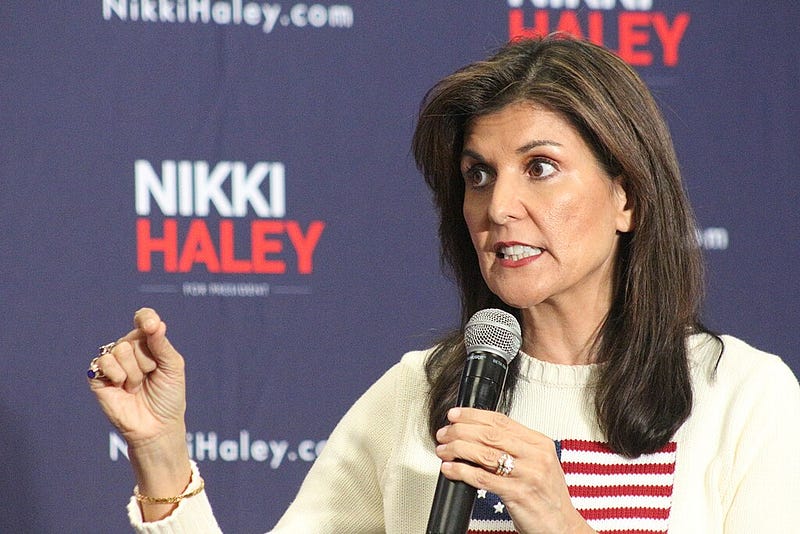
.jpg)
The cause of the United States’ Civil War was slavery.
There are layers of nuance to the history, economy, and culture of chattel slavery that ultimately erupted into the nation’s bloodiest internal conflict in April of 1861. That’s all subtext. Had the United States government never sanctioned slavery, or had the North and South both agreed on the status of America’s original sin moving forward, the South would not have seceded and there would not have been a Civil War.
Broken down to its root compound, the U.S. Civil War was a direct product of slavery.
Nikki Haley knows this. The surging Republican presidential candidate is 51 years old. She’s a life long resident of the South. She’s a graduate of Clemson University, one of the region’s highest ranked public institutions. She has served as a United States ambassador, South Carolina’s governor, and a congressional representative. She’s not a moron like Ron DeSantis, a pathological gaslighter like Vivek Ramaswamy, or a sociopathic agent of chaos like former president Donald Trump. In nearly 20 years of public service, Haley has proven herself to be a steady hand and a competent, if generally tepid, administrator.
When she ordered the removal of the confederate flag from the South Carolina statehouse in 2015, she damn sure wasn’t doing it because the flag represented a dissenting opinion on administrative procedure. She rightly took the flag down because it represented the South’s declaration of war against the United States in the name of sustaining the enslavement of Black people.
Yet, when asked at a recent New Hampshire town hall “What was the cause of the United States Civil War?”, Haley responded as follows:
“I think the cause of the Civil War was basically how government was gonna run — the freedoms what people could and couldn’t do.
I think it always comes down to the role of government and what the rights of the people are. And I will always stand by the fact that I think government was intended to secure the rights and freedoms of the people. It was never meant to be all things to all people.
Government doesn’t need to tell you how to live your life. They don’t need to tell you what you can and can’t do. They don’t need to be a part of your life. They need to make sure that you have freedom. We need to have capitalism. We need to have economic freedom. We need to makes sure that we do all things so that individuals have liberties so that they can have freedom of speech, freedom of religion, freedom to do or be anything they want to be without government getting in the way.”
The craven cowardice of Haley’s evasive Heritage Foundation talking point smorgasbord of a non-answer is nearly as disgusting as any of the bigoted bile spewed from Trump’s lips over the past decade. Haley’s equivocation doesn’t bubble with the overheated vitriol and naked hate that mark Trump’s current “retribution” tour. But what she lacks in ugliness, Haley makes up for with intentionality.
Trump, obscene as he is, isn’t capable of better. The former president is all id completely uninhibited by impulse control. He’s more avatar than person: a living, seething embodiment of all the fatal flaws — greed, bigotry, rank ignorance — that America has attempted to sweep under the rug for centuries, even as they define its every iteration. At this stage of his (and the nation’s) physical and mental decay, Trump no longer even looks like a human being. He’s a grotesque, a crudely drawn comic book villain. His behavior and rhetoric mirror his physicality. The tragedy of Trump is not his depravity, it’s that nearly half of American voters embrace it.
The tragedy of Haley is that she knows better. She is better. Yet she chooses to pander to the very worst impulses of a party corroded, perhaps irreparably, by a half century of cynically bigoted strategies perpetrated by monied white men desperate to preserve an antebellum social hierarchy at the expense of people like her.
Nikki’s Story
Nikki Haley’s story is fascinating, and uniquely American. Nimarata Nikki Randhawa grew up in predominantly Black Bamberg, South Carolina (the first state to secede from the Union). Born in 1972, she entered the world just in time to reap the hard won benefits of the 1960s Civil Rights Movement, through which Black Americans began to gain legal redress for the cultural remnants of slavery.
Both her parents were first generation immigrants, whose advanced degrees and professional experience in India counted for little in the U.S. It was historically Black Voorhees College in South Carolina that ultimately took a chance on her father, hiring him as a biology professor in 1969. After stints as educators, her parents became entrepreneurs, opening a pair of clothing boutiques, at which Nimarata worked as a bookkeeper as teen.
Upon graduating Clemson, she worked in accounting and finance at several South Carolina businesses. She established herself as a leader in the state’s business community, eventually serving on the boards of trustees at multiple chambers of commerce, and as treasurer of the National Association of Women Business Owners. Presumably her passion for, and hands on experience with, small businesses led her to Republican politics.
Haley is uniquely positioned to center her family’s success story in a larger narrative of entrepreneurship as a viable path around the systemic racism and sexism that keep the American dream frustratingly out of reach for so many women and minorities. Pivoting the GOP’s brand from grievance politics and religious fascism to economic opportunity would be a viable strategy to diversify its aging base. It could make strides in connecting the party with a new generation of women and minorities eager for career options outside the corporate structures that have historically marginalized them.
Yet, at every opportunity, Haley ducks this narrative. She opts instead to downplay systemic inequality and pretend the playing field that was closed to her immigrant parents is now completely even.
Her Civil War dodge is hardly an isolated incident. Throughout her political career, Haley’s rhetoric has often presented a false binary between the necessity of personal accountability and the existence of bigotry. Instead of drawing on her family’s experience to empathize with the struggles of other marginalized groups, she has too often used her parents’ success as a cudgel with which to bludgeon minorities who have failed to overcome far greater obstacles. (Indian Americans were never enslaved in the United States.)
In her speech endorsing Trump at the Republican National Convention, Haley attempted to erase the lived experience of millions of Americans to the rapturous applause of a room full of one-percenters and evangelical Christians. She cynically chided: “It has become fashionable to say America is racist. That is a lie. America is not racist.”
She went on to castigate democrats for “turning a blind eye to riots and rage,” while failing to mention the murder of George Floyd by a white police officer, which precipitated the summer’s civil unrest.
As her campaign picks up steam, all signs are that Haley is prepared to move from simply denying racism to actively propagating it. In a recent ABC News interview, Haley leaned into ethnic slurs and sneering cruelty worthy of Trump himself when asked where displaced Palestinians should go in light of recent terror attacks on their region:
“I’ve always said that what you should have is they should go to pro-Hamas countries… Isn’t that telling that Egypt won’t take them. Because they don’t trust which ones are terrorists and which ones aren’t.”
Haley isn’t quite ready to explicitly slur darker hued people in her own country, but in conflating Palestinian refugees with Hamas terrorists (essentially a shadow arm of the Iranian government), she certainly seems to be priming the pump by slurring melenated people abroad.
And to what end? Trump leads Haley by 30 to 40 points in most current polls. She’s struggling to clear DeSantis, who has proven a historically inept politician. Unless Trump dies or becomes incapacitated, she has as much chance of winning the Republican nomination as you or I do. There is no law preventing Trump from running as a convicted felon. The bet here is, an imprisoned martyr Trump is probably the most formidable Trump.
There’s little chance Trump will choose Haley as his running mate after she’s spent the past six months implying he’s too old and demented to serve another term. And who in their right mind would want to be Trump’s Vice President? He did, after all, try to hang the last guy.
There’s only one plausible explanation for Haley’s seeming determination to embrace the GOP’s worst devils rather than attempting to resurrect its angels. Nimarata Randhawa is deep in the sunken place.
Nimarata’s Sunken Place
The concept of “the sunken place” was introduced in Jordan Peele’s 2017 film, Get Out. In a Tweet shortly after the film’s release, Peele explained the sunken place to mean, “we’re marginalized. No matter how hard we scream, the system silences us.” Dictionary.com defines the term as “used to imply a black person appears complicit with racist people or institutions.”
The two definitions are ultimately of a piece. After having their screams repeatedly, and often violently silenced, many minorities simply try to disappear into the wallpaper of the very institutions that silenced them. In obscuring their unique experiences and perspectives, the “sinkers” hope to find acceptance, however tacit, from their marginalizers. Unwittingly, they become complicit in fortifying the very systems and institutions that forced them to the margins by providing them a veneer of inclusiveness.
The sinkers’ acquiescence may succeed in enabling them to skirt bigotry’s most brutal eruptions, but it fails dismally in allowing them to grow or thrive in the institutions into which they’ve crept. Such is the plight of Nimarata Randhawa. She has sacrificed her values, her history, even her given name for the sake of assimilation into a political party where her glass ceiling remains perilously low.
On paper, Haley is by far the most qualified presidential candidate in the Republican field. Yet, the most she can hope for is a token “diversity” placement at the bottom of a DeSantis ticket should 80 years of Big Macs and Häagen-Dazs finally exact consequences on Trump the justice system appears incapable of delivering.
“What do you want me to say?”
The moment in Haley’s Civil War exchange that evoked the most visceral response from me was not her “don’t tread on me” soliloquy, but what came next. When Haley finally paused for breath at the conclusion of her antebellum filibuster, her questioner rightly called her to account, scolding: “In the year 2023, it’s astonishing to me that you answer that question without mentioning the word ‘slavery’.”
“What do you want me to say about slavery?”, she asks in turn.
My initial reaction was utter contempt. The response embodies everything I’ve always found off-putting about Haley. She seems perennially in search of the answer she should give; the words that will satisfy the gatekeepers of the sunken place without alienating the wider audience that she must eventually reach if her soul-sucking sacrifice is ever to pay off.
Yet, I also felt a rare twinge of pity for her. I didn’t get the sense she was being sarcastic in her counter-question. She’s too measured for that. Sarcasm would position Haley as far too edgy to fit within the GOP’s narrowly imagined confines of femininity. It would be perceived as “uppity” in response to a question from a white man, even one with whom the majority of Republicans disagree.
Haley was earnestly asking what her inquisitor wanted to hear. Had he complied, she would have happily parroted back some variation of the verbiage he offered. He refused to let her save face, replying curtly, “You have answered my question. Thank you.”
As Haley retreated to a small smattering of applause, her furtive eyes belied her uneasy smile. It was as if, in that moment, she realized the impossible task with which she has saddled herself. How is a woman of color born to immigrants supposed to ascend to the top of her party by draping herself in its rhetoric and conventions, when those very conventions dictate that women, people of color, and immigrants should remain subordinant?
Nikki Haley was deep in the bowels of the sunken place. Perhaps she was even realizing for the first time that she would never be her party’s standard bearer.
Such an epiphany should offer emancipation. It could free Haley from her short-sighted jockeying with DeSantis for the GOP’s top participation trophy. It could liberate her to tell her story, her family’s story, and undoubtedly the story of many others drawn to conservative economic principles because of their deeply and genuinely held belief that the path to social equity is entrepreneurship. Done from the platform of a high profile presidential campaign, such a rhetorical turn could position Haley at the forefront of the genesis of a long overdue GOP rebrand.
The dazed, almost rueful look on her face quickly confirmed that Haley will never make such a pivot. She’s been a part of the Republican wallpaper for too long to step into a spotlight as scorching as the one that would undoubtedly sear her to her core if she began challenging party orthodoxy in the era of MAGA. As her eyes quickly darted too and fro, seemingly both saddened and disoriented, Haley seemed to be processing not only the futility of her political task, but the limitations imposed by her own weakness.
Perhaps that’s why I felt sorry for Haley for those few fleeting beats. It’s surreal to witness the final piece of a once ambitious and idealistic woman of color’s implosion in real time, as she’s pushed into the deepest depths of the sunken place by a party, a country, and and ethos of subjugation.
It’s also why I can definitively say she is unfit to serve in American government. At a moment when strong leadership is required to bring a country in crisis back from the brink, Haley’s Civil War dodge demonstrates beyond a reasonable doubt that she isn’t capable of leading. She is ultimately resigned to following her party over the cliff, even though she knows better.