
Biden’s Infrastructure Plan Is Good, But Not Great
It keeps infrastructure afloat, but much more will be needed.

What is Considered “Infrastructure”?
When people think of infrastructure, they most often think of roads.
This can conjure either the excitement of the national highway system being developed or the loathing when learning of the latest Bridge to Nowhere.
In reality, there is no universally agreed upon definition of “infrastructure”.
Unfortunately, this ambiguity is politically expedient to support the plans proposed by one’s own party, while allowing enough wiggle room to bash the plans proposed by the opposing party.
People oftentimes define infrastructure the same way Supreme Court Justice Potter Stewart described hard-core pornography, saying, “…I know it when I see it.”
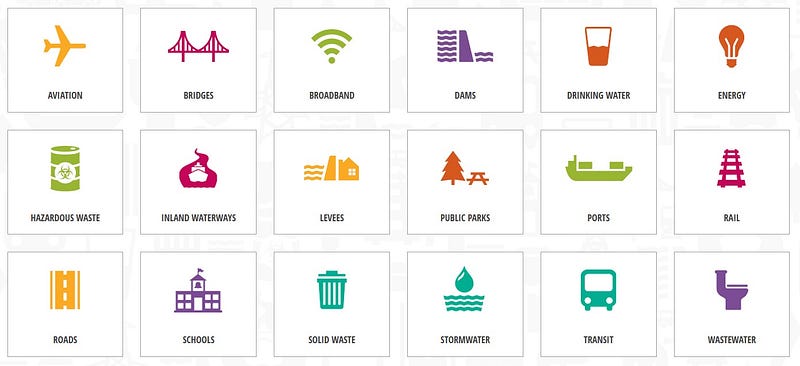
The best definition of infrastructure comes from the experts; the good folks at the American Society of Civil Engineers.
Infrastructure supports nearly every aspect of life. Our pipes deliver drinking water to homes and hospitals.
Airports, railroads, and inland waterways transport goods from farms and manufacturing plants to store shelves.
The roads that crisscross the country allow us to get to work and school safely, and the network of transmission and distribution lines keeps the lights on and our electronics charged.
Dams enable consistent water supply in arid climates, and levees hold back floodwaters to protect rain-soaked communities.
Every four years, ASCE puts out in Infrastructure Report Card, using a simple A through F grade in the following categories.
Overall, American infrastructure has a grade of C-.
For the first time in 20 years, our infrastructure GPA is a C-, up from a D+ in 2017.
This is good news and an indication we’re headed in the right direction, but a lot of work remains. (emphasis added)
Now that we know what “infrastructure” is (and how bad a state it is in), we next need to figure out how (and how well) the much-touted Democratic infrastructure plan will address it.
What Is In President Biden’s Infrastructure Plan?
For all the hullabaloo swarming throughout the news cycle, the “grandiose” infrastructure plan is simply a combination of two different plans.
- The first plan consists of the actual work targeted for improvement, officially titled the American Jobs Plan.
- The second part consists of how to pay for everything, called the Made In America Tax Plan.
So what is in these two plans?
What We Get — American Jobs Plan
This is the guts of the infrastructure plan, where strategies and tactics get laid out for which project in which state gets what money at what time.
It’s also what’s making most of the headlines.
So what exactly is in it?
At $2.2 trillion, a hell of a lot. At a high level, it can be broken down into four main parts.
Transportation infrastructure: $621 billion
This category includes all the standard railway, road, bridge, highway, and airport improvements that are rolled out every four years, with $305 billion tagged for investment.
It also includes $174 billion to building out a network of 500,000 electric vehicle (EV) charging stations.
Is an EV network really infrastructure?
I’m sure there’s a Venn diagram somewhere in the dusty depths of academic research that answer this question. While it may fit in several categories, infrastructure seems the best fit.
Quality of life at home: $650 billion
This category includes the infrastructure that we normally don’t see or don’t operate, such was drinking water, wastewater, and storm water systems, with $211 billion assigned.
The electric grid is assigned to this category, which I can see. Those poor bastards in Texas certainly had a horrible quality of life when their power went out and their pipes burst.
One estimate had the cost of the Texas storm between $197 billion and $298 billion.
Other items include
- High-speed broadband: $100 billion
- Upgrading and building public schools: $100 billion
Are broadband and public schools infrastructure?
Ask any parent who had to juggle all-day Zoom calls while trying to teach their grade schooler who is in a virtual classroom, and you will get a resounding YES!
The last item to touch on is the $213 billion to, “build, preserve and retrofit more than 2 million affordable homes and commercial buildings,” along with, “the construction or rehabilitation of 500,000 homes for low- and middle-income owners.”
Infrastructure?
Eh, close enough. The nation’s building stock is so energy inefficient that any money planned for upgrading it is welcome news. At these poor levels, any funding is welcome, regardless of what it’s called.
Caregivers for elderly and people with disabilities: $400 billion
This is probably the most politically contentious item in the plan, in that is is basically supports easier access to nursing home, expands Medicare services, and increases pay for employees in this sector.
Maybe not the traditional engineering sense of infrastructure, but it is definitely part of this country’s healthcare infrastructure.
Research, development and manufacturing: $480 billion
There is a plethora of R&D in this category, so I won’t name them all. I will say, however, that I am an apologist for federally funded R&D, and I weep over how low the US has sunk in funding any type of research.
Federally funded research is the type of “curiosity research” that expands the scope of human knowledge, without any plan or goal for the use of its results.
No less than Goldman Sachs claims that the US has dropped the ball, with 2020 seeing the lowest R&D outlays in 60 years.
The historically low level of R&D may have severe consequences for the long-term advancement of science and technology in the United States.
The bulk of federal funding for R&D is for basic and applied research, which often require consistent and substantial funding over long periods, and is not easily replaced by funding from the private sector.
Many impactful innovations, including the internet and GPS, originated from publicly funded entities, including the Defense Advanced Research Projects Agency (DARPA).
How to Pay For It — Made in America Tax Plan
To help pay for the Jobs Plan, the Biden Administration is proposing a series of tax overhauls, starting with increasing the corporate tax rate from 21% to 28%.
This is where the rending of cloth and gnashing of teeth start.
Questions About the Plans
As with any political proposal, these two plans have plenty of criticism, interestingly from both sides of the aisle.
Will the Jobs Plan successfully upgrade our infrastructure?
Yes and no, depending on the definition of “success”.
Will the Jobs Plan succeed in addressing its full scope of projects?
Definitely maybe.
We live in an imperfect world with imperfect people executing imperfect plans. To expect that all the proposals, projects, and programs be completed on-time and on-budget is naive. Overall, I expect a 80%-ish success rate.
Will the Jobs Plan succeed in addressing the full scope of America’s infrastructure needs?
Definitely not.
If you dig deeper in the ASCE Infrastructure Report Card, you will find the Investment Gap, described below.
Every four years, ASCE estimates the investment needed in each infrastructure category to maintain a state of good repair and earn a grade of B.
The most recent analysis reveals that while we’ve made incremental immediate gains in some of the infrastructure categories, our long-term investment gap continues to grow.
We’re still just paying about half of our infrastructure bill — and the total investment gap has gone from $2.1 trillion over 10 years to $2.59 trillion over 10 years.
Jobs Plan: $2.2 trillion over 15 years = $147 billion/year
Investment Gap: $2.6 trillion over 10 years = $260 billion/year
The numbers don’t work, the Jobs Plan only provides a little over half of the required investment, and our infrastructure will remain in disrepair.
This gap is the source of criticism from some Democrats, claiming that the plan should be much bigger in scope and budget.
Will the Jobs Plan actually create jobs?
Since the word “jobs” is in the title, one would obviously expect jobs to be created, right?
Again, yes and no.
Does the Jobs Plan create more jobs?
In the short run, likely not.
In the long run, most definitely.
From an report by Moody’s Analytics,
The infrastructure plan results in a stronger economy over the coming decade, with higher GDP, more jobs and lower unemployment.
However, the most immediate impact in early 2022 is to marginally reduce growth, as the higher corporate taxes take effect right away while the increased infrastructure spending does not get going in earnest until later in the year.
This changes quickly.
By 2023 and throughout much of the midpart of the decade the ramp-up in infrastructure spending significantly lifts growth.
That makes sense. So let’s ask the next question.
How many jobs will the Plan create?
The administration got in a little trouble last week when it claimed that the Jobs Plan would create 19 million new jobs.
Not quite.
There will be 19 million new jobs created over the next decade, for sure, but most of those will be created regardless of the Plan.
The White House had to walk back some of the claims. From Jen Psaki, White House Press Secretary:
Moody’s ran an analysis that showed that the economy would create 19 million jobs over the next decade if Congress passes the American Jobs Plan — almost 3 million more than if it doesn’t.
[T]hat is what the impact would be of the American Jobs Plan: 2.7 million, to be totally clear.
What type of jobs will the Plan create?
This is a big issue with the Plan, especially in the energy sector.
Investing in renewables will create more jobs in that sector, but at the expense of other jobs in the fossil fuel sector.
- Lifelong operators at a coal-fired power plant won’t just suddenly learn how to install wind turbines overnight.
- Electric vehicles use fewer parts, so there will be fewer assembly line workers and parts suppliers.
These are generational changes, with some employees beyond retraining.
No all is doom and gloom, though.
Looking at the overall plan, a Georgetown University report shows that,
Some 75% of the jobs created from such an infrastructure package would be for “workers with no more than a high school diploma and some non-degreed short-term postsecondary training,”
Additionally,
An infrastructure program would create 8 million jobs for workers with a high school diploma or less, 4.8 million jobs for workers with more than a high school diploma but less than a bachelor’s degree, and 2.25 million jobs for workers with bachelor’s degrees and above.
The bottom line?
More and better jobs will be created for the many at the expense of obsolete careers for the few.
Is There Too Much “Pork” in the Plan?
Not to be hyperbolic, but this is where the right has lost its fucking mind.
- From Tucker Carlson:
Only about 5% of that $2 trillion will actually go to roads and bridges. So, 5% on infrastructure, 95% on social engineering.
5%…really?
The roads, bridges, highways, airports, and railways (the “traditional” infrastructure) get $305 billion, which is almost 14%.
And that doesn’t even include funding for the water systems.
- From Senator Roy Blunt, R-Mo:
I also think it would be an easy victory if we go back and look at roads and bridges and ports and airports and maybe even underground water systems and broadband.
You’d still be talking about less than 30% of this entire package, and it’s an easily doable 30%.”
This is a little more realistic, but not by much.
Given the investment required by the ASCE and how far this Jobs Plan already falls short, 30% would be more of a mockery of legislative action rather than actually getting anything done.
This plan is not about rebuilding America’s backbone. Less than 6% of this massive proposal goes to roads and bridges.
It would spend more money just on electric cars than on America’s roads, bridges, ports, airports, and waterways combined.
Again, the math is wrong.
The “traditional” infrastructure costs (and I’m being pretty strict here) total $268 billion.
- Modernize bridges, highways, roads, and main streets that are in most critical need of repair: $115 billion
- Inland waterways, coastal ports, land ports of entry, and ferries: $17 billion
- Upgrade airports: $25 billion
- Water infrastructure — including $45 billion to eliminate all lead pipes and $56 billion to modernize America’s drinking water, wastewater, and storm water systems: $111 billion
The electric vehicle investment is $174 billion.
$268 billion > $174 billion. Go figure.
Besides, the whole premise of opposing investment in electric vehicles is the height of hypocrisy, when the fully endorses the $20 billion per year in subsidies that the oil and gas industry receives.
Conclusion
For all the exaggerations from conservatives about overspending and the criticisms from the left about underfunding, the bottom line is that the Jobs Act is an overall economic boon.
Most Recent Stories
- Are We In Housing Bubble 2.0?
- What’s Going On With Inflation?
- COVID Destroyed Women’s Finances
- Jobs, Jobs Everywhere, and Not a Soul to Work
Don’t miss my next article! Click here to get notified when I publish new material.
If you love the articles published in Money. Daily., then become a member of the Medium community and get full access to our full archives.
This article is for informational purposes only, it should not be considered Financial or Legal Advice. Not all information will be accurate. Consult a financial professional before making any major financial decisions.