
Cannabis | Health | Science
Bias in Cannabis Research Focuses on Harmful Effects
These 4 tips can help to identify spurious claims and questionable study designs.
I’ve written a number of articles about cannabis research. Every time I write one about new research finding some undesirable effect associated with marijuana use, someone in the comments accuses me of bias.
Sometimes I respond to defend myself. “I reported research results,” I’ll say. “I did not advocate for or against cannabis. Of course, additional research is needed to confirm or refute these studies.” Sometimes I even throw in, “For the record, I am pro-cannabis and cannabis products and used to be an executive with a company in the cannabis space.”
I think I might have been trying a little too hard with that last one, but it all got me thinking. When looking for new cannabis research to write about, there do seem to be more studies about harmful effects than beneficial ones. Does that mean that cannabis use, on the whole, does more harm than good? Or is there bias in the research?
The U.S. and U.K. Cannabis Research Funding is Skewed Toward Harmful Effects
According to a recent analysis of cannabis research funding in the United States, the United Kingdom, and Canada, of the $1.56 billion that was directed to cannabis research between 2000 and 2018, about half of the money went to studies focusing on the potential harms of the recreational drug.
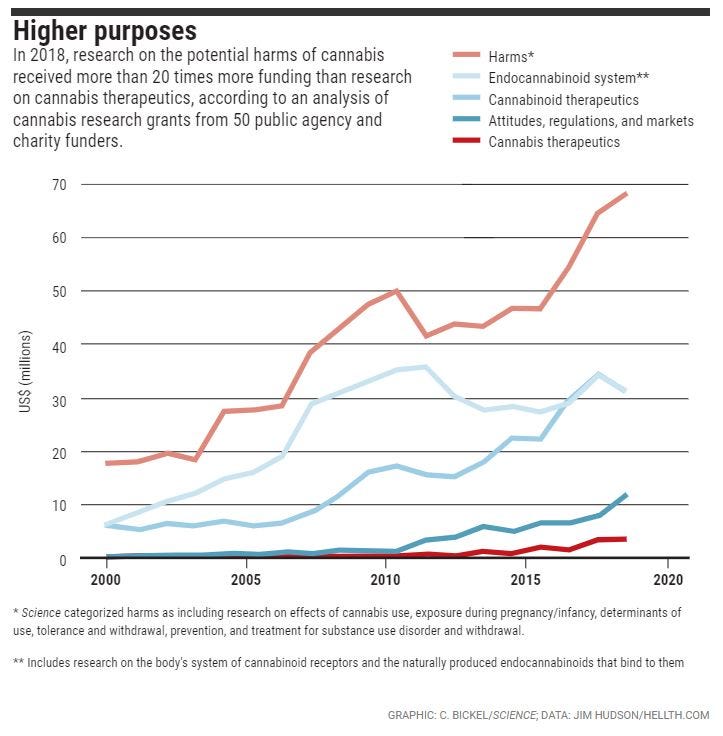
That seems balanced, right? But when you look at the single biggest source of funds (over $1 billion of the total funding), the U.S. National Institute on Drug Abuse (NIDA) spent far more money to research cannabis misuse and harmful effects than on the therapeutic benefits of cannabis and cannabis-derived chemicals. And although overall funding for cannabis research in the U.S. has been rising steadily, the money to explore cannabis medical treatments isn’t growing as fast as funding for research on harms, as shown in the graphic to the left.
Daniel Mallinson, Ph.D., an assistant professor of public policy and administration at Pennsylvania State University, Harrisburg, noted, “The fact that most of the cannabis money is going to drug abuse and probably to cannabis use disorder versus medical purposes—that says something.”
There also appeared to be country-specific biases when it came to cannabis research funding. Over the 19-year period, the U.S. spent $1.49 billion, while Canada spent $32.2 million and the U.K. spent $40 million. Like the U.S., the U.K.’s cannabis research spending was overwhelmingly focused on harmful effects. By contrast, Canada’s cannabis research funding focused on naturally produced endocannabinoids and the endogenous cannabinoid receptors to which they bind.
Legal barriers may have also biased cannabis research in all three countries. In 2018, the total spent to research medical treatments was overwhelmingly focused on the use of cannabinoids derived from marijuana as opposed to the use of marijuana itself. That’s partly due to the fact that it’s easier for researchers to work with isolated compounds and prepare carefully calibrated doses compared to using marijuana flowers. But at least in the U.S., it’s also because it’s difficult for researchers to get government authorization to use marijuana plants for research.

Spotting Spurious Claims and Questionable Study Designs
Naseem Miller is a senior editor at The Journalist’s Resource, a project of the Shorenstein Center on Media, Politics and Public Policy at Harvard University’s John F. Kennedy School of Government.
Miller published an article on April 30 in which she offers several tips to help journalists add scientific evidence to their stories about marijuana. She includes what I think provides a good framework for being more mindful when it comes to interpreting cannabis research results. While not exhaustive, the following :
- Be careful about extrapolating animal studies to humans. As a patent attorney, I once helped a university client get an issued patent for a method to treat traumatic brain injury when the lead inventor had already described the method in several published studies before the patent application was filed. Normally, that would have killed their chances for a patent. But their method was specific to treating human subjects and was supported by clinical trial data, while the prior studies used an animal model with an abysmal record for predicting efficacy in humans. I was able to point to over 30 different pharmacological agents that had shown promise based on animal model data but that had failed when they got to human clinical trials. Results from animal studies don’t always translate to humans.
- Differences in study design make a difference. How researchers define their subjects can vary widely from one study to another. “It’s really important that … you take a look at the … article and see how the paper has defined ‘frequent’ or ‘regular’ or ‘heavy’ cannabis use,” explained Madeline Meier, Ph.D., an associate professor in the department of psychology at Arizona State University. “Because lots of times, we’ll see that in one study, we’re talking about 30 or more lifetime uses, and in another study, we’re talking about daily use for 20 years. You can’t compare those two studies.” Doses, delivery methods, the potency of different cannabis products, and many other variables can also make it hard to directly compare studies. “Daily use of a low-potency product is not likely to have any negative, harmful consequences in terms of psychoactive effects and may be very therapeutic and beneficial. Daily use of a concentrate that has an average potency of 70% THC is a different thing,” noted Rosalie Liccardo Pacula, Ph.D., a professor and the Elizabeth Garrett Chair in Health Policy, Economics, and Law in the Sol Price School of Public Policy at the University of Southern California.
- Be mindful of your own biases. Knowing what bias we each bring to the interpretation of research results can help us realize when we are being overly critical or not critical enough. “Some people may know someone who is using [cannabis] to good effects. Others may have known someone who used it to bad effect or had other personal experiences,” said Tauheed Zaman, M.D., an addiction psychiatrist at the San Francisco VA Health Care System. “But I think we need to step back and look at the data, like really dispassionately look at the data. And I think that is kind of what’s missing during some heated discussions around cannabis.”
- It’s the evidence, stupid. There’s a tendency for issues involving cannabis to become highly politicized. Similar to the third point, this can sometimes distract from a dispassionate assessment of the evidence. “Regardless of whether we’re progressive or liberal or conservative, or whatever part of the spectrum, people should go by the scientific evidence,” said Zaman. “I think the issue is getting politicized and sometimes distracting from the evidence. What about kids getting ahold of these products? What about adults who have addictions or have psychosis or mental health issues? All of that is being completely glossed over by a belief that A. — this is progressive politics and you better get on this side if you’re progressive — and B. — dollars, dollars, dollars, by which I mean the tax revenue and other financial aspects of the cannabis industry.”
More like this:


