
Bent into Shape: the Ant Chair
Danish architect, Arne Jacobsen bent plywood into the elegant, and deceptively simple, sculptural ‘Ant Chair’…
Arne Jacobsen preferred to be known as an architect and believed the design of furnishings and décor was part of the overall remit. He built an impressive international reputation, designing some high-profile public and domestic buildings. He also thought the same design principles should apply throughout the built environment, which aligned him with Bauhaus teachings and the philosophy of many Scandinavian contemporaries such as Alvar Aalto and Poul Henningsen.
Along with his repeat collaborator, Erik Møller, he was responsible for Aarhus City Hall. Its monolithic modern simplicity caused an uproar among critics who interpreted it as anti-monumental and anti-authoritarian. It was just too avant-garde for the day and, before its completion in 1942, the architects had to compromise by adding a token tower and cladding its façade with marble instead of bare concrete.
Historically, Jacobsen’s most important contribution was probably the Scandinavian Airlines System hotel at Copenhagen Airport, the city’s first skyscraper, opened in 1960. It’s cited as the earliest hotel to be designed holistically by its architect. Arne Jacobsen designed all aspects, from the superstructure down to the furnishings, fabrics, colour-schemes, ashtrays, cafeteria cutlery, gift shop souvenirs… even the airport busses and aspects of the connecting road system.
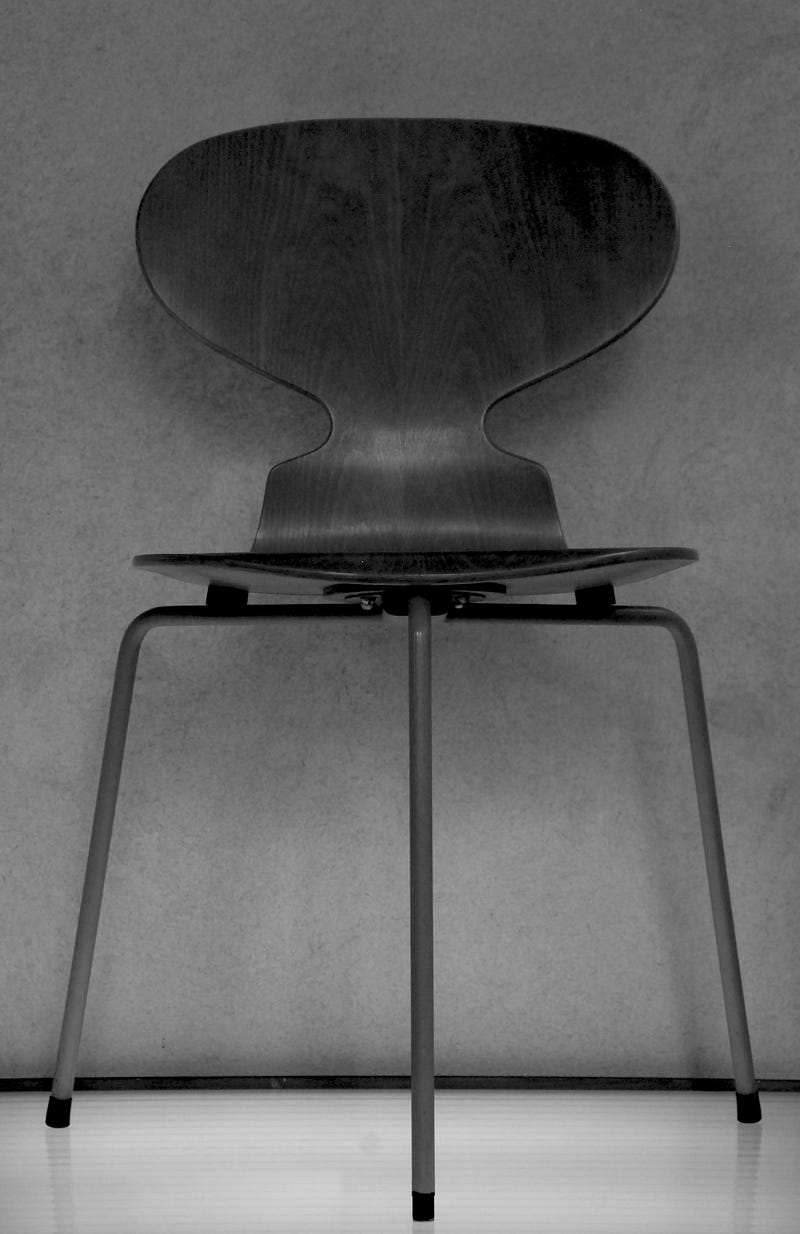
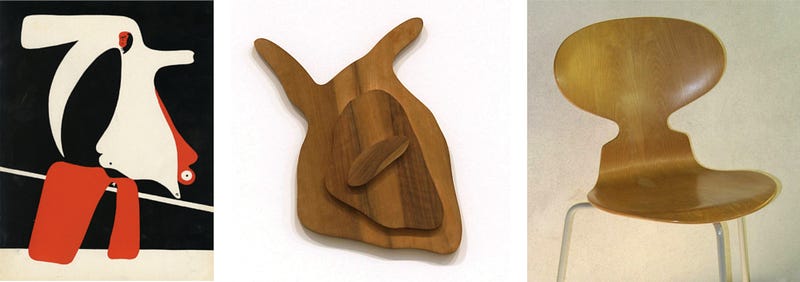
Probably the best known of his designs remains the far more humble, though no less important, chair that reminded him of an inquisitive ant. The distinctive shape of the seat recalls the biomorphic abstractions of Joan Miró and Jean Arp, an influence that becomes clearer when the Ant chair considered as a piece of sculpture.
The seat section successfully fulfils several sculptural characteristics. There is a strong interplay of positive and negative space with the seat’s form ‘cupping’ the implied negative form of the potential sitter and then interacting with that form when present. Its function dictates that it references the human form and so the shape becomes a figurative element. An abstraction of the absent body.
The negative forms in the design of the one-piece seat are pleasingly balanced. (It reminds me of those surrealist vases where the surrounding space looks like two profiles facing each other.) The bilateral symmetry is a logical design choice as it accommodates average human shape and chairs come with an established ergonomic language that instantly conveys how they are to be used.
The stylish outline was also dictated by the manufacturing process. It allows the desired curves to form without creasing or cracking during the steam bending stage and also reach a compromise between elegance, material flexibility, weight, and the necessary mechanical strength.
Interestingly, the slim chair legs introduce a triadic symmetry which, in sculptural terms, creates a progression of form leading to a gentle tension. There is a dialogue between their slender cylindrical rhythm and the broad curvilinear plain they support. Both components, the legs and the seat, deal with the interaction of positive and negative forms — the three legs embracing a finite volume, the plywood seat cupping an open space in anticipation of being filled by the animate and varying human form. Of course, the same can be said of any functional chair, though few present such a pleasingly simple aesthetic.
Which brings us nicely to the choice of just three legs. This seems to have been the most contentious of Jacobsen’s design choices here. Though the three legged formation makes perfect design sense, the version that would later go into mass production reverted to the more familiar four legged ‘norm’. A three-leg chair was just too weird for public tastes!
Jacobsen had been applying the Bauhaus mantra of ‘form follows function’. He’d wanted to produce a versatile, lightweight, stackable chair that was stable, even on uneven surfaces. (Those of us who live in old houses with warped floorboards will know of the fun and frustration that comes from the wobbliness of chairs.) Jacobsen had gone back to the basic principles of the rustic milking stool to find an age-old and highly effective solution. Milking stools are three-legged for a reason — so they can be moved around, remaining stable when placed on uneven ground in the open field or cowshed. Three points will always contact the surface upon which they rest, which is also the reason why photographers’ tripods are, well, tripods!
Three legs also use less materials than four, thus simplifying manufacture and reducing production costs. It was prototyped with tubular metal legs either in polished steel or finished with a plastic coating. When stacked, the tower of chairs would form a graceful spiral, enhancing their sculptural role when not in use.
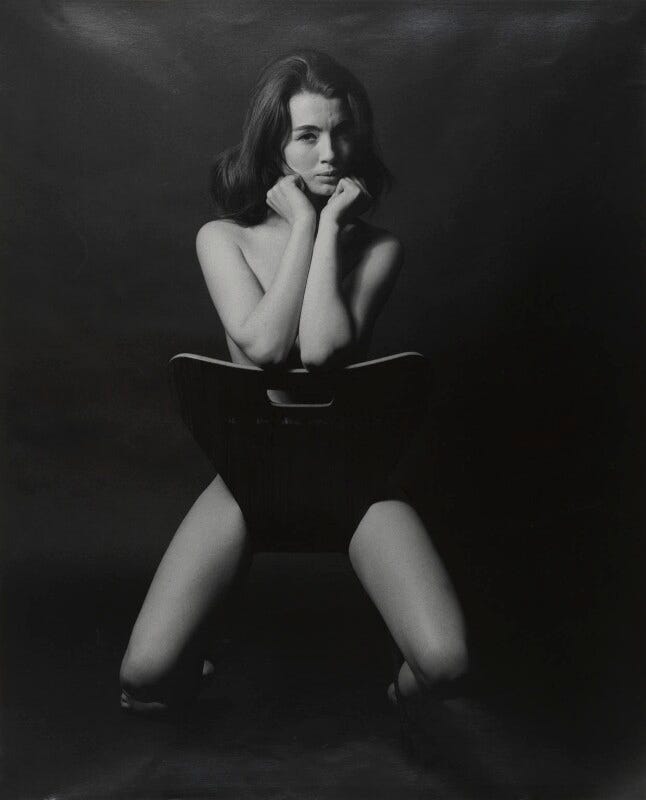
Initially, the chairs were manufactured by the the influential Fritz Hansen furniture company. Alas, shortly after its launch in 1953, the four legged version replaced the original Ant and from 1955 that, too, was effectively replaced by an adapted design known as the ‘Number 7 Chair’. The №7 became a best-seller and achieved ‘iconic’ status in the 1960s — mainly due to featuring in the much-reproduced photograph of a nude Christine Keeler, taken in 1963 by Lewis Morley in the fresh aftermath of ‘The Profumo Affair’.
Although Jacobsen’s use of steam-bending plywood was innovative, it built upon a few precedents. The husband and wife team, Charles and Ray Eames, were also producing modern office furniture using steam-formed plywood around the same time. They’d pioneered the process during the Second World War to make bespoke splints for emergency transport of the wounded.
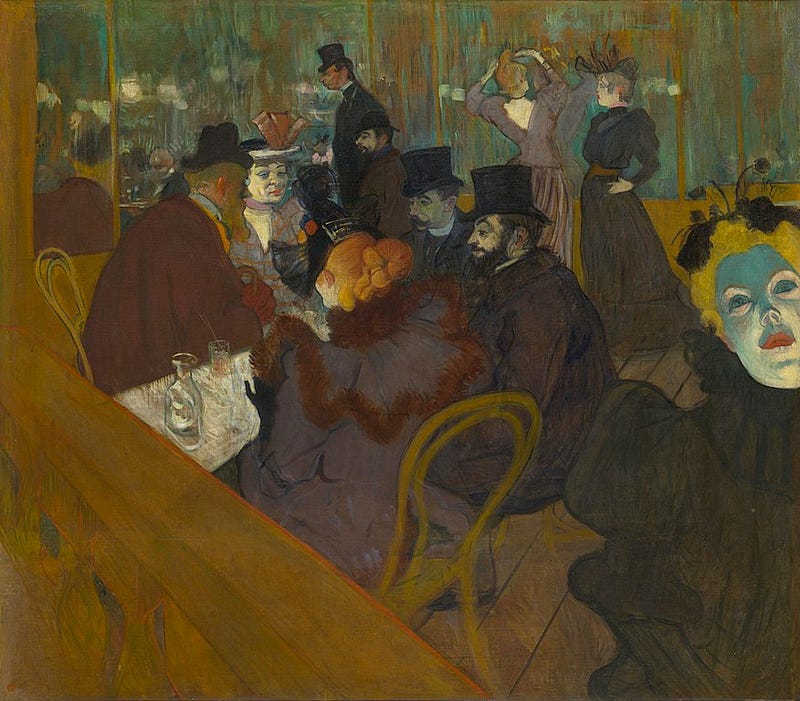
Around a century earlier, during the 1830s, Michael Thonet of Vienna had used steam-bent wood veneers in cabinet-making to create lightweight furniture strengthened by curvilinear forms. He adapted this technique to the shaping of solid wood slats and spindles for making chairs that won him a medal at the 1851 Great Exhibition in London for the ‘Vienna Bentwood Chairs’. This encouraged him to continue extensive experimentation to perfect the process until, in 1859, he unveiled his Chair Number 14.
The №14, aka ‘The Vienna Coffee House Chair’, was designed to be sold ‘mail order’ and could be transported ‘flat-packed’ for easy assembly on arrival. There were just six pieces to be slotted and screwed together and, likewise, it could be dissembled for off-season storage if necessary. Later, two extra pieces were added to strengthen the back. It was the world’s first mass-produced chair, intended for heavy use in public venues and was a huge success, ubiquitous in cafés, bars, and bistros the world over. By 1930, more than 50 million had been sold.
All the chairs mentioned in this article, the №14, the Ant, the №7, and those of Charles and Ray Eames are all still available today, either as expensive artisan replicas or in mass-produced versions.
The design of Marcel Breuer’s B3 or ‘Wassily’ chair is also discussed by Remy Dean in Signifier.


,_Tate_Modern.JPG)


