
Aristotle’s Ethical Doctrine of the Mean

Aristotle’s ethical system is correctly called an example of virtue ethics. I wrote about three versions of virtue ethics last year, including Aristotle. The most distinctive part of Aristotle’s version of virtue ethics is his doctrine of the mean. I’ll first describe Aristotle’s conception of virtue, then his concept of the mean.
How Aristotle Defines Virtue
Aristotle describes two types of virtues: intellectual and moral. Intellectual virtues derive from the rational part of the soul and include wisdom, understanding, and prudence. People develop these virtues through education and teaching. (Aristotle, 1980, 1103a) In contrast, moral virtues derive from the appetitive aspect of the non-rational part of the soul. A person develops ethical moral through habituation and practice. The moral virtues include courage, temperance, and justice. This division is similar to the one Plato made between reason and courage.
According to Aristotle, we develop virtue by cultivating good habits and acquiring practical wisdom, or phronesis. He states that “none of the moral virtues arises in us by nature…we become just by doing just acts, temperate by doing temperate acts, brave by doing brave acts.” (Aristotle, 1980, 1103a) Therefore, developing good habits is crucial in shaping our character and instilling ethical virtues.
Aristotle’s virtue ethics is teleological, meaning that it is directed toward achieving specific goals, the ultimate end of human life being flourishing or eudaimonia. (Aristotle, 1980, 1097a) This is in contrast with Kant’s deontological ethics founded on universal ethical principles and duties that must be followed regardless of their consequences or whether they achieve specific ends. Kant would say that virtue is to will the universal ethical law. Aristotle connects virtue with practical wisdom.
Practical wisdom Aristotle describes as “a reasoned and true state of capacity to act with regard to human goods.” (Aristotle, 1980, 1140b) Developing practical wisdom is essential for correctly applying ethical virtues in specific situations. By applying practical wisdom to particular situations, we can determine the appropriate mean in our choices and actions and can align our desires and emotions with reason.
Aristotle further, and most importantly, defines virtue as “a state of character concerned with choice, lying in a mean, i.e., the mean relative to us, this being determined by a rational principle” (Aristotle, 1980, 1106b). Virtues are dispositions of character that enable us to make correct choices and take appropriate actions in various situations. Correct choices lie in a mean between two extremes. Thus, virtue is achieved though a rational disposition to make choices and act in ways that finds a balance between excess and deficiency. That balance is Aristotle’s concept of the mean.
The Mean
Aristotle presented his doctrine of the Mean in his book the Nicomachean Ethics (Aristotle, 1980, II.6-IV.1; Book VI), and it is the central concept in his virtue ethics. Aristotle’s mean is not a mathematical calculation but a relative mean that depends on the specific situation and individual involved. The mean is relative to the individual who determines it guided by practical wisdom, which allow them to determine the appropriate action in a specific context.
Correct and appropriate choices lie in a mean between two extremes.
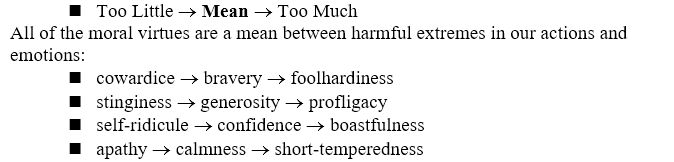
It is important in the doctrine of the mean that it is a general principle applied to particular situations. Sometimes the mean lies closer to one extreme than the other because of the particular circumstances involved. Because situations are different, it is not sufficient to say, “be brave,” because the mean of bravery differs from situation to situation. There are still ethical standards, but they are relative to the situation. It is always wrong to eat too much, but “too much” will be different for each individual. That is why Aristotle’s emphasis is on the virtue of practical reason — the ability to discern how to make ethical decisions — is the key to an ethical, good, and happy life. Aristotle’s doctrine of the mean applies not only actions but emotions. He believes that virtuous people should feel emotions in the appropriate way, at the appropriate time, and for appropriate reasons. (Aristotle, 1980, p.1106b) For Aristotle, reason is always the judge of what is appropriate.
Aristotle further develops the concept of the mean by connected its roots in the natural world. He conducted observations how animals practice moderation, writing, “And of the qualities that are in animals in accordance with their natures, some are means to what is best, others are to what is worst, and some are in between.” (Aristotle, 1980, I.1 487b33–488b29) This shows that the doctrine of the mean is not only a human virtue but for creatures throughout the natural world.
We are in some ways like the animals, Aristotle believes, but we are rational animals, and that means we possess, as animals do not, the intellectual virtues. We apply practical wisdom to know and attain the mean. Developing practical wisdom further enables us to recognize and act upon the mean in our daily lives.
Philosopher Bernard Williams claims that Aristotle’s doctrine of the Mean, claims is too ambiguous and imprecise to offer useful guidance in real-world situations. He argues that, “The general idea of a mean is certainly much less illuminating when we try to apply it to the detail of conduct and emotions.” (Williams, 1965, p. 71)
Williams’s assertion is an oversimplification of Aristotle’s system, but he is correct to distinguish between the philosophical and practical merits of the doctrine of the mean. True, the doctrine is sometimes limited in providing practical guidance for making ethical decisions. But Aristotle did not intend his ethical system as a step-by-step guide but as a philosophical exploration of the nature of virtues and the good life. We should assess the usefulness of Aristotle’s doctrine on its philosophical contributions rather than on its practical applications.
The Mean as Virtue Ethics
The doctrine of the mean is a concept with both philosophical and practical application. Philosophically, it defines virtue. Aristotle states that virtuous people act virtuously because they have developed the correct habits and dispositions and because they take pleasure in acting virtuously. (Aristotle, 1980, p.1104b) This is in contrast with Kant’s ethical system, which states that to be ethical, actions must be motivated by duty, not by personal desires or inclinations. For Kant, ethical worth derives from actions taken out of respect for the universal ethical law, regardless of whether the person enjoys performing those actions. (Kant, 1785, p. 4:400)
For Kant, an action is ethically right only if it is in accordance with a maxim that can be applied universally without leading to logical contradictions or undermining the possibility of further ethical actions. (Kant, 1785, p. 4:421) In contrast, Aristotle’s doctrine of the Mean is context-sensitive; it acknowledges that different situations may require different responses, and the appropriate mean between extremes depends on the specific circumstances. (Aristotle, 1980, p.1106a)
Aristotle‘s doctrine of the mean is not intended as an explicit formula for ethical action but as a framework for understanding virtues and their contribution to human flourishing. His ethical system provides a more holistic and comprehensive philosophical understanding of human well-being. In this philosophical doctrine grounded in human lived experience, Aristotle’s ethical framework is more realistic than Kant’s ethics of universal principles and duties.
Aristotle’s doctrine of the mean may not provide explicit solutions to the challenges of the 21st century, but its focus on the cultivation of the virtues and human flourishing can contribute to ongoing dialogue about ethical decision making in our time. Aristotle’s emphasis on virtues and the development of personal character can help individuals understand the importance of cultivating virtuous dispositions that will contribute to their well-being and the well-being of others.
References:
Aristotle (trans. Ross, W. D.) (1980) Nicomachean Ethics. Oxford: Oxford University Press.
Kant, I. (trans. Paton, H. J.) (1785) Groundwork for the Metaphysics of Morals. New York: Harper Torchbooks.
Williams, B. (1980). “The Point of View of the Universe.” In Moral Luck. Cambridge University Press.