
How Can I Be a Better Person? On Virtue Ethics
I was asked a few years ago to write this chapter for an open-source textbook.
This chapter explores a variety of approaches to the question of moral virtue and what it means to be a good person. It examines four ethical systems that revolve around the concept of virtue: Aristotle’s virtue ethics, Aquinas’s Christian version of Aristotelian virtue ethics, Buddhist virtue ethics, and Chinese virtue ethics. Each will be presented as a different way of understanding what it might mean to live as a good person. For Aristotle, this is to be understood in terms of striving for the mean between extremes in the context of a well-ordered political community. For Aquinas, it is to be understood within the context of Christianity and natural law. For Buddhism, virtue is understood in terms of a life oriented toward the eightfold path that leads to making the soul balanced and harmonious. For Chinese philosophy, virtue means being in harmony with the Cosmic Dao.
What Is Virtue Ethics?
In philosophies of virtue ethics, rather than an emphasis on following rules, the emphasis is on developing oneself as a good person. It is not that following rules is not important; it is more the sense that being ethical means more than simply following the rules. Virtue ethics links goodness with wisdom because virtue is knowing how to make ethical decisions rather than knowing a list of rules. Because virtue depends on the particularities of individual people and their particular situations, exact knowledge is not possible in many circumstances. Virtue ethicists tend to reject the view that ethical theory should provide a set of commands that dictate what we should do on all occasions. Instead, virtue ethicists advocate the cultivation of wisdom and character that people can use to internalize basic ethical principles from which they can determine the ethical course of action in particular situations. Virtue ethicists tend to see ethical principles as being inherent in the world and as being discoverable by means of rational reflection and disciplined living. The different forms of virtue ethics may or may not focus on God as the ultimate source of ethical principles. What unites the various forms of virtue ethics is the focus on moral education to cultivate moral wisdom, discernment, and character in the belief that ethical virtue will manifest in ethical actions.
Aristotle on Excellence and Flourishing
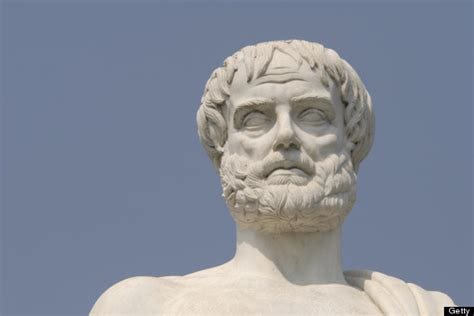
The ancient Greek philosopher Aristotle defines human good as the activity of the soul in accordance with virtue. Aristotle believed that our purpose is to pursue our proper human end, which is eudemonia, which is best translated as “human flourishing.” Eudemonia is not momentary pleasure but enduring contentment — not just a good day but a good life. Aristotle said that one swallow does not make a summer, and so, too, one day does not make one blessed and happy. (<<1.7>>) The final goal of all human activity, Aristotle said, was eudemonia. We work to make money, to make a home, and we sacrifice to improve our future, all with the ultimate aim of living well.
Human flourishing means acting in ways that cause your essential human nature to achieve its most excellent form of expression. Aristotle held that a good life of lasting contentment can be gained only by a life of active virtue — a life lived with both phrónesis, or “practical wisdom,” and aretē, or “excellence.” Aristotle wrote that
we take the characteristic activity of a human being to be a certain kind of life; and if we take this kind of life to be activity of the soul and actions in accordance with reason, and the characteristic activity of the good person to be to carry this out well and nobly, and a characteristic activity to be accomplished well when it is accomplished in accordance with the appropriate virtue; then if this is so, the human good turns out to be activity of the soul in accordance with virtue. (Aristotle, Nicomachean Ethics, 1098a)
The ethical demand on us is to develop our character to become a person of excellent ethical wisdom because, from that excellence, good actions will flow, leading to a good life. Virtuous actions come from a virtuous person; therefore, it is wise to focus on being a virtuous person.
For Aristotle, ethics is a science with objective truths that can be discovered and understood through reason. Whether a particular course of action is good or not and whether a person is a good person or not are ideas that can be understood objectively.
The cultivation of virtue must be accompanied by a cultivation of rationality. Aristotle saw the human soul as having three components: the nutritive part, responsible for taking in nutrition; the sensitive and appetitive part, responsible for sensing and responding to the environment, including the desires and appetites that motivate actions; and the rational part, responsible for practical and productive intellect. All three components are essential to being a human, but they exist in a clear hierarchy, with the faculties of reason at the top, and these can and should control and guide the appetites into productive and ethical actions. Aristotle characterizes the desiring and emotional part of the soul as partaking of reason insofar as it complies with reason and accepts its leadership. (1102b31) The person of good virtue has cultivated a stable soul that is not swayed by appetites or desires but is governed by reason. Being ethical, then, is a skill that one develops, so just as you can through practice become good at math or playing a musical instrument, you can through practice become a virtuous person. When you have reached a certain level of skill in math or playing music, you no longer need a teacher to guide you, and you quickly can understand what to do. The same is true in Aristotle’s conception of ethical decision making — it becomes an ingrained habit.
How can the rational human come to understand what proper ethical actions are? Aristotle’s answer is his doctrine of the mean, or the balanced course of action:
Virtue is a state of character concerned with a choice, lying in a mean relative to us, this being determined by a rational principle, and by that principle by which the person of practical wisdom would determine it. <<2.6>>
We see here Aristotle’s emphasis on a virtuous character that enables us to make a rational ethical choice. There are two important aspects of this. The first is the concept of the choice lying in a mean relative to our circumstances, and the second is that what the mean is in any particular situation can be determined by any person of practical reason. The ethical course of action is relative to our particular circumstances, meaning that there is not one rule that fits all situations, but the ethical course of action is objectively true in that any rational person looking at the situation will be able to understand the correct ethical course of action.
By the mean, Aristotle refers to something midway between two extremes. The virtuous act is the one that falls between the extremes of what is deficient and what is excessive.
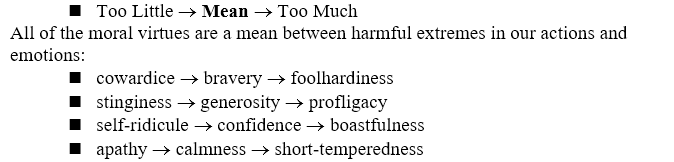
Sometimes the mean lies closer to one extreme than the other because of the particular circumstances involved. Because situations are different, it is not sufficient to say, “be brave,” because the mean of bravery differs from situation to situation. There are still ethical standards, but they are relative to the situation. It is always wrong to eat too much, but “too much” will be different for each individual. That is why an emphasis on virtue — the ability to discern how to make ethical decisions — is the key to an ethical, good, and happy life.
The better you are at finding and acting on the mean, the more you have phrónesis (“practical wisdom”). This form of practical reason helps one recognize which features of a situation are morally relevant and how one can do the right thing in practice. Practical reason is rational because it is open to rational influence. Again, virtue is a learned skill. A person who listens to and learns from the reason of others is a rational person, and the same holds for ethics. As Aristotle sees it, every thought that one has and action that one takes contributes to the development of either a virtue or a vice. Virtues such as temperance, courage, and truthfulness become increasingly a part of our actions the more we intend to do them and the more we practice doing them. The truly virtuous person:
- Knows what she or he is doing.
- Chooses a virtuous act for its own sake.
- Chooses as a result of a settled moral state.
- Chooses gladly and easily.
These are possible only through developing a virtuous disposition in which the soul is settled by reason. The more you practice virtue, the more you are capable of virtue because virtue becomes a way of life. Leading an objectively rational good life will produce a subjectively happy life of the kind appropriate to being human.

Thomas Aquinas on Virtue
Aristotle’s writings had been lost to Western Europe for centuries until they were rediscovered and translated into Latin in the late 12th and early 13th centuries. Aristotle’s texts posed problems for Christian philosophers in reconciling them with Christian theology, which led to many arguments within the Catholic Church. To the rescue came St. Thomas Aquinas who wrote the Summa Theologia (The Sum of Theological Knowledge), creating a system that could, as advertised, provide answers to all questions. Thomas’s philosophy was based on the writings of Aristotle, who he reverently called “The Philosopher” and placed as a source of truth almost on the same level as the Bible. You will see similarities between Aristotle’s and Thomas’s ethical systems.
Like Aristotle, Thomas based ethics on the pursuit of our proper human end. Unlike Aristotle, Thomas believed that our proper human end of eudemonia is not found in this world. Aristotle’s system, Thomas believed, was as good as humans could achieve on the basis of the natural realm, but our end as humans is to be perfected through union with God. For Thomas, every event occurs because there is some end toward which things are directed, and, we humans, like everything else in the universe, have our own ends. Unlike everything else, we as humans can consciously choose which ends we pursue, and ethics concerns which ends are worth our efforts to pursue. Like Aristotle, Thomas believed that ethical understanding comes through virtue and that virtue is a skill that must be developed. Also like Aristotle, Thomas believed that we learn what is ethical through our reason, which we can use to uncover God’s natural law that is imbued in creation. By rationally reflecting on what is in accord with nature and our own natural inclinations, we can understand the ethical virtues.
Thomas’s Aristotelian idea that humans can rationally understand ethical principles had to deal with the Christian concept that humanity’s sinful nature prevented such understanding. Thomas held that sin affects our moral life but not our rational life, clearing the way for the use of our human intellect to learn ethical truths. Thomas borrowed from Islamic philosophers the conception that intellect is both passive and active. Intellect passively takes in sense experience and ideas but actively processes them to abstract universal truths. This is a natural process that is inherent in the human mind without requiring illumination from God and that is unaffected by sin as was commonly believed in Thomas’s time. The universals abstracted by the mind are tied to real features in the world, the universals first existing in the mind of God who used them to create the objects in the world. Put simply, we use our intellect to understand the world God has created. It is an orderly and purposeful world, all of the objects in it receiving their purpose from God. By observing the world and reflecting on our observations, we can learn about the natural world, including God’s ethical laws, which permeate the natural world. Thomas used this conception to develop what we now know as “natural law” — the idea that ethical truths are ingrained in nature.
To be virtuous, we need to learn God’s natural law that governs the motion of objects in nature and instructs us in ethical behavior. To be rational, which is central to our human ends, requires intellectual discipline, but it is the way to virtue. Through reflecting on natural law, we learn and develop as ingrained habits the four cardinal virtues of temperance, courage, prudence, and justice. Virtuous persons practice the four cardinal virtues in their daily lives, and from those virtues flow ethical behaviors of all kinds in all situations.
Buddhist Virtue Ethics
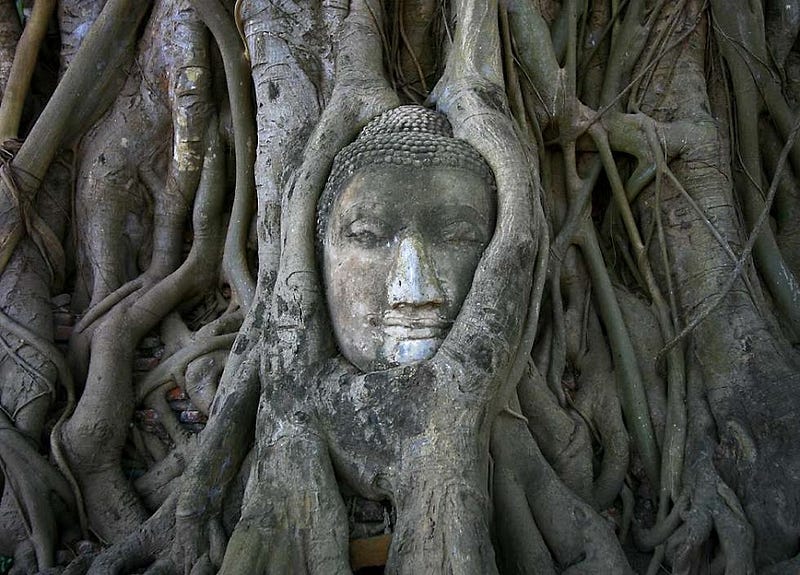
The Buddhist philosophical tradition is as ancient as Aristotle’s virtue ethics and arose on the Indian subcontinent. The Buddhist virtue ethical system teaches the art of making the soul balanced and harmonious through humility, with the goal of being free from suffering. The founder of Buddhism, Siddhārtha Gautama, taught that what could be called evil acts are performed out of ignorance and fear; therefore, rules and threats of punishment do not curtail these acts. We learn how to act in a suitable way (sammā, meaning best or most effective in the circumstances) by focusing on thinking suitably because our thoughts lead to our actions. The emphasis in Buddhism is on what is suitable and unsuitable rather than on the Western sense of right and wrong or good and evil. A life of virtue is outlined by the eightfold path: suitable view, suitable intention, suitable mindfulness, suitable concentration, suitable effort, suitable speech, suitable bodily conduct, and suitable livelihood. By making one’s thoughts and actions suitable, one promotes positive outcomes and lessens harmful outcomes. This is especially important to Buddhists because of the Gautama’s teaching about karma.
The law of karma says that thoughts and actions that intend to harm others will eventually cause harm to ourselves and that thoughts and actions that intend to benefit others will eventually benefit us. In the Buddhist conception of time, “eventually” could mean in a future life that is multiple reincarnations away, so Buddhists think less in terms of immediate consequences of thoughts and actions and more in terms of the intrinsic value of them. Karma is not a strict determinism in that we still have free will and can mitigate the consequences of karma through our virtuous thoughts and actions. To avoid future suffering in this life or future lives, a Buddhist focuses on developing inner virtue to be able to think and act suitably to avoid negative karma and generate positive karma. As with Aristotle’s virtue ethics, the more you practice virtue, the more you are capable of virtue. Having made a commitment to follow the eightfold path as a way of life, you are disposed to follow those rules.
Chinese Virtue Ethics
For more than two millennia, Chinese philosophy has been dominated by two great traditions: Confucianism and Daoism (Taoism). Both traditions are founded on their teaching of the Dao, which is best translated as “the way.” Dao is both noun and verb, both how the universe is and how things behave properly. The Dao cannot be described completely in words but can be sensed as the source of all things and the rhythm of Being. All things come from Dao, and all things have their own Dao, or essence, which comes from the Cosmic Dao. Adepts of both Confucianism and Daoism believe that to be in the Dao and in harmony with it is to be virtuous and at peace and that this state of enduring harmony with the Dao, similar to Aristotle’s eudemonia, is the proper human goal. Both Confucianist and Daoist ethical systems teach that a community flourishes when its members are in harmony with the Dao and that the state flourishes when its leaders are in harmony with the Dao. However, Confucianism and Daoism are in disagreement about how communities and governments can keep in harmony with the Dao and, thus, promulgate different ideas about how to attain virtue.
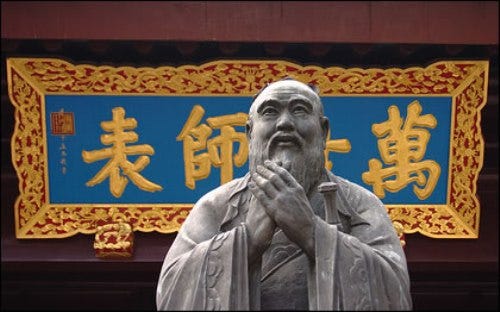
Confucianism is the social and ethical system set down by Kongzi (Master Kong), known in the West as Confucius. Kongzi saw the virtuous person as an artistic creation achieved through the diligent practice of ethical excellence by way of strict ritual. Ritual, or Li, is the art and practice of crafting one’s character from the raw material of human nature. Just as a craftsperson uses tools to fashion wood or stone, a person uses ritual behaviors to carve and polish his or her character. Li extends to all aspects of life; Kongzi taught that our every action affects our character and our environment, so every activity needs to be performed with the proper respect and procedures. Most of the rites specified by Kongzi concern human interactions, reflecting the great importance he placed on suitably respecting one’s superiors. Ancient Chinese society was highly stratified, and Kongzi thought that maintaining the social hierarchy was essential to social order. Showing respect for one’s superiors, such as government officials, elders, and ancestors, was more than politeness — it was essential for society to function properly. The more one practices the rites, the more one develops virtue, and most importantly the virtue of ren or benevolence. Ren should be understood not as acts of kindness but as acts of propriety that create virtue in oneself and society. Practicing the rites virtuously brings each person and society in harmony with the Dao and leads to a good life for all.
Daoism has long provided a strong counterpoint to Confucianism. As the name implies, Daoism focuses on harmony with the Dao rather than on human teachings, the exact opposite of the Confucian system of ritual behavior. Daoist ethics centers on the fundamental virtue of wu wei, meaning “effortless action.” Daoism rejects formal ritual and deliberately striving for virtue, emphasizing instead that virtue comes from naturalness, simplicity, and spontaneity. Daoism at times seems to be anticivilization with its calls for us to detach from the artificiality of social traditions and rituals and to adopt instead a quiet life communing with nature. At other times, though, Daoism attempts to reform society, especially its leaders:
If you want to be a great leader, you must learn to follow the Dao. Stop trying to control. Let go of fixed plans and concepts and the world will govern itself. The more prohibitions you have, the less virtuous people will be. (Dao De Jing, Mitchell translation, Chapter 57)
The Daoist idea is that separating ourselves from nature is separating ourselves from the Dao and that what most contributes to this separation from the Dao are the social institutions of government, military, and other social hierarchies and power structures. The Daoist virtue of wu wei involves a life of walking away from the artificial trappings of human pretension and arrogance and shaping your actions according to what others think of you. Instead, a Daoist seeks a oneness with the rhythms of nature, which probably requires walking away from society itself. Deliberately, Daoism does not provide a set of rules and rituals; instead, Daoism provides guidelines on the virtues of selflessness, moderation, detachment, and humility. Accordingly, Daoist philosophers never published books of ritual practices like Kongzi did; instead, Daoists taught the virtues through stories that show Daoist sages exemplifying these virtues.
Objections to Virtue Ethics
There are two main objections to virtue ethics as an ethical system: its vagueness and its relativism.
1. Virtue ethics is too vague and subjective and does not produce explicit rules for moral conduct that can tell us how to act in specific circumstances.
When facing ethical dilemmas, we feel better if we have a clear answer about what to do. Virtue ethics offers general ideals rather than definitive commands. We can create laws based on a definitive ethic against stealing, but we cannot make laws saying “be wise” or “be patient.” Also problematic is that virtue ethics tends to hold that its virtues apply variably according to the situation. It is far easier to practice the principles of never lying or always being generous. Virtue ethics says there are times when lying is a better course of action and being generous is a worse course of action, and this variability creates uncertainty. What is more, how can I decide when the virtue applies and when it should not? Telling me to be wise and reflect on the ethical virtues and the situation is offering more vagueness. Finally, we want to be able to rely on other people’s behavior, and those who practice virtue ethics will be variable in their behavior, so we would not know exactly where we stand with them.
To consider this objection, we need to think about the nature of ethics itself. Yes, we could say definitively, “you should not lie” and “you should not steal,” but what are those prohibitions based on? A virtue ethicist could argue that both are based on the ethical principle of honesty and that if that is so, then cultivating the virtue of honesty will lead one to not lie or steal from others. Perhaps it is the case that virtue ethics focuses on the foundation of ethical life and provides us with the tools to make ethical decisions in the varying circumstances of our daily lives. The variability in the behavior of those who practice virtue ethics reflects the variability of everyday life.
2. There are different cultural definitions of human flourishing and virtue.
All human cultures have ethical values, but values vary across cultures, so how can we decide which set of virtues is right? Even within a culture, two people will have different views about what the virtues and when and how they apply. Because virtue ethics gives us no specific commands for how to act, each person is left to himself or herself to decide how to act. Virtue ethics is too relative to be a helpful ethical theory.
Ethical relativism is a concern. If ethics means anything, it has to have some objective basis and cannot be left entirely up to how people feel and think. Virtue ethicists are aware of this danger and would respond to it that virtue ethics is based on objective realities of the world and human nature. The virtues are manifestations of how things are, or should be, outside of cultural or individual subjectivity. Different cultures differ on how ethical virtues should be applied, but every culture values virtues such as honesty, benevolence, courage, and justice. Differences in how cultures apply virtues may reflect objective differences in their circumstances. When we interact with another culture, those differences do need to be dealt with, but saying our culture is completely right and the other wrong is not a helpful approach. Individuals do face the burden of needing to determine how best to apply the virtues, but is this not similar to the decisions we have to make in all aspects of our lives?
Full book, Intro to Philosophy: Ethics available at https://press.rebus.community/intro-to-phil-ethics/