
Aristotle’s Good Life
We have a purpose, he said, and that purpose is to be virtuous.
Everything has a final cause, and that includes people. Our final cause as a human substance is to fulfill the purpose that is a part of that substance. Keep in mind, Aristotle is thinking in the mindset of 2,300 years ago. Aristotle’s idea that “we should fulfill our purpose” is not at all the idea we have today of the individualized self-fulfillment of “I should fulfill my personal goals.” We will have to wait another 2,100 years before we begin seeing philosophers thinking that individuals have unique desires and personal goals. Aristotle, and most people after him, thought of the human being as being of one substance, and each particular human person partakes of that essence. That means that we are essentially all the same. That reduction of people to particular instances of a single universal type was the dominant way of thinking about humanity until that assumption started to be challenged around 200 years ago.
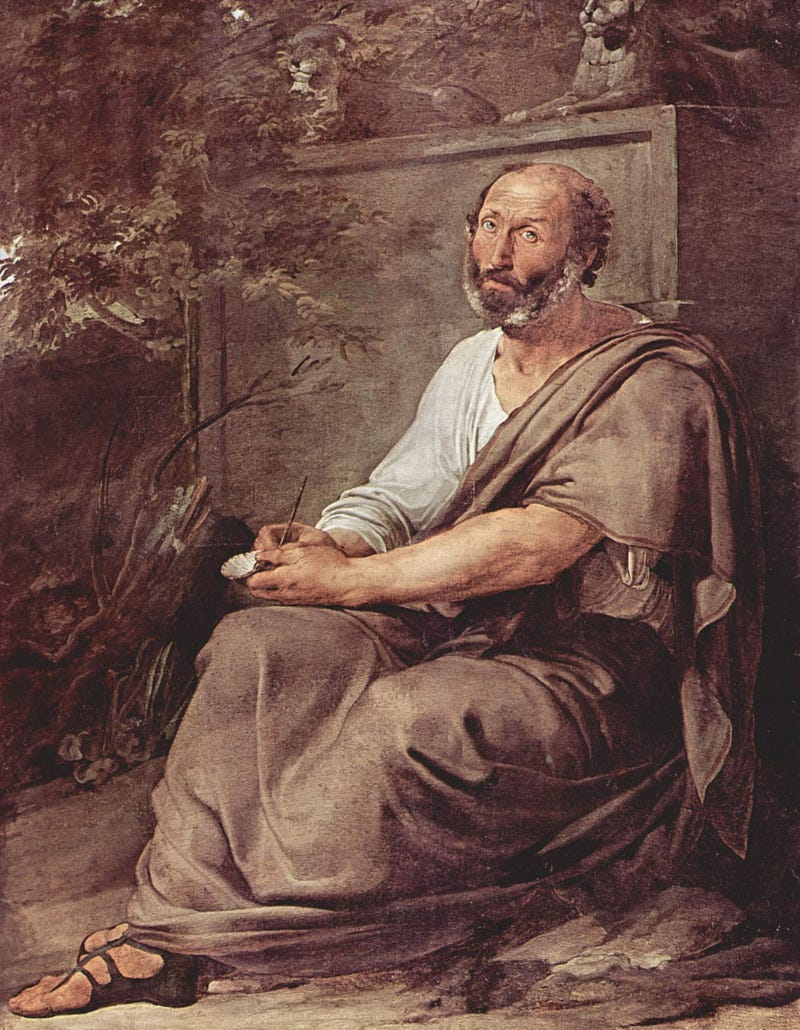
Aristotle wrote that the purpose of all humans is to live a certain kind of life, something commentators have called “the good life.” For Aristotle, the notion of a good life is intertwined with morality, and morality is based on reason:
We state the function of man to be a certain kind of life, and this to be an activity or actions of the soul implying a rational principle, and the function of a good man to be the good and noble performance of these, and if any action is well performed when it is performed in accordance with the appropriate excellence: if this is the case, human good turns out to be activity of soul in accordance with virtue. (Nicomachean Ethics 1.7.5)
That quote is from Aristotle’s written work on moral philosophy, Nicomachean Ethics, in which he gives his theory of what constitutes the good. His moral reasoning is in line with his research method of understanding objects, an understanding based on his observations and what he sees as being the objective facts. His approach produces a straightforward, grounded moral philosophy, but his understanding is constrained by the limits of his experience. Aristotle was a man of privilege in a hierarchical society. His viewpoint of morality included only men of his social status. We’ll see more about that in the next section about his theories on community and government.
For Aristotle, morality is a question of how humans can achieve the ultimate good. He considers this question in purely functional terms. What I mean by this is that we say a hammer is good if it functions as it should. The final cause of a hammer is to successfully pound nails. If it can accomplish that function, then it is a good hammer because it is achieving its ultimate good of completing its function. Aristotle considers humans in the same way. Like all objects, human beings have a final cause. Aristotle says that our final cause as human substances is to fulfill our human function or purpose.
Aristotle argues that the ultimate functional good of all humans is happiness, but not just happy feelings — a particular state of happiness that he calls eudaimonia. Don’t think of eudaimonia as pleasures, because those are fleeting, but think of it as the contentment of living well and having a life worth living. Most interesting is Aristotle’s claim that everything we do is in one way or another directed toward the goal of the contented well-being of eudaimonia. Ask yourself why you do anything you do. You are reading this book right now; why? To get an A in a philosophy course. Why? To get a university degree. Why? To get a good job. Why? To make money. Why? To have a good life. Ah, yes, eudaimonia is your ultimate goal.
Some people chase wealth, fame, honor, or other fleeting ways to feel good, but Aristotle says that eudaimonia, “the good life,” is achieved by living the disciplined life of virtue. Aristotle taught that virtue is measured by what helps humans to achieve the good life. In other words, you achieve a good life by living a good life. This isn’t circular reasoning; it is the nature of virtue ethics. Aristotle and other virtue ethicists teach that we must develop our psyche to cultivate the virtues of temperance, justice, and courage — the virtues that define a good, well-functioning human. We cultivate virtue by practicing virtue. We become temperate by doing temperate acts. We become just by doing just acts. And so forth. In living our lives in this way, we fulfill our human purpose and will achieve the state of eudaimonia. Being virtuous brings us the good life.
Achieving eudaimonia through virtue is the broad purpose of being human, but how do we decide on specific moral decisions? When faced with the decision to do A or B, how do we know which choice is the moral course of action? Not surprisingly, Aristotle says that the person of virtue will be able to correctly choose. This is because, Aristotle says:
Virtue, then, is a state of character concerned with choice, lying in a mean, i.e. the mean relative to us, this being determined by a rational principle, and by that principle by which the man of practical wisdom would determine it. Now it is a mean between two vices, that which depends on excess and that which depends on defect; and again it is a mean because the vices respectively fall short of or exceed what is right in both passions and actions, while virtue both finds and chooses that which is intermediate. (Nicomachean Ethics, 2.6.6)
This sentence is the heart of Aristotle’s ethics, and it holds a lot of meaning.
First, virtue is a state of character — it is a beingness from which one acts. As previously mentioned, we become just by doing just acts. Being virtuous means being dedicated to making correct moral decisions and then acting on those correct decisions. Aristotle says that a virtuous person “delights in virtuous actions and is vexed at vicious ones.” (Nicomachean Ethics, 9.9.4) The virtuous human makes a choice to act, but the choice must come from a certain character.
That virtuous state of character is making the correct choice by determining the mean course of action relative to the situation. By “mean,” Aristotle refers to that course of action that lies in the middle between extremes. He explains that “excess is a form of failure, and so is defect, while the intermediate is praised and a form of success.” (Nicomachean Ethics, 2.6.3) Aristotle’s position is that the middle path between the extreme possibilities is always the correct moral path.
Here’s an example from Aristotle’s time. Let’s say your infantry company is in the midst of a battle, and enemy soldiers are charging your company’s position. What are your extreme possibilities for action? One extreme choice would be to run away in panic. The opposite extreme choice would be to abandon your defensive position and charge the enemy. Between the extreme choices of cowardice and foolhardiness lies the mean or middle choice of standing your ground and meeting the enemy’s charge. This simple example is emblematic of how Aristotle wants us to think about every moral decision that confronts us. Rationally determine the middle ground between extreme possibilities. Rational thinking is the key because the mean is determined by reason. The person who intuitively makes moral choices in this way is a person of virtue.
The mean is relative to us, to the particular situation that confronts us. That it is relative does not imply that we have any leeway to make personal moral choices. Aristotle specifies that the mean relative to us is determined by a rational principle that any and every man of practical wisdom would determine. Aristotle declares that though every situation is different, every particular situation has one rationally correct moral answer to it. Every rational man in that situation would reach the same conclusion. And Aristotle is thinking of men only; he believed women lacked the capacity for reason, which hypocritically is a quite extreme and irrational belief. Back to the infantry example: Every man in that unit who thinks rationally about that particular situation will be able to determine the correct prudent action to take.
The bottom line for Aristotle’s moral philosophy is the demand that we always practice rationally driven moderation. Aristotle’s word for this is phrónēsis, which is best translated as “practical wisdom” with a strong sense of prudence. We do not make moral decisions on the basis of emotion or personal preferences; we make moral decisions on the basis of the middle path as determined by rational principles. If we live life in this way, we will develop the state of character of virtue. and living the virtuous life is the efficient cause of how we reach our final cause of eudaimonia.
It is important to remember that living the virtuous life is a continual process; virtue is not an action we do once and then we are virtuous forever more. It is a beingness of continually choosing the intermediate moral choice. Acquiring and maintaining virtue for Aristotle meant developing the habit of phrónēsis. Only the human who consistently practices phrónēsis can develop moral virtue. Like any good habit, the more we practice it, the easier it becomes. By acting virtuously we create a virtuous character, and a virtuous character will more readily act virtuously. Virtue begets virtue. Aristotle’s example is developing courage. You may lack courage at first, but by performing an initial act of courage, you begin a habit. Developing courage is the process of incremental change, small steps of prudent courage taken over time that molds your character.
The human with moral virtue cares not about fame, fortune, or power but rather to act according to the dictates of reason. The virtuous human seeks neither to control others nor to submit to others, but acts with wise, prudent self-control. Though the practice of virtue, the human has the contentment of living well and having a life worth living.