
Utilitarianism: Consequentialist Moral Philosophy
It was in the 1780s that the two most-discussed moral theories were developed. One was the deontological morality of Kant and the other was the consequentialist morality of Jeremy Bentham. Deontological means adherence to a set of universally true moral laws, and Kant appealed to our duty to obey rational moral laws that he saw as imperatives on us. Consequentialist means a moral system that assesses the consequences of actions as to their moral correctness, and this, Bentham claimed, was the only legitimate moral system.
This two different ways of thinking about morality — the fundamental principles of how we should act toward others — had major effects on the rest of philosophy. In many ways, Kant’s deontological system was an encapsulation of long tradition. Bentham’s consequentialism, or as he referred to it, “utilitarianism,” broke from that long tradition of seeing morality as obedience to transcendent rules.
I discussed Kant’s moral philosophy in another article. Here, I will discuss utilitarianism: the moral philosophy based on consequences.
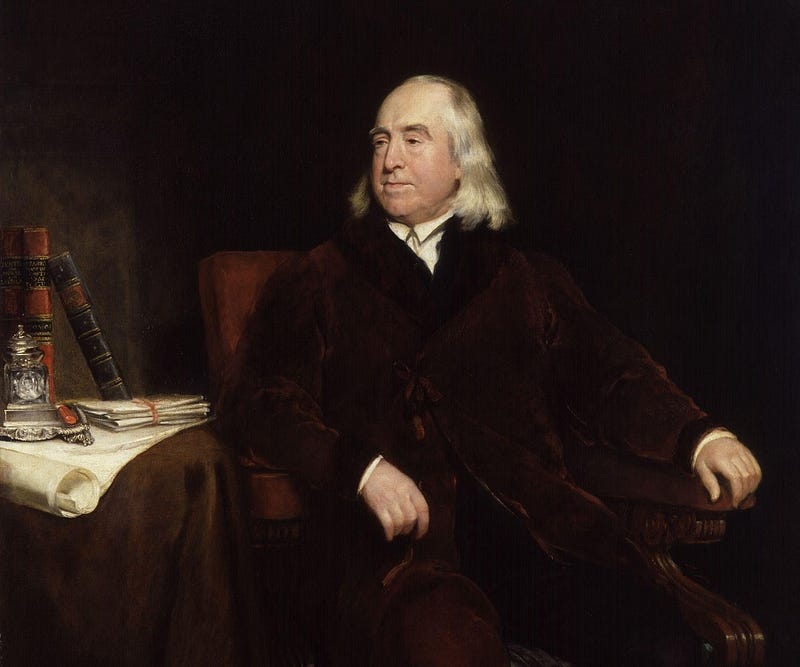
Jeremy Bentham’s Utilitarianism
Happiness. Who doesn’t want more happiness? Everyone wants happiness, Jeremy Bentham (1748–1832) thought, and that’s not a bad assumption. Aristotle said that everyone wanted to attain eudaimonia, a state of contentment of living well and having a life worth living. Bentham’s idea was similar but far less lofty. Like Hobbes, Bentham believed that the basic human reality was pain and pleasure. He begins his book on his theory with this definitive statement:
Nature has placed mankind under the governance of two sovereign masters, pain and pleasure. It is for them alone to point out what we ought to do, as well as to determine what we shall do. On the one hand the standard of right and wrong, on the other the chain of causes and effects, are fastened to their throne. They govern us in all we do, in all we say, in all we think: every effort we can make to throw off our subjection, will serve but to demonstrate and confirm it. In words a man may pretend to abjure their empire: but in reality he will remain subject to it all the while. (An Introduction to the Principles of Morals and Legislation, I)
He shares Hobbes’s theory of endeavors. Bentham was also, like Hobbes, a determinist. Therefore, Bentham considered morals and politics to be a kind of physics that just needed to be solved through equations. We just want to be happy, and any pleasure will do, he thought. Greater happiness could also simply be a lessening of pain and suffering. If there’s a pain-to-pleasure scale of −10 to 10, lessening pain from −4 to −2 is good, just like increasing happiness from 2 to 4 is good.
Bentham set out to change moral philosophy, which he thought was empty. He took a very different approach to moral decision-making by focusing on the consequences of actions. In some respects, Bentham, who grew up wealthy and never knew anything but privilege, was expressing the bourgeois sentiments that Marx later condemned. His moral theory is correctly described as a form of hedonism: Pleasure means moral good. Bentham saw moral systems based on universal laws (like Kant’s) and rights (like Locke and Wollstonecraft’s) to be denying the reality of pain and pleasure. To counter what he thought were the absurdities of those systems, he introduces what he coins the “principle of utility.”
The principle of utility recognizes this subjection, and assumes it for the foundation of that system, the object of which is to rear the fabric of felicity by the hands of reason and of law. Systems which attempt to question it, deal in sounds instead of sense, in caprice instead of reason, in darkness instead of light. (An Introduction to the Principles of Morals and Legislation, I)
Utility, for Bentham, was a quality within any object whereby it tends to produce benefit, advantage, pleasure, good, or happiness or to prevent the happening of mischief, pain, evil, or unhappiness to people. Just as the objects in the world can produce impressions of sight and sound in us, they can produce pain and pleasure in us. Obviously, Bentham observes, we prefer pleasure to pain. Everything we do as individuals, and everything our governmental, social, political, and legal institutions do, should follow the principle of choosing that course of action that results in the greatest happiness for the greatest number of people.
This principle of producing the greatest happiness for the greatest number of people, which he called the “principle of utility,” he proposes to be the guiding principle of all human activity. In adopting the principle, Bentham is rejecting any consideration of human rights, virtue, motive, or goals. All that matters are the consequences of an action. If an action increases total happiness, it is good; if it doesn’t, it’s not good. It was that simple for him.
Bentham genuinely believed the principle of utility was a universal truth that can be objectively, rationally quantified and scientifically measured. He developed an equation to measure happiness that he believed could be used to solve moral and political issues. He called this a “felicific calculus” meaning “a calculation to produce happiness.” He didn’t provide us with any kind of happimeter or specific ways by which we could measure units of happiness. He did leave us with the basic principle of the felicific calculus to guide our thinking about social policy. He proposed that we measure the utility of any proposed action on seven scales:
1. The intensity of pleasure produced
2. The duration of that pleasure
3. The certainty the action will actually produce pleasure
4. How soon the pleasurable result will occur
5. How likely the action will produce more pleasures of the same kind
6. Whether the pleasure will be followed by sensations of the opposite kind (pain followed by pleasure or pleasure followed by pain)
7. How many other people will be effected by the action
Even though we lack a happimeter, we can analyze any proposed course of action by using these seven scales, as Bentham would want us to do.
Bentham believed that the English legal system was founded on unscientific principles — that it was a confused muddle of historical prejudices and superstitions. He was most critical of the prevailing theory at the time of inalienable human rights. Bentham attacked the French revolutionary “Declaration of the Rights of Man and the Citizen” (1789) as “rhetorical nonsense — nonsense upon stilts.” Condescending though he was, Bentham was not arguing that people should not have rights; he was taking issue with the presumed source of those rights. Bentham was arguing that rights do not exist in nature but are willfully created by human institutions. They are not absolutes but are matters for debate. In this way, Bentham was taking Locke’s vision of the social contract one step further: Not only is government created by humans to serve human needs but the concept of rights is likewise created by humans to serve human needs. But Locke had believed that the need government served was the inalienable human rights of life, liberty, and property. Bentham believed the need government served was the need to ensure the greatest happiness for the greatest number of people.
Bentham walked the walk of the principles he set forth. He spent decades advocating for social reform. He is particularly known for his proposals for criminal justice reform. He proposed that the focus shift from retribution against criminals to reforming them to create greater social happiness. Punishment causes pain, Bentham argued, which is bad; therefore, criminals should be punished only enough to deter criminal acts but no more. He focused on one common aspect of punishment in his time — locking prisoners in solitary dark cells. His proposal was a new form of prison architecture, the panopticon, from the Greek for “all seeing.” In this architectural plan, prison cells are built in a circle with a central observation platform. Bentham’s idea was that instead of rows in which each prisoner is isolated and out of sight, the prison guards could more easily watch all of the prisoners. The design followed Bentham’s belief that power should be visible, but he added that the guards in the central tower should be behind blinds or other means of concealment. From this, Bentham said, prisoners had the sentiment of a sort of invisible omnipresence of authority; whether they were being watched and held to account was unverifiable. If prisoners knew that at every moment they could be watched, they would behave, and if they increasingly behaved, they could increasingly be reformed to become better citizens. Obviously, this idea of invisible, all-seeing authority has chilling implications. But Bentham said the utility of unverifiable authority also applied to the guards and the managers of the prison. Their positions in the prison would be visible to passersby, so they did not know whether they were being watched by the larger public and, therefore, would be less inclined to abuse their power over the prisoners. Bentham did not abandon the idea that fear of punishment would increase utility.
All was not oppressive in Bentham’s plan. His architectural plan included skylights in the central area of the prison that would allow sunlight and air into the prison. He extended the panopticon idea to factories. In this area also, he thought that decreasing isolation and the sentiment of a sort of invisible omnipresence of authority would encourage workers to behave. We can’t deny that we behave better at work when the boss is around. He did not champion the individual as did the German idealists or Kierkegaard and Nietzsche. Bentham thought that the aggregate happiness in society was what matters and that utilitarianism requires everyone to be impartial and a disinterested spectator as to who specifically experiences happiness.
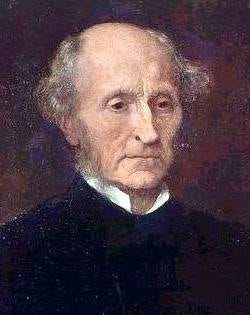
John Stuart Mill’s Utilitarianism
John Stuart Mill (1806–1873) was also British but lived two generations after Bentham. He was strongly influenced by Bentham, adopting utilitarianism, but giving it a strongly different emphasis. Mill made his mark in philosophy with his 1843 book A System of Logic. Mill cowrote several essays with his wife, Harriet Taylor, whom he considered his friend and equal, though everyone else ignored her because she was a woman working in a very sexist time.
Central to Mill’s philosophy was that “over himself, over his own body and mind, the individual is sovereign” but that political philosophy should be guided by what is good for society as a whole. There is a slight tension in Mill between the individual and the commons. Mill does not think like Hobbes and Hegel that the individual should give his or her all to the state, but Mill also does not think like Rousseau or Marx that the state and the individual are at odds. Instead, Mill believed that the state should be interested primarily in ensuring the welfare of its citizens, especially their liberty. In 1859, he wrote On Liberty, in which he advocated for all people to have complete freedom as long as they acted responsibly toward other people.
In his major work on moral theory, Utilitarianism (1863), Mill says that morality is implicitly utilitarian, that people naturally act to maximize happiness. Bentham had advocated increasing “utility,” but Mill opted for the more direct term of the “greatest happiness principle.” In a number of respects, Mill’s version was more down-to-earth and practical than Bentham’s abstract conception.
Mill recognized several flaws in Bentham’s formulation. One was that there was no real incentive for people to contribute to the happiness of others. Mill countered that the firm foundation of morality was our social feelings for each other and the desire to be in unity with them. Another problem was that Bentham was not recognizing that some pleasures were ultimately better than others. Mill thought that intellectual pleasures were more valuable than mindless physical pleasures. Bentham had famously said that a child’s game was as good as poetry if they both produced happiness. Mill famously replied that:
It is better to be a human being dissatisfied than a pig satisfied; better to be Socrates dissatisfied than a fool satisfied. And if the fool, or the pig, are of a different opinion, it is because they only know their own side of the question. The other party to the comparison knows both sides. (Utilitarianism, 3.7)
Not any pleasure would do, Mill said. Pleasures that edified the mind and spirit were more valuable than empty, fleeting pleasures. In other words, put down the video game and read a book.
A third concern of Mill’s was that Bentham’s felicific calculus was without compassion and sentiment; it reduced people to mere objects. Mill saw that Bentham’s principle of utility could be used to force people to do things they do not want to do. Bentham said that individuals should be impartial to their own happiness and look instead to the aggregate happiness of all. Mill was aware that this could be interpreted to permit the suffering of a small number of people if that suffering caused happiness for a larger number. One of Mill’s concerns was eliminating poverty, which caused disease, a sense of worthlessness, unkindness, and other forms of suffering. He could not agree with the logic that poverty and inequality could be justified if the happiness of the wealthy was greater than the unhappiness of the poor. He insisted that greatest happiness principle should not be calculated to rationalize individual suffering.
Although Mill believed in the crux of Bentham’s utilitarianism, he worried that it would almost certainly lead to a tyranny of the majority. If the majority comes to believe that they can be happy through the harsh treatment and exploitation of minority groups, then they could argue that the government is obligated to do that. Bentham’s utilitarianism denies individual human rights; consequently, the majority could use the power of government to oppress minority groups. Mill believed there was more to morality than majority rule — that the state has to consider the happiness and rights of all.
To protect those people in the minority, Mill introduced the “harm principle.”
The only purpose for which power can be rightfully exercised over any member of a civilised community, against his will, is to prevent harm to others. His own good, either physical or moral, is not a sufficient warrant. (On Liberty, p. 17)
By establishing this principle, Mill is prohibiting the exploitation of the few by the many. The harm principle denies the utility of slavery, which a strict utilitarian could argue is justifiable if the pain caused by the enslavement of some is less than the pleasure of those who benefit from the products of slavery. The harm principle also expressed Mill’s strong belief in personal freedom. One’s personal tastes and habits are the concern of that individual. As long as one doesn’t harm anyone else, the public has no business interfering. This has led to concept of the “victimless crime,” the usual examples being drug use and prostitution. Mill was not endorsing these practices but simply making the point that social morality has bigger, better concerns.
Writing in the midst of the industrial revolution, Mill declared that people are people, not machines. It was society’s obligation not simply to give people pleasure but to facilitate their personal growth that would cultivate lasting happiness, similar to Aristotle’s eudaimonia.
Human nature is not a machine to be built after a model, and set to do exactly the work prescribed for it, but a tree, which requires to grow and develop itself on all sides, according to the tendency of the inward forces which make it a living thing. (On Liberty, p. 111)
Mill thought that combining the basic idea of utilitarianism with a concept of human rights would retain respect for human dignity while accepting the value of human happiness.
Mill was a leading influence on what has come to be known as “social democracy.” As Mill put it, the role of government is to represent the public interest, serve society, and be answerable to it. Government should not exert any power of coercion on people, even when the public opinion calls for such coercion. This is another expression of Mill’s caution against the “tyranny of the majority.” Mill emphasized the preventative and supportive roles of government. To protect the innocent, the government must take precautions against crimes before they have been committed and must detect and punish criminals afterward. He agreed with the death penalty for aggravated murder but said that the legal system must be constrained to following the harm principle.
Mill became a well-known and respected author and statesman, and he leveraged his fame to argue for the rights of women in his book, The Subjection of Women (1869). His arguments were similar to Mary Wollstonecraft’s arguments decades earlier, but Mill’s book, because he was a man and famous, was more widely read and respected. Mill took up Wollstonecraft’s observations that society systematically discriminates against women, subjecting them to a lower status. All people should be accorded the same rights and opportunities, Mill argued, and the legal subordination of one sex to the other should be abolished.
Mill walked his talk even more than did Bentham. Bentham stayed aloof from politics, but Mill ran for public office and served a term as a member of the British parliament. During his tenure there, he was a leading progressive voice, most notably being the first member of parliament to advocate for women’s suffrage.
References
Jeremy Bentham, An Introduction to the Principles of Morals and Legislation. Clarendon Press, 1907. Public Domain.
Immanuel Kant, Fundamental Principles of the Metaphysic of Morals, Project Gutenberg, https://www.gutenberg.org/ebooks/5682.
John Stuart Mill, On Liberty, Project Gutenberg. http://www.gutenberg.org/ebooks/34901.
John Stuart Mill, Utilitarianism, Project Gutenberg, http://www.gutenberg.org/ebooks/11224


