
Moana I: Converting Gods and Devils
I: Converting God into the Devil
Moana has an unusual quest — she must return a heart stolen from a god, Te Fiti, with the thief, Maui, as her companion. One creates a crisis by stealing a heart while the other resolves that crisis. Yet she ends up returning the heart not to Te Fiti, but to the demon that has taken her place, Te Ka, only to see Te Ka turn into Te Fiti. Moana and Maui, hero and antihero, are oddly one. As are Te Fiti and Te Ka, god and demon. As above, so below.
The quest is also unusual in how it inverts basic religious power dynamics. Instead of humans depending on gods to save the world, the gods depend on mortals to save them from crises that mortals themselves cause. From the influence Maui and Moana have on the divine, Te Fiti/Te Ka suffers the crisis because her suffering is the crisis. To save her people, Moana must save her god. To save her god, she must make her god whole, which means she must make herself whole. We can only give what we are.
To understand how Moana strives to make herself whole, we need understand what is cleaving her apart: Her psyche is dichotomously split between the masculine, represented by Maui, and the feminine, represented by Moana herself. Hence Moana and Maui are split halves of a single archetype: the masculine and the feminine hero.
Crucially, in Moana, the feminine is the hero (she who resolves the crisis) whereas the masculine is the antihero (he who causes the crisis). Maui steals a talisman from the god which alters the consciousness of humans and sullies the relationship between the human and the divine. This is precisely what happens when Adam and Eve eat the forbidden fruit. Moana is a retelling of the Fall in Genesis that continues into the ultimate resolution: the return of humans to the Garden, reconciling the human and the divine.
Yet Maui and Moana not only represent the first two human, they also are the last two beings in their realm. If Maui represents the alienation of the human and the divine, Moana represents their reconciliation. The original sin separating humans from God was Adam’s and Eve’s eating fruit from the Tree of Knowledge. Te Fiti’s heart relates to the fruit (green being the color of the heart chakra as well as of apples). The Tree from which it was plucked was therefore the goddess herself. To redress this sin, the heroes must give to the god rather than take from from her, causing a reunion between the human and the divine rather than a separation, as humans return to Paradise rather than be banished from it. While the crisis of humans is to be separated from God, perhaps the crisis of the god is to be alienated from humans.
The crisis was instantiated by love being taken from the god. Yet love cannot be ‘taken,’ or it ceases to be love, and starts being power. The heart in the god is love; the heart out of the god is power. Power is what egoic humans do with love, and so it is what they do to love. Maui’s original sin is to devolve divine love into human power, a power made all the more dangerous because it is separated from love. Without love, there is no oneness, and so no restraint as to how that power is used.
The mythological crisis Moana and Maui resolve on the divine plane is the ascent of the demon caused by the theft of the divine heart. On the human realm, two crises plague Moana’s people: 1) the biological: a blight threatening starvation; 2) the social: a cessation of ocean exploration to settle new islands, rendering the blight not a local but an existential problem. By not exploring the sea, Moana’s people are contained within the plague. They could otherwise resolve the plague by finding a new home.
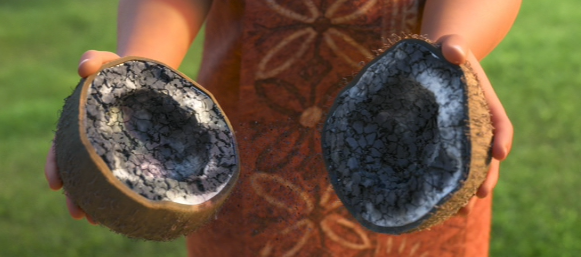
We can liken the blight ruining the food supply to modern ecocide: a destructive spiritual practice on the metaphysical plane that becomes a nonsustainable way of life on the physical plane. We can similarly liken the founding of new islands to humanity attaining new consciousness. For the ocean symbolizes the unconscious and land, especially newly emergent volcanic islands, symbolize emergent consciousness. Yet consciousness has become stagnant, for no new islands are sought after. Sea exploration has ceased due to a failed patriarchal line embodied by Moana’s father, Chief Tui, who secretively hides his people’s ships in a cave out of his thalassophobia (fear of the ocean).
The mythological crisis manifests on every human plane: on the spirit level, the ascent of the demon and descent of the goddess; on the heart level, the divine heart being stolen; on the mental level, the failed leadership among a seafaring people; on the physical level, the blight. The imbalance between divinity and humanity, love and power, masculine and feminine, life and death are one crisis manifesting on all levels of life.
The crisis begins when Maui steals the heart from Te Fiti. Who is Maui? He is an orphan, having been thrown into the ocean as a baby by his parents, only to be rescued and empowered by gods. Being an orphan instilled with miraculous powers aligns him with heroes from Moses and Christ to Darth Vader and Harry Potter. The gods hybridize Maui into a demigod who lives for millennia, shapeshifts and employs superhuman strength. As such, he represents a midpoint of the human and the divine: where power and love meet.
The gods gave Maui power, but they did not heal him; what he needed was love. (The Jedi do the same thing in training Annakin but taking him from his mother.) Filled with power but lacking love, Maui is a classic narcissist. Without shame for restraint or empathy for connection, he lives in his own world, symbolically seen in his inhabiting a desert isle. He remains riddled with insecurity, a need for adulation and lacks basic insight into his solipsistic manipulations. In short, he represents our masculine civilization that can do anything but empathize, that can do anything because it does not empathize.
Maui takes on power but has no love, takes on power instead of love, takes on power because of lack of love. He is the god of a godless world. Dostoevsky’s Kirilov states this nakedly:
If there is no God, then I am God.
Without love or empathy, there is no moral restraint on our actions. Another of Dostoevsky’s characters, Ivan Karamazov, says,
If there is no God, everything is permitted.
Maui’s being a narcissist implies his having suffered an abusive childhood. Was Maui actually thrown into the ocean as a baby? Did gods actually rescue and empower him? Or is his origin story better explained as an abused child’s mythologized fantasy? The bad parents who neglected him were metaphorized into the monstrous parents who ‘threw him into the ocean.’ The ‘gods’ who rescued Maui and made him special — just what a narcissist wants as compensation for lack of love — are the good parents, fantasized as a compensatory coping mechanism.
Otto Rank discusses this pattern in myth and fairy tale:
The hero is the child of very distinguished parents… His origin is preceded by difficulties… [T]he newborn child…is doomed to be killed or exposed. As a rule, he is surrendered to the water… After he has grown up, he…takes revenge…on the one hand, and is acknowledged, on the other, achieving greatness and fame.
Rank’s description fits Maui’s life to a tee. The parents who loved him and the parents who abandoned him were the same people — this is the paradox of love and pain, one an abused child cannot reconcile. The psyche, especially that of a toddler, is not delimited by reality. The toddler fantasizes that the parents who love him and the ones who harm him, despite not having separate bodies, are actually different people. While adults figuratively state an alcoholic is a ‘different person’ when drunk, toddlers understand the same of their abusive parents, only literally.
In narcissists, we call this phenomenon splitting: idealizing and demonizing people into unrealistic polarities. The cognition learned as an abused toddler solidifies over the years as narcissism grows around the wounded child to protect him like a hardened shell. (We will see this symbol later in Tamatoa, the gold-covered crab. The narcissist ornamentalizes his greed to camouflage a personality that is in fact a defense against love.) The adult narcissist that toddler becomes continues to mythologize people into the same extremes, including himself: I am great, and you are nothing.
Hence Maui is simultaneously inferior and superior: the most wounded child who grew into the most special demigod…who committed the worst crime but who was entitled to the most special love. We can now see why Maui stole Te Fiti’s heart. Because he did not feel love in his traumatic upbringing. Because the world owed him. Because he took by cruelty what Mother would not give in kindness. This brings to mind the African proverb:
The child who is not embraced by the village will burn it down to feel its warmth.
The mother who gives is what Maui wanted. The enraged child robbed of his heart is what Maui actually was. Maui re-enacted his traumatic childhood on the god: he turned Te Fiti (the good mother) into Te Ka (the enraged child). Moana’s quest is therefore to reunite the wounded child, Maui, with the Great Mother, Te Fiti. She must transform both Te Ka and Maui into beings receptive to love. Moana is then the messiah to Maui’s anti-messiah: where lack of love in taking the heart separated, the presence of love in giving the heart will reunite.
How is Maui an anti-messiah? His dynamic is the photonegative of that of Christ. He is a being with immense power and infantile consciousness who robs the divine, disturbing the human-divine dynamic. By saving himself at the sacrifice of all others, Maui indeed becomes a god in a godless world.
Maui thus takes from God, which I call power. Moana gives to God, which I call love. Power witnesses the god as a means and the self as the end. In love, there are no means or end, so self and God are one. Hence Moana and Te Fiti look alike. Whereas Maui sees the god as something to be exploited, Moana sees a higher-dimensional mirror. Moana heals the love that did not happen by becoming the love that happens.
As Ramana Maharshi explained,
Master, how should we treat others?
There are no others.
Maui’s theme of compensating himself for lack of love with usurped power is sublimely allegorized in Wagner’s Ring. The ugly dwarf Alberich seeks love from the beautiful Rhinemaidens. After they mock him and spur his advances, he notices the gold shining in the Rhine. The Rhinemaidens tell him the gold can be formed into a ring that will let him rule the world — if he will first foresake love. Loveless and powerful, the miserable Alberich puts a curse on the ring: anyone who wields its power will foresake love as he did. Anyone who gains what I have gained, will lose what I have lost.
I believe modern civilization suffers Alberich’s curse: we have all the power we could wish for but engage it without love. When I look to humanity, I see Maui. The ‘curse’ is the state of the world where power ascends and love descends. In Moana, a loveless world is one that cannot feed the people of Motonui. The same theme is seen in The Lion King when love literally descends in Mufasa’s death as power ascends in Scar’s reign during which, once again, there is no food to eat.
Love is only love when it is our highest principle. Once power reigns, love becomes conditional, and so is no longer love. Jung writes of this complementary relationship:
Where love rules, there is no will to power, and where power predominates, love is lacking. The one is the shadow of the other.
This is why the Devil tempts humans with power in exchange for their souls. ‘The Devil’ is our apotheosized ego that trades the love we believe we cannot have for the power that will allow us to reign in a loveless world.
Maui, like anyone, most wants love. But unresolved trauma has facilitated the belief that he cannot have love. What God takes away, the Devil returns to us in a different form. Maui was then freed to take in his narcissism what he would never have allowed himself in a state of love.
Hence when we follow the Devil, we leave God’s heart — or, in Maui’s case, take it. For what is the Devil but God’s ego? With our purest love, we know God, are God. With our purest power, we know the Devil, are the Devil. (This reminds me of Charles Manson’s Helter Skelter henchman to state (1:50) ‘I’m the Devil. And I’m here to do the Devil’s business.’) When we have given up on our soul, the egoic aspect of the human, the narcissist, aligns with the egoic aspect of the divine, the Devil.
The ego feeds itself power by removing love from the heart or even the heart itself. When this is done willingly, we see the Devil doing the giving, as Omicron does to Galvatron in the original Transformers. When done unwillingly, we see the god (Te Fiti) being robbed. The Devil who gives and the goddess who is robbed are the same symbol.
Taking from the divine inevitably incurs punishment. Prometheus steals fire from the gods for humanity, only to be chained to a rock where a bird eats of his liver everyday — the same place where Christ is pierced by a spear while on the Cross. Prometheus chained to a rock and Christ nailed to a cross are analogous symbols: a pierced martyr who gave divine consciousness to humanity at his own sacrifice.
Like Prometheus, Maui is punished: by being banished onto a desert island. But unlike Jesus, who transforms into the Christ, Maui experiences no ego death leading to a transcendenence. Instead, he lives in a sterile world where he is isolated, where there is no life, where there is no love: the narcissist’s inner world.
Maui spent much of his time on the island in its cave. The cave is a symbol of the womb, but this womb is sterile: rather than create life, Maui grandiosely carves an immense statue of himself. When a narcissist has finally lost everything and everyone, and so has no one to worship him, he worships himself.
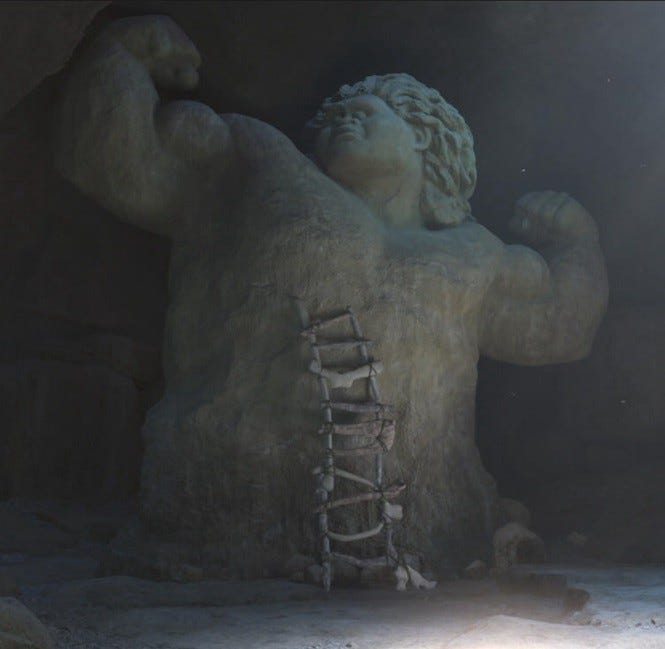
Maui, like Te Ka, has no legs.
Te Fiti, the goddess of life, the Great Mother of all, has lost her heart, and with it, the power to create life. Hence the next symbol we see of the Great Mother means sterility; a womb without love is a womb without life. The creative life-force cannot flow through Maui, for where Te Fiti makes others, Maui makes only himself.
Moana ends this stasis. As the first person to enter the cave in 1,000 years, she represents new life in the womb. When she climbs out the cave through a vaginally shaped aperture, in the process breaking Maui’s statue, she in effect parthenogenically gives birth to herself. The rebirth of the feminine overcomes the repressive masculine. When Moana’s breaks the patriarchal form in Maui’s statue, her iconoclasm (breaking of the idols) becomes literal.
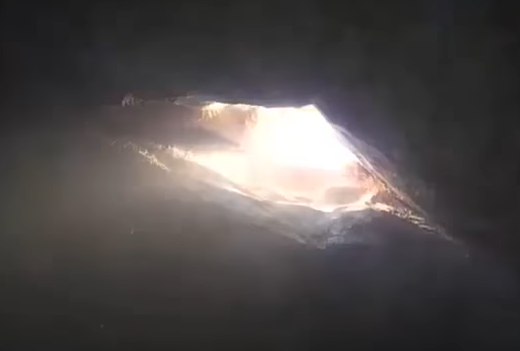
The opening of the womb seen from within.
Moana’s journey with Maui begins when she leaves the womb of the divine feminine and ends when she restores that divine feminine with its heart. From womb to heart: a journey of the feminine. Moana’s quest allegorizes the human journey to the divine: from birth to death, we seek the union of the heart we carry with the heart of the divine. Finally, Moana’s uncanny resemblance of Te Fiti further suggests she, like Christ, is the child of the god; Moana is the messiah of the divine feminine.
Like any savior, she encounters resistance in those whose hearts she would reawaken. Immediately upon meeting Moana, Maui needlessly buries her alive in the cave. If he merely wanted her ship, he could have taken it. Hence the action takes on a symbolic value: putting her in the cave symbolizes the masculine’s attempt to once again repress the feminine. He then tells his tattoo he is leaving the island to get his hook — not the heart. After 1,000 years of reflection, Maui has remained the same person: seeking power rather than love. Then, the moment Moana shows him the heart, he immediately throws it back into the ocean, for he avoids accountability for his theft and love for his heart for the same reason. The ocean throws the heart back, hitting him him in his third eye. This spiritual awakening overwhelms him, and he falls on his back, as if the heart weighed as much as he did. However, he again avoids the call, and jumps off the canoe, preferring even the island and another millenium of solitude to this quest.
Why choose the island over the heart? Fear. Maui’s tattoo serves as his illustrated subconscious, and there we see him chattering his teeth, evincing his fear of the heart. He then tells Moana, ‘That is not a heart. It is a curse.’ The abused child grows to associate love with trauma. A narcissist appears to fear the abandonment that made him narcissistic most of all, but in truth, his greatest fear is facing the love he once knew and lost.
This is the avoidant attachment style prevalent in narcissists. They chuck feelings of vulnerability to the ocean of their subconscious, and believe that love is either unreal (that is not a heart) or unwanted (it is a curse), a curse cured by power. Power is never sought outside an absence of love. Even the gods we associate with power are themselves loveless, like Te Ka.
While power in divine hands can mean oneness, like Te Ka’s power to create life, power in human hands as a rule means duality: the subject over the object, the means to the end. For in human hands, power inevitably means power over another person. Perhaps the very meaning of love is oneness, with power’s being duality.
When love is given, the giver and receiver are both the more. When Maui took power from the god, he had the ability but lacked the consciousness to wield the sacred power of life. To do what gods do we must first become as gods are. Te Fiti does not have power over life because she is life. Hence the oneness of divine love: I give to you to become you, for I am you. Maui took the heart of life because he did not identify with life. I take love because I am not love.
If Te Fiti is the symbol of life itself, with her heart as the symbol of love itself, the heart Moana carries round her neck represents the love within life, the love that makes life. By contrast, Maui first seizes the heart, then throws it away, belying the narcissist’s inner world: once life is devoid of love, it can be harvested for power. When life is lived without love and viewed as a series of means to the narcissist’s end, the world becomes hostile — and so Te Ka embodies the world as Maui made it.
Maui and Moana. Love and power. Te Fiti and Te Ka. The two deities in Moana reflect two kinds of relationship between the human and the divine. Te Fiti’s reign represents the union of the divine and human hearts just as Te Ka’s reign represents their separation. Hence Moana is what I call a quantum mythology: the level of consciousness reflects the manifestation of reality. The nature or personality of the god becomes a manifestation of the human-divine relationship; perhaps human nature is a manifestation of our relationship with the divine. Maui represents narcissistic patriarchy; when his is the dominant influence on the human-divine relationship, the people starve and the god is Te Ka. When Moana’s love and maritime leadership are the dominant influence, the people thrive and the god is Te Fiti. As above, so below.
There are in fact two ontological transitions: from Te Fiti to Te Ka (the mythological crisis), and from Te Ka to Te Fiti (the mythological resolution). The first transition symbolizes the Fall of Man: humans are alienated from a god who is suddenly hostile to them. Maui is banished from the garden of life to toil in alienation. In the second transition, humans and the god are reconciled, and the archetypal return to the verdant Garden shows the human journey back to divine oneness has come full circle.
Moana is a retelling of the Eden myth, only here, it is the male who is responsible for corruption, and the female who leads humans back to a promised land. Moana=Moses, right down to the parting of the waters to escape wrath and certain death after God had ‘hardened the heart of Pharaoh’ or in Maui’s case, stolen it.
The heart, when stolen, is the fruit of the Tree of Knowledge whose theft disrupts human union with the divine. Before the theft, Yahweh is a creator of life, like Te Fiti. After the theft, Yahweh becomes enraged and ostracizes humans as Te Ka does to Maui.
The heart, when returned, is the fruit of the Tree of Life — life as oneness of self and world, self and other, self and God. Those who eat of the Tree of Life live forever. By recreating Te Fiti, who in turn recreates life, Moana helps humanity eat of the Tree of Life, complete with the paradisiacal return to the Garden.
Read Parts II Converting Love into Power, III Converting Trauma to Narcissism and IV Converting the Devil into God.
To follow me: https://medium.com/@myartman


