
Moana III: Converting Trauma to Narcissism
The second demonic figure is Tamatoa, a giant, possibly hermit, crab. Once the wounded child becomes an adult, he needs protection from a world he does not trust. Tamatoa’s living within an ornamentalized shell he exchanges throughout life to fit his needs is a keen metaphor for the narcissist living in his ego because he cannot bear living in the world.
Despite being a crab, Tamatoa is an archetypal dragon. He lives in a lair where he obsesses over the gold and ‘shiny’ objects that cover him, akin to Tolkien’s Smaug from The Hobbit and Wagner’s Fafner from The Ring. Smaug rolls and lays on his treasure until it becomes encrusted in his flesh, particularly his vulnerable underbelly. Tolkien’s dragon covers its vulnerability with greed until it hardens him inwardly and impresses others outwardly, which is what narcissists do with their ego.
Wagner is subtler with his symbolism. Fafner built Valhalla, the home of the gods, for the chief god, Wotan. He was originally to be paid in the form of Freia, the goddess of youth, who, like Te Fiti, is associated with the renewal of life. He is then persuaded to take treasure in Freia’s place: enough gold to physically cover Freia. Like Maui, Fafner commodifies the feminine, thereby trading love for power. And, like Maui, Fafner shapeshifts, turning himself into a dragon to hoard his treasure.
Like Smaug, Tamatoa not only guards his treasure, he covers himself with his it. Nonetheless, he continues to covet the goddess’s heart. The irony: his leading a heartless life has led him to covet the heart — but not as a heart, just as Fasolt wanted not the love of Freia but her shape in gold. That both Maui and Tamatoa focus on the heart with the same misinformed covetousness suggests we are seeing a gargantuan embodiment of Maui’s own ego. Hence Tamatoa knows intimate details of Maui’s traumatic childhood and hates Maui, for he is Maui; his hatred of Maui symbolizes Maui’s self-hatred.
Tamatoa even treats Maui the way Maui treats Te Fiti. Maui took Te Fiti’s heart not as a scared talisman but as a treasure to fulfill his will to power, over which he could gloat. Tamatoa sports Maui’s own hook not as a magical talisman allowing Maui to shapeshift but simply as the pièce de résistance of his shiny shell. What is sacred to you is a thing to me.
Indeed, both share the same insatiable ego. Despite Maui’s having provided so much for humanity — the sun, the sky, the tides — he wears his achievements like trophies, just as Tamatoa wears his treasure. For both Tamatoa and Maui, the treasure is: having one’s treasure admired.
Imagine Christ sporting tattoos celebrating his having raised Lazarus from the dead or walking on water. The difference between Christ’s gifts to humanity and Maui’s is that the former is about about the ones who receives whereas the latter is about one who gives. Maui gives to others only to give to himself. For Christ, love is an end in itself; for Maui, love is a means, and therefore, not love. He cannot feel love because he cannot give love. The only way to have it is to give it. And because he cannot become the loving god, he demands to become the loved god. If I cannot become like God, I will make God become like me. This goes a long way in explaining the transformation from Te Fiti to Te Ka.
The sheer insanity of the narcissist — the baseline cognitive state of the god of a godless world — becomes visible when Tamatoa’s shadow is revealed. In the light, he is simply greedy, shiny, covetous…but this comes from an inner emptiness that is only visible in the dark. Tamatoa’s bioluminescence belies his depravity and capacity to mesmerize. He looks like he can take over others’ minds because his own mind has been taken over.
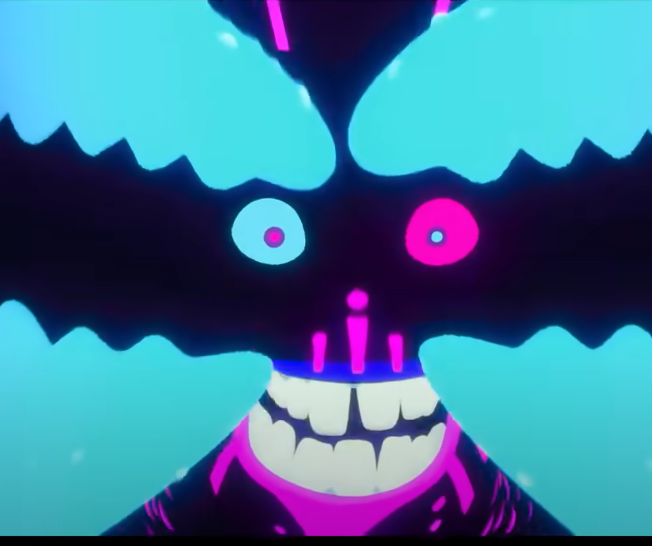
This is the hidden face of the narcissist: the twisted priest who makes a religion out of desire. The perverse power is but a defense against love, a way to defend the narcissist’s inner child. In the film’s epilogue, we see Tamatoa on his back, helpless, having lost both the hook (power) and the heart (love). And all he has to say is: ‘Did you like my song?’ To the end, he wants to know if he was admired.
The inner child gets revealed when there is no more power to spend, no more pain to defend. On his back, helpless, revealing the psychological infant he is, Tamatoa shows his vulnerable side.
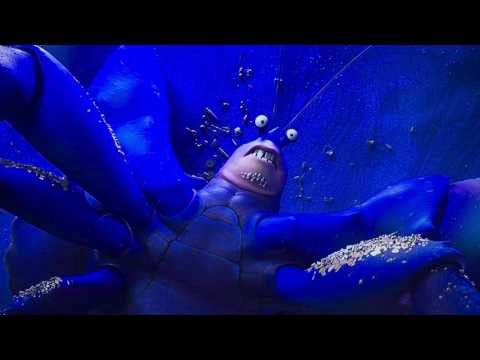
As an archetypal dragon, Tamatoa serves as a gatekeeper to the final, most destructive villain. To confront Te Ka, Maui first needs his hook, which is perched on Tamatoa’s back, and so the road to Te Ka runs through Tamatoa. This dynamic parallels other hero’s journey films. In Star Wars, Jabba the Hutt imprisons Princess Leia and Han Solo just as Tamatoa imprisons Moana. He lives in an underground cave just as Tamatoa lives in an undersea cave. While both monstrous sybarites are confronted by male heroes, they are ultimately overcome by female heroes who rebel against the hedonism and misogyny they represent; Leia strangles Jabba, and Moana outsmarts Tamatoa.
The Matrix depicts the same dynamic in the form of The Merovingian. He is found in his subterranean club as lord of the underworld. His three identical bodyguards represent the three-headed Cerberus who guards the gates of Hades. To access his realm, the hero must push the Help button on the elevator whose P is cracked, rendering ‘Hel,’ the Norse spelling of Hell. And it is the female Trinity, like Moana and Leia, who overcomes the Merovingian.
All three greed-demons understand or reveal something about the hero. Jabba is the only villain to resist Luke’s Jedi mind-trick. The Merovingian reveals that Neo had ‘predecessors’, implying that the One is himself part of the cyclical Reloading of the Matrix. And Tamatoa discusses both Maui’s childhood trauma and Moana’s grandmother’s opsimathy (the wisdom given on one’s deathbed). Furthermore, all three imprison something or someone necessary for the next phase of the journey. Jabba holds Leia and Han; The Merovingian holds Neo; Tamatoa holds Maui’s hook.
Jabba holds the frozen Han Solo as a decoration. Han was a smuggler who owed Jabba as a crimelord. Han is rescued and thawed, suggesting a rebirth motif; he dies as a smuggler to be reborn as a hero. The hero’s previous identity of greed must be confronted; the one who once rewarded him for this behavior now punishes him. This is how it is with the Devil; he rewards us to reinforce devilish behavior until we are his because we have become like him. In being freed from Jabba, Han is freed from his past to live a life of virtue just as Maui is given his hook to aid Moana and right the wrongs of his own past.
The Merovingian holds Neo at Mobil Station, an anagram for Limbo, i.e., Purgatory. Neo is ultimately freed, and soon, with Trinity, breaches the clouds covering all of Earth to become the first humans in thousands of years to feel sunlight. Hell (Hel), Purgatory (Limbo), Heaven (the light): Dante’s progression through the afterlife. And who guides The Matrix’s heroes through The Merovingian’s Hel? Seraph: their guardian angel.
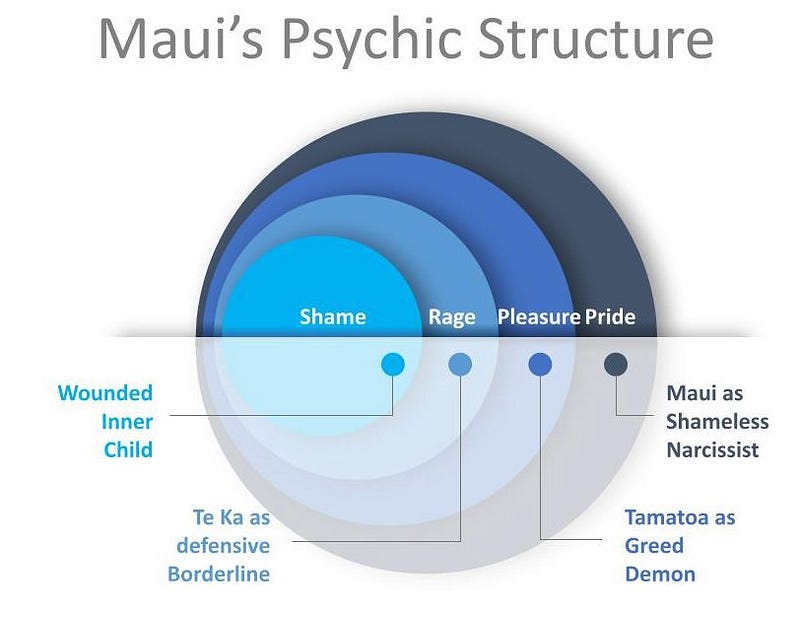
In each myth, in order to have the final confrontation between hero and demon, the intermediary demon must first be confronted. Why then are the greed-demons (Jabba, the Merovingian, Tamatoa) gatekeeping for the destruction-demons (Darth Vader, Smith, Te Ka)? The order has to do with Moana’s journey being inwards, to the core of Maui’s psyche, where she will finally find his wounded inner child. Moana first met Maui himself as an unabashed narcissist who celebrated his triumphs and manipulated her to his own end all the while. In the next stage, Tamatoa is the isolated narcissist who makes a religion with greed replacing faith and a shiny shell compensating for his lack of a luminscent soul. The narcissized inner child grows up to seek egoic compensation for living in a world without love. This is what I took from the world once I could not find love.
Between the greed demon and the inner child lies a borderline, Te Ka, who fears the love she needs, and so lashes out at its approach. Maui’s first defense against love, is his own baseline pride. Underneath his ego lies another shell: an adorned ego in which even love is something ‘shiny’ to be pursued. His deeper and darker defense, borderline, belies his rage and destructiveness. This is why narcissistic rage episodes closely resemble those of borderlines. Inside the aloof narcissist, a subpersonality is constellated that finally reveals the emotional demonstration of pain turned into wrath.
Narcissists pretend not to need love, but inevitably lash out against a world whose love he can perceive but cannot become. Where the narcissist tries to enjoy the lack of love and makes you worship their enjoyment, the borderline burns in the lack of love, and makes you feel their pain. The narcissist seeks power to enjoy a loveless life whereas the borderline abuses power to destroy the experience of love. Psychologically, for Maui to confront his destructiveness — his misuse of power — he first needs to confront his greed — his drive to power. Symbolically, for Maui to confront Te Ka and her misuse of power, he must first confont Tamatoa and his greed.
Hence Maui’s hook takes on a new meaning. Like himself, the hook was thrown into the ocean in a hateful act by the Terrible Mother only to be redeemed later out of a sense of love. The hook was initially Maui’s talisman as a demigod. The miracles he performed were but fodder for his ego. The hook was to him just what is was to Tamatoa: a treasure to please oneself rather than a tool to help others. Rather than the hook transforming Maui into new animals forms, he is finally transforming himself into a more empathetic person (yet he remains selfish and solipsistic, hence the hook only partly functions at this junction). When he frees the hook from Tamatoa, he symbolically liberates his powers from his ego. This is the meaning of Maui’s confrontation with Tamatoa. Afterwards, Maui and Moana ascend (evolve) whereas Tamatoa falls back and is stuck (in stasis).
We see the ego fail itself when Moana outsmarts Tamatoa by using his greed against him. She covers a barnacle with bioluminescent algae, mimicking the Heart. Tamatoa is fooled because he only witnesses the Heart’s appearance, not its feeling; this is what happens when love becomes a possession. As he seizes the glowing rock, Maui escapes with his hook, and Moana with the Heart. By trying to possess the Heart as well as the hook — by trying to possess love as well as power — Tamatoa loses both: a recapitulation of Maui’s own disgrace.
The realm of the monsters is their journey through Maui’s greed, and his subsequent liberation from it. For narcissism is a realm that imprisons all who enter it, including those who reign there. Hence Milton’s Satan states:
Better to reign in Hell, than serve in Heaven.
Our last image of Tamatoa comes in the epilogue, in which he is stuck on his back. As a father, it is clear to me how he resembles a young child in need of his parent. This also presages meeting Maui’s inner child later, when Te Ka crawls.
We see Tamatoa/Maui as a being who sought power (hook) but remained a wounded child nonetheless. It is in the nature of a villain to sacrifice what is most sacred (love) for what is most ‘precious’ (ego), as Gollum avariciously calls the Ring. Hence we covet the very power that separates us from love.
The classic example of this dynamic is the snake in the Garden of Eden, who conveys knowledge (power) that results in an alienation from God. The loving Yahweh (Te Fiti) becomes the angry Yahweh (Te Ka) after having lost the one thing He truly wanted not to become a possession. (We will later see how returning the heart to the god parallels humans ultimately returning to the Garden.) Moana retells the story of Genesis in a specific way; to be east of Eden is to be a narcissist.
Read Parts I Converting Gods and Devils, II Converting Love into Power, and IV Converting the Devil into God.
To follow me: https://medium.com/@myartman
To subscribe: https://medium.com/@myartman/membership


