
Moana II: Converting Love into Power
We have seen Moana as a hero’s journey centered on love and transcendence. The crisis Moana overcomes involves its opposite: lack of love and stasis. Hence we need to witness the anti-hero in Maui and his psychological defense against love and growth.
Maui’s narcissism parallels the eponymous narcissist of Greek mythology. Narcissus was the child of Cephissus, the Greek god of rivers, (not Sisyphus, the eternal boulder-pusher) and Liriope. Cephissus raped Liriope, and so Narcissus was conceived. Liriope projects onto her son a mixture of pain and love. Hence he grows up without conceptually being able to experience love without pain. When Narcissus finally believes he finds love, he does so by gazing in a river — a symbol of his rapacious father. Narcissus looks for love through his wound. Hence he is unable to love another but rather projects his self-love on someone who only exists to reflect back his own projections. He dies of his self-love which paradoxically is and is not requited.
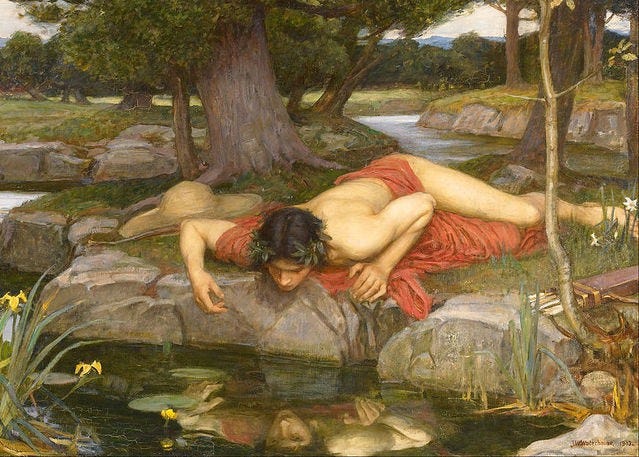
Narcissus’s conception was an act of power, not an act of love, and so what he later thought was falling in love was really falling in power, an act that always ends in self-destruction. Like Maui, Cephissus creates by taking by force from the divine feminine through what should have been an act of love. The resultant power unrestrained by any compassion self-destructs, as Narcissus did, as our civilization is. Ours is the age of Maui.
Moana as a myth speaks to our self-destructive civilization whose immense power compensates for, and is allowed by, our lack of love. We ourselves have taken the heart from our god, Gaia, and in exchange, our world very much looks like Te Ka rules over it: with power ascendant and love descendant. Worse, we are in an ecocide our leaders do not genuinely engage, just as Chief Tui refuses to confront his island’s blight.
Ecocide is the collective physical condition of seeing the world without love. Maui sees the god, the heart and himself precisely the way his parents saw him — without love. The love we receive or fail to receive becomes the deepest education of who we are and how to be. Hence he destroyed without limit and without love: these being the same.
When I think of face transplants, humans on the Moon, cars on Mars, satellites beyond the outermost planet, telescopic images of the early universe, mathematical models of the first flickering moments of the cosmos; cloning animals, extinguishing species, creating new species; melting ice caps, seeding clouds to make rain; manufacturing nuclear weapons capable of destroying all terrestrial life; and soon, creating virtual realities (synthetic Maya) indistinguishable from non-virtual reality and virtual consciousness in AI that shall pass the Turing Test — these are the abilities of the gods when first we imagined them: the ability to make life, reshape life, end life, model reality. Our civilization is creating and destroying without any sense of limit or love. This is the power of Maui: the power to do anything but love.
For what shall it profit a man, if he shall gain the whole world, but lose his soul? — Mark 8:36
To do all this for the sake of power, power as a means and an end in itself, the sake of creating or destroying anything and everything simply because we can, undoes the spirit of creation, of love, of oneness. The god creates out of love while we create out of power.
While engineering a rocket to fly to the Moon carries a deep love of science and an awe of humankind, the lack of kindness behind this seminal event belied its destructive roots. The Apollo Project was an outgrowth of the Manhattan Project, so that even as we went to new worlds, it was from developing the ability to destroy this one. Even the Moon landing was a kind of peacock feather in a highly masculinized Cold War. Perhaps, like Abel and Cain, the USA and USSR were offering their rivalrous bounties to their god, only, it was a war god. As Cleanthes said:
We choose our Fate by what gods we worship.
The masculine is seen in a highly distressing light in Moana: the aspect of humanity which has weakened the divine feminine to empower a loveless civilization. Moana’s father, Chief Tui, overcome by fear from his friend’s maritime death, prohibits his seafaring people from discovering new islands, even while his was dying. Symbolically, a male has stopped his tribe from engaging the ocean (the feminine), locking them onto one piece of dying land (the masculine). Re-engaging the feminine (becoming seafaring again) would allow for the settling of new islands (attaining new consciousness) and so resolve the plague (reconcile the human-divine alienation).
Tui locks away his people’s fleet in a cave (womb) — another male misuses the womb as the feminine is being used not for gestation but repression — just as Maui attempted to lock Moana away into a cave. In both cases, the dominant masculine principle maintains its stasis by locking away a feminine symbol in a non-gestating womb. When the womb is sterile, the masculine is cut off from the feminine, and has no idea what to do with itself other than: more of the same. It is when Moana enters Tui’s cave that her people’s path towards salvation begins: to the ocean, as Moana is pulled, as her name in fact means: ocean.
Concordantly, when Moana enters Maui’s cave, he begins his sea-journey to encounter Te Ka. Moana gives life to Maui and resolves his crisis by taking him on a sea journey. Moana in parallel gives life to her people and resolves their crisis by taking them on a sea journey. The former is the spirit quest, the latter the physical quest. In Joseph Campbell’s language, she has become master of both worlds.
We see the same parallel in Return of the Jedi when Luke’s confrontation with Vader (the spirit battle) parallels the destruction of the Death Star (physical battle). In The Lord of the Rings, the spirit battle is Frodo’s battle to keep or let go of the Ring while the physical battle is between the armies of Middle-earth and Sauron’s orcs. In The Matrix, the spirit battle is between Neo and Smith while the physical battle is between the Machines and humans in Zion. The physical battle is what we do in the 3D, such as ending a blight and finding a new island. The spirit battle takes place within. This is what Solzhenitsyn meant when he wrote:
[T]he line dividing good and evil cuts through the heart of every human being.
The masculine reigning over the womb marks the ascent of power (Te Ka) over love (Te Fiti). Both Tui and Maui stubbornly maintain the very causes of their problems. Tui’s thalassaphobia and Maui’s narcissism demonstrate their misunderstanding of what power is for. For a chief, power should be the means to guide one’s people, but Tui refuses to confront his fear, even at the cost of starving his people. For a demigod, power should be the means to bring the human and divine realms closer, but in his grandiosity, Maui instead wrests power from the god to humans, in the process taking everything that mattered from both.
We see a similar theme in another patriarch who abuses power out of fear. Uranus, the first chief of the Greek gods, abandons some of his children, as Maui’s parents did to him. He imprisons them inside a cave, as Tui does to his people’s fleet. One of his free children, Chronos, kills him and becomes the chief god. Chronos is warned by his dying father that he shall have a child that shall in turn kill him. Chronos swallows his children to ensure none will supplant him. As in Moana, the masculine usurps the womb, turning gestation from a form of creation into a form of repression. Chronos is ultimately killed by his son, Zeus. Like Maui, Zeus is a shape-shifter who misuses his ability to abuse the feminine. He transforms into a swan and rapes queen Leda. From this rape, Helen of Troy is conceived. Helen is herself kidnapped and raped, starting a decade of war in Troy.
This generational trauma of Uranus-Chronos-Zeus-Leda-Helen speaks to the parallel between toxic masculinity and the vices of the gods. The masculine is not brutal in and of itself but becomes so in cutting itself off from the feminine. Insofar as the masculine reduces the feminine to a thing to be taken, the masculine reduces itself to a thing that takes.
In this sense, Maui’s theft of Te Fiti’s heart can be seen as a rape, not of copulation, but of possession. (Foucault noted that rape is not an act of sex, but one of power.) The goddess, bereft of her heart, is now Te Ka: without love, without compassion, without oneness with her people or her world.
How do you turn a god into a demon? Take away her love. For what is a demon but a god without a heart?
Hence Te Fiti transforms into Te Ka. Who transforms her? Maui, the shape-shifter. His biggest trick was to shift not his own shape, but that of Te Fiti. The change from god to demon reflects the change in that which guides and aligns humanity: the change from love to power. Moana was released 6 days after the election of President Trump, a kind of low (or high) point for patriarchy in cultural and ecocidal terms.
We now see Moana’s journey as a matriarchal quest to return the equilbrium of the cosmic forces of love and power that the masculine disrupted. Her chieftan father resists her going to sea whereas her grandmother, with her Piscean personality and manta ray totem, gives Moana the heart and sets her on her quest. We don’t know where Tala gets Te Fiti’s heart, but it appears, like mitochondrial DNA, to be matrilineal. The feminine line tells the heroine to go on the quest while the masculine line resists it.
We also see the masculine-feminine polarity in their elemental contrast. Maui is the demigod of Wind and Water whereas Te Ka is the demon of Earth and Fire. Wind and water are the elements voyagers who settled and explored the Pacific islands navigate whereas earth and fire comprise the destructive volcanoes Ta Ka embodies. Under Chief Tui, the people of Motunui cease exploring, and so stop being a people of wind and water. Tui and Maui (note the similar spellings) both imprison themselves on dying islands by their lack of consciousness; both were freed by Moana’s awakening.
Hence Moana’s quest is to undo Maui’s. As Beatrice guided Dante through the afterlife, Moana similarly accompanies Maui through a realm where his vices have been embodied into demonic figures patterned after his wounds: the wounded child in Maui, the greedy sybarite in Tamatoa, the destructive demon in Te Ka. Each of these can be considered a progression into Maui’s heart, like the layers of an onion, revealing his defenses against love. These are in fact plausible stages of narcissistic development: abandonment, greed, rage.
The first demonic figure is Maui himself. (Maui need be included in this list because, like Tamatoa and Te Ka, he assaults Moana: when he throws her into the cave and seals her in with a boulder.)
We earlier discussed the worldview of the abandoned child: When he cannot experience love, he feels thrown away. When the cycle of abuse then turns to its love stage, his abusive parents are mythologized into the compensatory gods who have saved him — from the horrid version of themselves. This is the Jekyll and Hyde of parenting, seen through the eyes of a toddler.
The narcissized child grows up attempting to access the good parents, whose existence negates that of the bad parents. I please my parents not only to attain their love, but to stop them from being abusers. Hence the child understands that, if the parents are displeased, they do not give love, and instead give abuse. The abused child spends their childhood navigating between these gates of heaven and hell. Just as Moana mythologically turns Te Ka into Te Fiti, Maui spent his abusive child trying to turn his borderline mother into the kinder version she was only at times capable of becoming.
Maui is empowered by these ‘gods’ to do great things for humanity: lasso the sun, pull up the sky, harness the breeze, pull up islands from the sea, etc. Maui has godlike abilities but not the human one that matters: to love. Indeed, he speaks irreverently, showing these labors are about his pride and the bottomless pit into which admiration for him ought to be cast. Only one who felt worthless would insist on being seen with worth.
And whose praise does he seek? That of humans. Maui is our civilization, constantly trying to impress itself without ever feeling it is enough, as capable in the material realm as it is incapable in the metaphysical. But I have also said that Maui is a narcissist. This is consistent: our civilization is narcissistic.
This is the origin story of Maui: the puer aeternus, the man-child, Peter Pan: a child who seized power when he could not receive love. And what does he do with all this power? What anyone who can do anything but feel safe in love does: Sabotage love.
This is the insidious problem with narcissistic parenting: it remains parenting by modeling and so normalizing behavior for a child who will not call his upbringing abuse until it becomes his personality. This is what narcissized children find when they become adults in therapy: their parent’s toxicity has become ingrained in the unthinking behaviors and beliefs where the dysfunction of love becomes the function of defending oneself against love.
The abandoned child that Maui was continued to reside wtihin the demigod Maui became. Hence the need to leverage his miracles for praise. Hence the shamelessness. Hence his urinating on the person who rescued him from a millennium on a desert isle. Hence the narcissism on a cosmic scale by stealing the heart all life depended upon. If I cannot have love, no one can.
Maui’s obsession with his wound prevents his having any insight as to how he harms others, and how unrealistic his perception of self and other, past and present really are. As if someone who did everything for humans would not care about causing their blight. As if the gods would bother saving a drowning infant but not love him. As if the gods would give power but not love. As if the gods would empower a traumatized baby only to turn him into a monster. As if the gods would give precisely what an abandoned, narcissized child would want — power — rather than what he needed, love.
This is the first of the three archetypes Moana’s journey uncovers: the wounded child Maui never ceased being, the same wounded child who governed his beliefs and marred his perceptions, justified his thievery, and identified missing love as the debt the world had to pay.
Read Parts I Converting Gods and Devils, III Converting Trauma to Narcissism and IV Converting the Devil into God.
To follow me: https://medium.com/@myartman
To subscribe: https://medium.com/@myartman/membership