avatarCindy Heath

Free AI web copilot to create summaries, insights and extended knowledge, download it at here

4488

Abstract

d want your product to be on the first two pages of search results.</p><h1 id="f5c6">You want your article on the top pages of organic search results.</h1><p id="827f">First, a couple of more terms to know. The people who click on a link are <b>visitors</b><i>,</i> and the total number of visitors is referred to as <b>traffic</b><i>.</i></p><p id="e8ef">Only a few people scroll beyond two pages of search results reported by <a href="https://backlinko.com/google-ctr-stats">Backlinko.com</a>, which is where you want your article.</p><p id="3f40"><b>How does Google decide which content to show the reader?</b></p><ul><li>Search engines promote <b>relevant</b> content to meet searchers’ intent. Write articles that are clear and informative.</li><li>The information must be <b>authoritative</b>. Verify that the site is reputable and offers good information when you provide backlinks.</li></ul><p id="a14e">Understanding what your audience is interested in or wants to know is the next step, and that’s where<b> keywords </b>come into action.</p><h2 id="c929">Keywords are the words or phrases people use to find information.</h2><p id="b0b5">The keywords you include in your article help people determine if your content is relevant to them. These words may be used in the title, subtitles, alt+text, video description, and content.</p><p id="d907">Each page on your website should focus on one keyword or <b>long-tail keywords,</b> three to five-word phrases.</p><p id="36a6">For best results, do the same thing with each article.</p><p id="05a1">Keywords are about your <b>audience</b>—the words they use and the content they’re looking for. To find these terms and phrases, you need to do some research.</p><h2 id="1b71">The beginner’s guide to keyword research for writers</h2><p id="b2bc">First, know your audience.</p><ul><li>Who are they?</li><li>What do they want to know?</li><li>Why are they searching for information?</li></ul><p id="6890">Imagine a writer who is an expert gardener. This person can write informative articles on a wide variety of topics within the large subject of gardening.</p><p id="d266"><b>Narrow down your topics.</b></p><p id="0521">Let’s assume this person’s specialty is vegetable gardening, and they want to focus on beginning gardeners. These people need to know the basics—from soil to seeds.</p><p id="4e2c">Now the writer has the who, what, and why.</p><ul><li>Novice vegetable gardeners</li><li>These gardeners need to know basic gardening information.</li><li>These folks want to grow vegetables.</li></ul><h2 id="a5a2">Begin keyword research by researching likely search phrases.</h2><p id="c109">You don’t need to start with just one word. You will have better results with <b>long-tail keywords.</b></p><p id="88d9">I suggest using an app: <a href="https://keywordseverywhere.com/">Keywords Everywhere.</a> This tool has a free browser add-on, though you have more functionality with the paid version.</p><figure id="8d96"><img src="https://cdn-images-1.readmedium.com/v2/resize:fit:800/1*sr8Nn82CQgCvUYdmkaaCwQ.jpeg"><figcaption>Screenshots and images by the author on canva.com</figcaption></figure><p id="907f">Since I have the add-on installed, each time I search, I get valuable data.</p><ol><li>Search for ‘vegetable gardening for beginners’.</li><li>Our writer needs to be more specific. KE provides a list of long-tail keywords. The image shows part of a lengthy list. The writer knows they can produce an interesting article about <i>raised bed vegetable gardening for beginners.</i></li><li>Good news. That phrase rates a lower SEO difficulty of 57.</li></ol><h2 id="eb7e">Next, search for ‘raised bed vegetable gardening for beginners’.</h2><p id="5898">About halfway down the page, look for the section titled <b><i>People also ask.</i></b></p><p id="d2ee">Here you will find other frequently asked questions. Answer these in your article because <b>Google loves it</b> when you <b>provide valuable information to searchers.</b></p><p id="0c8c"><b>Questions about raised bed gardening include:</b></p><ul><li>What can I plant in a raised garden bed for beginners?</li><li>What vegetables are best grown in a raised bed?</li><li>How do you start a raised vegetable garden?</li><li>What vegetables should not be grown in a raised bed?</li></ul><p id="407e"><b>Keywords Everywhere also gave me more words to consider.</b></p><ul><li>easy vegetables to grow in raised beds</li><li>how to fill a raised garden bed cheap</li><li

Options

inexpensive raised garden bed ideas</li><li>4x8 raised bed vegetable garden layout</li><li>raised bed garden soil</li><li>raised garden bed plans</li></ul><p id="99d1">This process is vital to <b>establish keywords</b>, but even more essential to find out <b>what readers want to know.</b></p><h2 id="ca42">What can a writer do with keywords to gain more readers?</h2><p id="0b4d">When a writer uses the right keywords effectively and provides valuable information in a well-formatted article, Google is more likely to show their article to searchers.</p><ol><li>Choose one keyword phrase for each article.</li><li>Include this phrase in the title and at least two subheadings.</li><li>Include this phrase in the opening paragraph which will be your meta description unless you manually change it.</li><li>Pick four or five questions you will answer in this article.</li><li>Choose four or five additional keywords to include in subheadings or content.</li><li>Use the keyword in your image and your alt+image description.</li></ol><h2 id="25ee">This keyword research helps you create your article outline.</h2><p id="f9ca"><b>Keyword phrase: </b>Raised Bed Vegetable Garden</p><p id="b26c"><b>Additional key phrases</b>: What plant, which vegetables, easy to grow, cheaply, plans, soil.</p><p id="92f6"><b>Questions to answer:</b> What can I plant? Which vegetables? How to get soil cheaply? Raised bed plans?</p><p id="5791"><b>Working title:</b> 6 <i>Secrets to Raised Bed Vegetable Garden Success</i></p><p id="7305">Before publishing, use the tips here: <a href="https://readmedium.com/3-ways-ai-partners-help-you-write-more-powerful-and-effective-headlines-8dd53d6a8912?sk=d067ddc1be983bd93bd231ca027bd256">3 Ways AI Partners Help You Write More Powerful and Effective Headlines</a>.</p><h2 id="4f1f">How to use your keyword phrase in your article</h2><p id="e36b"><b>Opening paragraph:</b> Have you always wanted a raised bed garden but don’t know where to start? An expert organic grower makes vegetable gardening easy with six tips and tricks for success.</p><p id="60b8"><b>Six subheadings:</b></p><ul><li>Plan Before Planting Your Raised Bed Vegetable Garden Beds</li><li>You Can Build Your Raised Beds Out of Cheap Materials</li><li>Where to Put Your Raised Bed Vegetable Garden</li><li>Choosing the Right Soil Without Spending a Ton</li><li>A List of Easy-to-Grow Vegetables For Beginners</li><li>Water Your Vegetables For Great Results in Your Raised Bed</li></ul><p id="b4a1"><b>Conclusion:</b></p><p id="3a20">Now you know the six tips for success with your first raised bed garden, which vegetables are you eager to plant? I’m dreaming of sweet carrots, spicy arugula, and tender eggplants.</p><p id="80ee">Share your tips for success with beginning vegetable gardeners—it’s half the fun.</p><h2 id="b6d3">Do you see how using keywords can make writing easier?</h2><p id="728a">Don’t believe people who say there is a magic number of times to use keywords; there isn’t. So don’t try to ‘stuff’ them into your writing. By researching before you begin writing, you will use them naturally.</p><p id="1ad7">Try these essential tools and techniques to determine <b>what people want to know</b>. Then use keywords to help people find your helpful, information-packed article.</p><p id="f2fb">Don’t worry; the more you practice—the easier keyword research and search engine optimization become.</p><p id="c5a9">Questions? Suggestions? Please comment, and I promise to respond.</p><div id="a050" class="link-block"> <a href="https://readmedium.com/how-to-easily-write-better-articles-df809b421a19"> <div> <div> <h2>How to Easily Write Better Articles</h2> <div><h3>Follow this simple four-part outline to produce compelling blog posts.</h3></div> <div><p>medium.com</p></div> </div> <div> <div style="background-image: url(https://miro.readmedium.com/v2/resize:fit:320/1*oPNC5fYbO3go2JYsIC10JQ.jpeg)"></div> </div> </div> </a> </div><p id="ae5a">Cindy has decades of experience as a teacher, entrepreneur, and writer. She loves marketing and can help you target your readers with her <a href="https://www.cindyheathwrites.com/personas">Reader Avatar</a> creation services, <a href="https://www.cindyheathwrites.com/writing-services">custom content creation</a>, and personal coaching.</p></article></body>

Basic Keyword Tools and Techniques You Can Use to Write Better Every Day

You’ll write faster, improve your SEO, and gain more readers.

Image by the author on canva.com

Finding the keywords for your article will be easy with a few essential tips. Knowing what people are looking for will help you answer readers’ questions and structure your writing.

Writing is tough. You’ve spent hours doing research and writing. The informative article has been polished and proofread, and the perfect photograph has been chosen. Finally, you hit publish and release your article to the world.

But if readers don’t find your writing, all that hard work goes to waste.

There are two main parts: technical SEO and on-the-page SEO.

Technical search engine optimization relates to the website that hosts your content, such as your blog, Medium, a website, or another site.

You should be all set when you post content on a site built on Squarespace, Wordpress, Wix, or another professionally designed site. It is important to follow their formatting suggestions, though.

Read this overview if you’re not familiar with the subject, 4 technical SEO tasks that are critical to organic success.

If you own a website, read the Search Engine Optimization (SEO) Starter Guide published by Google.

Again, this part of SEO is more technical and the responsibility of the developers designing the website.

Image by the author on canva.com

To me, it’s like understanding the basics of how your car works; you probably don’t repair your vehicle, but you should know why engine oil is critical to its operation.

Most people don’t know how to fix their car—or their website, and that’s OK.

Search engines look for helpful content.

On-page search engine optimization includes techniques that make it easier for people to find valuable information in your articles. For example, sites such as Bing or Google use bots to analyze data and index what they find.

Google describes the purpose of SEO as providing helpful content.

“The helpful content system aims to better reward content where visitors feel they’ve had a satisfying experience, while content that doesn’t meet a visitor’s expectations won’t perform as well.” — Google Search’s helpful content system and your website

What is the purpose of Search Engine Optimization (SEO)?

SEO is used for many purposes. For instance, it can drive business to an e-commerce site, a local business, or an informational article by pushing content to the top of search results.
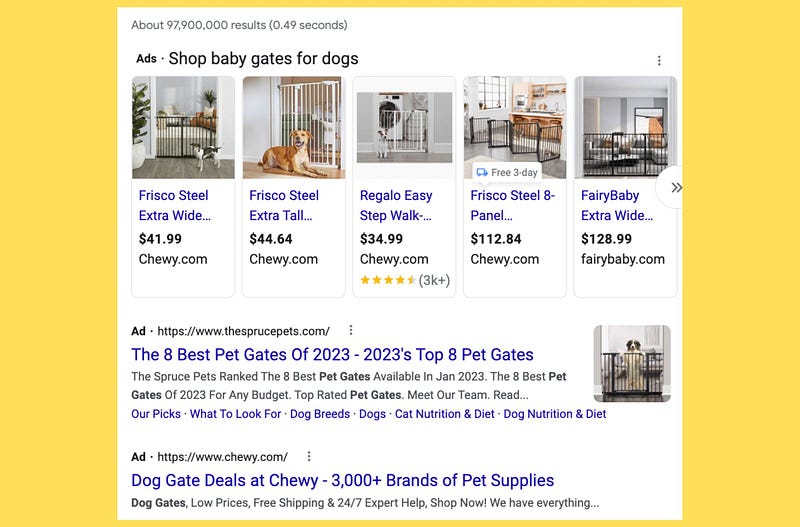
Google screenshot by the author on canva.com

Here is a screenshot of the results, known as the search engine results page (SERP) for a search for baby gates for dogs.

At the top, you see images of baby gates and descriptive snippets marked as Ads.

Companies pay money for this paid traffic and carefully choose keywords to show us products.

Next, you see the organic search results.
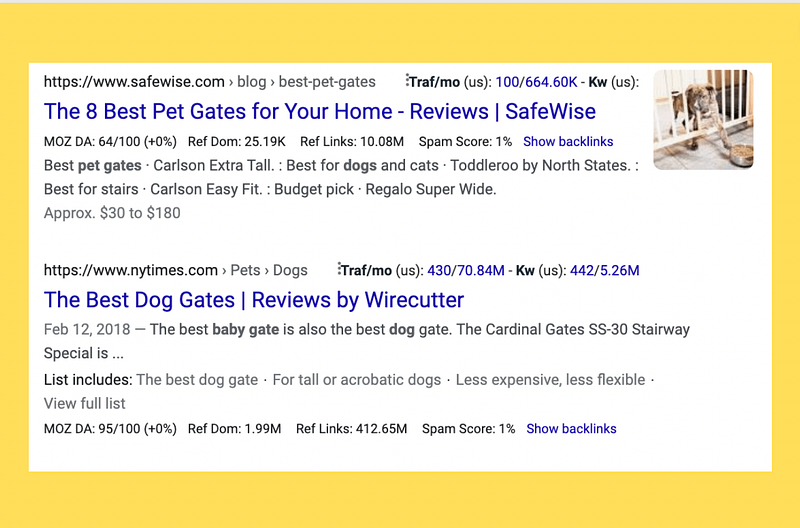
Google screenshot by the author on canva.com

If you sell dog gates, you’d want your product to be on the first two pages of search results.

You want your article on the top pages of organic search results.

First, a couple of more terms to know. The people who click on a link are visitors, and the total number of visitors is referred to as traffic.

Only a few people scroll beyond two pages of search results reported by Backlinko.com, which is where you want your article.

How does Google decide which content to show the reader?

  • Search engines promote relevant content to meet searchers’ intent. Write articles that are clear and informative.
  • The information must be authoritative. Verify that the site is reputable and offers good information when you provide backlinks.

Understanding what your audience is interested in or wants to know is the next step, and that’s where keywords come into action.

Keywords are the words or phrases people use to find information.

The keywords you include in your article help people determine if your content is relevant to them. These words may be used in the title, subtitles, alt+text, video description, and content.

Each page on your website should focus on one keyword or long-tail keywords, three to five-word phrases.

For best results, do the same thing with each article.

Keywords are about your audience—the words they use and the content they’re looking for. To find these terms and phrases, you need to do some research.

The beginner’s guide to keyword research for writers

First, know your audience.

  • Who are they?
  • What do they want to know?
  • Why are they searching for information?

Imagine a writer who is an expert gardener. This person can write informative articles on a wide variety of topics within the large subject of gardening.

Narrow down your topics.

Let’s assume this person’s specialty is vegetable gardening, and they want to focus on beginning gardeners. These people need to know the basics—from soil to seeds.

Now the writer has the who, what, and why.

  • Novice vegetable gardeners
  • These gardeners need to know basic gardening information.
  • These folks want to grow vegetables.

Begin keyword research by researching likely search phrases.

You don’t need to start with just one word. You will have better results with long-tail keywords.

I suggest using an app: Keywords Everywhere. This tool has a free browser add-on, though you have more functionality with the paid version.
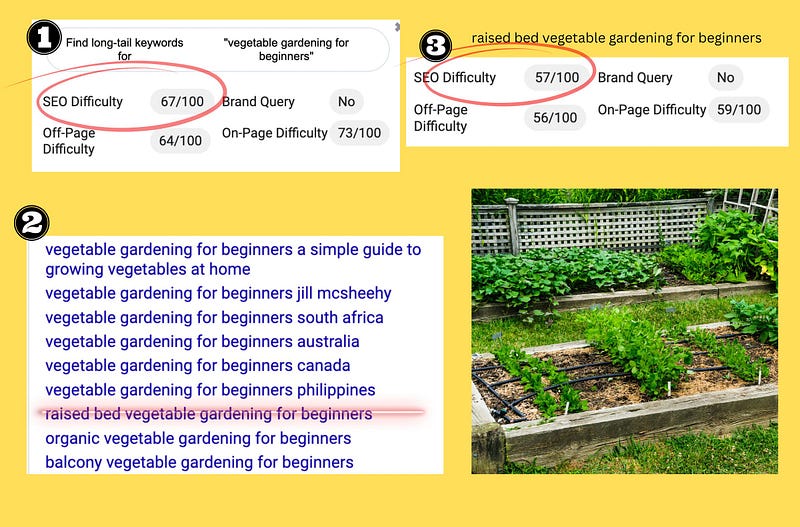
Screenshots and images by the author on canva.com

Since I have the add-on installed, each time I search, I get valuable data.

  1. Search for ‘vegetable gardening for beginners’.
  2. Our writer needs to be more specific. KE provides a list of long-tail keywords. The image shows part of a lengthy list. The writer knows they can produce an interesting article about raised bed vegetable gardening for beginners.
  3. Good news. That phrase rates a lower SEO difficulty of 57.

Next, search for ‘raised bed vegetable gardening for beginners’.

About halfway down the page, look for the section titled People also ask.

Here you will find other frequently asked questions. Answer these in your article because Google loves it when you provide valuable information to searchers.

Questions about raised bed gardening include:

  • What can I plant in a raised garden bed for beginners?
  • What vegetables are best grown in a raised bed?
  • How do you start a raised vegetable garden?
  • What vegetables should not be grown in a raised bed?

Keywords Everywhere also gave me more words to consider.

  • easy vegetables to grow in raised beds
  • how to fill a raised garden bed cheap
  • inexpensive raised garden bed ideas
  • 4x8 raised bed vegetable garden layout
  • raised bed garden soil
  • raised garden bed plans

This process is vital to establish keywords, but even more essential to find out what readers want to know.

What can a writer do with keywords to gain more readers?

When a writer uses the right keywords effectively and provides valuable information in a well-formatted article, Google is more likely to show their article to searchers.

  1. Choose one keyword phrase for each article.
  2. Include this phrase in the title and at least two subheadings.
  3. Include this phrase in the opening paragraph which will be your meta description unless you manually change it.
  4. Pick four or five questions you will answer in this article.
  5. Choose four or five additional keywords to include in subheadings or content.
  6. Use the keyword in your image and your alt+image description.

This keyword research helps you create your article outline.

Keyword phrase: Raised Bed Vegetable Garden

Additional key phrases: What plant, which vegetables, easy to grow, cheaply, plans, soil.

Questions to answer: What can I plant? Which vegetables? How to get soil cheaply? Raised bed plans?

Working title: 6 Secrets to Raised Bed Vegetable Garden Success

Before publishing, use the tips here: 3 Ways AI Partners Help You Write More Powerful and Effective Headlines.

How to use your keyword phrase in your article

Opening paragraph: Have you always wanted a raised bed garden but don’t know where to start? An expert organic grower makes vegetable gardening easy with six tips and tricks for success.

Six subheadings:

  • Plan Before Planting Your Raised Bed Vegetable Garden Beds
  • You Can Build Your Raised Beds Out of Cheap Materials
  • Where to Put Your Raised Bed Vegetable Garden
  • Choosing the Right Soil Without Spending a Ton
  • A List of Easy-to-Grow Vegetables For Beginners
  • Water Your Vegetables For Great Results in Your Raised Bed

Conclusion:

Now you know the six tips for success with your first raised bed garden, which vegetables are you eager to plant? I’m dreaming of sweet carrots, spicy arugula, and tender eggplants.

Share your tips for success with beginning vegetable gardeners—it’s half the fun.

Do you see how using keywords can make writing easier?

Don’t believe people who say there is a magic number of times to use keywords; there isn’t. So don’t try to ‘stuff’ them into your writing. By researching before you begin writing, you will use them naturally.

Try these essential tools and techniques to determine what people want to know. Then use keywords to help people find your helpful, information-packed article.

Don’t worry; the more you practice—the easier keyword research and search engine optimization become.

Questions? Suggestions? Please comment, and I promise to respond.

Cindy has decades of experience as a teacher, entrepreneur, and writer. She loves marketing and can help you target your readers with her Reader Avatar creation services, custom content creation, and personal coaching.

Writing
Writing Tips
SEO
Marketing
Writing Life
Recommended from ReadMedium