
How to Easily Write Better Articles
Follow this simple four-part outline to produce compelling blog posts.

Approximately 7.5 million blog posts are created every day.
Like many writers, you’ve probably had these common questions.
- How can you get noticed?
- What will make your writing stand out?
- How can you better articles in less time?
- Don’t panic! I’ve discovered a simple formula that will make your writing more successful.
Write an article readers want to read.
I’ve made an outline that hangs on the wall above my desk. K.I.S.S.
Yup, you know what that means! Keep It Simple, Stupid. Note to self.
My K.I.S.S. outline reminds me that I only need four essential parts to a successful article.
Here are the four parts of a winning article.
I. Title
The ideal title for a blog post or article is 50–70 characters. It should clearly explain what the reader will gain from reading the article.
Do not:
- Try to be vague, clever, or wordy.
- Include a keyword in the title if you want Google to find your article.
- Here’s a lousy title from one of my articles: The Important Thing is to Never Stop Learning. It’s so vague and blah I don’t even want to read it.
It does not tell the reader that it’s a tribute to my father, who instilled such a love of reading in his six children that four of us became bookstore owners.
Four Siblings Own Four Bookstores — A Tribute to Their Book Loving Dad.
Much better. It has 69 characters and tells the reader precisely the article's subject while inspiring curiosity.
Can you phrase your title, so it answers a question?
Can you use a number to show the reader there will be specific steps to show them how to succeed?
Remember: a reader wants to know, “What’s in it for me?”
My title promises value in exchange for the reader’s time.
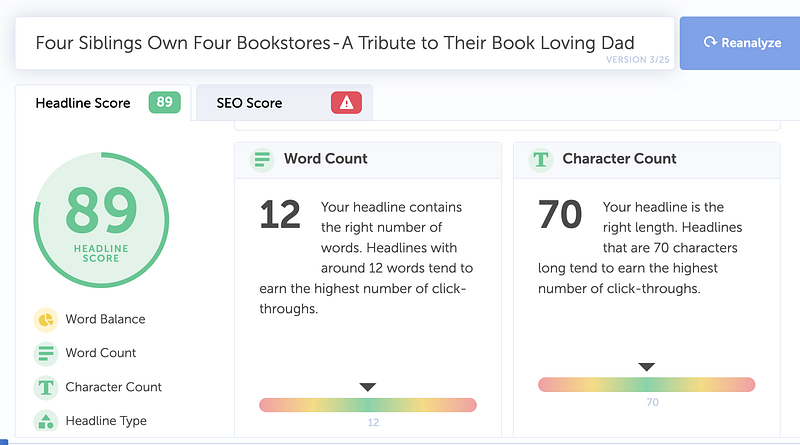
When I use Coschedule Headline Analyzer’s free option to tweak my titles to a score of 75 or higher, my articles receive more reads.
II. Introduction
Tell the reader these three things;
- why this subject is important,
- who it applies to, and
- what the article will cover.
This section may include a shocking statistic, an interesting anecdote, or a fascinating quote.
It should contain 10% to 15% of the expected word count of your article. If you plan a 1,000-word article, allocate 100–150 words for this section.
III. The body of your article
This section contains about 75% of your word count. Here is where you will include topics such as:
- terms the reader should know,
- how-to tips the reader can use,
- examples to illustrate your points,
- helpful tips and reminders to make the reader’s life easier, and
- resources to benefit your reader.
Before I start writing my first draft, I take a few minutes to note the points I plan to cover in this section.
- If I need references to document specific facts, I add research to that item.
- What are the specific items I want to point out to the reader?
- Is there a natural order to the tips I want to share?
- What do I need to write to fulfill the promise I made in my title?
IV. Conclusion
Many writers struggle with the closing paragraphs of their articles. Here you have 10% of your word count to bring your topic to a neat ending.
Call this section whatever works for you: wrap it up, in conclusion, or now what?
Here is your chance to connect with your reader one last time. Make it personal and share your experience one more time.
For instance:
I’ve been writing website content, freelance articles, and blog posts since 2016.
After hundreds of articles and thousands of hours of experience, when I stick to this plan, I save time, clients are satisfied, readers respond, and I make more money.
Then end your article with a summary of what you’ve written.
To save time, produce clear and understandable articles your readers will love, and make more money—you need a reproducible plan.
Remember the four parts to a successful article.
Nail a descriptive and enticing title.
Open with a hook and tell readers how you will help them.
Give the reader clear, well-written benefits.
End with a short summary.
And for the last part of your conclusion, include your call-to-action or CTA.
- What do you want the reader to do?
- What are the next steps the reader can take?
- Can you end with a question to motivate your reader to respond?
Opening a dialogue with the person reading your work develops faithful readers.
If you are writing for commercial clients, they want to move the reader to take action.
Drawing an article to a satisfying conclusion is the hardest part of the process for me.
What have you found the most challenging part of writing valuable articles? Please share your questions or tips. Becoming better writers is a lifelong process, and I’d love your input.
Cindy has been a farmer, teacher, bookstore owner, and writer. She writes on various topics, coaches writers, and offers editing services. Get in touch if she can help you.


