
Barinasuchus: The Largest Terrestrial Predator of the Cenozoic
Meet the biggest terrestrial carnivore since the age of the dinosaurs…
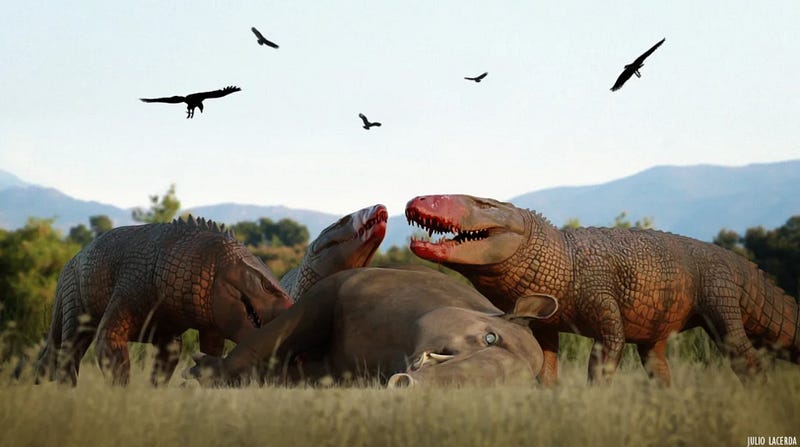
In the annals of prehistory, tales of colossal predators evoke images of towering carnivores ruling ancient landscapes. From the iconic Tyrannosaurus rex to the awe-inspiring Megalodon, these creatures have captured the imagination of scientists and enthusiasts alike. However, tucked away in the shadows of these giants lies a lesser-known but equally formidable predator: Barinasuchus arveloi. With a ferocity rivaling that of its Mesozoic counterparts, Barinasuchus emerges as a true titan of the Cenozoic era, reclaiming the title of the largest terrestrial predator since the age of the dinosaurs.
“Barinas crocodile”
Barinasuchus was a massive crocodyliform that roamed the ancient floodplains of South America between 40–10 million years ago. Its name means “Barinas crocodile”, in reference to the Barinas Formation of western Venezuela where the type material was found. Fossils of Barinasuchus have also been discovered in the Divisadero Largo Formation of Argentina and the Ipururo Formation of Peru.
Barinasuchus belongs to the family of sebecosuchians, a group of crocodyliforms characterized by their terrestrial adaptations and predatory lifestyles. Like other sebecosuchians, Barinasuchus possessed a long, slender snout lined with rows of sharp, conical teeth, ideal for grasping and tearing flesh. Its skull was reinforced with thick, bony plates, providing protection against the struggles of its prey and rival predators.
A muscular tail and powerful limbs supported its elongated, streamlined body. Barinasuchus limbs were positioned directly beneath its body, enabling it to move swiftly and gracefully. These characteristics made Barinasuchus uniquely adapted for a terrestrial lifestyle.

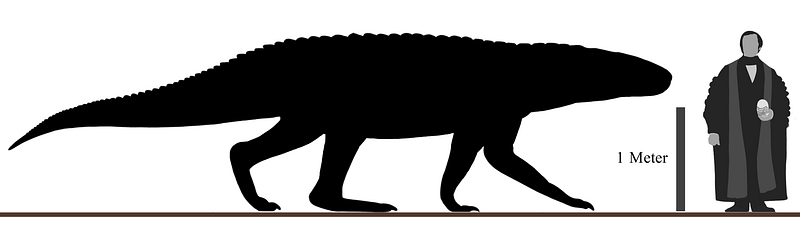
Barinasuchus was a true behemoth, dwarfing modern crocodilians and mammal predators in both size and stature. Estimates based on fossil remains suggest that it reached lengths of up to 6 meters (20 feet) and weighed more than 1,600 kilograms (3,500 pounds). This is heavier than any terrestrial mammalian predator of the Cenozoic era.
Prey and Competition
As the largest terrestrial predator of its time, Barinasuchus occupied the coveted position of apex predator in its ecosystem, preying on a variety of herbivorous mammals and reptiles. Its immense size and formidable jaws made it a fearsome opponent, capable of taking down even the largest and most heavily armored prey. Barinasuchus likely stalked the savannahs and forests of South America preying on the large Notoungulates, a diverse group of native mammals with forms resembling animals as disparate as rabbits and rhinoceroses. It may have also hunted rodents, giant ground sloths, and large birds which were abundant on the continent.
Despite its terrestrial adaptations, Barinasuchus was not averse to aquatic environments, where it would have used its powerful tail to propel itself through the water in pursuit of prey. This dual lifestyle allowed it to exploit a wide range of habitats and resources, making it a highly successful and adaptable predator in its prehistoric world.

While Barinasuchus may have reigned supreme as the largest predator of its time, it shared its habitat with a diverse array of carnivorous species. Rival predators such as saber-toothed cats would have posed significant threats to Barinasuchus, competing for territory and resources in the ancient Venezuelan wilderness. However, its size and strength likely gave it a competitive edge, allowing it to dominate its rivals and assert its dominance in the food chain.
Extinction
Despite its imposing stature and formidable hunting prowess, Barinasuchus eventually met its demise around 10 million years ago, succumbing to the forces of extinction that swept across the planet during the late Miocene. The exact cause of its extinction remains uncertain, but factors such as climate change, habitat loss, and competition from other predators may have contributed to its downfall. Whatever the cause, the legacy of Barinasuchus lives on as a testament to the incredible diversity and resilience of life on Earth.
Epilogue
In the shadowy realm of prehistory, Barinasuchus stands as a silent sentinel of a bygone era, a relic of a time when giants roamed the earth and ruled the land. With its massive size, formidable strength, and predatory prowess, Barinasuchus emerges as a true titan of the Cenozoic era, reclaiming the title of the largest terrestrial predator since the age of the dinosaurs. While its reign may have been fleeting, its legacy endures as a testament to the enduring power and majesty of nature’s most fearsome creations.
Relevant Reads:
Sources
Paolill A, Linares OJ (2007). “Nuevos cocodrilos Sebecosuchia del Cenozoico Suramericano (Mesosuchia: Crocodylia)” (PDF). Paleobiologia Neotropical (in Spanish). 3: 1–25. Archived from the original (PDF) on 2009–03–03. Retrieved 2009–02–15.
Kellner AW, Pinheiro AE, Campos DA (2014–01–15). “A new sebecid from the paleogene of Brazil and the crocodyliform radiation after the K-Pg boundary”. PLOS ONE. 9 (1): e81386. Bibcode:2014PLoSO…981386K. doi:10.1371/journal.pone.0081386. PMC 3893294. PMID 24454686.
Pol D, Nascimento PM, Carvalho AB, Riccomini C, Pires-Domingues RA, Zaher H (2014–04–02). “A new notosuchian from the Late Cretaceous of Brazil and the phylogeny of advanced notosuchians”. PLOS ONE. 9 (4): e93105. Bibcode:2014PLoSO…993105P. doi:10.1371/journal.pone.0093105. PMC 3973723. PMID 24695105.


