
Backspin: Warren G — Regulate… G Funk Era (1994)
A kinder, gentler gangsta. (81/100)
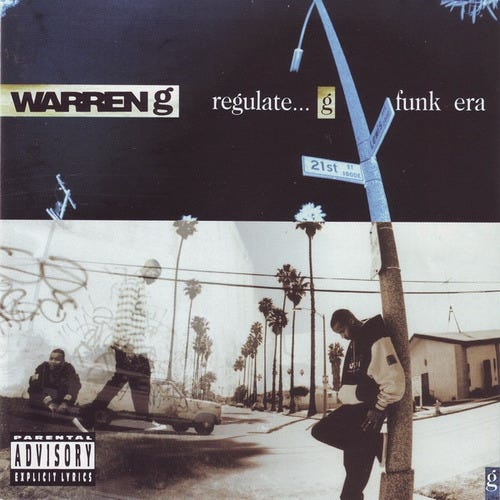
“I’m tweaking into a whole new era,” an autumn-evening-cool Warren G announces to begin the final verse of his now-iconic single “Regulate.”
“Funk on a whole new level,” he expounds, followed by Nate Dogg’s dulcet accompaniment:
Where the rhythm is the bass and the bass is the treble.
Warren returns to the mic to round out an explanation as clear as his easy elocution:
Chords. Strings. We bring melody. G-Funk: where rhythm is life, and life is rhythm.
Indeed, if the long bubbling elements of Southern California’s intoxicating brand of gangster funk coalesced on his big cousin Dr. Dre’s The Chronic, and exploded into a full-fledged phenomenon on his high school friend and 213 co-founder Snoop Doggy Dogg’s Doggystyle, it was Warren G’s 1994 debut on which the G-Funk brand truly took shape.
The Chronic leveraged deep P-Funk-inspired grooves to draw a distinction between the new generation of West Coast MCs featured alongside the N.W.A maestro and their their predecessors. Doggystyle further refined the slinky bass and synth driven soundscapes to build out the larger-than-life persona of a generational mic presence. On Regulate… G Funk Era, the sound itself is the star, and it shines like a midnight moon through the Southern Cali smog.
Already a radio and video staple from its appearance on the Deathrow-released Above the Rim soundtrack by the time Regulate… G Funk Era hit shelves, “Regulate” proves a perfect tone-setter to open the album. Markedly sparer and more intimate than Dre’s sonic tsunamis, “Regulate” eschews the over-the-top hedonism and melodrama characteristic of early G-Funk (and early ‘90s gangsta rap in general) for a conversational night-in-the-life ease.
Even as the threat of violence lingers beneath the moody keys and bassline cribbed from Michael McDonald’s “I Keep Forgettin’ (Every Time You’re Near),” it never overpowers the lived-in tranquility that makes the record such a sneakily absorbing listen. The vibe is so smooth that it’s easy to overlook how quickly the story, unspooled in a subtly intricate dual narrative from Warren and his smooth-crooning 213 partner Nate, escalates from a simple night of cruising to an all-out bloodbath.
And that’s just in the first verse.
Nate having dispensed with Warren’s would be jackers, the tension dissolves as quickly as it mounted, with the 213 twosome resuming their strange-chasing. The violence isn’t an event, it’s simply a hazard of a distinctly ’90s Southern California way-of-life embodied throughout the album. The guns, the girls, the blunts, and the brews synonymous with gangsta rap are ever present, but never dominant. They’re simply part of the fabric of what, at heart, feels like a lifestyle album.
“Do You See” strikes a decidedly sunnier tone. The piercing synth line from Junior’s “Mama Used Say” provides a breezy air of wistfulness, while the breakbeat from Mtume’s “Juicy Fruit” serves up the trunk-ready knock. Warren fleshes out the world in which his musical milieu was steeped with a disarmingly earnest coming-of-age tale. His story spans a childhood negotiating the treacherous terrain of Long Beach through the moment of truth marked by Snoop’s early ’90s arrest.
You make me wanna holla, get out the game Too many motherf*****s know my name While Snoop Dogg’s serving time up in Wayside I puts it down on the street, don’t try to take mine I had to reassure the homie that he wasn’t alone We’d talk, and him and Nate’d conversate on the phone He kept saying, “N****, it won’t be long Before a little skinny n**** like me’ll be home” I said “Snoop, things done changed, it’s not the same We need to get up out the game ’Cause we can get paid in a different way With you kickin’ dope rhymes and I DJ” Well as time goes past, slowly we try to make it But things are getting hectic, I just can’t take it Should I, A: Go back to slangin’ dope Or should I, B: Maintain and try to cope Or should I, C: Just get crazy and wild But no, I chose D: Create the G-Child
The track embodies what made Warren G different from his G-Funk peers, who sold themselves as larger than life alpha gangstas. Warren comes across as a regular guy navigating a gangsta world, while also enjoying the universal spoils of youth: parties, girls, and the unshakable bonds with the peers with whom he strived to chart a path forward.
The crew features prominently throughout the remaining 10 tracks. It proves a double-edged sword. Fellow Long Beach duo Twinz provide a shot of dynamism to the easing riding “Recognize,” but fail to substantially differentiate themselves from Warren, let alone each other.
Jah Skillz exudes youthful enthusiasm over Warren’s synth and sample smorgasbord on “Super Soul Sis.” The solo showcase goes down easy, but could have been a standout with a verse from Warren. For all her energy and charisma, Skillz lacks the modulation and control of craft to provide the track the necessary momentum for a true knockout blow.
Long Beach’s The Dove Shack emerge as Warren’s star proteges. The trio pair charismatic flows with a melodically crooned chorus on “This is the Shack,” offering a sneak preview of the style that would make their debut single “Summer Time in the LBC” a mainstay of the following year. The cascading drums and jaunty guitar chords provide a subtle but invigorating departure from the album’s sonic template, injecting it the a welcomed infusion of energy as it rounds into the final lap.
For all the diversity and energy of the guests, the moments when the album springs most fully to life, save the title track, are Warren G’s solo outings.
While the discrepancy speaks in part to the shortcomings of Warren’s crew, none of whom went on to the sustained success of Dre’s Chronic cohort, it’s also a testament to Warren’s understated proficiency on the mic. While not a particularly dexterous spitter or intricate wordsmith, he wields the reins of his tracks with an easy charisma and warm accessibility that blends seamlessly with his meticulously calibrated production.
Take the second single, “This D.J.,” a hypnotic display of the sonic minimalism that would become a hallmark of G-Funk as it emerged as hip-hop’s definitive sound in the mid-90s. Atop the subtly propulsive rhythm and keys from Midnight Star’s “Curious,” Warren delivers a breezy mission statement, asserting his musical prowess without breaking a sweat.
His vocals slide easily in and out of the musical pockets, serving as both rhythmic and melodic accompaniment. His understatedly potent lyrics seep into the subconscious rather than grabbing you by the neck. I hadn’t listened to “This D.J.” in years, yet found myself rapping along to bars I didn’t realize I had ever memorized.
Warren manages to project infectious swagger through melodic inflections and sharp enunciation on the Latin-tinged “And Ya Don’t Stop.” The track grounds its easy SoCal melodies in the rugged rhythm of The Honey Drippers’ break beat staple, “Impeach the President”.
The preponderance of New York style break beats featuring prominently in the production feel like a calculated play to assure Regulate… G Funk Era’s bi-coastal appeal. The national radio ubiquity of the singles speak to its effectiveness. Released through New York based Violator Records and Def Jam, the album sent a clear signal that G-Funk had expanded well beyond its Southern California breeding ground.
While Regulate… G Funk Era is not the paradigm shifter that The Chronic and Doggystyle were, it is largely responsible for synthesizing the paradigm into a replicable package. By stripping the grooves of their density, Warren G placed the focused squarely on the signature elements — elongated synth notes, bubbling basslines, and warmly crisp percussion.
In Warren’s hands, G-Funk rounded into the hip-hop equivalent of yacht rock: vibe music that instantly evokes a place and a lifestyle with its sonic textures. The hooks are sticky, the melodies infectious, the lyrics, while often well crafted, are ultimately secondary to the feel.
It’s the first iteration of hip-hop in which the MC is secondary; more an instrument in the mix than the star of the story. As such, G-Funk emerged as the perfect accompaniment for leisurely drives, backyard barbecues, and Hennessy-drenched house parties.
Like yacht rock a decade prior, it also burned out quickly. Its formula became too easily replicable, its sonic hallmarks synonymous with a particular moment in time. Similarly, both sub-genres’ era-specific associations and breezily melodic textures lend themselves to nostalgia with the passage of time, allowing their classics to remain vibrant decades past their heyday.
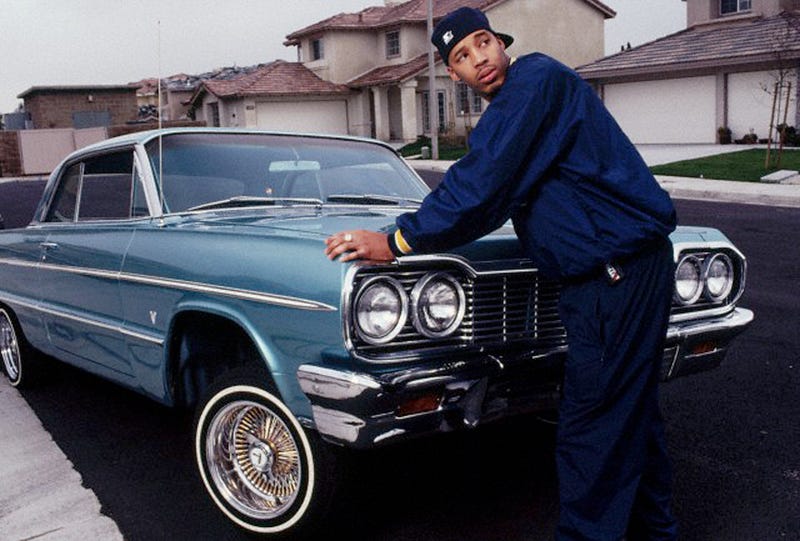
Put on Regulate… G Funk Era and you’re instantly transported to 1994, where you’re rolling through the Southern Cali streets, top down on the lowrider, a 40 in your lap and a blunt in your Dickies pocket. You’ve probably got a pistol in the glove box just in case, as the brutal nihilsm of early gangsta rap still lingers over the lifestyle of a G. But unlike its predecessor, G-Funk wasn’t mired in death. It was embracing a life, a moment, and a culture.
Warren G brought the G-Funk era into focus so all could see.
By the Numbers
Production: 9 Lyrics (how the words are put together): 7 Delivery & Flow: 7.5 Content (Substance): 7 Cohesiveness: 9 Consistency: 8 Originality: 8.5 Listenability: 9 Impact/Influence: 9 Longevity: 7
Total — 81
Previous
SEE ALL
Backspin is a look back at the albums that shaped and defined hip-hop. It explores what made them resonate, the impact they had on the culture, and where they fit in today’s ever-expanding hip-hop canon.


