Backspin: Eminem — The Slim Shady LP (1999)
When repression meets alienation. (81.5/100)
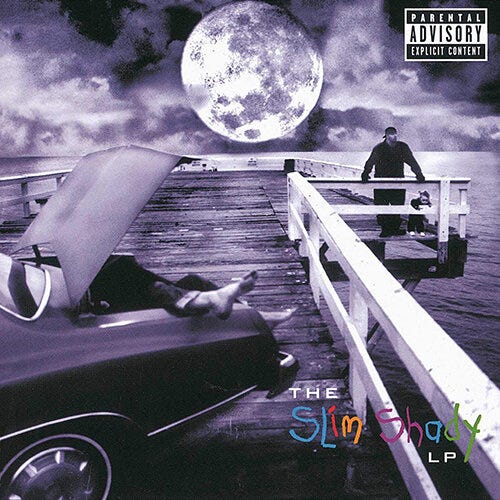
On paper, The Slim Shady LP should have been a novelty trifle. A pitchy-voiced midwestern white boy gleefully spitting tales of murder, mayhem, and psychosis in an off-kilter flow would appear to spell 15 minutes of fame, quickly relegated to a time capsule of kitsch.
Instead, Eminem’s major label debut marked the tipping point for one of hip-hop’s longest and most commercially prolific careers. A look back at The Slim Shady LP reveals the early building blocks of an enduring connection between artist and fan base.
It’s not the shock-and-awe that gives the project its gravitas. There’s an undercurrent of humanity that allows the album to transcend its tropes and position Eminem as a voice for elements of society and psyche generally repressed into dormancy.
A dark slice of cultural id was bubbling as the new millennium encroached. The outsized success of The Slim Shady LP was, perhaps, a harbinger of the malnourished chickens that would come home to roost in the 21st Century.
The opening “Public Service Announcement” aims to proactively disarm potential critics by steering them to take Eminem neither literally nor seriously. It’s followed by the lead single, “My Name Is,” which showcases Eminem’s dark proclivities at their most cartoonish. Over perhaps Dr. Dre’s silliest beat, Em introduces the spritely psychopathology of his Slim Shady alter ego that dominates with devil-may-care aplomb:
Hi kids! Do you like violence? Wanna see me stick Nine inch Nails, through each one of my eyelids? Wanna copy me and do exactly like I did? Try ‘cid and get f***ed up worse that my life is? My brain’s dead weight, I’m tryin’ to get my head straight But I can’t figure out which Spice Girl I wanna impregnate
Yet, behind the hijinks lies the vulnerability of alienation all too familiar to adolescents of all stripes.
Well since age twelve, I’ve felt like I’m someone else ’Cause I hung my original self from the top bunk with a belt
“My Name Is,” along with Aftermath/Interscope’s robust marketing campaign, went to great pains to distinguish Slim Shady (the character) from Eminem (the rapper) and Marshall Mathers (the man). Yet, the album benefits immensely from blurring those lines. Rather than a creation of Mathers, Shady plays as a component of him, allowing the possibility that there’s a Shady in all of us.
“Guilty Conscience” teases out the universality of Slim Shady, with Em deploying the character as the “devil on the shoulder” to a trifecta of characters faced with moral dilemmas. Shady goads the disaffected youths to indulge their basest impulses toward robbery, rape, and murder. In a masterfully meta bit of casting, Dr. Dre attempts to talk them down.
Given Dre’s well documented history of misbehavior on and off record, his role as “angel” suggests Shady is a phase we all pass through. Yet, the good doctor’s ultimate capitulation to Slim is a sly suggestion that Shady never truly dies, instead simply retreating into hibernation with age and comfort.
“Brain Damage,” goes a layer deeper, providing Shady an all too relatable origin story rooted in victimization. With each instance of bullying from classmates, condescension from teachers, and abuse from parents, alienations calcifies into rage, cementing Shady as a coping mechanism for an unforgiving world.
“If I Had” presents the same alienation in grown-up form. Painting in stark sepia tones, a twenty-something Marshall laments the litany of struggles that seemingly relegate him to the hard scrabble fringes of the land of milk and honey. While tales of urban poverty were nothing new to hip-hop, the plight of the heartland’s working-middle class rapidly losing its place at the dawn of a century of automation and outsourcing was largely uncharted territory.
It’s that very plight out of which Shady, traditionally lulled into latency with the progression into adulthood, begins to re-emerge in Em’s character as in society. It’s likely what allowed The Slim Shady LP to resonate with an audience beyond the pimple cream and body spray crowd.
“Rock Bottom” is either Marshall rounding into Shady, or Shady in a rare moment of reflection. Over moodily minimalistic production from the Bass Brothers, Em articulates a seething anger born of perennial relegation to the outside looking in. His stark portrait of an American dream in decay spoke to industrial towns left behind by the technological revolution the country over just as saliently as it did to his native Detroit.
My life is full of empty promises and broken dreams I’m hopin’ things look up, but there ain’t no job openings I feel discouraged, hungry and malnourished Livin’ in this house with no furnace, unfurnished And I’m sick of workin’ dead-end jobs with lame pay And I’m tired of bein’ hired and fired the same day But f*** it, if you know the rules to the game, play ’Cause when we die, we know we all goin’ the same way ’Cause it’s cool to be the player, but it sucks to be the fan When all you need is bucks to be the man, plus a luxury sedan Or comfortable and roomy in a 6 But they threw me in the mix with all these gloomy lunatics Who walk around depressed, and smoke a pound of cess a day And yesterday went by so quick, it seems like it was just today My daughter wants to throw the ball, but I’m too stressed to play Live half my life and throw the rest away
When there’s nothing left to lose, our worst demons are emboldened to run wild. Too often, rage erupts at whoever is closest and most vulnerable. On The Slim Shady LP, the eruption comes in the form of “‘97 Bonnie and Clyde”. In an arrestingly unsettling bit of horrorcore revenge fantasy, Em allows Slim to imagine his baby mama drama played out to the bloodiest possible conclusion.
Portraying the murder of his ex-wife as the ultimate act of devotion to his daughter is a masterstroke of storytelling, simultaneously upping the ante on the psychosis and making his character oddly sympathetic. Eminem’s ability to infuse the grotesque with a micro dose of humanity allows his forays into the macabre to avoid the forced feeling that prevented the mid-90s horrorcore movement from truly gaining a foothold in the mainstream.
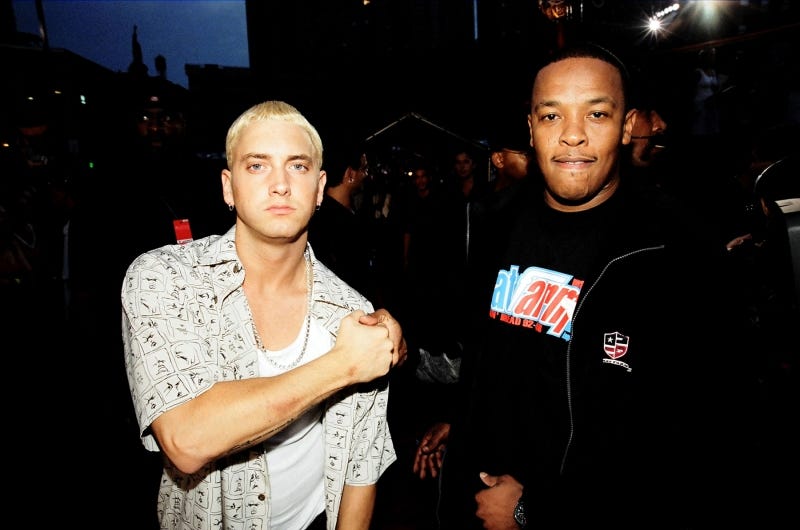
The album offers a glimmer of hope as we see Shady’s fiery intensity channeled into the outlet of hip-hop on a trifecta of late-sequenced stand outs. “Just Don’t Give a F***” is the album’s first true flex of the battle rap prowess upon which Em built his considerable rep on Detroit’s mid-90s underground circuit. While the staccato flow and punchline-heavy bars are built for cypher pugilism, Em delivers them in the Shady persona. The conceit allows his boasts a level of absurdism that would likely have gotten him clowned as corny had he attempted to spit them “straight.”
Longtime running mate Royce Da 5'9" joins Em for a tag team murder-fest on “Bad Meets Evil.” Royce, always a master technician, seems to inspire Em to heighten his focus on precision without sacrificing the jittery angst that give his delivery its edge.
“Still Don’t Give a F***” delivers a dynamic closer, offering a cross-pollination of Shady and Marshall. From the moody synths to the strident delivery and defiantly pronounced chorus, the track plays like a sneak preview of the stylistic hallmarks that would come to define Eminem’s style in years to come.
When compared to 2000’s The Marshall Mathers LP and 2002’s The Eminem Show, it’s glaringly clear that The Slim Shady LP doesn’t offer prime Eminem in terms of technical MCing. Em himself has said he can’t listen to it today, because he’s rapping ahead of the beat for most of the project. For me, the unorthodoxy of his delivery actually works as a reflection of the psychological instability of the Slim Shady character.
More problematic is the production, handled largely by the Bass Brothers. Driven mostly by mid-tempo programmed percussions and atmospheric keyboards, the beats often feel generic. Too many songs are left begging for sonic backdrops matching the edge and color of their subject matter and Em’s vocal performance. Even Dr. Dre’s offerings feel surprisingly paint-by- -the-numbers; the earliest entries in a long and puzzling tradition of Dre saddling his highest selling artist with seemingly throw away tracks.
The album also over stays its welcome — another flaw that would recur throughout Em’s career. Tracks like “Cum on Everybody,” “As the World Turns,” and “I’m Shady” feel redundant, offering little more than generic re-hashes of Shady shenanigans delivered more colorfully over better production on other tracks.
The sharp tin of Eminem’s voice, while extremely effective at cutting through any soundscape, is best in small doses. Over the course of 20 tracks with minimal guest appearances, it simply becomes grating.
It’s hardly a sleight to say the The Slim Shady LP’s importance ultimately outstrips its quality. Like the movie Fight Club, also released in 1999, the album tapped into a rising tide of unrest that would come to wreak havoc on a 21st Century defined by the further demise of the working class and the angst of alienated young white men.
Less than two months after the album’s release, two 12th grade students murdered 12 of their classmates at Colorado’s Columbine High School. It began a trend of mass shootings that has only increased in frequency in the ensuing years. The Columbine murderers were affiliated with a clique called The Trench Coat mafia, formed as a response to bullying — essentially an upper-middle class version of Slim Shady.
Message boards the dark web over are awash with self-pitying diatribes and revenge fantasies of alienated young “incels” indulging their inner-Slims via the anonymity of the internet.
While the political bent of the January 6th insurrectionists might not be in line with Shady (unlike Em himself, Slim seems fiercely apolitical), the viking helmets and weaponized feces absolutely are.
We should have been so lucky as for The Slim Shady LP to fizzle as a novelty hit. Such a response would have reflected a world in a far healthier position to handle the desocialization inherent in the digital age. Instead, it connected deeply and enduringly with a collective id preparing to wreak havoc at the moment when repression met alienation.
By the Numbers
Production: 7 Lyrics (how the words are put together): 9 Delivery & Flow: 8.5 Content (Substance): 8.5 Cohesiveness: 8 Consistency: 6.5 Originality: 9.5 Listenability: 7.5 Impact/Influence: 9 Longevity: 8
Total — 81.5
Next
Previous
SEE ALL
Backspin is a look back at the albums that shaped and defined hip-hop. It explores what made them resonate, the impact they had on the culture, and where they fit in today’s ever-expanding hip-hop canon.