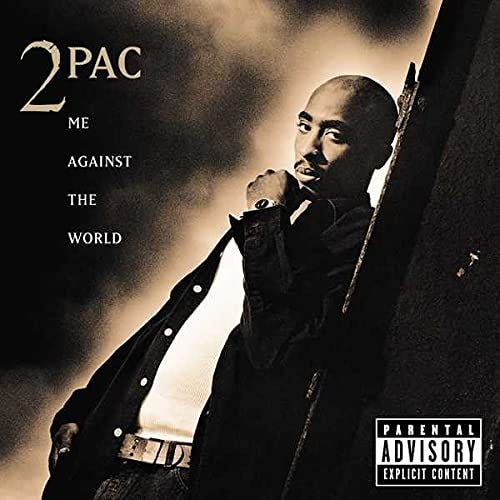
Backspin: 2Pac — Me Against the World (1995)
Making a martyr. (92/100)
Imagine you’re 23 years old.
You’re on top of the world, and you’re under the gun. You’ve achieved your dream, only to watch it spiral into a nightmare.
The art form that once represented your escape is now your albatross. The world you set out to save appears hellbent upon destroying you. The culture you love greets your hard earned success with hostility. You’re all alone in a fight, and you don’t even fully understand what you’re fighting for.
That’s the existential vice in which Tupac Shakur found himself in 1995. The raging struggle gives his third album, Me Against the World, its searing poignancy and, in light of Pac’s untimely 1996 death, its eerie sense of inevitability.
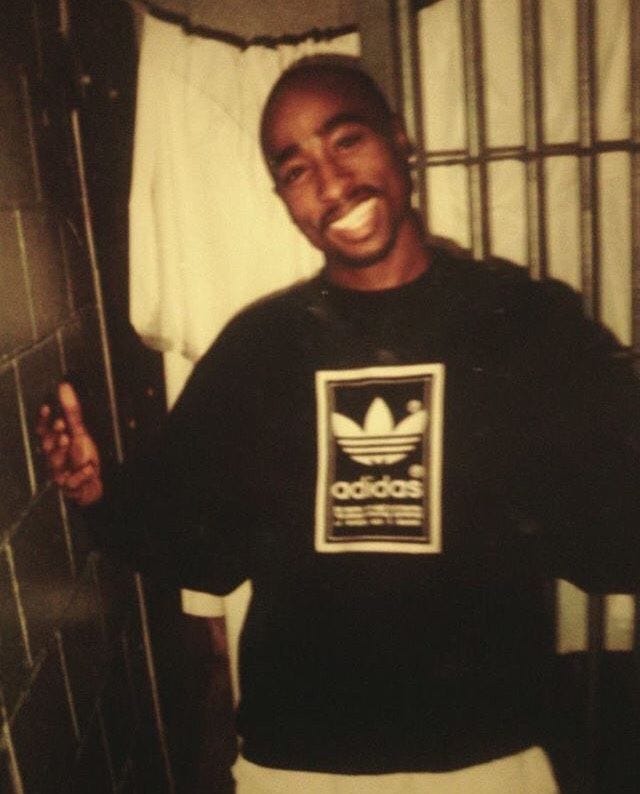
The intro runs down the litany of fronts on which 2Pac was battling via a montage of news reports recounting his highly publicized altercations, arrests, and near-fatal shooting. Notably absent is reference to the ordeal likely weighing heaviest on Pac’s psyche: the sexual assault charges for which he was preparing to stand trial while composing the album. (His 18-month sentence for sexual abuse began the month before the album’s March release.)
“If I Die 2nite” establishes the album’s defiant brand of fatalism. The tense opener positions Pac as an island under siege amid a turbulent sea of predators, conspirators, and backstabbers. He’s not going down without a fight (“Pray to the heavens, .357s to the sky”). He’s also making peace with the prospect of death as an escape (“I wonder if heaven got a ghetto for thug n****s/A stress-free life and a spot for drug dealers”).
Easy Mo B’s brooding production sets the sonic table for an album in which the era’s G-Funk hallmarks are inverted. Instead of soaring, the keys wander the dark space between menace and despondency. In stark contrast to the pristine openness of prototypical G-Funk, Me Against the World’s mix is intentionally thick, trudging through a sonic quicksand mirroring both the weight on Pac’s shoulders and the dense ambiguity of a world mired in the circularity of contradiction.
The next two tracks define the battlefields of the wars in which Pac feels embroiled. The title cut’s uncharacteristically serene production from Soulshock and Karlin underscores Pac’s angst filled lyrics with an air of stoic resignation as he unpacks his fight to save a generation that seems disinterested in salvation. He ultimately includes himself as one of the lost souls incapable of accepting the transformation he so desperately needs, but closes the track with heartfelt words of encouragement for his peers.
“So Many Tears” is a stunning exercise in self-reflection, with Pac turning his focus to the war raging inside him. His Digital Underground mentor, the late Shock G, serves up a subtle masterpiece of a track that manages to make Stevie Wonder’s airy “That Girl” sound foreboding. Pac laments his descent into darkness even as he offers a clear-eyed diagnosis of the diseased world that brought him there.
Lord knows I tried, been a witness to homicide Seen drive-by’s takin’ lives, little kids die Wonder why as I walk by Broken-hearted as I glance at the chalk line, gettin’ high This ain’t the life for me, I want a change But ain’t no future bright for me, I’m stuck in the game I’m trapped inside a maze See this Tanqueray influenced me to gettin’ crazy Disillusioned lately, I’ve been really wantin’ babies So I could see a part of me that wasn’t always shady Don’t trust my lady, ’Cause she’s a product of this poison I’m hearin’ noises, I think she’s f***in’ on my boys Can’t take no more, I’m fallin’ to the floor Beggin’ for the Lord to let me into heaven’s door
The war rages at its most primal on the battleground of Pac’s relationship with women. He loves their humanity, often lionizing them as a rare source of light in a dark world. He also loves them as an activity. “Temptations” grapples with the contradiction and the elevated stakes it represents in Pac’s dizzying new world of celebrity.
Beneath his bravado, Pac’s lusty entreaties are presented as a futile quest for intimacy; to heal somebody and have somebody heal him. The human connection he craves is rendered nearly impossible by the transience of road life and the paranoia bred of the inherent treachery of the rap world. He’s left to settle for fleeting, and ultimately unsatisfying moments of escape.
“Temptations” doesn’t directly address the sexual assault allegations. Still, it feels like a mea culpa to his fans, conveying how he ended up in the compromising situation that he likely feared would end his career, if not his life. (He was facing a potentially lengthy prison sentence in New York as the West Coast’s most prominent artist at the height of a white hot coastal feud.)
The album offers two moments of unambiguous affection, as Pac pays passionate tribute to his two unconditional loves.
The now-legendary lead single “Dear Mama” is a heartfelt love letter to his mother, Afeni Shakur. Pac doesn’t shy away from chronicling the tumultuous parts of their relationship, nor from painting unvarnished portraits of both as deeply flawed people drawing strength from each other. Though achingly personal, the song transcends Afeni and Pac, becoming a celebration of the maternal strength that has held Black families and communities together through generations of trauma.
Pac’s diagnosis of his family structure as the catalyst for his descent into the “thug life” he seems to accept will be his eventual undoing humanizes a pathology all too common:
Now, ain’t nobody tell us it was fair No love from my daddy, ’cause the coward wasn’t there He passed away and I didn’t cry ’Cause my anger wouldn’t let me feel for a stranger They say I’m wrong and I’m heartless, but all along I was lookin’ for a father, he was gone I hung around with the thugs, and even though they sold drugs They showed a young brother love
“Old School” offers a far more jubilant homage to Pac’s other sanctuary: the classic hip-hop of his youth. Over a serene horn sample and a track that barrels forward with the reckless abandon of a midnight express train, Pac name checks hip-hop’s pioneers and evokes the adrenaline rush of embracing the nascent culture when it represented freedom and possibility.
Skeptics were quick to dismiss the song as a calculated spotlighting of his pre-adolescent years in New York City to soften up the hardrocks with whom he would soon be bidding on New York’s infamous Rikers Island and Clinton Correctional. Regardless of motivation, the emotion feels genuine. In stark contrast to the cynicism and fatalism that define Me Against the World, “Old School”’s closing ad libs explode with giddy innocence as he reminisces about stickball games and Italian Icies.
The respite is short lived. The album’s final lap plays out like Pac’s Scarface-esque last stand. In his final collaboration with his former protege, Shock G serves up a bubbling cauldron of funk on “F*** the World.” The swirling orgy of synths embodies the alienation conveyed by Pac in a defiant screed against any an all enemies, from crooked cops to jealous peers, and the two-faced “devils” labeling him a rapist.
If “F*** the World” represents a final cathartic eruption, “Death Around the Corner” is Pac’s transition into stoic resignation. Over relentless production from Johnny “J”, Pac takes stock of his past and present while stealing himself for the inevitable. The song opens with an allusion to the iconic photograph of Malcolm X, a marked man by both the government and his former Nation of Islam cohort, peering out the window, AK-47 in hand. The parallel is clear. Tupac Shakur has accepted his fate as a martyr.
On “Outlaw” he fully embraces it. The album’s ominously measured closer finds Pac in full Tony Montana mode, escaping into a revenge fantasy in which he goes out blasting, taking with him as many adversaries as his clip can account for:
Got me runnin’ from these coward-ass, crooked-ass cops Helicopters tryna hover over n****s ’til we drop Got no time for the court, my only thought is open fire Hit the district attorney, but f*** that b****, cause she’s a liar Now it’s time to expire, I see the judge, spray the bench “Motherf***ers is crooked,” is what I scream, and hit the fence I commence to get wicked, spittin’ rounds as the plot thickens Never missin’, an early grave is my only mission If I die, never worry, bury me beside my four-five May God forgive me, I was high Label me a outlaw
Imagine you’re 23 years old.
Despite possessing generational talent, you feel your fate is already sealed; your limitless potential boxed in by institutional barriers, cultural pathologies, and past mistakes.
You should have a half century of life ahead of you in which to change the world. Instead you’re resigned to an untimely demise as your only outlet for impact. And escape.
Imagine, you possess the passion, fortitude, and vision to channel the rage, confusion, and despair ravaging your once-rich spirit into a transcendent body of work that would make generations of similarly situated young people feel seen.
The unvarnished baring of your tortured soul opens the emotional floodgates of the traditionally ice-grilled genre and culture you call home. Your existential purge frees less fearless, but equally tortured young men the world over to explore their humanity through hip-hop. It removes the constraints of flamboyant personas and machismo previously part and parcel of the genre. Your prophecy ultimately proves prescient
Imagine you don’t live to see the full extent of your influence take form.
Those were the uncharted waters in which Tupac Shakur found himself flailing in ’95, desperately trying to fling a life preserver to current and future generations, even while drowning himself.
It’s what makes 2Pac hip-hop’s most endlessly fascinating figure, and Me Against the World his first truly great, and arguably most viscerally powerful album.
By the Numbers
Production: 8.5 Lyrics (how the words are put together): 9 Delivery & Flow: 9.5 Content (Substance): 10 Cohesiveness: 9 Consistency: 9 Originality: 9 Listenability: 9 Impact/Influence: 9 Longevity: 10
Total — 92
Next
Previous
SEE ALL
Backspin is a look back at the albums that shaped and defined hip-hop. It explores what made them resonate, the impact they had on the culture, and where they fit in today’s ever-expanding hip-hop canon.