
Backspin: Slick Rick — The Great Adventures of Slick Rick (1988)
Hip-Hop’s most colorful character was always the star of the story. (88/100)
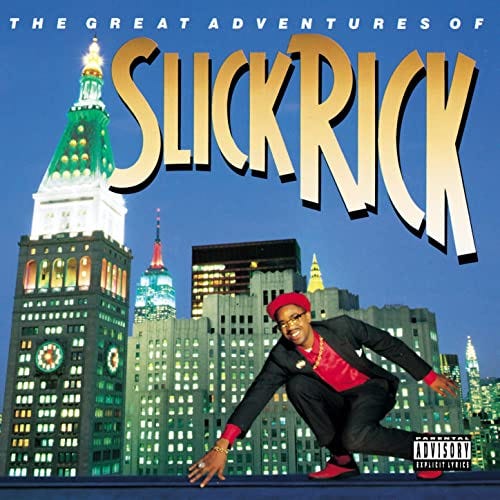
Slick Rick is a master storyteller. His fabulist flourishes on Doug E. Fresh’s 1985 dance floor burner, “The Show,” were so clever and evocative they had revelers hanging on every word of an all-time great party record. Fresh wisely recognized the lightening he had caught in a reel-to-reel deck and made the single’s B-Side a showcase for the colorful narrative derring-do of the MC then known as Ricky D. As a result, “La Di Da Di” improbably went onto be every bit as revered as its A-Side, making the London born lyricist the toast of the town.
Three years in the making, Rick’s 1988 debut was quite possibly the most anticipated freshman offering in hip-hop’s first decade on wax. The Great Adventures of Slick Rick remarkably managed to not only meet the lofty expectations, but exceed them. Unfurling like an inner city Grimm’s Fairy Tales for the Reagan era, the album brings color and whimsy to the stark narratives and washed out concrete that defined a generation of youth whose adventures often got lost among New York City’s 8 million stories.
After the somewhat awkward opener, “Treat Her Like a Prostitute” (more on that later), the album starts in earnest with the triumphant horns of “The Ruler’s Back.” The leisurely sway of the shakers and the bassline’s whimsical wobble immediately create a stark contrast to the urgency that defined hip-hop production in ’88. It felt like a throwback, not so much to 1985 as to 1485. Rick clearly relishes the set up, using the track to define his persona as the impish raconteur deftly weaving tall tales to delight the masses and make sense of a vast and often brutal world, all the while slyly wooing the fairest maidens of the village.
The persona pays early dividends on “Children’s Story,” with Rick spinning a fable set on the streets of the inner city. The subject matter - urban poverty, fast money, police brutality - was already well-trodden ground in the burgeoning worlds of gangsta and conscious rap. But by framing it within the structure of a bedtime story for kids, Rick is able to add both colorful aplomb and ethical certainty. “Straight and narrow, or your soul gets cast,” he concludes after the song’s climactic chase has ended in tragedy.
“The Moment I Feared” takes a darker, but even more evocative turn. Rick switches to first person narration to recount a seemingly unremarkable day that quickly spirals from bad to worse to catastrophic. Produced by Hank Shocklee and Eric Sadler of Public Enemy’s vaunted Bomb Squad, the murky layering of the track creates a disorienting tension that builds as Rick’s misadventure spirals further out of control.
Well I’m sittin’ on my lunch break, grinnin’ my teeth It’s the last day of the week, boy what a relief My muscles kind of ache, they felt rigid and stiff So I looked around, and I smoked this big fat spliff Now I’m happy as can be, I’m in this pothead spell I put some Visine in my eyes so that no one can tell It’s 12:55 almost time for the bell Put the breath mints in the mouth, so that the mouth don’t smell Now back on the job, I don’t bother no one I keep strictly to myself and all my work gets done Now the job’s finally over, it’s time to have fun And I’m hangin out with Trevor and this a kid named John Now I’m drunker than a skunk and happy as can be We went to the Latin Quarters and we got in free Scoopin’ all the girls like nothin’ with my truck jewelry Cause I’m a fly brown brother and you can’t school me Boogie Down was performin’, hey they ain’t no joke And a bunch of Brooklyn kids was lookin’ all down my throat Was it my big chains with the big plates on ‘em? Then they rolled on me and told me to run ‘em It was the moment I feared
An amorous Davy Crockett takes center stage in “Indian Girl (Adult Story),” an x-rated allegory about the wild frontier of sexual exploration. While the Native American stereotypes leaned on for much of the humor might cause cringes in the 21st Century, Rick’s masterful turns of phrase will probably have even the “wokest” listeners chuckling in spite of themselves. The subtext of sexual caution is, perhaps, even more relevant in the Tinder age.
If the aforementioned “Treat Her Like a Prostitute” was going to be included on Great Adventures (not a necessity, since it had been released as a B-side earlier in the year), it should have been placed immediately after “Indian Girl” to comprise the “adult” portion of the album. With Rick’s endearingly roguish persona more firmly established, his admonitions to “never treat no girlie well until you’re sure of the scoop” might land more as tongue-in-cheek hyperbole rather than mean spirited misogyny. As the album open, it creates dissonance, setting a sour tone for an album that generally espouses morality and personal growth.
Nowhere is that mantra deployed to greater effect than on the album’s lead single, “A Teenage Love,” a mature and melancholy exploration of the hurt that “Prostitute” seems to grow out of. Where the latter lashed out, the former looks inward, with Rick once again using narrative vignettes to sort out the pain that comes when young people find themselves swept up in adult emotions.
Precious times, hopin’ they won’t end Tell your mother ‘bout your lover Also your best friend Ya mighty proud while your holdin’ their hand Boys, “yeah, that’s my woman,” and Girls, “yeah, that’s my man” This pressure brings a sort of warmth to ya heart And everything seems so great at the start For she loves him, and he also loves her And it’s hard to turn back to who the person you were But later on, problems start to occur And the bond which combines y’all turn into a blur For the feelings were the same, now here’s the score You love them too much, and they don’t love you anymore Due to your attitude, another, or because you’re not being true Or maybe they’re just plain sick of seeing you Word, now it might seem strange You better take hints quick, and make the right change
Having walked us through the depths of first love, Rick evokes the excitement of infatuation just as effectively on “Mona Lisa.” It might be the definitive Slick Rick performance as he effortlessly bounces in and out of multiple characters, nimbly pitching and inflecting his voice to indicate the transitions. His British accent and use of old-timey vernacular (what other rapper could get away with describing themselves as “ravishing?”) brings a magical innocence to the retelling of a brief moment of flirtation at a pizza counter. Rick, as “Mona” crooning “Walk On By” as the rapper’s cab fades into the distance, leaving both to wonder what might have been, caps the track on a dreamlike note.
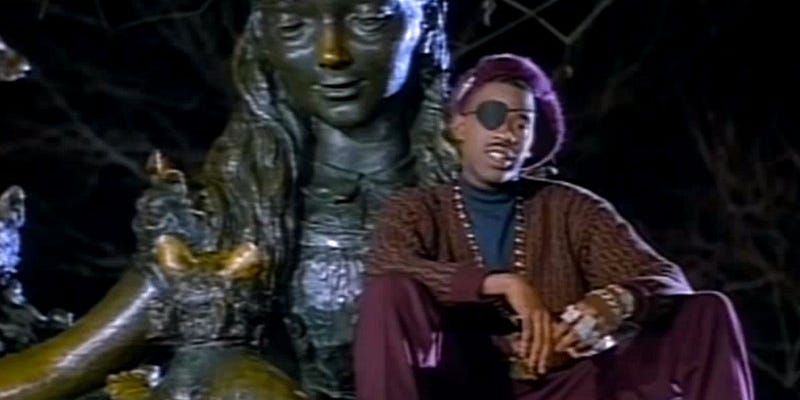
The enchantment reaches its zenith with “Hey Young World,” a hip-hop lullaby that only Rick could have pulled off. Over an ethereal synth line, Rick breezily transitions between melodic and rhythmic deliveries to impart words of wisdom and encouragement as simple as they are timeless. A rapper imploring kids to do their chores should not have played in the same year Eazy-E proclaimed himself “the brother that’ll smother your mother,” but due to the fairytale feel of the album and Rick’s disarming earnestness, it plays as a reinforcement of the album’s moral subtext rather than preachy sloganeering.
The Great Adventures of Slick Rick isn’t perfect. “Kit (What’s the Scoop),” in which Rick takes to the streets with the talking car from Night Rider has aged about as well as the TV show it’s based on. Likewise, the perfunctory party jam “Let’s Get Crazy” and the braggadocio of “Teacher, Teacher” feel phoned in to check off boxes deemed essential for a successful late ’80s rap album.
But Slick Rick wasn’t like other rappers. He still isn’t. He’s at his best when his boundless imagination is free to roam, translating the the ordinary into the fantastic with his unique blend of childlike wonder and world weary wisdom.
As ingenious a project as Great Adventures is, it feels more like a prodigious talent discovering the magnitude of his own gifts rather than his eventual masterwork. Unfortunately, Rick’s real life story took a turn every bit as dark as the album’s most jarring cautionary tales, ensnaring him in the legal system for the better part of the ’90s and early 2000s.
Had Rick been free to record organically, I suspect his true masterpiece would have come in the early ’90s. The slower, jazz tinged production that dominated New York during that era would have complimented Rick’s velvet vocal tones to perfection, and his his outsized personality would have popped in the music video era. Moreover, a new generation of rappers was largely turning away from rapping about rapping and increasingly telling vivid stories of urban struggle to enthrall a new found suburban fanbase. Rick would have been right at home.
The palpable influence Rick had on the ’90s Renaissance era despite not be present simply speaks to the power of The Great Adventures of Slick Rick, and the lasting imprint it had on a generation of listeners and future artists alike.
By the Numbers
Production: 7.5 Lyrics (how the words are put together): 9.5 Delivery & Flow: 9.5 Content (Substance): 9 Cohesiveness: 7.5 Consistency: 7 Originality: 9.5 Listenability: 8.5 Impact/Influence: 10 Longevity: 10
Total — 88
Next
Previous
Backspin is a look back at the albums that shaped and defined hip-hop. It explores what made them resonate, the impact they had on the culture, and where they fit in today’s ever-expanding hip-hop canon.