
Backspin: Outkast — ATLiens (1996)
Outkast’s sophomore opus elevated alienation to higher ground. (94/100)
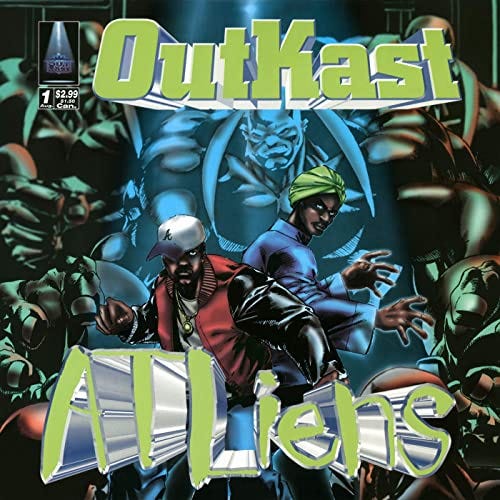
“I’m tired of folks, the closed minded folks,” an incredulous Andre Benjamin told the equally agitated crowd packing Madison Square Garden as the boos rained down.
The scene was the 1995 Source Hip-Hop Awards. Outkast, the Atlanta duo consisting of Benjamin and Antwan “Big Boi” Patton, had taken the stage to collect their trophy for Best New Artist. Tension was thick as August air thanks to the escalating coastal beef between New York and California icons vying for the night’s highest accolades. Until Outkast’s name was called by a stunned Christopher “Kid” Reid, the South hadn’t even registered as an afterthought.
As the boos cascaded, the message to Outkast, their region, and their culture was clear: “you don’t belong.”
A moment that should have represented the ultimate validation had warped into resounding rejection in the time it took Dre and Big Boi to emerge from the crowd and onto the stage.
“Are you Alien? Out of this world?”
Outkast’s ingenious sophomore outing, ATLiens is both a product of that alienation and a meditation on it. Their debut, Southernplayalisticadillacmuzik, was immersed in its dirty south surroundings; of a piece with the world it inhabited. ATLiens stands at an observant remove. In this world, but not of it.
Beginning with a slow fade in, “You May Die,” quite literally ascends to a higher plane. Over plaintive strings, a lilting female voice recites a Greek passage. The words translate to:
I’m eagerly observing The Sun. God is floating, observing us. My life floats on, without interruption. We are outside ourselves, lifeless. Amen
Joi, Myrna Crenshaw, and Trina Powell christen the track with haunting harmonies, like sirens from the nexus of the ancient womb of civilization and the purple haze of the post-apocalypse. Their words are equal parts warning and reassurance:
You can be sure Some go low to get high You may hurt ‘til you cry You may die Keep on trying
At first glance, “Two Dope Boyz (In a Cadillac)” would appear to pick up where Southernplaylistic left off, with Dre and Big Boi whipping a vintage Caddy through dark Atlanta streets. But it feels like an inversion. The debut’s lush keys and strings are replaced by a tepid piano riff lingering furtively low in the mix. Thick soulful percussion gives way to crisp, mechanical programming rendered with utilitarian restraint. Where melodic vocals once exploded into anthemic hooks, here they simply linger eerily in the background, placing the focus squarely on the MC’s uncharacteristically aggressive rhymes.
The Madison Square Garden boos undoubtedly fresh in their minds, Dre and Big Boi emerge with a pronounced chip on their coiled shoulders. Formerly more interested in using their considerable rhyme skills as the brush with which to paint vibrant pictures of their world, here they wield them like a sword, slicing and dicing all comers. After Big Boi unleashes a noticeably upgraded flow, spraying staccato syllables like machine gun fire, Dre lays down the ultimate trump card, clowning his hypothetical opponent’s “lazy cliches,” before condescendingly dismissing the whole concept of battling so integral to the hip-hop ecosystem that cast him out.
The title track ups the aggression, laying down a mission statement under the guise of a party banger. At first pass it feels like a futuristic re-imagining of Southernplaylistic’s “Ain’t No Thang,” with it’s rollicking uptempo bounce and jubilant southern fried hook. But paired with the verses, which are by turns combative and introspective, the irresistible chorus feels ironic, like a mockery of an audience incapable of seeing past southern fried stereotypes.
Now throw your hands in the ay-er And wave ’em like you just don’t cay-er And if you like fish and grits and all that pimp s*** Everybody let me hear you say, “O-Yea-yer”
As becomes standard for the album, nearly every line is meticulously crafted and placed. Big Boi’s seemingly innocuous shout to his incarcerated uncle Darnell subtly introduces the broader concept of societal alienation. Dre expounds, speaking to the cultural homogeny that punishes growth and exploration. With each bar, you can hear Dre growing more comfortable in his skin, embracing his role as a budding patriarch and the power his words may have in expanding the universe for his biological and artistic descendants.
… the future of the world depends on If or if not the child we raise gon’ have that n**** syndrome Or will it know to be the hardest regardless of the skin tone? Or will he feel like if he tune it, it just might get picked on? Or will it give a f*** about what others say and get gone? They alienate us cause we different, keep your hands to the sky Like Sounds of Blackness, when I practice what I preach ain’t no lie I’ll be the baker and the maker of the piece of my pie Now breaker, breaker 10–4, can I get some reply?
“Are you Alien? Out of this world?”
Alas, “movin’ on up in the world” breeds its own uniquely surreal brand of alienation, as explored in ATLiens’ lead single, “Elevators (Me & You).” The album’s only breakout hit, thanks undoubtedly to its hypnotic hook, “Elevators” is a masterclass in dissonance - both sonic and cognitive. While the imagery of the chorus recalls vintage Outkast hits like “Players Ball,” the echoed stutter of the drums paired with the elongated synth chords feel downright eerie, like the Cadillac took a wrong turn off of Peachtree Street into the Twilight Zone.
As Dre and Big Boi recall their come up in the early verses, there’s no joy to be found. It’s as if they’re looking down on their younger selves as they ascend further into the ether, desperate but unable to warn them of the perils to come. Dre’s closing verse is one of the most poignant of his career, detailing a chance encounter with a former classmate as desperate to “elevate” Dre into an avatar of success as Dre seeks to form a human connection around the commonality of struggle.
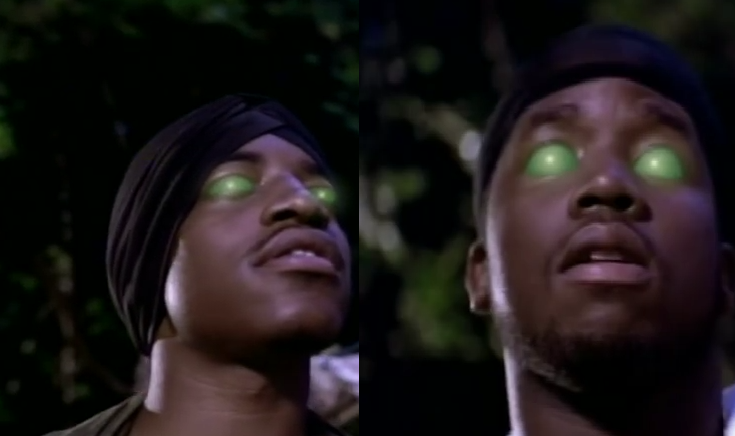
“Mainstream,” featuring Goodie Mob’s T-Mo and Khujo, digs deeper into the pressures, internal and external, to adapt to the molds cast by the corporate world for which the MCs were suddenly valuable assets, and of the community from whence they came. The resulting phenomenon is an alienation from self reflected by the ambient undertones of the album’s production.
The gospel-gothic harmonies of “Decatur Psalm” provide Big Boi’s description of well trodden Atlanta streets a dystopian sense of foreboding. In the space of two years, Big Boi has gone from a member of the underworld ecosystem to potential prey. In one of the album’s most poignant vignettes, he recalls the delicate and potentially treacherous balance of being both a nurturer and a protector of his daughter in a world where the financial security he has worked so hard to provide now poses a threat to their physical safety.
I need to take my ass to the crib and drop the baby off ’Cause them n****s at the corner store been looking at me for too long Starin’ like accidents on highways High days are better than sober ones Don’t be biased, but I know it has to come So I put two in the sky to let them know I’m babysittin’ Y’all don’t know nothin’ ‘bout Big Boi, ’cause that n**** steady dippin’
“Are you Alien? Out of this world?”
The subtext of family is present throughout ATLiens. It’s both a beacon of hope in the album’s otherwise bleak landscape, and the most potentially tragic casualty from the alienation of the life Dre and Big Boi have chosen.
“Jazzy Belle” portrays the late 20th Century single life as a modern day Sodom and Gomorrah. The detachment of sex from connection is presented as both cause and symptom of an eroding family structure unraveling communities. Portraying the titular archetype as a purveyor of sin rendering men helpless to their lowest desires, Big Boi castigates a particular harlot for attempting to lure him from his family. He ultimately succumbs to the temptation to “use ’em and abuse ‘em.”
The biblical illusions turn from foreboding to downright apocalyptic on “Babylon,” in which connections of the heart are portrayed as all but doomed against the seductiveness of carnal indulgence. Against a hauntingly minimalist backdrop, Dre sets the scene with one of the most evocative opening verses committed to wax:
I came into this world high as a bird From secondhand cocaine powder — I know it sounds absurd I never tooted, but it’s in my veins While the rest of the country bungies off bridges without no snap-back And b****es, they say they need that To shake they fannies in the ass clubs They go the other route Turn each other out Burn each other out Where a bona fide n**** like me can’t even get no backrub these days Ain’t that bleak on they part? But let me hold it down, ’cause they shut you down when you speak from your heart
Indeed, the flesh and the soul are connected throughout ATLiens. Romantic alienation grows out of and feeds into the spiritual alienation that comes to a head on “Millennium.” A murmured chorus atop mournful guitar strings orient despondent verses in a sonic purgatory where two of rap’s greatest wordsmiths are at a loss for verbiage.
“Are you Alien? Out of this world?”
That’s the ghostly refrain seemingly speaking directly to Dre, Big Boi, and us throughout “E.T. (Extraterrestrial).” ATLiens’ production sheds layers so subtly as the journey progresses that it isn’t until the albums final leg that we realize nearly all garnish and artifice of the tangible world have been stripped away.
We’re left not so much as a drumbeat to syncopate the experience; just ominous keys and open space. Only the words of the two MCs remain to cut a path to salvation.
It’s as liberating as it is disconcerting. For all the chaos and destruction plaguing the physical world below, the plane on which we’re now floating is a new frontier from which we’re free to define our own journey. It’s here that the album’s true theme comes into focus.
While “13th Floor/Growing Old” appears on the surface to be a meditation on mortality, a closer look reveals something far more urgent to Outkast and their listeners. Both Andre Benjamin and Antwan Andre Patton turned 21 in early 1996, mere months before ATLiens’ August release. The climatic 14th track is their coming of age treatise.
With rhymes that vacillate between romanticizing the reckless escapades of youth and negotiating the weight of responsibility that comes with maturity, the song treats adulthood as the ultimate alienation. The simplicity of adolescence breeds the connection of immediacy, or as Big Boi waxes poetic, “smoking good and sloppy head on highways.”
That carefree devouring of life has a particular time and place, but isn’t meant to last forever, as he stoically concludes:
Fridays are tight, but Saturday just makes it old Winter nights are hot, warm enough to feed your soul
To come of age is to become aware of the world around you, rather than simply existing in it. That type of reflection, that seriousness of purpose requires distance. Separation. The piercing eye of an outsider.
Alienation.
Sometimes alienation breeds innovation. From the downpour of boos on that fateful 1995 night sprouted the seeds of one of hip-hop’s most uniquely edifying bodies of work.
ATLiens remains one of one in the hip-hop canon, and that’s for the best. Less prodigious talents would have foundered in the elusiveness of the ethereal soundscapes, and a string of pale imitations would only have cheapened the original. Instead, ATLiens’ legacy is far more subtle. Fittingly, it lives on in the fringes of the southern pantheon, where a vanguard of innovators like Big K.R.I.T., David Banner, and CunninLyguists continue to harvest the garden at intersection of deep rooted southern spirituality and free floating afro-futurism that Outkast planted.
By the Numbers
Production: 9.5 Lyrics (how the words are put together): 10 Delivery & Flow: 10 Content (Substance): 10 Cohesiveness: 9.5 Consistency: 9 Originality: 10 Listenability: 8.5 Impact/Influence: 8.5 Longevity: 9
Total — 94
Related
Next
Previous
SEE ALL..
Backspin is a look back at the albums that shaped and defined hip-hop. It explores what made them resonate, the impact they had on the culture, and where they fit in today’s ever-expanding hip-hop canon.