
Backspin: Boogie Down Productions — Criminal Minded (1987)
Boogie Down Productions’ groundbreaking debut was more “minded” than criminal. (95/100)
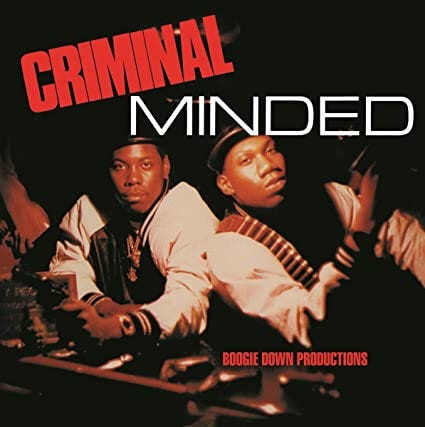
Hip-Hop loves revisionist history. Nowhere is that more apparent than in the mythology that has grown around Boogie Down Productions’ debut album in the decades since its 1987 release. Criminal Minded, legend now has it, was actually the first gangsta rap album. It’s a comforting thought for east coast true schoolers, moving the birthplace of hip-hop’s most enduring subgenre from the sunshine of southern California to New York’s South Bronx sidewalks. It’s also a gross over simplification of an album that’s true innovation was its sophistication. The fact is, Criminal Minded is a lot more “minded” than “criminal.”
“Poetry,” wastes little time in subverting expectations set by the album’s title and the heavy artillery brandished on its cover. The relentless opener instantly positions the album, and hip-hop as a whole, not on the street, but in the academy. The subtext is clear. This is no simple fad or inner city trifle, but high art, worthy of reverence and study.
DJ Scott La Rock’s production pulsates with a studied precision that structures its gritty intensity, his scratches deployed strategically, like sonic punctuation. Though he wouldn’t officially adopt the moniker until the following year, KRS-One organically steps into the role of teacher. His pristine voice, impeccable enunciation, and cerebral approach to braggadocio makes his masterful MCing as captivating as it is commanding. Listeners might be just as inclined to take notes as nod their heads as he methodically lays out the day’s lesson:
Well now you’re forced to listen to the teacher and the lesson Class is in session, so you can stop guessin’ If this is a tape or a written down memo See I am a professional, this is not a demo In fact call it a lecture, a visual picture Sort of a poetic and rhythm-like mixture Listen I’m not dissin’ , but there’s somethin’ that you’re missin’ Maybe you should touch reality, stop wishin’ For beats with plenty bass and lyrics said in haste If its meaning doesn’t manifest, put it to rest I am a poet, you try to show it, yet blow it It takes concentration for fresh communication Observation, that is to see without speaking Take off your coat, take notes, I am teaching A class, or rather school, cause you need schooling I am not a king or queen, I’m not ruling This is an introduction to poetry A small dedication to those that might know of me They might know of you and maybe your gang But one thing’s for sure, neither one of y’all can hang ’Cause yo I’m like a arrow, and Scott is the crossbow Say something now … thought so You seem to be the type that only understand The annihilation and destruction of the next man That’s not poetry, that is insanity It’s simply fantasy, far from reality Poetry is the language of imagination Poetry is a form of positive creation Difficult, isn’t it? The point, you’re missin’ it Your face is in front of my hand so I’m dissin’ it
There are no wasted lines in a KRS rhyme. Couplets build upon one another, laying out a clear concept upon which subsequent verses expand. Even (or perhaps especially) in battle, he takes the same measured approach, preferring to systematically dismantle opponents with knowledge and logic rather than threats and bombast. Nowhere is that more apparent than on “South Bronx,” in which he effectively buries the rival Juice Crew by positioning his hip-hop supremacy in the larger context of the culture’s roots and evolution.
KRS-One was minted in the same Bronx streets on which hip-hop provided an unlikely escape for a generation of youth, placing him above simple barbs from crosstown rivals. He wins by schooling his opponents, because what better way to demonstrate supremacy than by educating? Released in 1986, well ahead of the album, “South Bronx” also introduced the “teacher vs. king” dichotomy that would become a motif in KRS’s early rhymes, and could be seen as a subliminal shot at rap’s reigning royalty, Run-DMC. (The self-proclaimed Kings of Rock never took the bait.)
“9mm Goes Bang” leans into the album’s “criminal” side the most blatantly. A cold blooded tale of violence and retribution, “9mm” provides every bit the vicarious thrill of N.W.A’s best, but with an economy and precision ahead of its time. The song’s simplicity keeps you hanging on every word as KRS details his altercation with a rival drug dealer, its potentially deadly fallout, and a timely escape in the “all black BMW” of Scott La Rock.
Built atop a brooding interpolation of Super Cat’s “History,” the track provides KRS with the perfect backdrop to deploy his dancehall-inspired chatting delivery, and exemplifies La Rock’s willingness to venture outside the sonic confines of mid-80s rap records. While reggae and dancehall were staples at the block parties at which hip-hop was forged, it had been largely missing from the records birthed by those parties until Criminal Minded. La Rock seemed to know innately that the dancehall backdrops brought the gritty side out of his partner. That’s probably why he digs into his Super Cat crates again for “The Bridge Is Over,” perhaps hip-hop’s most iconic dis track.
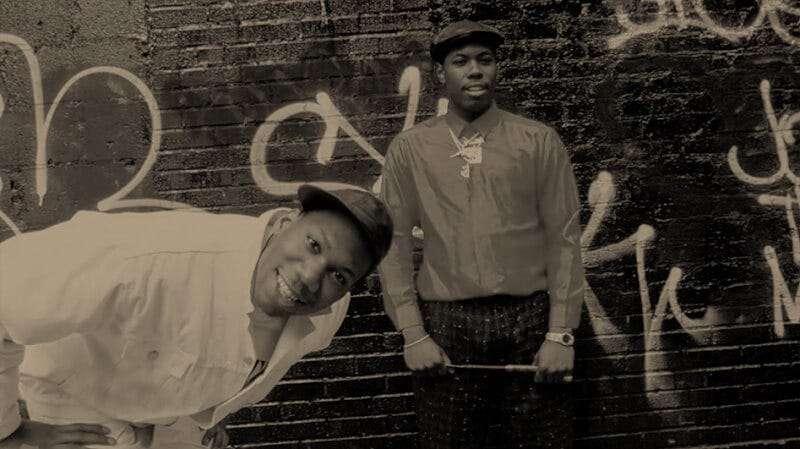
If “South Bronx” took the Juice Crew to school, “The Bridge is Over” takes them behind the school house. Originally performed as a live routine, the studio version manages to retain the energy of a stage performance. When KRS taunts “Bronx created hip-hop, Queens will only get dropped, but you’re still telling lies to me,” you’re just as likely to sing along when listening through earbuds by your damn self as you’d be in a crowd of hundreds.
“Remix for the P is Free” returns to the formula of vivid street narratives over aggressive dancehall samples. Sonically, it may be the album’s hardest song, but lyrically, it’s far removed from the brutal nihilism of “9mm Goes Bang.” KRS’s tales of aborted sexual encounters are used to illustrate the destruction inflicted upon urban communities by the crack epidemic of the ‘80s. While it lacks the nuance of his later cautionary tales, like 1990’s “Love Gonna Get’cha (Material Love)”, the no frills bluntness of KRS’s lyrics paired with the throbbing beat bring a jarring urgency to the track.
La Rock’s sampling eclecticism doesn’t stop in Jamaica. “Dope Beat” loops ACDC’s hard rock anthem “Back in Black” as an aggressive backdrop for KRS to serve up a lyrical beatdown. While Run-DMC and The Beastie Boys had taken forays into rock ’n roll, BDP abducts rock’n roll and drags it into the hip-hop hemisphere. The drums are the engine that powers the rhymes, and the piercing guitars merely serve as fuel injection.
A spirited interpolation of Esther Williams’ disco burner “Last Night Changed It All” offers a much needed moment of levity, as KRS waxes poetic on his DJ’s libidinous ways on “Super Hoe.” It’s the perfect cleanser before the unrelenting title track closes out the album.
“Criminal Minded” is hip-hop in its purest form: a deceptively simple drum track propelling relentless rhymes that command the listener’s attention with their bluster, but hold it with their substance. The genius of the production is in what it withholds. When the piercing horn stabs from Trouble Funk’s “Let’s Get Small” slice through intermittently, it feels like a build up to an explosion that never comes. The conspicuous absence it leaves draws the ear intently to KRS’s cerebral rhymes, which serve as a counterpoint to the aggression of the beat rather than a verbalization of it. The rebuttal to the revisionists is right there in the lyrics. BDP’s criminal mindedness is not a glorification of violence, drugs, or exploitation. It’s a philosophy of empowerment to rise above the quicksand of the streets using the the most potent weapon of all: the mind.
It’s actually the often overlooked album cut, “A Word from Our Sponsors,” that articulates the mind state most clearly:
Listen, circumstances put me right in the street With the will to survive, get paid, eat, and sleep Some weep, or should I rather say some cry Can’t get by, so later on they die Because the strong will survive, the weak will perish Ignorance is a poison, and knowledge will nourish
On an early 2000s mixtape, KRS-One succinctly defined hip-hop as “victory over the streets.” In 1987, he may not have quite synthesized his philosophical ethos, but the raw elements were all there. It’s that very rawness that gives the album the urgency that makes it so compelling, even to this day. Like master crooks angling for the big score that will finance their escape, KRS-One and Scott La Rock summoned all of their skill, savvy, and grit to bring their vision to fruition. Tragically, La Rock was unable to see the journey through. He was murdered shortly after the album’s release. But KRS-One has continued to build on the foundation laid with his partner for over three decades, illustrating the power of a mind to move a culture.
By the Numbers
Production: 9.5 Lyrics (how the words are put together): 9 Delivery & Flow: 9 Content (Substance): 9.5 Cohesiveness: 10 Consistency: 9.5 Originality: 9.5 Listenability: 9 Impact/Influence: 10 Longevity: 10
Total — 95
Next
Previous
Backspin is a look back at the albums that shaped and defined hip-hop. It explores what made them resonate, the impact they had on the culture, and where they fit in today’s ever-expanding hip-hop canon.