
Ayaan Hirsi Ali’s Muddled Conversion to Christianity
And the search for a viable Western religion in the conflict between civilizations
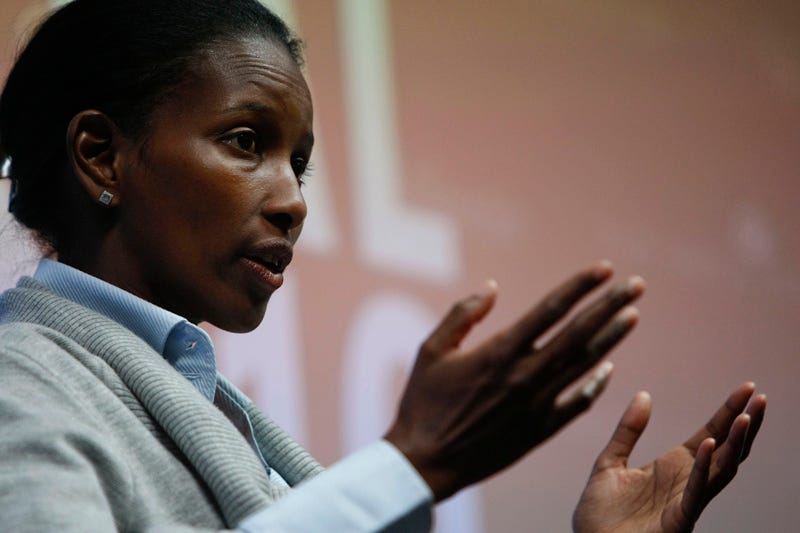
Ayaan Hirsi Ali, the one-time leading new atheist, has converted to Christianity. And her reasons aren’t as harebrained as you might think.
Hirsi Ali overcame her early indoctrination into Islam, in Kenya, at the hands of the Muslim Brotherhood, having welcomed Bertrand Russell’s skepticism, as she found the latter expressed in his book Why I am not a Christian. She became a secular activist and an outspoken critic of Islam’s treatment of women.
But as she says in her article, “Why I am now a Christian,” she’s since feared that liberalism is losing the culture war with more united ideologies, including Chinese or Russian authoritarianism, medievalist Islam, and even “the viral spread of woke ideology, which is eating into the moral fibre of the next generation.”
Hirsi Ali’s search for a strong Western ideology
One problem, she says, is that “atheism is too weak and divisive a doctrine to fortify us against our menacing foes.” This is especially so because, as Tom Holland explains in Dominion, Western secularism is based on the Judeo-Christian civilization. Liberal values, she says, derive from monotheism, so Western atheists are inherently alienated from their cultural roots.
Moreover, citing a line that’s often attributed to GK Chesterton (but is instead due to Émile Cammaerts) and that echoes Dostoyevsky’s infamous insinuation in The Brothers Karamazov, she says, “When men choose not to believe in God, they do not thereafter believe in nothing, they then become capable of believing in anything.” Wokeness seems her main example of a frivolous secular ideology that hasn’t any hope of countering Russian authoritarian kleptocracy, Chinese collectivism, or Islamism.
The second problem, then, is that atheism doesn’t fortify the soul. As she says, for her, “Atheism failed to answer a simple question: what is the meaning and purpose of life?” Lacking an obvious answer, the West is losing the global propaganda war just as surely as Israel’s losing it in its conflict with the Muslim world. Consequently, she says,
In this nihilistic vacuum, the challenge before us becomes civilisational. We can’t withstand China, Russia and Iran if we can’t explain to our populations why it matters that we do. We can’t fight woke ideology if we can’t defend the civilisation that it is determined to destroy. And we can’t counter Islamism with purely secular tools. To win the hearts and minds of Muslims here in the West, we have to offer them something more than videos on TikTok.
She goes on to say that, “Unless we offer something as meaningful, I fear the erosion of our civilisation will continue. And fortunately, there is no need to look for some new-age concoction of medication and mindfulness. Christianity has it all.”
A Pascalian wager
Although Hirsi Ali’s criticisms of atheistic liberalism here aren’t harebrained, they do indicate that she’s confused.
Her criticisms go back at least to Friedrich Nietzsche. Nazis styled their vulgar fascism as an answer to Nietzsche’s problem of the death of God, a problem that sparked terror in enlightened individuals. In place of God, we’d have the Übermenschen, heroic, pure Germans who overcome harsh realities.
That gambit burned itself out in WWII, as did Germany’s fascination with countercultural inwardness. With the subsequent collapse of the Soviet Union, the triumph of American-led liberalism was indeed a pyrrhic victory since compared to Nazism, liberalism is spiritually hollow by design. The point of liberalism is that it’s safer to protect individual liberties than to impose some conception of absolute truth on everyone. All liberals seek to “impose” is multicultural tolerance for opposing interests, out of respect for everyone’s right to decide for themselves what to think and how to live.
So, Hirsi Ali’s worry about the sustainability of liberalism in a world of competing absolutes is well-founded. Her solution, however, is just a non sequitur. After all, none of this has to do with atheism. It’s liberalism that Hirsi Ali thinks is a weak basis for a civilization. No one said atheism itself should tell us the meaning of life. Atheism is just a rational doubt about the religious claim that some gods or miracles are real.
That is, she thinks liberalism is weak even as she accepts liberal values since she says the “freedom of conscience and speech is perhaps the greatest benefit of Western civilisation.” The problem, for her, is that those values aren’t well-defended on atheistic grounds.
Yet Hirsi Ali’s turn to Christianity looks like a Pascalian wager. She’s betting that an atheistic culture will fail — even though she cites China as a strong counterweight to the West, and China’s thoroughly atheistic. Still, like Ben Shapiro, she says the West needs a religious foundation since atheistic liberalism isn’t sufficiently inspiring or unifying.
Yet you don’t determine the truth by betting on the possibilities. And just because Christianity might be more useful than liberalism in certain respects, doesn’t mean Christian theology is true. Logically, then, Hirsi Ali’s criticisms pose no challenge at all to atheism, not unless she sides with an extreme pragmatist conception of truth.
But her confusions don’t end there.

Some problems with modern Christianity
What could it mean to turn from atheistic liberalism to Christianity, after conceding, as she says, that “Christianity outgrew its dogmatic stage”? What followed that stage of “Judeo-Christian” history was precisely secular liberalism or atheistic, naturalistic humanism. Only then did freedom of thought flourish in the West, with the doubting of Christianity.
Moreover, whereas she says that the precious freedom of conscience “is the product of centuries of debate within Jewish and Christian communities,” she doesn’t reckon with the fact that that debate was also with paganism. Christian dualism and Gnostic tendencies, for example, are outgrowths of Neoplatonism. Augustine incorporated that pagan and Gnostic dualism into Christendom.
That Greco-Roman influence on both Hellenistic Judaism and Romanized Christianity is relevant because the modern stage of Christianity, the one that followed dogmatic, Scholastic medievalism in Europe reached back to ancient paganism in search of independent, viable foundations of humanism. The result was a more naturalistic, human-centered outlook, one that promoted pride in our civilizational progress, pride that was evident in the scientific and industrial revolutions, and in the rise of capitalism and democracy.
The kind of liberal Christianity that Hirsi Ali might have in mind as her replacement ideology is hardly admirable since as I’ve shown elsewhere, this kind of Christianity is a pitiful thing indeed. Liberal Christianity is just an insipid gloss on secular humanism.
She tries to motivate some such Christianity by saying, “It became increasingly clear that Christ’s teaching implied not only a circumscribed role for religion as something separate from politics. It also implied compassion for the sinner and humility for the believer.”
Sure, the Jesus of the New Testament wasn’t interested in politics — because he’s portrayed as having thought that the world was about to end, that God’s kingdom was soon to arrive, making human political and progressive pretentions moot. Jesus rejected politics because he was a counter-cultural moral purist, and that absolutism conflicts with liberal tolerance.
Hence, liberal Christianity is an exercise in sophistical whitewashing with feel-good platitudes. The liberal Christian needs to square humanistic tolerance and cognitive humility with Jesus’s uncompromising otherworldliness — which is an impossible task.
If Hirsi Ali turns instead to conservative Christianity, her worry should be that that form of the religion is unsustainable because of its flagrant conflicts with science and with practically every other facet of modernity. In fact, the difference between conservative Christianity and Islamic fundamentalism is only cosmetic. So, Hirsi Ali would only be shopping around in picking one flavour of religious fundamentalism over another.
Given her forwarding of Cammaert’s smug allegation that atheism is compatible with a wide variety of worldviews, she might reply that it’s the atheist who does the shopping for beliefs, whereas the Christian is anchored by a creed. Fundamentalist Christianity is indeed narrowminded; indeed, it’s so narrowminded that the fundamentalist is bound to ignore or to downplay the inhuman variety of things that the natural universe in fact includes.
In that respect, liberal tolerance is more realistic than religious fundamentalism because the liberal’s open-mindedness accords with the universe’s mindless, undiscriminating creativity. Are you imagining a whole planet made mainly of water or diamond? How about weird alien cultures, bizarre laws of quantum causality, or an astronomical range of possibilities? The godless universe has you covered.
Of course, that’s not to grant that the atheistic liberal is so open-minded as to be irrational. The Christian is chained to an archaic creed, while the typical atheist is anchored to the methods of critical thinking.
So no, atheists aren’t likely to believe just anything. On the contrary, by sacrificing their integrity in accepting coded gibberish so they can pass the test and belong to their religious group, theists such as Christians are poised to believe other kinds of nonsense too. Hence, Evangelical Christians can transition smoothly from accepting apocalyptic, end-times theology to entertaining Trumpian conspiracy theories about stolen elections and baby-eating Democrats.
A noble atheistic religion?
Regardless of the type of Christianity Hirsi Ali means to promote, the trick would be to find an honourable answer to the question of life’s meaning, and a practice that can unite and uplift the masses.
The problem with new atheism, as I’ve argued elsewhere, is that it was too scientistic and insufficiently philosophical, so the leaders of that social movement just dismissed Nietzsche’s challenge. Hence, after the tribal collapse of new atheism, atheists like me explore nobler kinds of religiosity such as transhumanist, existential pantheism.
If Hirsi Ali’s looking for a mass movement to counter Russia, China, and Iran, however, she’d have to surrender a hope for excellence or nobility since those are likely rare goods. Mainstream culture is always relatively lame because it’s political rather than artistically or spiritually inspired. Liberalism is political, as was the bastardized Jesus movement that governed Christendom, and as is Chinese pragmatic materialism and the Muslim world’s exaltation in the act of surrendering to a higher power.
Politics is unfit for spiritualists. Hence, a spiritual or existentially awake person should shun organized religions. Betting on the outcome of civilizational conflicts, too, is a political, not a spiritual act. Hirsi Ali’s time in Dutch politics, and her work for the conservative Hoover and American Enterprise institutes have apparently tainted her response to the Nietzschean crisis of late modernity.
I collect my Medium writings in paperback and eBook forms, and I put them up on Amazon. Check them out if you’d like to have them handy and to support my writing in that way. The newest one is Questing for Epiphanies in a Haunted House, and its 600 pages include 99 recent, wide-ranging articles of mine.


