
Critiquing Christianity
The Emptiness of Liberal Christianity
How the righteousness of liberal Christianity reduces to secular humanism

What’s the use of liberal Christianity? Does it add anything crucial to secular humanism or is that watered-down religion superfluous in the twenty-first century?
Let’s test the merit of liberal Christianity by considering Dan Foster’s case against the conservative Christian’s celebration of the Supreme Court’s overturning of Roe v Wade.
The liberal Christian takedown of Evangelical bigotry
Dan Foster is repulsed by the Evangelical Sean Feucht’s tweeted response to the SCOTUS decision: “Goliath is dead!!! Time to chase down the Philistines!!!” Feucht is here comparing Goliath to Roe, and he’s saying, presumably, that all secular liberal culture should be demolished too, that thanks to the David of Donald Trump, Christian forces have the secular enemies on the run and shouldn’t let anything un-Christian in the US escape the Christian’s wrath.
Or Feucht’s saying something appalling along those lines. As Foster understands it:
In Feucht’s Biblical analogy, the people of God are those who oppose abortion. Therefore, to have a different view of abortion to the hard-core pro-life view is to be an enemy of God and God’s apparently chosen people.
Feucht is effectively saying, “We are the good guys here! We are the people of God! Anyone who isn’t a pro-lifer is a Philistine. They are our enemy, and we must defeat them in battle.”
What disturbs Foster is that “When you presume that God is on your side, the logical side effect is that you presume that your way is God’s way. That being the case, you must do what you can to impose that ‘way’ on the rest of the world.”
Foster points out that the US is a multicultural nation: ‘In reality, many groups of people cannot or will not conform to the religious and cultural template that our “Christian nation” imposes. People of different races, faiths, cultures, genders, and sexual preferences don’t fit under a Christian nationalist regime.’ Moreover, “The idea that one group enjoys the favor of God more than another is really the spirit behind colonialism, racism, sexism, elitism, homophobia, Islamophobia, and any other kind of prejudice you’d care to name. Only when you believe that all people are God’s people can you truly embrace all people in the same way God does.”
Then there’s what Foster thinks is the irony of Feucht’s conclusion:
The way that Jesus lived his life was a critique of the misuse of religion for exercising power over others. His most scathing words were reserved for the religious leaders who sought to burden the average person with religious obligation and law-keeping.
Yet, here we stand at a moment in history where certain “Christians” believe they must impose the “Christian” way on the rest of society by force.
Fact: True Christianity has never been driven forward by force. True Christianity has never been imposed on others but imparted through love and humility.
Today, I can’t help but think that Jesus is not with the “Christians” as they celebrate the end of abortion with great fanfare and much back-slapping. Rather, I think he is at the side of the woman who has had her destiny decided for her by the church — even though she may or may not have faith in their God.
Cherry picking and the No True Scotsman fallacy
Yet the US is multicultural despite Christian history and the universal implications of Christian dogmas. Multiculturalism is based on the secular liberal concept of tolerance for different expressions of human freedom. America’s separation of church and state isn’t based on Jesus’s cryptic rejoinder to render to Caesar what’s Caesar’s, but on the abhorrence of wars between religions.
Rather than establishing any religion as official policy, you let the citizens believe and do whatever they want, if they’re not harming anyone else in the process. That’s what would later be known as John Stuart Mill’s harm principle, a staple of liberalism which was enshrined also in France’s 1789 Declaration of the Rights of Man and of the Citizen:
Liberty consists in the freedom to do everything which injures no one else; hence the exercise of the natural rights of each man has no limits except those which assure to the other members of the society the enjoyment of the same rights. These limits can only be determined by law.
Was Jesus liberal when he preached hellfire for everyone who had the temerity to think the wrong thoughts, let alone to act against God’s commandments? I think not. If “all people are God’s people,” as Foster says, why does Paul speak of divine “wrath” for the unsaved (1 Thess. 5:9), and why do the canonical gospels present Jesus as threatening repeatedly that the unsaved will be punished forever in Hell?
Does Foster not believe that God’s on his side more than on the Muslim’s, the Buddhist’s, or the secular humanist’s? Or is the liberal “Christian” so timid and mealy-mouthed that he or she thinks everyone’s entitled to his or her own truth, that there’s truth in all religions and even in atheistic worldviews, that everyone will go to Heaven in the end, and that there’s no pressing need to trust in Christian revelation in this life?
Foster doesn’t like how conservative Christians seek to impose their faith on others. But in that case, Foster must be opposed to virtually all of Christian history, from the persecution of Gnostics as heretics, to the destruction of pagan culture, to the Inquisition, the Crusades, the burning of books and witches, the pogroms, the racist missions to foreign lands, the conquering of the New World, the Nazi Holocaust (against the Jews whom the New Testament demonized and scapegoated), and duplicitous Christian evangelism in the modern conflict between faith and reason.
All of which stems from Saint Paul’s zeal to spread the gospel, and from Mark 16:15, in which the risen Jesus says to his followers, “Go into all the world and preach the gospel to all creation.” See also the equivalent account of what’s known as the Great Commission, in Matt. 28:18–20: ‘Then Jesus came to them and said, “All authority in heaven and on earth has been given to me. Therefore go and make disciples of all nations, baptizing them in the name of the Father and of the Son and of the Holy Spirit, and teaching them to obey everything I have commanded you.”’
The New Testament has the risen Jesus tell his followers to teach “all nations…to obey everything” he commanded. But Foster is prepared to declare Feucht and his zealous ilk untrue Christians, because Foster stands on the shoulders of secular liberals. This is indeed ironic, but not in the way Foster thinks.
“True Christianity,” Foster says, “has never been driven forward by force.” But of course, this is just the no true Scotsman fallacy, which ignores the Church’s egregious and lengthy history of being spread precisely by force, from the fourth century onwards. Who’s to say what counts as true Christianity, without begging the question? So why not just ditch the Christian brand of moralizing since it’s been rendered obsolete by philosophical ethics and by science-driven, industrial progress?
Foster says Jesus’s most scathing words were for the Pharisees who tried to enforce a legalistic conception of Judaism (according to the anti-Jewish New Testament). And Foster assumes that Christians ought to be as humble and loving as gentle Jesus. But this gets to the heart of the matter: Was Jesus special or not? The Gnostics followed the Mystery Cults which in turn kept alive Eastern mysticism in the Mediterranean, the point being that the dying-and-rising savior god is only a symbol of everyone’s divine potential to be reborn with a theophany.
That inclusive form of Christianity died out because it couldn’t sustain an organized Christian religion. Thus, for the leading church, Jesus became the only begotten Son of God, which meant the Christian’s obligation isn’t to attempt to be fully Christlike since that would be blasphemous. Rather, the Christian’s duty is to trust in Jesus’s unique power to save you. The Christian has no business reinventing the wheel if Jesus’s life and death were all that God needed to establish a way for us to atone for our sins. Why, then, shouldn’t the true Christian just spread the gospel and eliminate all satanic obstacles to the Great Commission? Aren’t Heaven and Hell on the line? Why tolerate rival religious or secular messages which will only get you killed in the afterlife?
It goes without saying that if the liberal Christian declines to take seriously the offending passages in the New Testament, this cherry-picking leads not to “true Christianity” but to the skeptical standpoint of liberal secular humanism.
Christian patriarchy and the sin of feminism
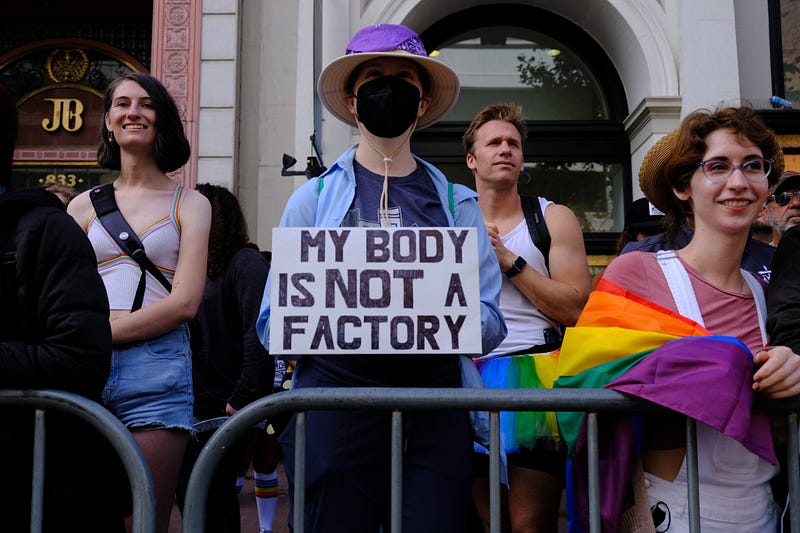
Finally, there’s the question of whether Jesus would be pro-fetus (known sophistically as “pro-life”) or in favour of women’s rights to abortion. The question is anachronistic since the Jesus that’s presented in the New Testament could hardly have fathomed the centuries that led to the modern, godless scientific perspective and to the secular liberalism that are behind the feminist support for women’s rights.
Jesus evidently thought the world was about to end within decades of his death, so were he to have witnessed centuries upon centuries of subsequent history with no Day of Judgment in sight, he might have been so humbled that he’d have lost his religious faith. In that case he’d have had no theological basis for defending the so-called pro-life position (according to which a God-given immaterial spirit enters the fetus at conception, thus making abortion murder even in the first trimester).
Jesus’s Jewish background was patriarchal, as was ancient Greco-Roman culture. This patriarchy was expressed in the Pauline 1 Timothy 2:12, “I permit no woman to teach or to have authority over men; she is to keep silent.” Indeed, all Jesus’s twelve apostles were male, as was Jesus himself, of course, according to the New Testament. Consequently, the Catholic Church forbade women to be priests.
But let’s take the question in the literary abstract: Theoretically, would the Jesus character in the gospels stand with the triumphalist authoritarian Church or with feminist women who demand their reproductive rights? The fact that feminism is based on secular humanism, which the New Testament would regard as satanically arrogant and blasphemous, means that Foster’s liberal Christianity ends up being a mirage.
True, Jesus says that God loves all his creatures and even knows the number of hairs on our head. But Jesus implies that God loves us as wayward children whose role isn’t to grow up and to go our separate ways as adults, but to obey God’s commandments forever. (This is the lesson of the Garden of Eden myth, for example.) Those who exercise their autonomy to depart from God will be punished for it, says the Bible.
Whereas a human parent expects her offspring to obey only while they’re still growing as children, once the children become adults, they’re expected to be independent from their parents. This independence is possible because the planet amounts to neutral territory that sustains many generations, and each generation outlives the previous one and must eventually care for itself. By contrast, God reserves the right to deprive his wayward offspring of any neutral stomping grounds in the long run. God discriminates, providing paradise for his obedient creatures in the afterlife, and torments and ruins for the unrepentant sinners who insist on their autonomy.
Modern feminism says women have equal rights to men in so far as both are people, where a person’s crucial features are his or her consciousness, reason, creativity, and freewill. It’s the celebration of that last attribute, freewill, that conflicts with any kind of Christianity that’s independent of secular humanism. God is supposed to punish us for misusing our freedom. Women want the right to abort unwanted fetuses because women want to take ownership of their earthly life. That in turn is because we appear to be on our own here, and because science informs us that we’re not immortal spirits but persons in the naturalistic sense and that a fetus in the first trimester (when most abortions happen) isn’t a person.
Foster’s welcome to his denunciations of conservative Christianity, the latter being indeed a travesty. But the liberal Christian sounds to me like a parasitic ghost floating around, attaching itself to living persons, and having the gall to dictate how people should live. The ghost of liberal Christianity is nothing without the liberal secular humanism that gives it its shred of dignity.


