
Conservative Savagery and the Overturning of Roe v Wade
The pretense of conservative legal reasoning and the anachronism of bigotry

The Trump-packed US Supreme Court overturned Roe v Wade in a lengthy decision written by Samuel Alito. That document’s length and legal formalities provide the illusion that the decision was reasoned and was based on a conservative judicial philosophy.
Conservatism is inherently anti-intellectual
In contemplating this turn of events, however, it’s crucial to recognize that no such philosophy exists, has ever existed, or could ever come into being. Conservativism is anti-philosophical, which is to say that philosophy is inherently progressive, being the search for knowledge that imperils ignorance, tradition, intuition, dogmatic opinion, and prejudice. Conservatism rests on the latter, primitive foundations which protected every form of barbarism for thousands of years, from tribal bigotry to patriarchy to slavery to autocracy.
Once you allow for the freedom of thought, you effectively end the tyrannical bullying that’s the hallmark of any “conservative tradition.” You thereby recognize the traits of personhood that alone can conduct a thoughtful inquiry, and that make us different from and even more precious than most animals. In holding to dogmas, intuitions, or traditions, against the tide of rational discovery, the conservative retreats to animal ignorance and to the instinctual automation of behaviour, typically by idealizing mere differences in power.
Every conservative “policy” follows directly from the crude oversimplifications of social Darwinism, all other conservative rationales being exercises in dishonest salesmanship. All you need to be a good social or fiscal conservative is to believe there’s no substantive difference between animals and people, and that people “ought” therefore to live like animals.
Conservative practice as such is therefore akin not to anything that occurs in a philosophy classroom, in a court of law, or in a reasoned debate, but to the “law of oligarchy” that prevails in the dominance hierarchies found throughout the animal kingdom. When the strongest, most ruthless, or sociable member of an animal pack dominates the other members, that’s the essence of what’s called the “conservative tradition” in human affairs. Whenever male animals dominate or rape their females or kill their young to safeguard a genetic lineage, that, too, is the essence of “conservative philosophy.”
In a nutshell, conservativism is Friedrich Nietzsche’s principle of the will to power, although Nietzsche prettified his crypto-Darwinian chauvinism with appeals to aesthetics. Regardless, the master, he said, ought to rule over the slave, the strong over the weak, and the “blond beasts” of the “noble races” over the weaker races, because that’s the will of nature and there’s no other worthy ground of morality or of what ought to be done. That’s the essence of “modern conservatism.”
Secular humanism as the foundation of American rights
Turning, though, to Alito’s decision, it goes without saying that you won’t find anything so forthright in it by way of a justification for the Court’s striking down of Roe.
The reason is that Americans have been living with far more than just fifty years of Roe as precedent. All developed societies have also relied on several centuries of humanistic, reason-based progress, from the Protestant Reformation to the European Renaissance, to the Scientific Revolution, the Enlightenment, the American and French Revolutions, and the Industrial Revolution. The end of slavery in the US, and the recognition of women’s right to vote, the civil rights of minorities, and women’s and same-sex people’s sexual autonomy flow not merely from any Supreme Court decision but from those centuries of modernity.
In the West the ground of these rights is none other than secular humanism, the ancient Greco-Roman individualism that stemmed from the Axial Age’s revolutions in “spirituality” (i.e. in existential insight) and that, after centuries of stagnation in Europe due to Christendom, was rediscovered in those very modern revolutions.
Conservatism itself, therefore, is anachronistic, which means the conservative must hide her waywardness behind excuses that are supposed to be at least superficially respectable. She must pretend there’s such a thing as a conservative intellectual or as a conservative philosophy, which is oxymoronic, or she must appeal to some stale theology to attempt to shame modernists for the “satanic” wrongness of their pride and progress.
Alito doesn’t say, then, that women have no right to abort their fetuses because women are supposed to be tied up in the home with the business of raising children to effectuate women’s slavery to men. Again, that protection of a dominance hierarchy is of the essence of conservative “reasoning” in every case. But after the defeat of fascism in WWII, conservatives can no longer voice their savagery so openly.
(Mind you, given what looks like the imminent collapse of the neoliberal economic order, and the global backlash against democracy in the rise of hypermasculine authoritarianism, including the Trump cult in the United States, conservatives might be more forthright now in airing their true grievances.)
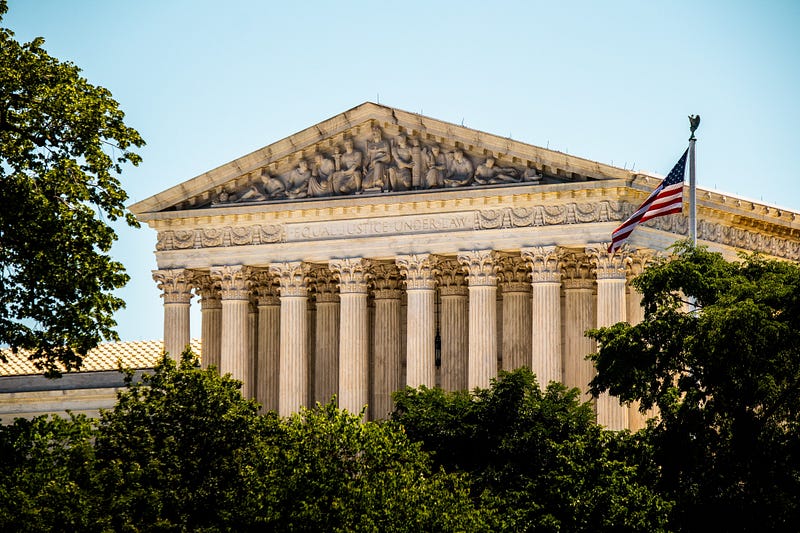
Individual liberty and secular enlightenment
In any case, Alito pretends instead that Roe had to be struck down because, in applying the Constitution’s Fourteenth Amendment, Roe failed to meet the test that goes back at least to a 1997 ruling, Washington v Glucksberg, which says, “The Court’s established method of substantive-due-process analysis has two primary features: First, the Court has regularly observed that the Clause specially protects those fundamental rights and liberties which are, objectively, deeply rooted in this Nation’s history and tradition…”
Thus, Alito says in the decision, “Guided by the history and tradition that map the essential components of the Nation’s concept of ordered liberty, the Court finds the Fourteenth Amendment clearly does not protect the right to an abortion. Until the latter part of the 20th century, there was no support in American law for a constitutional right to obtain an abortion.”
As for that amendment’s reference to “liberty,” Alito says, ‘The term “liberty” alone provides little guidance. Thus, historical inquiries are essential whenever the Court is asked to recognize a new component of the “liberty” interest protected by the Due Process Clause.’
Mind you, it’s not just that amendment which protects liberty. The Constitution’s first sentence says the Constitution’s purpose is, in part, to “secure the Blessings of Liberty to ourselves and our Posterity.” As to the meaning of those blessings, the Constitution was surely informed by the Declaration of Independence, which says, “We hold these truths to be self-evident, that all men are created equal, that they are endowed by their Creator with certain unalienable Rights, that among these are Life, Liberty and the pursuit of Happiness.”
Notice that although the Constitution refers there to our Creator-given rights, that’s only window dressing since the Constitution’s business is wholly secular. Christianity would have everyone repress their sinful liberty and to sacrifice their earthly happiness like Jesus on the cross to obtain paradise in an afterlife, whereas the Constitution’s framers were saying that the government’s task is to wave away that religious agenda, to enable people to be free and to find happiness in this life.
Indeed, the Framers’ deistic principles of progressive secular humanism derive, in turn, from ancient Epicureanism and from Baruch Spinoza’s naturalization of theistic religions, as Matthew Stewart shows in Nature’s God. They derive, too, from John Locke’s argument that
The state of nature has a law of nature to govern it, which obliges every one: and reason, which is that law, teaches all mankind, who will but consult it, that being all equal and independent, no one ought to harm another in his life, health, liberty, or possessions: for men being all the workmanship of one omnipotent, and infinitely wise maker; all the servants of one sovereign master, sent into the world by his order, and about his business; they are his property, whose workmanship they are, made to last during his, not one another’s pleasure: and being furnished with like faculties, sharing all in one community of nature, there cannot be supposed any such subordination among us, that may authorize us to destroy one another, as if we were made for one another’s uses, as the inferior ranks of creatures are for ours. Every one, as he is bound to preserve himself, and not to quit his station wilfully, so by the like reason, when his own preservation comes not in competition, ought he, as much as he can, to preserve the rest of mankind, and may not, unless it be to do justice on an offender, take away, or impair the life, or what tends to the preservation of the life, the liberty, health, limb, or goods of another.
As with the rest of his early-modern philosophizing, Locke’s argument, made in the seventeenth century, is infamous for mixing up philosophical reasoning with religious posturing. Like a good conservative, a religious person would just appeal to the commandments laid out in some scripture. But towards the end of that quotation Locke says reason as the law of nature informs us that we’re all equally free. His appeal here is to the Golden Rule, or to logical consistency in matters of morality. Sure, we’re supposedly God’s playthings, but just as we each preserve ourselves, Locke says, “so by the like reason” we should seek “to preserve the rest of mankind.”
Later, in the nineteenth century, John Stuart Mill famously explained liberty as being based on the harm principle, which is that
the sole end for which mankind are warranted, individually or collectively, in interfering with the liberty of action of any of their number, is self-protection. That the only purpose for which power can be rightfully exercised over any member of a civilised community, against his will, is to prevent harm to others…The only part of the conduct of anyone, for which he is amenable to society, is that which concerns others. In the part which merely concerns himself, his independence is, of right, absolute. Over himself, over his own body and mind, the individual is sovereign.
The Constitution’s “blessings of liberty,” then, are practically infinite in that the long-established secular reasoning is that our individual freedom shouldn’t be restricted unless our exercise of that freedom interferes with someone else’s exercise of their freedom. No wonder, then, the Constitution doesn’t make explicit every possible liberty that ought to be legally protected in a free society! Such a document would be endless. If you’re not harming anyone else in the process, you should be free to do whatever you want, even if you’re thereby harming yourself. That’s the American way, which has nothing to do with Christianity.
But even if you were just to apply a narrow, originalist understanding of the Fourteenth Amendment, you’d then have to recognize that that amendment was part of America’s reconstruction after the Civil War. The clauses were intended to provide citizenship rights to former slaves, protecting their bodily autonomy and their sexual rights, too, including their right against rape, and their rights over their children and to be married. Protecting women’s freedom to decide how to use their reproductive capacity, then, would hardly be a stretch from that context. Indeed, Alito’s assertion that the word “liberty” in the Fourteenth Amendment “provides little guidance” is so woefully ahistorical as to be disingenuous.
Modernity and America’s progressive history
As for Alito’s appeal to the lack of protections for abortion in American tradition and history, this is quite specious. That tradition and history are overwhelmingly progressive in comparison to the practices of the ancient and medieval worlds. Note the amendments to the Constitution which correct much of the lingering conservatism (i.e. the blinkered medievalism) that made some of the Framers such notorious hypocrites.
Technically, for instance, the Declaration says only that all men are created equal. Are women, therefore, not persons with equal rights under the law in the US? Perhaps that’s what the sexist Founding Fathers had in mind, just as they waxed eloquent about the Enlightenment philosophy of humanism even while many of them kept African Americans as slaves. Yet the Nineteenth Amendment gives the right to vote to all US citizens: “The right of citizens of the United States to vote shall not be denied or abridged by the United States or by any State on account of sex.”
And the Civil War led to the Thirteenth Amendment, which prohibits slavery in the US. Indeed, the wording of the Thirteenth Amendment implicitly grants women the right to self-determination by outlawing not just slavery but “involuntary servitude,” the latter being the implicit aim of patriarchal conservatism. Again, the “pro-lifer’s” conservative agenda is just the ancient one of keeping women tied up in the home, raising children so they lack men’s power that’s obtained from their control of society’s institutions.
Amusingly, Clarence Thomas made that authoritarian intention explicit when he warned in the decision that ‘we should reconsider all of this Court’s substantive due process precedents, including Griswold, Lawrence, and Obergefell. Because any substantive due process decision is “demonstrably erroneous…”’ That means Alito’s “reasoning” counts just as much against protections for contraception, sodomy, and same-sex marriage as it does against abortion. But Thomas neglected to add that Loving v Virginia, which protects interracial marriage, is just as threatened, and that’s because Thomas happens to be personally in such a marriage.
Regardless, the American tradition is one of recognizing more and more implications of the secular humanism that was at the root of the American Revolution and of modernity more generally. The rights to use contraception, to enter any kind of consensual sexual relationship, or for a women to control her reproductive capacity clearly stem from that tradition of modern progress that did away with the ancient and medieval restrictions on individual liberty.
The Fourteenth Amendment on which Roe was based follows from that progressive history, in saying, “nor shall any State deprive any person of life, liberty, or property, without due process of law.” The burden is on the state to justify depriving the individual — including even a former slave — of his or her right to decide how to dispose of his or her autonomy. The fact that the overturning of Roe is the only case in which the Supreme Court removed an established right, as opposed to adding individual rights and undoing archaic repressions is itself evidence of America’s progressive history which Alito ignores.
The early American history of abortion
And just to give all due credit to Alito’s citing of centuries of common law in support of the claim that abortion is homicide, going back to the misogynistic witch persecutor, Matthew Hale, from the seventeenth century, none of that’s relevant because women weren’t regarded as persons or given a vote in the American political process prior to 1920. Alito’s cynical history lesson would be like presenting a Stone Age caveman’s opinion on quantum mechanics at a physics conference. That outdated history isn’t relevant, let alone decisive.
But that’s not to say Alito’s representation of the past is fair. It shouldn’t surprise us that a Catholic dogmatist like Alito would have trouble with an objective telling of history. The historical-critical method demolishes his mainstream version of Christianity, just as a more complete, unbiased look at history makes nonsense of his cherry-picked account of abortion in the early US.
Abortion was legal and commonplace in the US prior to the mid-nineteenth century, as long as it was done before what was called the “quickening,” the time of the mother’s first felt fetal movement, between the sixteenth and twenty-fourth weeks of pregnancy. The practice was so common that Benjamin Franklin included a recipe for abortion in his widely read textbook of practical information, “The American Instructor or Young Man’s Best Companion.”
The anti-abortion movement started in the nineteenth century when mostly white male doctors saw an untapped market and a way of wresting business from the mostly female, often Black midwives. Ironically, the doctors’ sales pitch was to appeal not to God or the Bible but to their greater scientific expertise, as compared with the midwives’ witchery (with their use of natural, time-honoured remedies).
In this respect, the anti-abortion movement resembles the dawning of the American funeral service industry in the mid-nineteenth century, before which time the dead person’s family took care of the task. Once again, entrepreneurs swooped in as they saw an untapped market, and spread disinformation about the dead body’s uncleanliness, implying that only trained experts should handle the funeral. As a result, Americans came to pay exorbitant fees for services that used to be done for free.
We shouldn’t forget that America’s true religion isn’t Christianity or even secular humanism, but capitalism.

A libertarian argument against abortion?
Perhaps you’re wondering, though, whether the emphasis on individual liberty might support a so-called pro-life argument against the abortion of fetuses. What of the fetus’s right to life? Doesn’t abortion do harm to the fetus, thus violating Mill’s harm principle?
This hinges on the features of personhood that give people special rights not enjoyed by animals. What makes an individual person different from an animal such that the person has the right to act however she wishes (if she doesn’t thereby deprive someone else of the equivalent right)?
Humanists point to traits such as reason, self-awareness, sensitivity to pain, freewill, imagination, and creativity, while so-called pro-life conservatives point to something intangible such as an immaterial spirit that could conceivably be shared even by a fetus in the first trimester. Between the two, only the humanist’s definition of personhood is reality-based. Perhaps abortions in the third trimester should be outlawed or severely restricted on these liberal grounds, assuming the fetus at that stage is viable and has enough natural qualities of personhood. But most abortions happen in the first trimester when the fetus has no such natural (real) qualities.
In any case, the conservative can’t adopt this rational argument without doing away with the savagery that runs rampant across both her worldview and her favoured politician’s policy platform. If even a first trimester fetus is fully a person so that the mother has no right to abort that fetus, since such an act would be murder, poor and non-White adults must have the same right to life, liberty, and the pursuit of happiness as the fetus that the pro-fetus conservative says she would dearly like to protect.
Why, then, hurl the poor adults into the amoral maw of capitalism rather than creating a welfare state to protect the dignity of the lower class? Why starve the government of taxes that could be used in a socialist program to provide everyone in the country with a decent way of life, with free education, healthcare, and a guaranteed living wage? Why demonize and block the brown-skinned refugees who seek asylum in the US? And why create the refugee problem in Mexico and Central America in the first place by insisting on the puritanical drug war, which empowers the drug cartels, when the recreational drugs could be decriminalized and regulated on libertarian grounds? Why insist on the execution of criminals? Why slobber over the prospect of filling the nation with millions of guns that threaten everyone’s safety?
The “pro-life” rhetoric is just a laughable pretext that conceals the conservative’s social Darwinian, patriarchal, xenophobic attitude towards abortion, feminism, and progressive protections of individual liberty.
To be sure, progressives, too, can be inconsistent in their understanding of personhood. The cult of Wokeness, for instance, is a pseudo-liberal form of censorship that exchanges the hysteria of toxic femininity for the more familiar, masculine kind. But when liberals push for “socialist” policies, they’re much more pro-life than the conservative bigots that masquerade as civilized humanists to make it seem as though they deserve a seat at the table.

The conservative’s specious appeal to democracy
Here’s another specious defense of the overturning of Roe: The conservative Court only thereby deferred to democracy, leaving the matter up to the states to decide rather than imposing the right to abortion at the federal level. Isn’t democracy a modern liberal institution? So why force all the states to be so liberal when roughly half are clearly conservative?
Alas for the pseudo-humanistic conservatives, they might as well argue for the repeal of the Constitutional amendments that ban slavery and discrimination against women in voting. Why not let the Southern states establish their Christian version of the Taliban? Why impose the same laws on all citizens of the country? Indeed, why have a unified country at all? Why not break it up into bands of Stone Age foragers or into animalistic dominance hierarchies? Isn’t that the endpoint of the conservative’s slippery slope?
Moreover, this appeal to democracy is disingenuous considering how the Republican Party must cheat at the ballot box to stay competitive in elections with its highly unpopular plutocratic and authoritarian policies. From gerrymandering to the Electoral College to the filibuster to Trump’s attempted coup and his Hitlerian lie about a stolen election, Republicans are as hostile to the principles of democracy as they are to every other facet of progressive modernity.
The Trumpian Supreme Court itself dismantled protections of democracy by weakening the Voting Rights Act and by preventing legal challenges to gerrymandering. Yet the Court has the temerity to pretend that its handing of certain issues over to democratic decision-making at the state level is done in good faith.
Indeed, the conservative’s appeal to states rights is evidently hypocritical since the same Court ruled also that a New York gun control law is unconstitutional. So, states should be able to decide for themselves whether to allow for abortion but not how they should regulate the ownership of guns.
Is this because the Constitution explicitly allows for the ownership of guns in the Second Amendment, but says nothing about abortion? Not at all since the only reason that amendment provides in favour of the otherwise bizarre notion that citizens should have the right to arm themselves as they wish is to establish “a well-regulated militia.”
In colonial America, all able-bodied men of a fighting age had to serve in the militia to defend their nation, rather like how all Jewish citizens in Israel serve in its military. Without such a purpose, the arming of everyone would obviously violate Mill’s harm principle and therefore has no modern humanistic justification. Likewise, the Second Amendment was written at a time when awkward muskets rather than deadlier handguns and automatic weapons were the norms.
Thus, the “conservative Justices” on the Supreme Court aren’t basing their decisions on legal reasoning but on social Darwinian prejudices. There’s no principle at stake for them, but only an anti-modern vision of people living like animals, with some dominating others in a glorious, Nietzschean war of all against all. Why should Americans have so many guns, according to them? Because that market enriches the gun manufacturers who can lord it over others in a wild dominance hierarchy (known euphemistically as a “free market”), and because the Wild West scenario is more like animal life in the wilderness than a civil society governed not by fear and instinct but by reason and humane ideals.
The conservative opposition to gun control is about making life nasty, brutish, and short again, just as the pro-fetus position is rather an anti-women one, because “conservative” is a euphemism for “savage.”


