
Affinity Between The Autistic & Deaf Communities
We have a lot more in common than people might think
Individual differences
I am Deaf and Autistic, and I have noticed quite a few commonalities between these two communities.
Below are general statements which do not apply to every Deaf or Autistic person and are based on my personal experiences.
When we spend the majority of our lives trying to adapt to fit the needs and expectations of mainstream society, it wears on us. It can be very exhausting and discouraging to constantly have to ask for accommodations or to make all of the effort to bridge communication gaps.
Hearing and allistic (non-autistic) people can make things easier by trying to meet us halfway, considering our needs without us always having to ask, and by making efforts to learn and better understand our perspectives.
Direct style of communication
Autistic and Deaf people tend to prefer a more direct, even blunt, style of communication, which other people may find a bit abrasive sometimes.
I very much prefer a direct and clear style of communication, whereas I find hearing neurotypicals tend to use cryptic or coded language, dancing around what they are really trying to say. Out with it already!
History of marginalization
Many in the Deaf and Autistic communities have experienced oppression, discrimination, and marginalization. In the Deaf community, many Deaf children were denied access to sign language, forced to learn to lip-read and speak in order to accommodate the hearing majority.
Similarly, Autistics have been subjected to dehumanizing and traumatic behavioural “therapies” in order to force us to behave more like neurotypicals.
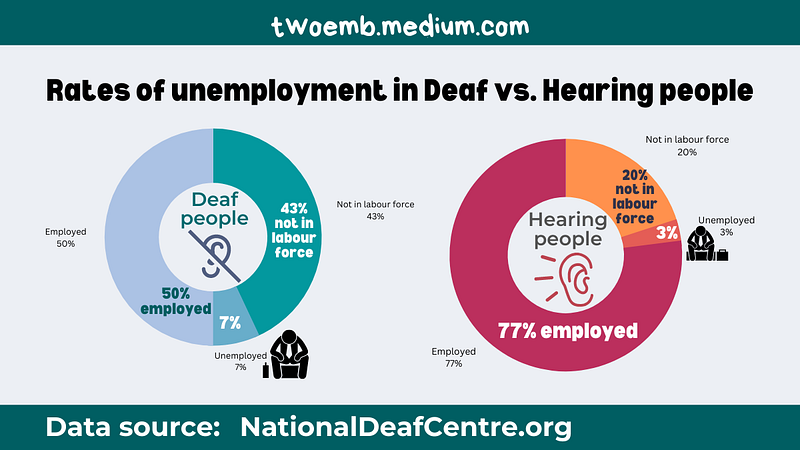
Deaf and Autistic people also experience much higher levels of poverty and unemployment as compared to hearing and allistic (non-autistic) people.
According to the National Deaf Centre, only half of Deaf adults in the U.S. are gainfully employed. The Canadian Association for the Deaf found only 20% of Deaf adults are employed full-time, 42% are under-employed, and 38% are unemployed.
Even more concerning, Statistics Canada found that as many as 86% of Autistic adults are unemployed.
There are many reasons for the high unemployment rates amongst Deaf and Autistic people, a few of which are:
- Language deprivation (ie. denied access to sign language)
- Disability discrimination (assumed incompetence)
- Lack of accessibility and accommodations in workplaces
- Lack of cultural competence (employers not understanding Deaf and Autistic cultural and communication differences)
Perspective & pride
A lot of Deaf and Autistic people do not consider themselves disabled. Many Deaf people consider deafness as an identity or physical trait, like eye colour or height. Similarly, many Autistics identify as having a different neurotype rather than being disabled by autism.
Many Deaf and Autistic people consider society to be more disabling than our physical or neurological differences. It is the lack of knowledge and accessibility we encounter on a daily basis that creates barriers, not our deafness or autism.
More than that, many of us take pride in our differences. We understand that our unique characteristics can make life more difficult sometimes, but can also be accompanied by benefits.
My ADHD can cause me difficulty staying focused on one thing at a time, but it has also led me to success in business. Being Autistic means I have communication and sensory differences, but it also means I have a unique perspective and incredible attention to detail.
Most importantly for me, and many others, is the sense of community.
Culture & community
Since identifying as neurodivergent, I have discovered an amazing community full of divergent thinkers and supportive people who are willing to share their experiences and ideas.
Having been involved with the Deaf community for most of my life, I have experienced the wonders of Deaf Gain. I’ve had the privilege of becoming fluent in sign language (ASL) and have met some amazing people.
Most people who are not involved in these communities don’t seem to understand that Autistics and Deaf communities have their own rich cultures. Culture is defined as,
“The set of shared attitudes, values, goals, and practices… the integrated pattern of human knowledge, belief, and behavior that depends upon the capacity for learning and transmitting knowledge to succeeding generations.” (Merriam-Webster)
In Deaf culture, there are signed languages. There are also predominant values, attitudes, and behaviours which are unique to the Deaf community. Ways of interacting, communicating, and sharing information.
In the Autistic community there is certainly a shared culture based upon shared experiences and neurology.
These shared cultures and communities create safe spaces where people can communicate in ways that are most comfortable for them, can be their authentic selves, and will find people who understand.
When we’ve spent the significant majority of our lives being misunderstood, having people make little to no effort to better understand or communicate with us, it is such a relief to be in a space and in a community where we can be ourselves.
© Jillian Enright, Neurodiversity MB
Related Articles
Ways to support my work
You can leave a “tip” on Ko-Fi at https://Ko-Fi.com/NeurodiversityMB
Become a paid subscriber to my Substack publication
Check out my online store at https://NeurodiversityMB.ca/shop
Read and share my articles from twoemb.medium.com


