
Autherine Lucy Foster, the Architect of Desegregating Alabama’s Education Systems
How one lady dared to stand up for education for all people of color in Alabama.
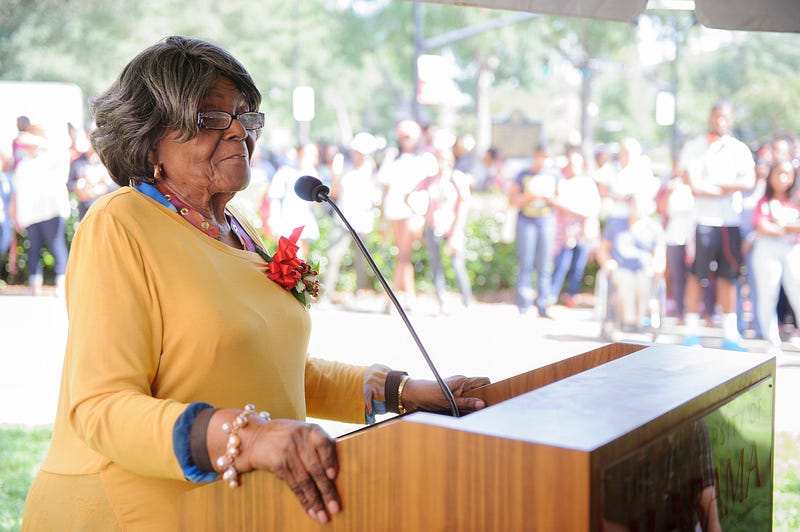
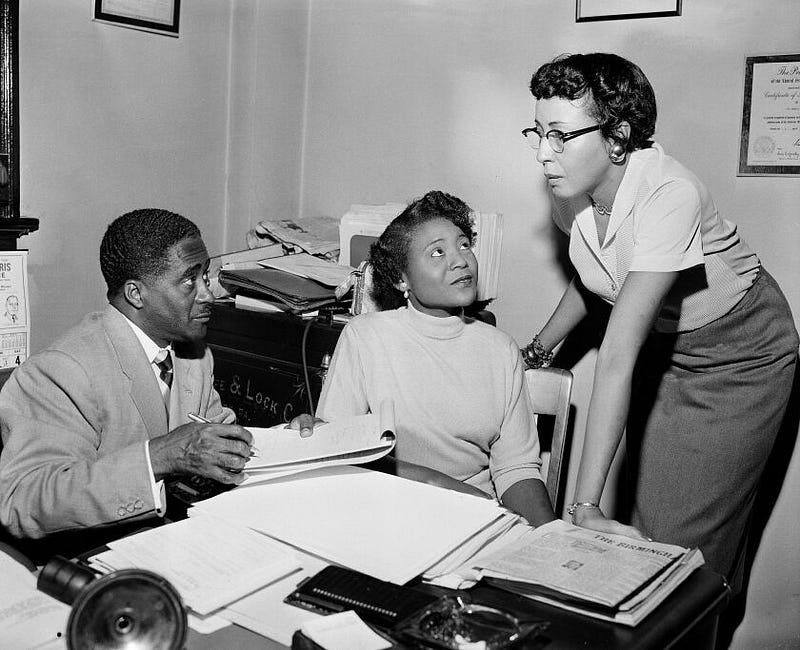
Autherine Lucy Foster, center, with Ruby Hurley, right, and attorney Arthur Shores as she shared her experience at the University of Alabama at a news conference in 1956.
Like many other civil rights activists who stood up for what was right for all people and especially Blacks who were denied not only civil rights but simple human dignity rights, Autherine Lucy Foster took that stance. For this, she endured death threats and racist taunts for being the first Black student to attend the University of Alabama, an all-white university.
The University of Alabama expelled her three days later, because of all the unrest that happened as a result of her attending and as they feared for her safety. She was faced with hostile crowds who chanted racial slurs and hurled debris at her.
She was the forerunner by six years before James Meredith attended another all-white University of Mississippi in 1962. Her determination caused her to face so much ugliness that is and was embedded in America’s soul.
James Meredith’s decision to attend another all-white university sparked a deadly riot by angry whites armed with rocks, bottles, and guns who clashed with federal marshals.
Thousands of federal troops arrived to quell the violence where two people died and hundreds were injured. Meredith was not deterred and emerged after so much unrest from the shelter of a dormitory the next day and became the first Black person to attend the University of Mississippi.
As a young girl, I recalled James Meredith’s historic act putting his life on the lines so that other Blacks who followed would have access to an equal education as Autherine Lucy Foster laid the groundwork for him to follow.
The world’s eyes were glued to the television and media, fearing for both their lives due to the racism that was so prevalent in Mississippi and Alabama, to racist states built on the backs of slavery.
Lucy was born in Shiloh, Alabama to Milton Cornelius Lucy and Minnie Maud Hosea who were sharecroppers and she was the youngest of five sons and four daughters. Her family owned and farmed 110 acres and her father was a blacksmith, made baskets and ax handles to supplement their income.
After high school in 1947, she attended Selma University for two years, then onto the historically black Miles College in Fairfield and graduated with a Bachelor of Arts in English.
Wanting to get a better education, in September 1952, Lucy and her friend, Pollie Myers, a civil-rights activist with the NAACP, applied to the University of Alabama to obtain a second undergraduate degree.
Initially, they were accepted into the school until the authorities realized they were not white. and rescinded their admittance to the school. With the support of the NAACP, Lucy and Myers filed a racial discrimination lawsuit against the school and it took almost three years to resolve.
June 29, 1955, the NAACP won a court order preventing the University of Alabama from rejecting their admission applications based on their race. Lucy was admitted but Hudson was rejected on the grounds that she had a child outside of wedlock which made her an unsuitable candidate.
Lucy was officially admitted but was barred from all dormitories and dining halls. Days later, the court amended the order to apply to all other African American students seeking admission.
The university had hoped Lucy’s isolation and without Hudson, she would eventually drop out of school. Hudson remained along with others on the sidelined and encouraged Lucy to remain.
February 3, 1956, Lucy enrolled as a graduate student and became the first African American ever admitted to a white public school or university in Alabama. Upon attending her first class, February 6, 1956, riots broke out on the campus and a mob of over a thousand men pelted the car in which the Dean of Women drove Lucy between classes, mobs jumped on the hood of the car, eggs and bricks were hurled, crosses burned, threats made against her life and the University president’s home was stoned. These riots led to Lucy being asked to leave for her own safety by the president and trustees of the university.
Hence Lucy became known as “the architect of desegregating Alabama’s education systems.” Thurgood Marshall, the first Black Supreme Court Justice, helped win the 1954 landmark Supreme Court desegregation case, Brown v. Board of Education.
Lucy’s attorneys, the NAACP, Arthur Shores, and Marshall helped build a lawsuit against the University of Alabama because they felt the school helped the white mob due to their lack of protection for Lucy preventing her from attending class. These legal proceedings lasted from 1953 until 1955.
Lucy and the NAACP filed contempt-of-court charges against the trustees and president of the University that led the Federal Court in Birmingham to order Lucy to be reinstated and demanded adequate protection for her.
Due to all the legal actions against the university, Lucy was expelled permanently on the basis that she had defamed and slandered the University and therefore could not be enrolled as a student. At this point, the NAACP felt it was pointless to continue the legal fight as Lucy acquiesced.
Later the University President, Oliver Carmichael, resigned due to the trustees’ opposition to Lucy’s admission. His resignation made a huge statement regarding the injustices against Lucy.
Everything changes sooner or later. The university’s trustees recently decided to rename the classroom building, Autherine Lucy Hall, removing the name of one-time Gov. Bibb Graves, a leader of the Ku Klux Klan.
A week after the University of Alabama officials had dedicated the campus building where Lucy briefly attended classes in her honor as a “master teacher,” happened on the hills of her death.
During the ceremony, she stated, “If I am a master teacher, what I hope I am teaching you is that love will take care of everything in our world, don’t you think?”
When Foster left the campus in the 1950s, Black students did not attend until 1963 in the face of Gov. George Wallace who vowed to prevent their entrance as he turned water hoses and dogs on the students amidst much protest. The National Guard later pushed Wallace aside.
In conclusion, Ms. Foster’s legacy includes the university honoring her as a revered alumnus, contributor to the desegregation of educational institutions with much bravery in the Deep South, civil rights advocate, spokesperson for the NAACP nationwide, and in 2019 was awarded an honorary doctorate by the university having returned and earned a master’s in education in 1992.
At 92, Lucy Foster gets to R.I.P. and deservingly so as she leaves a path for many to follow and stand on her shoulders.
For additional reads:


