
Art and Philosophy: The Ship of Theseus and Art Restoration
How much of this artwork can you restore before it isn’t the same work anymore?
Part I: The Most Expensive Painting
After the Salvator Mundi, a painting ostensibly by Leonardo da Vinci, broke the record for the world’s most expensive painting in 2017 when the hammer fell at $450 million, the art world was a buzz with gossip. The painting had sky-rocketed in value, having appeared at auction in 2005 with a modest $1,200–1,800 auction estimate. It also far outstripped the previous record-holder for most expensive painting, Interchange by Willem de Kooning which sold for $300 million in 2015.
When planning the sale, the auction house, Christie’s, had done something very odd: they had placed this Renaissance-era painting in their contemporary evening sale. This unusual move made a Renaissance Art History professor of my acquaintance quip, “Of course it’s contemporary, at least half of it was painted in the last decade.”
The painting has come under fire for not being a “real” Leonardo, and with a lot of scrutiny about the way it was restored. After the painting was bought by a consortium of dealers in 2005, they commissioned respected art restorer Dianne Dwyer Modestini to oversee the restoration. Modestini began by cleaning the old over painting on the painting, and this photograph demonstrates just how much of the original painting had been lost:
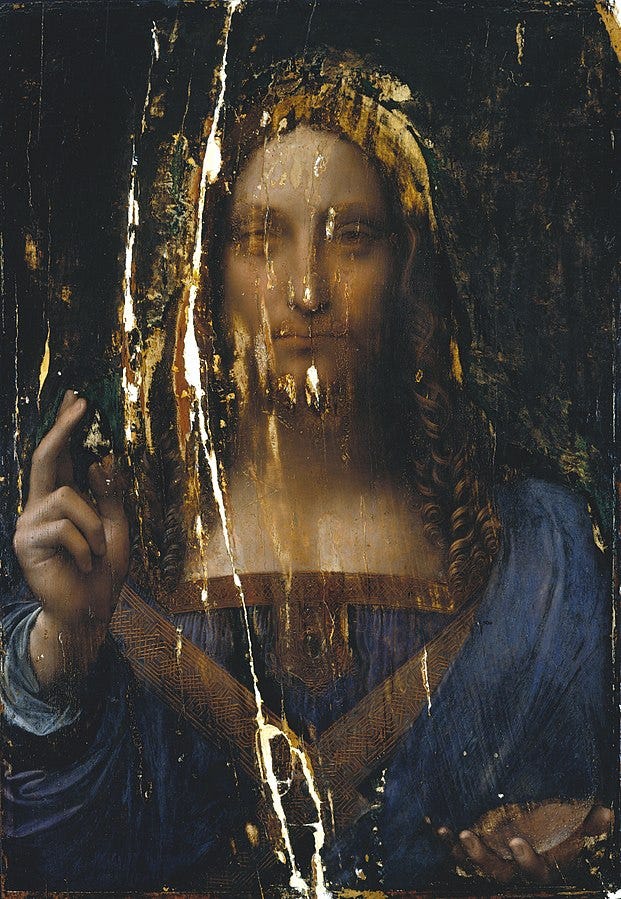

There are some other concerns about Salvator Mundi’s attribution, to be sure. Many still think it is likely not by Leonardo, or perhaps only partially by him. But still, there is a lot of scorn directed at this restoration in particular, and especially what this means for the painting’s proposed authorship. Why is that?
Part II: Art Restoration
Art restoration is part of a larger process of taking care of art that we call art conservation. Art conservators take care of artworks by providing them the correct light levels, humidity, temperature, regular cleanings, and pest control needed to prolong their lives. However, sometimes conservation is not enough (or has come too late) and so conservators may attempt to restore an artwork.
Sometimes the process of restoring artworks is also a learning process and can tell us a lot about how the artworks were made and how they were later used. The recent exhibition of Vermeer paintings at the National Gallery of Art revealed new information about Vermeer’s materials and process of painting, for example.
What the restoration process is depends a lot on the type of object and the type of damage it received. Sometimes surface dirt will be removed, sometimes yellowing varnish will be removed and replaced, sometimes holes will be filled in, sometimes paint will be retouched.
New techniques and procedures are developed all the time, and our tastes in conservation also change. Some techniques from the past are regarded with horror today, such as the acid bath and vigorous scrubbing that conservators gave to the Parthenon Marbles at the British Museum in the nineteenth-century to whiten them. Nowadays it is fairly common for conservators to use techniques that can be reversed later when the artwork has to be restored again.
But what does this have to do with philosophy?
Part III: The Ship of Theseus
The Ship of Theseus is a thought experiment and one of the unsolved problems of philosophy. Our first record of it comes from Plutarch, writing in the early second century CE.
The problem is based on this mythological story: King Minos of Crete declared war on King Aegeus of Athens, only offering peace if the Athenians would send him fourteen Athenian children every year to sacrifice to the Minotaur trapped in his labyrinth. This continued for several years, until King Aegeus’s son Theseus successfully defeated the Minotaur.
To commemorate this event, the Athenians took Theseus’s ship on an annual pilgrimage to Delos to pay respects to the god Apollo. This continues for years, decades, and centuries.
The problem is: If you have a ship, and the ship is repaired and eventually after centuries of repairs every part of the ship is replaced, is still the same ship?
The philosophy essentially comes down to whether or not “the ship” is the same thing as all of the components that make it up.
If we replace just one part of the ship, is it still the same ship? How much can we replace before it is a new ship? Does it matter if we replace the items one at a time, or all at once?
And if your immediate reaction is to ask “Why does it matter?”, that’s where art comes in.
Part IV: Art as Applied Philosophy
Each time a conservator works on an artwork, they (and their clients) make decisions about what type of procedures to perform and what the ideal end result will be. In doing so, they engage the Ship of Theseus problem.
Instead of a ship, let’s consider a painting. Say that a painting was made and later needs to be restored. Under which of the following restoration circumstances would it be the same painting, and under which circumstances would it be a different work?
- The artist is working in his studio on the painting and towards the end of the process makes an alteration to a particular part of the painting. Is it still the same painting?
- The painting is freshly painted but still wet and the client agrees to buy it, but when the artist is going to deliver the artwork to their client, he smudges part of the painting. The artist fixes the smudge and delivers the artwork to the client. Is it the same painting?
- Many years after the client has purchased the painting, the painting receives a scratch on the surface. The artist is still alive and comes over to fix it. Is it the same painting?
- Many years after the client has purchased the painting, the artist comes to visit and decides he did not like how he painted a particular part of the painting. He paints over it to fix this error. Is it the same painting?
- Many years after the client has purchased the painting, the artist has died but the painting gets a scratch. The client commissions an art conservator to fix the scratch. Is it the same painting?
- The painting becomes damaged, but it is more than a scratch. Say that something fell onto the painting and a big scuff marl has occurred. Ten percent of the painting has to be repainted. Is it the same painting?
- Twenty percent? Is it the same painting?
- Fifty percent? Is it the same painting?
- What if the damage has not happened all at once, but over time? Over hundreds of years, a scratch here and there have been restored. Is it the same painting?
- Many years later, the varnish on the painting placed by the artist has yellowed and discolored. The clients commission a conservator to remove the old, discolored varnish and replace it with a clear varnish. No other changes are made. Is it the same painting?
- Many years later, the client’s descendants decide to reframe the artwork. In the process they realize that the frame they like is a little too small for the artwork, so they cut a few inches off the bottom of the painting to make it fit the new frame. Is it the same painting?
- Many years later, the client’s descendant is also an artist and she adds her own design on top of the painting. Is it the same painting?
- The painting is totally ruined and there is no saving it. Another artist scrapes the old painting away and reuses the canvas to make an identical artwork. Is it the same painting?
- The painting is totally ruined and there is no saving it. Another artist scrapes the old painting away and reuses the canvas to make their own unique artwork. Is it the same painting?
Where on this list do you think we cross the line into having a completely new artwork? Most of us would probably agree that the first one is certainly the same painting, and the last two are certainly not the same painting, but in the middle the situations have us scratching our heads and saying “Well, it depends.”
The authenticity of the painting is made, in part, by the author of the painting, the materials the time frame, and the intention. These elements, held in some sort of balance, determine whether or not we think of the painting as being authentic, of being the “same painting.”
No object can truly stay in stasis over a long period of time. Most of us would agree that if you had a boat and replaced every single part of it in one go, you have a new boat. But it’s a matter of degrees. No one outside of a philosophy classroom would say that you have a new boat if you just replaced one screw of it.
Though, saying that, we do sometimes place additional value on an object when all parts of the item are original rather than replacements, especially with specific brands, or with antiques and items of historical significance. Authenticity of an object has a lot to do with its perceived wholeness or originality.
Is it the same with paintings?
Part V: Conclusion
This may sound like more idle speculation, but it is a thorny question with real monetary consequences. While almost no truly old artwork has survived without at least some form of restoration, an artwork that has major restorations (like the Salvator Mundi) can also raise questions about authenticity. This is partially because restorations by necessity are interpretive and sometimes conjecture, and also because it is possible for a restorer to take liberties in ways that would influence an artwork’s attribution. Where artwork attributions rely on connoisseurship, anything that changes the original artist’s intention or result can threaten our ability to make an accurate attribution of authorship.
Much of this is in the eye of the beholder, though. There is no real formula for calculating what kind of changes had been made to an artwork and what impacts those have on price .Some artworks can become more valuable after they are restored. Take, for example, Pablo Picasso’s Le Rêve of 1932. This painting was purchased by mogul Steve Wynn in 2001, and in 2006 he agreed to sell the painting to Steve Cohen for $139 million. The day after the sale was agreed upon, Wynn was showing the painting to friends and accidentally put his right elbow through the canvas. The sale was cancelled and the painting was restored for $90,000. The thing that boggles the mind is that Cohen did end up purchasing the damaged and restored painting from Wynn in 2013, this time for $155 million.
So, “it depends.” Art is frequently the place where theoretical philosophy comes to life, which may be something to consider the next time you hear a philosophical problem and think “What difference does it make anyway?”
Hi, I’m Mary! I’m an art researcher and avid reader. If you enjoyed this piece and want to hear more about writing, books, art history, education, and museums, consider giving me a follow. Thank you for your support!