
What Does the National Gallery’s Vermeer Exhibition Teach Us About Connoisseurship?
Or, how much should we trust the experts about art attribution?
In October of 2022 the National Gallery of Art in Washington DC opened their show Vermeer’s Secrets in which they revealed that Girl with a Flute, a painting that has been in the museum’s collection for eighty years, is not, as has long been thought, a painting by Dutch master Johannes Vermeer. Instead, they’re attributing it to “Studio of Johannes Vermeer.”
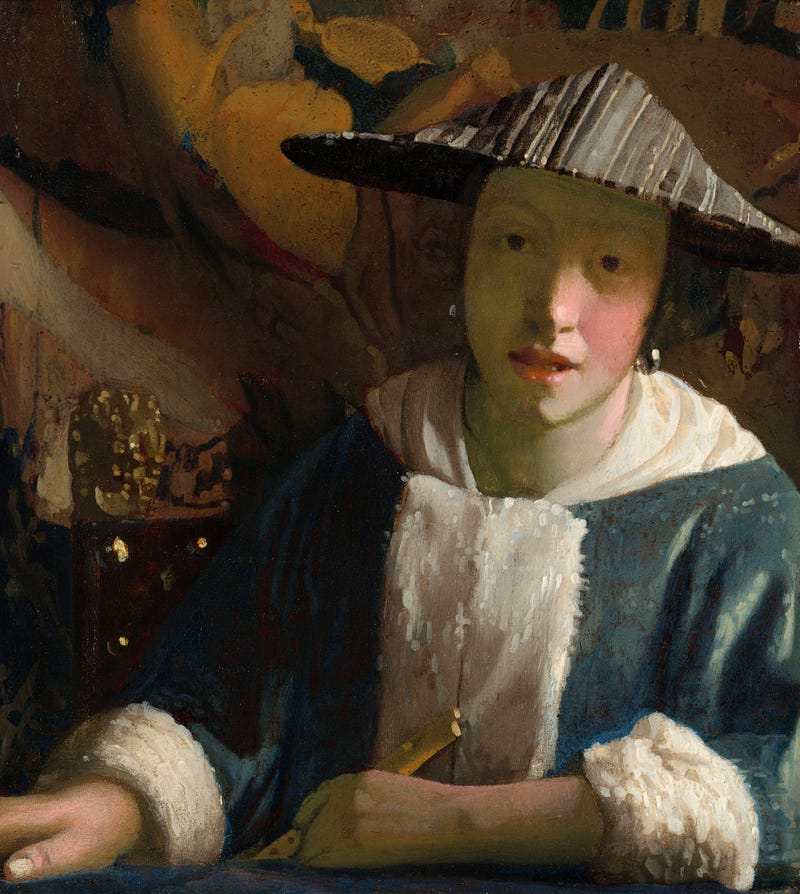
Johannes Vermeer, most well known for Girl with the Pearl Earring, was not a prolific artist. These days we are down to about 33 universally-agreed-upon Vermeer paintings. He also has a long history of being copied by other artists, from the legendary forgeries of Han Van Meegeren to this bizarre painting that fooled the National Gallery of Art back in the 1930s:
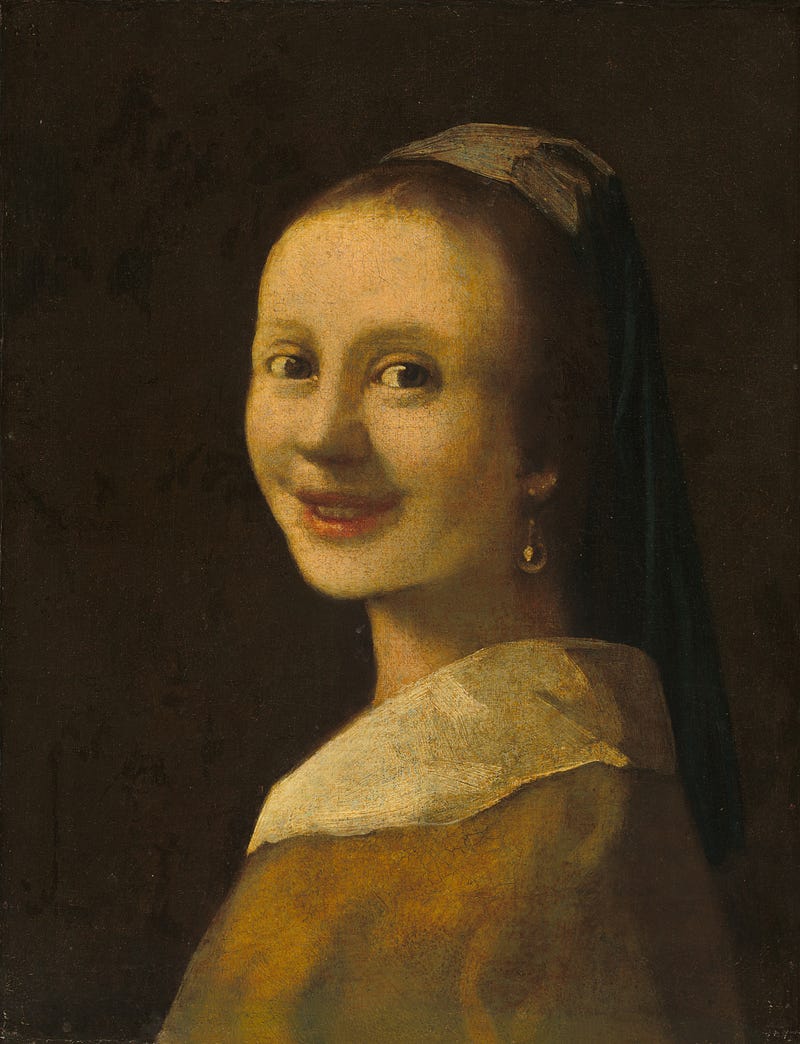
This exhibition is a great chance to discuss some of the thorny issues that arise with art attribution, and the pitfalls of relying on connoisseurship.
Art attribution is the process by which Art Historians determine the authorship of a particular work of art. They do this utilizing provenance research, connoisseurship, and new technologies.
Provenance is the ownership trail of an artwork. In an ideal world, we would have a record of everywhere an artwork has been from the time it left the artist’s studio until the present day.
Of course, historical reality means that this is very rarely the case, especially not when an artwork is hundreds of years old. Historically many collectors didn’t keep thorough records of their collections, or records are made at the time of the collector’s death by someone who isn’t familiar with the collection, or the records get lost, or the records are burned, or the titles change over time, or a dealer changes the name of an artist to a better selling artist’s name… the issues are endless.
Vermeer’s case is especially complicated because he fell into virtual obscurity after his death in 1675. He did not have a large studio working with him and most of his artworks were made for private collectors, not big municipal commissions like those of his contemporaries Rembrandt van Rijn or Frans Hals. We do have a few pieces of evidence, like the Dissius auction from 1696, but this is far from a complete paper trail. By the time interest in Vermeer was really revived in the 1860s by French art critic Etienne J. Théophile Thoré, Art Historians were virtually starting from scratch with the documentation.
When interest in Vermeer did take off he quickly became a favorite of the wealthy industrialist class and collectors like Andrew W. Mellon and Henry Clay Frick (not to mention Vermeer’s many fans in Nazi Germany) eagerly sought out his work. But since the supply was so small, and there was so little paperwork to make good authentications, the market had to flex somewhere. Over the course of the late nineteenth and early twentieth century, the Vermeer market was flooded with both falsely attributed paintings and outright forgeries.
Since the mid-twentieth century Art Historians have been narrowing down this flooded market, identifying forgeries and correcting attributions. In places where the paper trail is thin, they do this with a combination of connoisseurship and technology.
The Vermeer’s Secrets exhibition is just the latest in a long line of attempts by museums and galleries to better understand what artworks are actually by Johannes Vermeer.
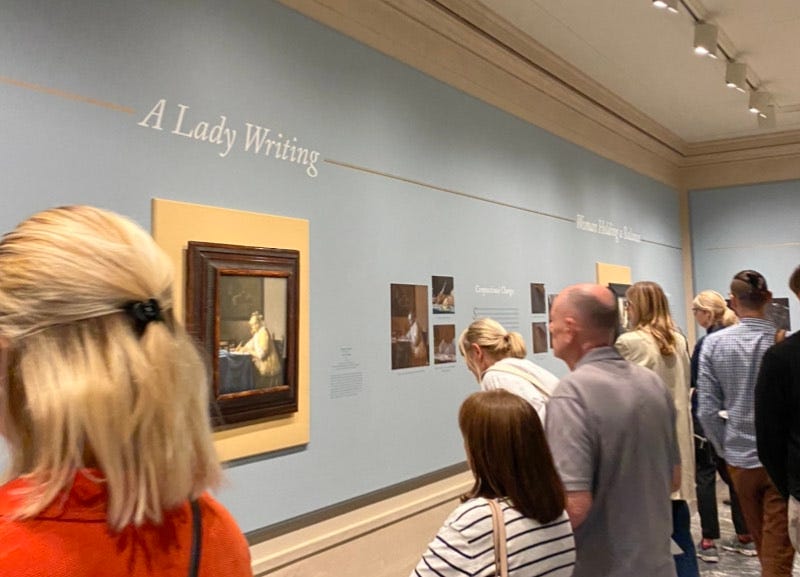
Connoisseurship is trusting the expert’s eye. Ideally someone who has studied an artist’s work for long enough would be able to identify the characteristics of that artist’s work.
Of course, connoisseurship is far from a perfect science. At it’s core connoisseurship reinforces the idea that an artist has stable traits to make them identifiable, or at least a steady trajectory. Anything that does not fit the mold risk being demoted to “student of” or “studio of” or “circle of” or “school of.” It struggles to account for experimentation in technique, aberrations in content, and lapses in aesthetic judgement. It assumes that someone like Vermeer never had a bad day.
It’s also enormously susceptible to trends. As the art critic Peter Schjeldahl wrote, “Fakes are contemporary portraits of past styles.” I mentioned Han van Meegeren above, and I think he’s a great example. The artworks that Han van Meegeren sold to members of the Nazi elite have a moody, 1930s aesthetic to them almost reminiscent of Edward Hopper. They certainly look very little like Vermeer to me.
Or how about these two early twentieth-century forgeries in the exhibition, both of which were collected by the National Gallery as genuine Vermeers?
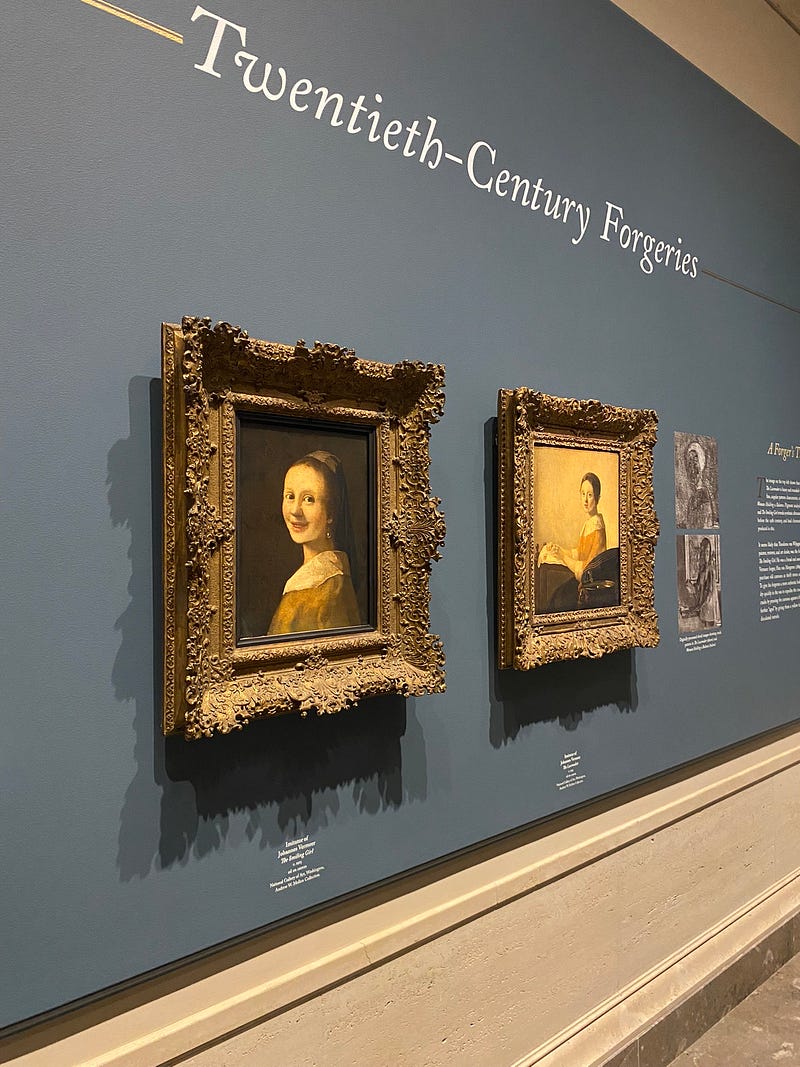
It’s worth remembering that Han van Meegeren and the other forgers were creating their forgeries at a time when the market was still flooded with falsely attributed Vermeer paintings, so what “a Vermeer” actually looked like was completely muddled. No wonder their artwork was able to scoot by, simply by appealing to the tastes of his era.
New technologies can help making accurate attributions, and nowadays Art Historians have a wealth of technologies at their disposal: X-rays for delving into different layers of the painting, reflectance imaging spectroscopy for mapping chemical features, x-ray fluorescence imaging for identifying pigments, and more. The exhibition even features an infrared hyperspectral reflectance imaging system used to scan the images.
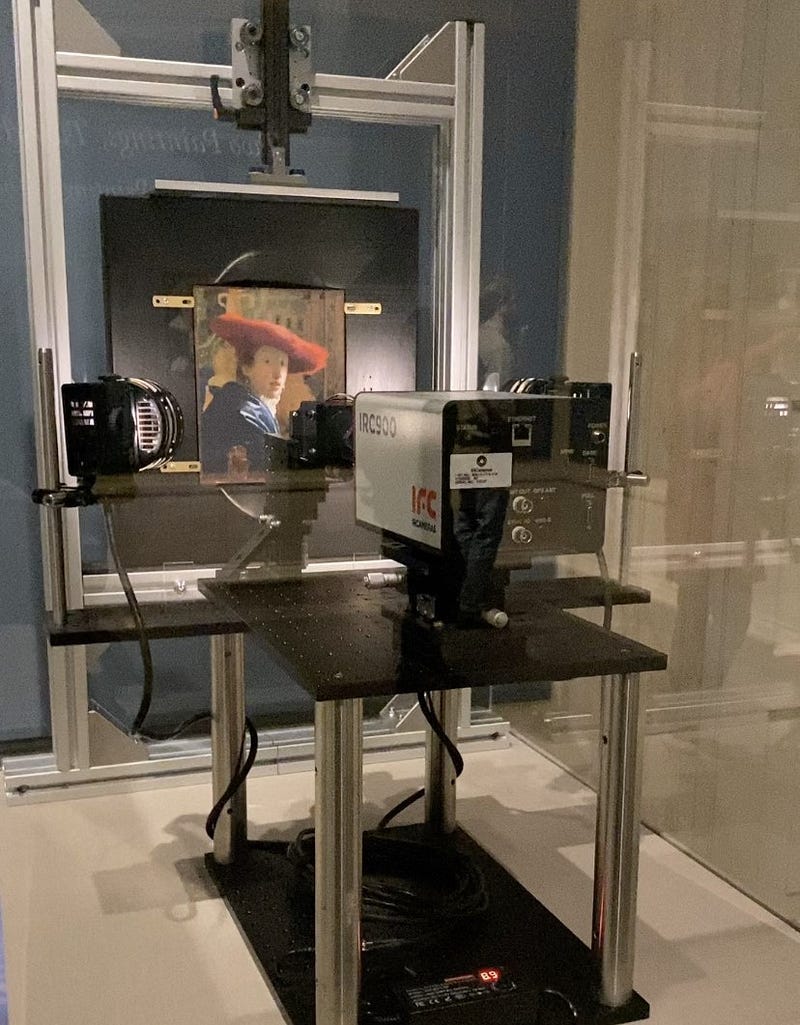
With this technology Art Historians can identify whether pigments are appropriate for the era of the painting, identify areas that may have been retouched later, and see if the artist made any changes to the composition while they were working.
With these new images, the scholars were able to determine that Girl with a Flute was painted in a different order than other Vermeer works. While Vermeer typically used coarsely ground pigment in his underpainting and finished with final layers of finely ground pigment, Girl with a Flute was painted with a fine underlayer and a coarse top layer. The painting also had embedded bristles from the brush that do not appear in other Vermeer paintings, suggesting that either an unusual brush or unusual force was used, compared to Vermeer’s typical work.
But it’s worth remembering that there is no machine where we can put a painting in and it spits out an accurate attribution. Well, not yet, anyway. All of the machines we use have to be interpreted by people. And as long as we’re relying on the judgement of people, there is the possibility of error.
It’s almost like we’re back at the connoisseurship problem, just with more data: who’s to say that Vermeer didn’t want to experiment on a small painting, using fine pigments first and then coarse ones? It’s a tricky problem. We’re stuck in the land of “possibly” and “most likely.” We may never know for sure.
So what does all of this tell us about attribution?
When it comes to art attribution, take nothing for granted. Everything can change in an instant. Sometimes it’s revelations made by new technology, sometimes it’s just our own tastes.
Hi, I’m Mary! I’m an art researcher who loves teaching about art. If you enjoyed this piece and want to hear more about art history and museums, consider giving me a follow. Thank you for your support!